ESG Reporting in New Zealand: Who Must Report, the Climate Standards and How to Start

The short answer
ESG reporting is how a business measures and publishes its environmental, social and governance performance: its emissions and climate risks, how it treats people, and how it is run. In New Zealand, only one part of ESG is legally mandatory. Around 200 large financial entities and listed issuers, called climate reporting entities, must publish an annual climate statement prepared under the Aotearoa New Zealand Climate Standards set by the External Reporting Board (XRB). Everything broader than climate, and everything done by smaller businesses, is voluntary. Voluntary reporters usually follow a recognised framework, such as the GRI Standards or the ISSB’s IFRS S1 and IFRS S2, so their reporting is structured and comparable. This guide explains who must report, what the climate standards require, how assurance works, and the practical first steps for any business that wants to start reporting well.
What ESG reporting covers
ESG stands for environmental, social and governance. The environmental part covers a business’s effect on the natural world and its exposure to environmental change. Climate sits at the centre of it: greenhouse gas emissions, energy use, and the risks that a changing climate and the shift to a low-emissions economy create for the business. Waste, water and resource use also sit under this heading.
The social part covers people. It includes how a business treats its workers, its health and safety record, its relationships with customers and suppliers, and its effect on the communities it operates in. The governance part covers how the business is directed and controlled: who oversees it, how decisions are made, how risks are managed, and whether its reporting can be trusted.
Reporting turns those topics into published information. A good ESG report explains the business’s material issues, what it is doing about them, and what the numbers show. The point is that readers, including investors, lenders, customers and the board, can judge performance for themselves instead of relying on marketing claims. In New Zealand the mandatory regime covers climate only, which is the environmental slice. The social and governance slices are reported voluntarily, although governance still matters under the mandate, because the climate standards require disclosure of who oversees climate risk.
Who must report in New Zealand
New Zealand’s mandatory regime is the climate-related disclosures (CRD) regime. It was created by the Financial Sector (Climate-related Disclosures and Other Matters) Amendment Act 2021, which inserted a new Part 7A into the Financial Markets Conduct Act 2013. The Financial Markets Authority (FMA) monitors and enforces the regime, and the XRB sets the standards that reporting must follow.
The regime applies to entities called climate reporting entities (CREs). According to the FMA, the regime captures around 200 entities. They fall into four groups:
| Entity type | Threshold in the current law |
|---|---|
| Large listed issuers of quoted equity securities | Market capitalisation over $60 million |
| Large listed issuers of quoted debt securities | Quoted debt over $60 million |
| Registered banks, credit unions and building societies | Total assets over $1 billion |
| Licensed insurers | Total assets over $1 billion, or annual gross premium revenue over $250 million |
| Managers of registered investment schemes (other than restricted schemes) | Total assets under management over $1 billion |

Issuers listed on growth markets are excluded. Ordinary trading companies, including large private companies, are not captured unless they sit in one of these categories. If there is any doubt about whether an entity is a CRE, the XRB recommends getting independent legal advice and, if uncertainty remains, speaking with the FMA.
A CRE must prepare an annual climate statement in accordance with the XRB’s climate standards, obtain independent assurance over the part of the statement that discloses greenhouse gas emissions, make the statement available to the public, and keep proper records to evidence that its statements comply with the law and the standards. Directors date and sign the climate statement on behalf of the entity.
Most New Zealand businesses are not CREs. They have no legal duty to publish ESG information. Many still choose to, because CREs need emissions and risk information from their supply chains and customers, and because lenders, insurers and larger customers increasingly ask suppliers for climate data.
Changes announced, and where they stand
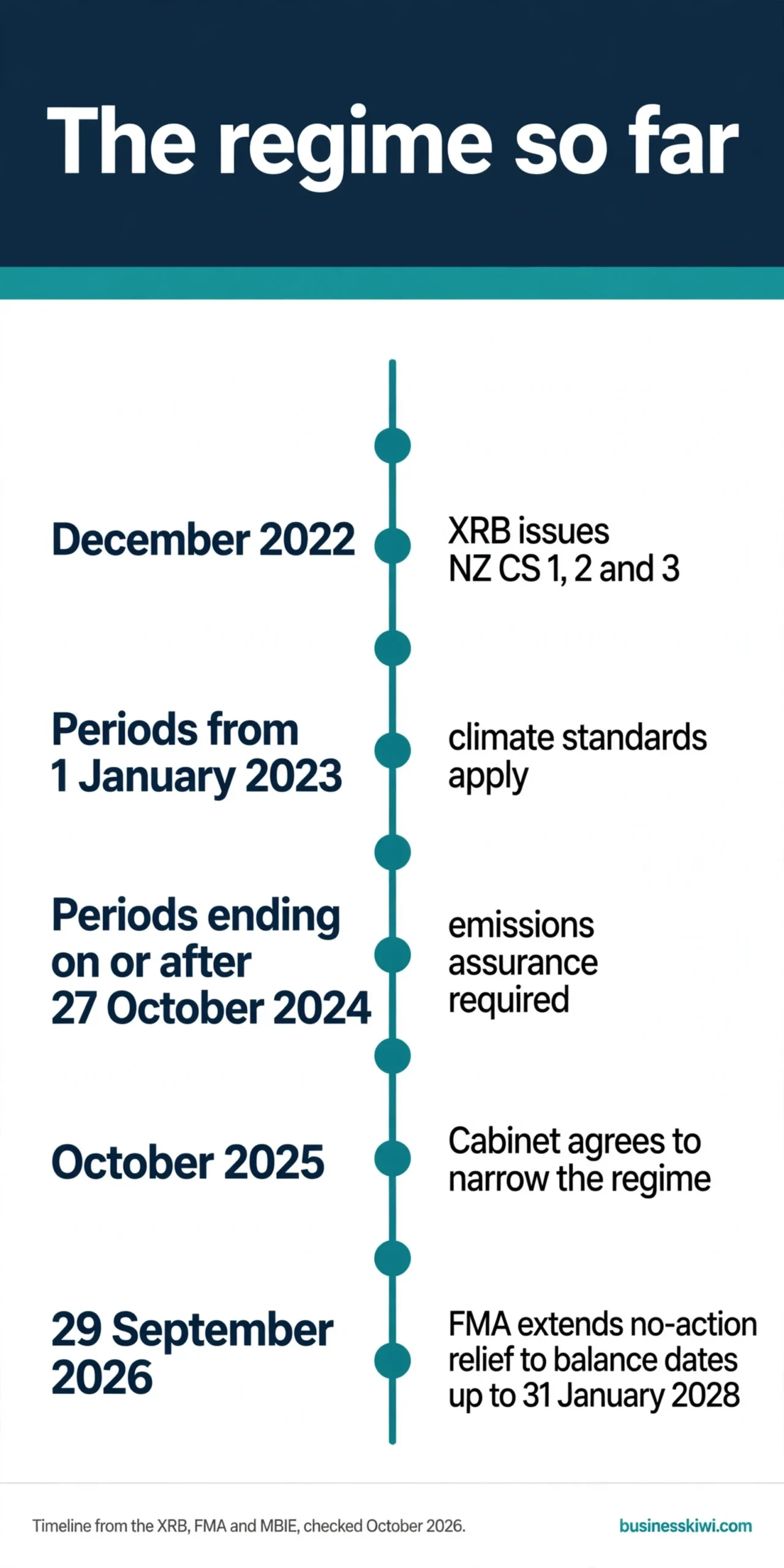
The scope of the mandatory regime is in transition, and this matters for any business checking whether it must report. In October 2025, Cabinet agreed to three changes, as recorded by the Ministry of Business, Innovation and Employment (MBIE): remove managed investment scheme managers from the regime, raise the listed issuer threshold from $60 million to $1 billion for both market capitalisation and the face value of quoted debt, and adjust liability settings so directors do not have deemed liability for entity breaches, and CREs and their directors are not liable for unsubstantiated representations in climate statements where they comply with the climate standards. A later announcement added that life and health insurers will also be removed.
MBIE confirms these changes need legislation to take effect. That legislation, the Financial Markets Conduct Amendment Bill 2025, was not passed before Parliament rose ahead of the 7 November 2026 general election, as the FMA records in its 29 September 2026 update. There is no certainty about whether, or with what priority, the incoming Government will progress the policy.
In the interim, the FMA has taken a “no action” approach for the affected entities: smaller listed issuers, managed investment scheme managers, and life and health insurers. A no action approach means the FMA will not take action against a person for breaching the obligation, although it does not necessarily stop third parties from taking legal action. The FMA extended the relief in September 2026 so it covers reporting periods with balance dates from 31 March 2027 through to 31 January 2028. It does not extend to the reporting period beginning 1 April 2027, with a 31 March 2028 balance date. The FMA has also reminded voluntary reporters that the fair dealing provisions in Part 2 of the Financial Markets Conduct Act still apply to what they publish. Businesses near the boundary should check the FMA’s current guidance before assuming they can stop reporting.

The XRB climate standards
CREs report under the Aotearoa New Zealand Climate Standards, issued by the XRB in December 2022 and applying to annual reporting periods beginning on or after 1 January 2023. The three standards are designed as a package and are meant to be read together.
NZ CS 1, Climate-related Disclosures, contains the actual disclosure requirements. They are organised around four themes. Governance covers the role of the board or other governing body in overseeing climate-related risks and opportunities, and the role management plays in assessing and managing them. Strategy covers how climate change is affecting the entity now and how it may do so in the future, including identified risks and opportunities, their current and anticipated impacts, and scenario analysis. Risk Management covers how climate-related risks are identified, assessed and managed, and how those processes fit into the entity’s overall risk management. Metrics and Targets covers how the entity measures and manages its climate risks and opportunities, including its greenhouse gas emissions and the targets it sets.
NZ CS 2, Adoption of Aotearoa New Zealand Climate Standards, provides optional adoption provisions. These give first-time reporters relief from some disclosure requirements while they build capability, recognising that some disclosures take time to produce well. An entity that uses an adoption provision must disclose that it has done so.
NZ CS 3, General Requirements for Climate-related Disclosures, contains the principles and general requirements behind the other two standards. It is centred on the principle of fair presentation and includes concepts such as materiality, plus requirements about the location of disclosures. The aim of the framework, as the XRB describes it, is to ensure the impacts of climate change are actively considered in business and investment decisions, and to help smooth the transition to a low-emissions, climate-resilient economy.
Emissions are measured in scopes, using the categories described by the Energy Efficiency and Conservation Authority (EECA). Scope 1 covers direct emissions from sources the organisation owns or controls, such as fuel used in company vehicles. Scope 2 covers indirect emissions from purchased energy, such as electricity. Scope 3 covers other indirect emissions in the value chain, such as business travel, freight, waste and supply chain emissions. NZ CS 1 requires disclosure of scope 1, 2 and 3 emissions.
Assurance: having the emissions numbers checked
Assurance is an independent check of reported information. Under the regime, a CRE must obtain independent assurance over the part of its climate statement that relates to the disclosure of greenhouse gas emissions. The rest of the climate statement is not subject to mandatory assurance.
The XRB’s assurance standard for this work is NZ SAE 1, Assurance Engagements over Greenhouse Gas Emissions Disclosures. It applies to accounting periods that end on or after 27 October 2024, so assurance has been a required part of the reporting cycle since then. Directors have a specific role here: the XRB notes that providing information and explanations to assurance practitioners about greenhouse gas emissions is one of the responsibilities the legislation places on them.
For businesses reporting voluntarily, assurance is a choice. Some businesses have their emissions inventory independently verified anyway, because checked numbers carry more weight with customers, lenders and tender panels than self-reported ones. The key point either way is that assurance can only test information that is properly recorded, which is why record keeping matters from the start.

Voluntary ESG reporting outside the mandate
Businesses outside the mandate that want to report in a disciplined way generally adopt an established framework rather than inventing their own structure. Two frameworks dominate.
The GRI Standards are built for reporting a business’s impacts on the economy, the environment and people. GRI describes them as enabling any organisation, large or small, private or public, to understand and report on those impacts in a comparable and credible way. The Standards form a modular set: Universal Standards that apply to all organisations, Sector Standards covering sector-specific impacts, and Topic Standards listing disclosures for particular topics. A business using GRI works out its material topics, then reports against the standards that match them.
The ISSB Standards take an investor focus. The International Sustainability Standards Board (ISSB), part of the IFRS Foundation, issued its first two standards in June 2023: IFRS S1, covering general requirements for disclosing sustainability-related financial information, and IFRS S2, covering climate-related disclosures. The IFRS Foundation describes the pair as a global baseline of investor-focused sustainability reporting standards, designed to improve the consistency, comparability and reliability of disclosures. Jurisdictions decide for themselves whether to adopt them into local rules.
Smaller businesses often start further back, with measurement rather than a full report. The Climate Action Toolbox, hosted on business.govt.nz, is a free government tool designed for small and medium businesses. It starts with a self-assessment, helps a business measure its emissions, and supports an action plan. EECA’s guidance points the same way: measure your emissions first, then build a reduction plan. A business that can measure its emissions reliably is most of the way towards being able to report them, and towards answering the questions that banks, insurers and larger customers are now asking.
What good reporting involves
The FMA’s published feedback on the first climate statements points to habits that separate strong reporting from weak reporting. Good disclosures are specific to the entity. They describe the entity’s own risks and opportunities, with context such as severity, exposure and time horizons, rather than generic sector-level statements. They cover material information and do not bury it under lists of immaterial items. They use appropriate data, so risks are neither understated nor overstated, and they link identified risks to impacts and to transition planning, including targets and actions.
Beneath the writing sit three practical foundations. The first is governance: someone senior, usually the board, genuinely oversees the topic and ensures the right skills are available. The second is data: emissions and risk information drawn from real business records, such as fuel, energy, travel and waste data, collected the same way each period so results can be compared. The third is record keeping. The FMA’s record keeping guidance sets out its expectations that CREs create and maintain proper records as evidence that their climate statements comply with the law and the standards. Voluntary reporters do not face the same legal duty, but the discipline is the same: if a figure is published, the business should be able to show where it came from.
Getting started
A business that wants to begin ESG reporting, or lift the quality of what it already publishes, can work through these steps.
- Work out whether you must report. Check your entity type against the CRE categories and thresholds. If you are affected by the announced changes, check the FMA’s current no action position for your balance date before deciding anything.
- Decide what your report needs to cover. For a CRE, the climate standards set the content. For a voluntary reporter, choose a framework, such as GRI or the ISSB Standards, and identify your material topics.
- Assign ownership. Give the board or owners oversight, and name the person responsible for collecting data and drafting disclosures.
- Measure your emissions. Use the Climate Action Toolbox or EECA’s guidance to build a first inventory across scope 1, 2 and the parts of scope 3 you can measure credibly.
- Set up record keeping. Store the source data, methods and assumptions behind every figure, so the numbers can be explained and checked later.
- Set targets and actions. Link them to the risks and opportunities you identified, and report progress against them each period.
- Consider assurance. If your emissions numbers will be relied on by lenders, customers or tender panels, independent assurance or verification makes them more credible.
- Publish, then repeat. Reporting improves with each cycle. Fix weak spots, and keep the same structure so progress is visible over time.
Related reading: our green investing guide looks at ESG from the investor side, our sustainable growth guide covers productivity, and our international business risk guide covers wider risk management. More business guides are in the Business and Industry section.
Frequently asked questions
Does my small business have to produce an ESG report?
No. Mandatory reporting in New Zealand only applies to climate reporting entities: large listed issuers, large banks, insurers and managers of registered investment schemes over the thresholds in the current law. Small and medium businesses report voluntarily, although they may be asked for emissions data by banks, insurers or larger customers.
What is the difference between ESG reporting and climate reporting?
Climate reporting is the mandatory New Zealand regime covering climate-related risks, opportunities and greenhouse gas emissions. ESG reporting is broader. It adds social topics, such as workforce and community impacts, and governance topics, such as board oversight and ethics, alongside the environmental ones. In New Zealand the broader ESG layer is voluntary.
What are the Aotearoa New Zealand Climate Standards?
They are the three standards issued by the XRB in December 2022 that climate reporting entities must follow: NZ CS 1, which sets the disclosure requirements across governance, strategy, risk management, and metrics and targets; NZ CS 2, which provides optional adoption provisions for first-time reporters; and NZ CS 3, which sets the principles and general requirements, including fair presentation and materiality.
When did mandatory climate reporting start?
The climate standards apply to annual reporting periods beginning on or after 1 January 2023, so the first climate statements were published from 2024. Independent assurance over greenhouse gas emissions disclosures applies to accounting periods ending on or after 27 October 2024.
Is the mandatory regime being scrapped?
No. The Government has agreed to narrow it by removing managed investment scheme managers and life and health insurers, and raising the listed issuer threshold from $60 million to $1 billion. Those changes need legislation, and the Bill had not passed when Parliament rose ahead of the November 2026 election. The FMA has extended no action relief for the affected entities in the meantime. Entities outside the affected groups remain required to report.
What is assurance, and do voluntary reporters need it?
Assurance is an independent check of reported information. It is mandatory for the greenhouse gas emissions part of a climate reporting entity’s climate statement, under the XRB’s NZ SAE 1 standard. Voluntary reporters do not have to obtain assurance, but many have their emissions independently verified so their numbers carry more weight with customers and lenders.
Which framework should a voluntary reporter use?
It depends on the audience. The GRI Standards suit reporting on a business’s impacts on the economy, environment and people for a wide range of stakeholders. The ISSB’s IFRS S1 and IFRS S2 suit investor-focused reporting on sustainability and climate risks. A smaller business may simply start by measuring its emissions with the free Climate Action Toolbox, then adopt a framework once the data is in place.
The bottom line
ESG reporting in New Zealand has a hard legal core and a voluntary layer around it. The legal core is climate reporting by around 200 large financial entities and listed issuers, under XRB standards, with assured emissions numbers and FMA oversight. That core is set to narrow once announced changes are legislated, and affected entities currently have FMA no action relief, so anyone near the boundary needs to check the current position carefully. The voluntary layer is where most businesses sit. For them, credible reporting means choosing a recognised framework, measuring emissions properly, keeping records that back every figure, and being specific about their own risks and actions. Businesses that build those habits now will be ready for customer and lender questions, and for any future widening of the rules.
Sources
- External Reporting Board (XRB), Director preparation guide: https://www.xrb.govt.nz/standards/climate-related-disclosures/resources/director-preparation-guide
- External Reporting Board (XRB), Recently issued climate standards: https://www.xrb.govt.nz/standards/recently-issued/new-climate-standards/
- Financial Markets Authority (FMA), FMA publishes final Climate Related Disclosures regime record keeping guidance (media release, MR No. 2023-42): https://www.fma.govt.nz/news/all-releases/media-releases/fma-publishes-final-climate-related-disclosures-regime
- Financial Markets Authority (FMA), ‘No action’ relief for life and health insurers due to be relieved of mandatory reporting (including the 29 September 2026 update): https://www.fma.govt.nz/business/services/climate-reporting-entities/no-action-relief-for-insurers/
- Ministry of Business, Innovation and Employment (MBIE), Capital Markets Reforms: https://www.mbie.govt.nz/business-and-employment/business/financial-markets-conduct-regulation/capital-markets-reforms
- GRI, GRI Standards: https://www.globalreporting.org/standards/
- IFRS Foundation, Cover note: Adoption Guide overview (IFRS Sustainability Disclosure Standards): https://www.ifrs.org/supporting-implementation/supporting-materials-for-ifrs-sustainability-disclosure-standards/cover-note-adoption-guide-overview/
- Energy Efficiency and Conservation Authority (EECA), Measure your business greenhouse gas emissions: https://www.genless.govt.nz/for-business/get-started/report-on-your-progress/
This article is general information about ESG reporting in New Zealand. It summarises official guidance published by the XRB, the FMA, MBIE, EECA, GRI and the IFRS Foundation at the time of writing. The mandatory climate reporting regime is subject to announced changes that had not been legislated when this article was written, and thresholds, relief and requirements can change. It is not legal, accounting or investment advice. Businesses should check the current position with the FMA and the XRB, and take professional advice, before relying on it.