Facade Engineers in NZ: The Job, the Pathway and the Pay

The short answer
A facade engineer specialises in the outside skin of a building: the cladding, curtain walls, windows and glazing that keep weather out, hold heat in and stand up to wind and earthquakes. It is a specialism inside building and structural engineering rather than a separate trade, and most facade engineers come through a civil or structural engineering degree first. There is no official New Zealand pay series for facade engineers alone. The closest official profile is Tahatū’s civil engineer occupation, which puts most common pay at $81,000 to $154,000 a year before tax. Senior facade engineers who sign off high-risk building work are usually Chartered Professional Engineers (CPEng), the registration Engineering New Zealand assesses.
What a facade engineer does
Aurecon, one of the large consultancies that employs facade engineers in New Zealand, defines the role plainly: a facade engineer is a specialist who focuses on the design and engineering of a building’s facade, making sure the exterior envelope is structurally sound, energy efficient, weathertight, airtight, and compliant with building codes and standards.
That short definition covers four quite different kinds of work:
- Structural performance. The facade has to carry its own weight and resist wind pressure, and in New Zealand it also has to move safely in an earthquake without panels or glass becoming a hazard. Engineering New Zealand describes structural engineers as the people who calculate loads such as snow, wind and earthquake forces and fit the structure to the architecture. Facade engineering applies that same discipline to the envelope instead of the frame.
- Weathertightness. Every joint, flashing and seal in the wall system is a potential leak path. Facade engineers detail how water is shed and drained so the building stays dry over decades, not just on handover day.
- Thermal performance. The envelope decides how much heat a building loses. Glazing ratios, framing materials and insulation continuity all pass through the facade design, which is why the role has grown as energy efficiency expectations have risen.
- Compliance and sign-off. Facade designs feed into building consent documentation. Only Chartered Professional Engineers may sign producer statements in New Zealand, so a CPEng facade engineer carries formal responsibility for certifying that a design meets the Building Code.
Day to day, the work mixes calculation and design review with meetings alongside architects, structural engineers and builders, plus time on site checking that what was drawn is what got installed.
Not all of the work is on new buildings. Engineering New Zealand lists assessing the strength of buildings after an event such as an earthquake, and assessing the safety of a structure, as core reasons to engage a structural engineer, and the envelope is part of that work. Fallen or cracked cladding and glass are a public safety risk after a quake, so facade engineers get called in to inspect, make safe and then design the repair or replacement. The same diagnostic skill set drives weathertightness investigations on buildings that leak.

The systems they work on
Facade engineers work across the full range of wall and window systems used on New Zealand buildings:
- Curtain walls: lightweight framed walls, usually glazed, that hang from the building’s structure rather than carrying it.
- Cladding systems: panel, metal, fibre cement, timber and masonry veneer systems fixed back to the frame.
- Windows and glazing: punched windows, shopfront systems, structural glazing and the fixings and brackets that hold them.
- The details between systems: seals, gaskets, membranes, flashings and movement joints, which is where most failures start.
The common thread is that the facade is a system, not a surface. A change to one part, such as a heavier glass unit, flows through to brackets, fixings, structure and seals, and the facade engineer is the person who checks the whole chain.
Where they work and who employs them
Most facade engineers work for engineering consultancies. Engineering New Zealand notes that most structural engineers work as consultants to architects or design-build contractors, and facade engineers sit inside the same buildings teams. At Aurecon, for example, facades is one of the specialisations inside its buildings team, alongside mechanical, electrical, structural, hydraulic, sustainability and fire protection engineers.
Beyond the big multidisciplinary firms, the employers are:
- Specialist facade consultancies that sell envelope design and review as their core service.
- Facade contractors and fabricators, who need engineers to turn a consultant’s design into shop drawings and site-ready systems.
- Building owners and developers on large projects, who sometimes engage facade expertise directly for peer review and remediation work on existing buildings.
The work concentrates in Auckland, Wellington and Christchurch, where most large commercial and apartment projects are built. Remediation of existing buildings with failed or ageing facades is a steady second stream of work alongside new builds.

How to become a facade engineer
There is no facade engineering degree in New Zealand and no separate licence for the specialism. The route is the standard professional engineering pathway, with facade work picked up inside a buildings or structural team.
Step 1: Get an accredited engineering degree
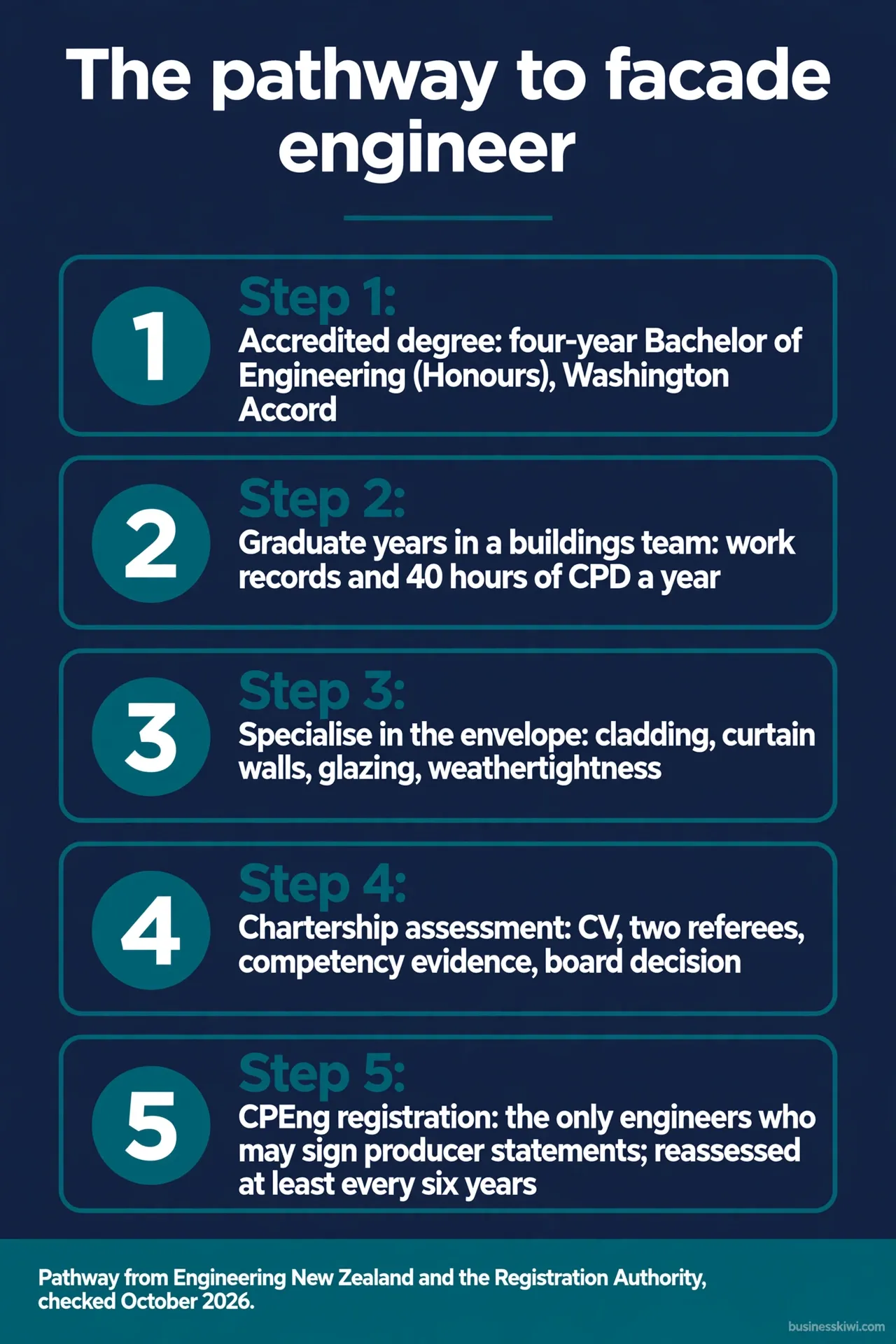
For the professional engineer category, Engineering New Zealand’s eligibility starts with a Washington Accord qualification, which in New Zealand means a four-year Bachelor of Engineering or Bachelor of Engineering (Honours), usually in civil or structural engineering. Engineering New Zealand accredits these degrees under the Washington Accord, so they are recognised internationally.
Facade teams are not closed to other graduates. Aurecon recruits its facade interns from students studying architecture, architectural engineering, environmental engineering and structural engineering, with study areas that include structural analysis and design principles and the design and analysis of building facade systems. Whatever the degree, employers look for structural analysis skills first.
Step 2: Build graduate experience in buildings work
New graduates join a consultancy team and learn the trade on live projects: running calculations, modelling facade systems, detailing connections, and getting on site to see how systems are fabricated and installed. This is also when engineers start the work and continuing professional development (CPD) records that a later chartership application depends on. Engineering New Zealand members are required to complete 40 hours of CPD each year.
Step 3: Specialise in the building envelope
Specialisation is earned on projects rather than awarded by a course. Engineers who keep taking facade packages, peer reviews and remediation jobs build the niche: deeper knowledge of cladding and glazing systems, weathertightness detailing, thermal performance and the New Zealand standards and Building Code clauses that govern the envelope.
Step 4: Get chartered
Chartership is the professional milestone. Engineering New Zealand offers two routes for professional engineers: Chartered Member (CMEngNZ), a quality mark of general competence and professionalism, and registration as a Chartered Professional Engineer (CPEng), which is a mark of current competence based on legislation. You can hold one or both.
The assessment asks for a current CV, two referees who can recommend you, evidence of how you meet the areas of competency, and work and CPD records linked as evidence. Assessors then hold an in-person session, may set a task, and make a recommendation to a board that makes the final decision. CPEng holders are reassessed at least every six years, commit to the CPEng Code of Ethical Conduct, and must show their competence is specific to New Zealand, including seismic design requirements, the Building Act and consenting processes. That New Zealand component also covers the principles of Te Tiriti o Waitangi and working appropriately with Māori communities, which Engineering New Zealand builds into its definition of good practice here.
Registration is not legally required to work as an engineer in New Zealand, and plenty of facade engineers do design work without it. In practice, though, CPEng is what lets an engineer sign producer statements, and councils and clients require that sign-off on higher-risk building work. For a facade engineer aiming at senior roles, chartership is the expected end point of the pathway.
Coming from overseas
The Registration Authority, which runs the CPEng register, can check whether an overseas engineering qualification is recognised in New Zealand against the Washington, Sydney or Dublin Accords. If the qualification is not accredited, an equivalent knowledge assessment lets an engineer demonstrate the same standard from study, further learning and work experience; the Authority says that assessment takes six to eight weeks to process. Immigration New Zealand may also ask for a letter certifying that an engineer meets the benchmark requirements for CPEng status, and NZQA can assess an overseas qualification against the New Zealand Qualifications Framework to set its level.
What facade engineers earn
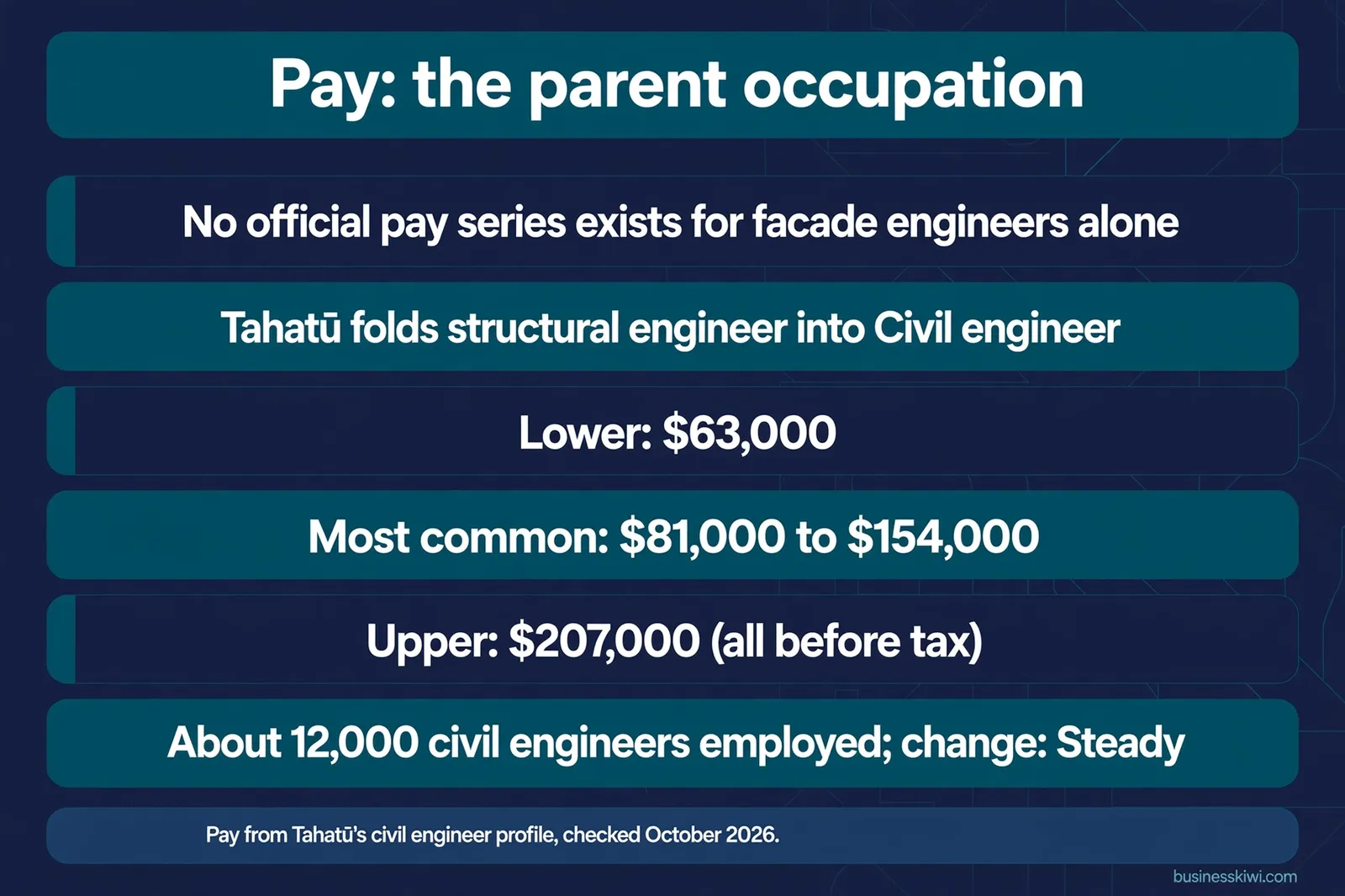
Start with what does not exist: no government or industry body publishes a pay figure for facade engineers as their own occupation, and this site will not invent one. Tahatū, the official careers service run by the Tertiary Education Commission, has no facade engineer profile. It folds structural engineer into its civil engineer occupation as an “also known as” title, and facade engineering sits inside that same parent occupation.
So the honest guide to pay is the Tahatū civil engineer profile, read as the parent occupation rather than as facade pay:
| Tahatū civil engineer pay point | Yearly pay (before tax) |
|---|---|
| Lower | $63,000 |
| Most common | $81,000 to $154,000 |
| Upper | $207,000 |
Those bands cover everyone from graduate civil engineers to senior specialists, so read them as the shape of the market a facade engineer works in, not a quote for the job title. Within that market, facade engineers progress along the same ladder as other building engineers: graduate roles at the lower end, independent project work through the most common band, and the upper end reserved for senior and principal engineers, typically chartered, who carry sign-off responsibility and lead teams. Where exactly a facade role lands depends on experience, chartership and the firm, and any specific salary claim you see advertised comes from an employer or recruiter, not from an official series.
Demand and outlook
Tahatū puts employment change for civil engineers as steady, with about 12,000 people employed in the occupation. Facade engineers are a small specialist slice of that total, and no official count of them exists.
The work itself follows the building cycle. New commercial and apartment construction creates design work, and the existing building stock creates a second, less cyclical stream: facade investigations, weathertightness remediation and recladding of ageing buildings. Because the specialism is small and the skills take years to build, experienced facade engineers are not quick to replace, but it would be wrong to dress that up as an official shortage claim. The official position is the steady one above.
Skills and personal qualities
The sources employers and the professional body publish point to a consistent skill set:
- Structural analysis and design. The core technical skill, applied to panels, glass, fixings and support framing under wind and earthquake loads.
- Facade systems knowledge. How cladding, curtain wall and glazing systems are designed, fabricated and installed, and where they fail.
- New Zealand codes and consenting. Seismic design requirements, the Building Act and Building Code, and how consent documentation and producer statements work. Engineering New Zealand tests exactly this New Zealand-specific knowledge in CPEng assessments.
- Detail and accuracy. Facade failures usually start in a detail nobody checked, so the job rewards engineers who sweat junctions, tolerances and seals.
- Communication. Facade engineers sit between architects who own the look, structural engineers who own the frame, and contractors who have to build it. Aurecon asks its facade recruits for the ability to build relationships with peers and clients, and the same applies at every level.
- Problem-solving on existing buildings. Remediation work means diagnosing why a facade leaks or moves, often with incomplete records of how it was built.
Related roles
- Structural engineer: the parent specialism. Tahatū lists it as an also known as title under civil engineer, and many facade engineers start as structural engineers.
- Civil engineer: the broad occupation that covers buildings, bridges, roads and water infrastructure, and the profile Tahatū uses for this whole family of roles.
- Building services engineer: the mechanical, electrical and hydraulic engineers who design what happens inside the envelope. Facade and services engineers work closely on energy performance.
- Architect and architectural engineer: the design side of the envelope. Some facade engineers arrive from architecture degrees and cross into engineering teams.
- Fire engineer: another buildings-team specialism, relevant because facade materials and cavities are part of a building’s fire design.
For the wider pay picture, see our engineer salary NZ guide, which sets out pay by engineering discipline. Our engineering courses NZ guide compares the study routes into the profession. For a different engineering specialism, our aircraft engineer salary guide covers that pathway and its pay. More careers guides like this one sit in our Jobs and Education section.
Frequently asked questions
Is facade engineering a separate job from structural engineering?
It is a specialism within it. Facade engineers apply structural engineering to the building envelope rather than the frame, and most train as civil or structural engineers first. Tahatū does not list facade engineer as its own occupation at all; it treats structural engineer as part of the civil engineer occupation.
What degree do I need to become a facade engineer?
The standard route is a four-year Bachelor of Engineering or Bachelor of Engineering (Honours) in civil or structural engineering, accredited by Engineering New Zealand under the Washington Accord. Facade teams also recruit from architecture, architectural engineering and environmental engineering degrees, but structural analysis skills are what employers test for.
Do facade engineers need to be CPEng?
Not to work as an engineer. Registration is not a legal requirement for engineering work in New Zealand. But only Chartered Professional Engineers may sign producer statements, and senior facade roles that carry sign-off responsibility for higher-risk building work expect CPEng. It is assessed by Engineering New Zealand and reassessed at least every six years.
How much does a facade engineer earn in NZ?
There is no official facade-specific figure. The closest official profile, Tahatū’s civil engineer occupation, shows pay before tax of $63,000 at the lower end, a most common range of $81,000 to $154,000, and $207,000 at the upper end. Treat those as the parent occupation’s bands, not a facade salary quote.
Is there a shortage of facade engineers in NZ?
No official source says so. Tahatū describes employment change for civil engineers as steady, with about 12,000 people employed. Facade engineering is a small niche inside that occupation with no official headcount or shortage listing of its own.
Can overseas facade engineers work in NZ?
Yes, subject to the usual visa requirements. The Registration Authority can check whether an overseas qualification is accredited under the Washington, Sydney or Dublin Accords, and offers an equivalent knowledge assessment if it is not. Immigration New Zealand may ask for a letter certifying that the engineer meets the CPEng benchmark.
What is the difference between a facade engineer and an architect?
The architect owns the building’s design and appearance, including how the facade looks. The facade engineer makes that design work as a physical system: structure, fixings, weathertightness, thermal performance and code compliance. On larger projects the two work side by side from early design through to site.
The bottom line
Facade engineering is a small, well-defined specialism inside New Zealand building engineering. The pathway is the standard one: an accredited engineering degree, graduate years in a buildings team, deliberate specialisation in the envelope, and CPEng chartership if you want sign-off responsibility. Pay has no official series of its own, so judge roles against the civil engineer bands Tahatū publishes and against the responsibility the role carries, especially producer statement sign-off. For a structural graduate who likes detail, buildings and the point where design meets weather, it is one of the more durable niches in the profession.
Sources
- Tahatū Career Navigator (Tertiary Education Commission), Civil engineer occupation profile: https://tahatu.govt.nz/work/explore-career-ideas/occupation/T00165-civil-engineer
- Engineering New Zealand, Get Chartered: https://www.engineeringnz.org/join-us/chartered-member/get-chartered/
- Engineering New Zealand, Find an engineer (types of engineers; Registration Authority role): https://www.engineeringnz.org/public-tools/find-engineer/
- Engineering New Zealand, Mutual Recognition Assessments Applicant Guidance (September 2026): https://www.engineeringnz.org/documents/1668/3.0_Mutual_Recognition_Assessments_Applicant_Guidance.pdf
- Registration Authority, Moving to New Zealand as an engineer: https://www.registrationauthority.org.nz/working-in-new-zealand
- Aurecon New Zealand, Façade Engineering intern description (what a façade engineer does; degrees recruited): https://mit-career-directory.prosple.com/graduate-employers/aurecon-nz/jobs-internships/facade-engineering-building-services-intern
This article is general information about facade engineering careers in New Zealand. It is not careers advice for any individual, and pay figures are the official bands for the broader civil engineer occupation, not a salary survey of facade engineers. Check Tahatū and Engineering New Zealand for the current position before making study or career decisions.