Footpath Signs in NZ: A-Frame Rules, Permits and Costs

Put an A-frame sign outside a café on a Saturday morning and it feels like the simplest marketing decision in the world. The board costs little, folds flat at night, and catches people who were never going to search for you online. What surprises many owners is that the patch of concrete the sign stands on is not theirs to use as they please. There is no single national rule for footpath signs in New Zealand. Each council writes its own bylaw for the footpaths and road reserves in its district, and those bylaws differ in ways that matter: one city licenses your board and charges an annual fee, another lets you put one sign out with no application at all provided it fits a schedule of sizes and clearances, and in the middle of Auckland a footpath sign on council land is not allowed in the first place.
This guide works through what the councils themselves publish: the main types of portable sign, who controls the footpath outside your shop, the patterns running through the bylaws we read in full, and then the detail for four districts whose documents were read end to end: Wellington, Auckland, Hamilton and Ashburton. Costs are covered twice over, because you may pay for the sign itself and, in some districts, for the permission to stand it outside. Everything specific is attributed to the council or supplier that publishes it. If your district is not one of the four, treat the examples as a map of what to look for, then check your own council’s bylaw before the sign goes out.
The sign types you will come across
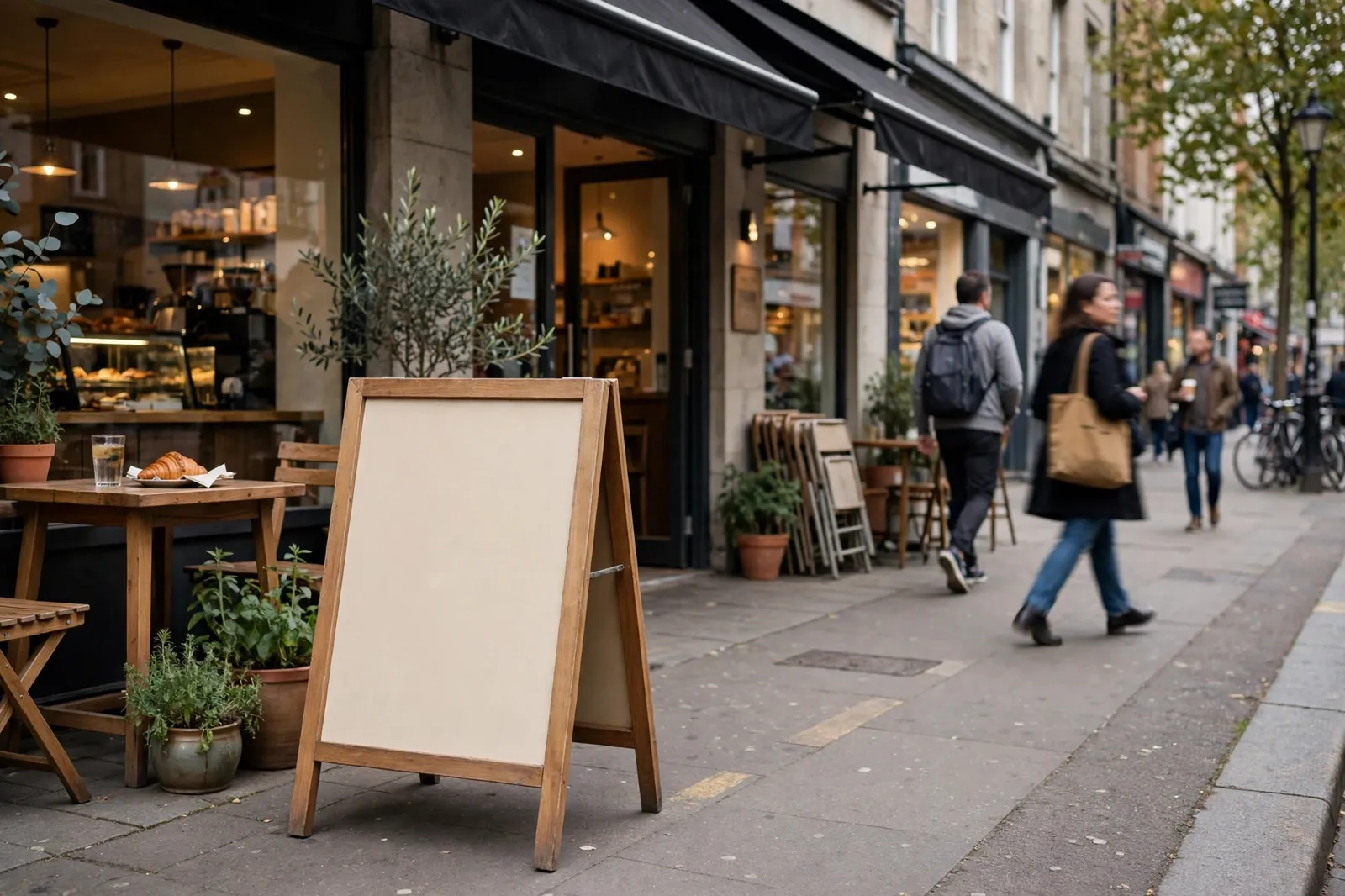
The classic footpath sign is the A-frame, also sold as a sandwich board or A-board. Two panels hinge at the top and lean against each other, so the sign reads in both directions along the footpath and folds flat for storage. Banner Express, a New Zealand sign supplier, describes its standard sandwich board as a powder-coated metal stand holding two corflute panels, in panel sizes of 600mm by 900mm and 900mm by 1200mm, with the panels replaceable when the message changes. VistaPrint NZ’s powder-coated steel versions weigh 6.5kg (small, with a 90cm by 60cm sign) and 8kg (large, 90cm by 120cm). At the boutique end, George and Willy of Mount Maunganui makes a single-panel folding A-frame from powder-coated aluminium, 61cm wide and 74cm high, weighing 4kg and sold blank, with lettering applied later by a local signwriter.
A blade sign is different: it mounts to the building or a post and projects out over the footpath rather than standing on it. Being fixed and in the road corridor, it falls under councils’ general sign rules, not their portable sign rules. Hamilton’s policy, for example, requires signs under a veranda to leave 2.75m of clearance to the footpath and sit back 0.5m from the kerb edge. A fixed projecting sign is a different job from a portable board.
Flags are the third family. Auckland Council’s portable sign rules cover flag signs alongside boards, with a size limit of 500mm wide, a display area height of 1.85m and a total height of 2.2m. The flags most shops buy are teardrop and feather flags: printed fabric tensioned over a flexible fibreglass pole and held by a base. Auckland-based supplier Flagseller sells teardrop kitsets in two setup heights, about 2.3m and about 3.6m, with bases from a ground spike for grass to steel plates and water tanks for hard surfaces. The teardrop shape has no loose flying edge, which the supplier notes reduces flapping and wear in windy spots; a feather flag gives a straighter, larger area for wording. A fourth type appears in city buildings: the ladder board, a single board listing several businesses, which Auckland and Hamilton both provide for where premises lack their own street frontage.
Who controls the footpath outside your shop
The footpath in front of a shop is almost always part of the road reserve, and the road reserve is controlled by the local council. That is why the rules are local. A sandwich board is not regulated the way food safety or employment is, by one national code, but district by district, through a bylaw each council makes for its own public places.
The distinction that decides most questions is whether the sign stands on public land or private land. A forecourt or strip of paving belonging to your building is private land, while councils’ portable sign rules are written for council-controlled public places: Auckland Council lists these as including footpaths, roads, verges, berms, squares and access ways. Step your board from your own forecourt onto the footpath and you have moved into bylaw territory. Auckland’s city centre rules make the split plainly: there, a portable sign may only be displayed on land that is not council-controlled. On your own land the footpath placement conditions fall away, although other sign rules can still apply to larger or fixed signs.
Two consequences follow. The landlord or centre management may have their own rules for private forecourts and shared entrances, quite apart from the council. And rules do not travel: a board legal in Ashburton may be too wide in Hamilton, and a Wellington licence proves nothing in Auckland.
How the rules work across the councils we read
Four councils’ documents were read in full for this guide, and a consistent pattern runs through them. Councils care about the same five things: how many signs, how big, exactly where they stand, when they come in, and what happens if you ignore the conditions.
Permission comes first, and it takes two forms. Wellington City Council licenses sandwich boards: you apply, pay a fee, and display the licence sticker on the board. Ashburton District Council’s bylaw starts from a written-permission requirement, then grants a general exemption so retailers can use a portable board immediately outside their premises without applying case by case. Hamilton City Council takes the same shape: its Trading in Public Places Policy requires a permit for a sign in or over a public place, but one compliant footpath sign needs none. Auckland Council works by rules rather than licences: the Signs Bylaw 2022 sets the conditions for each zone, and a sign that fits them can be displayed.
Numbers are tightly capped everywhere: one sign per premises in Auckland, with premises lacking their own ground-floor frontage and access sharing one ladder board per building; one sign per road frontage in Hamilton; one board per licence in Wellington; and in Ashburton, signs only immediately outside the premises they advertise.
Size limits cluster around a familiar product. The common 600mm by 900mm A-frame panel fits Wellington’s maximum (900mm high, 600mm wide), Auckland’s portable board limit (1.2m high, 600mm wide, 460mm deep) and Ashburton’s (1.2m high, 65cm wide). Hamilton’s schedule is the tightest: signs other than flags and banners may be no more than 600mm wide and 750mm high, with a base area of no more than 0.45 square metres. Auckland also keeps portable signs at least 10m from any free-standing identification sign for the same premises.
Placement is about keeping a clear path, and every council quantifies it. Auckland requires at least 1.8m of footpath width left unobstructed, the sign at least 0.6m from the kerb (0.8m on an Auckland Transport bus route), at least 5m from any road intersection and 2m from any access way, service lane or vehicle crossing, positioned towards the kerb nearest the main entrance and on a grass verge where one exists. Hamilton’s layout schedule requires a continuous 2.0m clearway down the middle of the footpath, 0.5m minimum from the kerb, and a 1m setback from street trees, benches, cycle racks, phone boxes, mobility parking zones and bus stops. Ashburton requires a clear pedestrian access way of not less than 2m, with the sign within 600mm of the legal boundary or the kerb. Wellington’s default position is kerbside, so pedestrians can pass under veranda cover.
Time and weather conditions repeat across all four. Signs come in at close of business: Wellington requires boards to be brought onto private property outside business hours and never left overnight, Auckland requires removal at the end of each day, and Hamilton requires removal outside business hours. Wind is a safety issue, not a preference. Wellington expects boards weighted for stability, folding boards latched so they cannot open or close in the wind, and boards brought indoors in heavy winds. Hamilton requires a sign to be secure against all weather conditions and gusts.
Content and hardware conditions are lighter but real. Hamilton prohibits illuminated advertising and reflective surfaces on footpath signs, requires that a sign not resemble a warning or road traffic sign, and bans sharp edges or projections that could injure pedestrians. Auckland restricts portable signs to advertising the premises and what is available there, so a board promoting something elsewhere is outside the rules. Auckland also bans portable signs from the roadway, shared paths, cycle paths, shared zones, pedestrian mall roads and home occupations.
Four districts, four different rulebooks
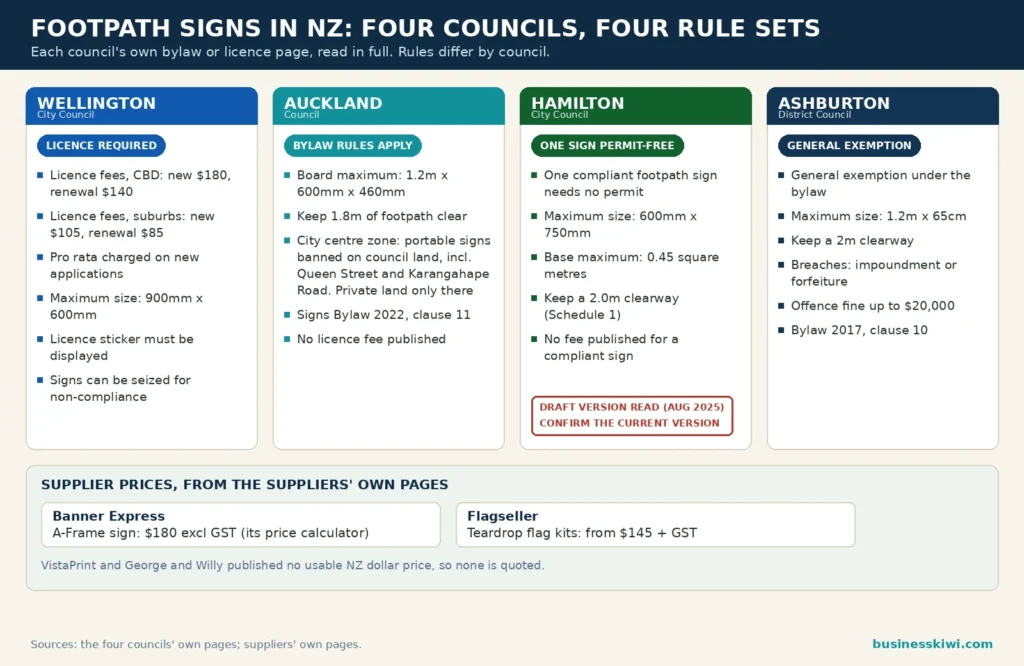
Wellington: a licence, a fee and a sticker. Wellington City Council requires a licence before a sandwich board goes on a public footpath, granted according to the safety and appropriateness of the location. Fees are published on the council’s sandwich boards page: in the CBD a new application costs $180 and a renewal $140; in the suburbs a new application costs $105 and a renewal $85, with new application fees charged pro rata. Licences run for one year, from 1 July to 30 June, with renewal reminders sent. A board may be no more than 900mm high and 600mm wide. Only one board is allowed per licence, the licence sticker must be attached and visible, and neither licence nor sticker is transferable. Application fees are not refunded. The council may decline an application or cancel a licence; where it cancels a paid licence, it credits the remaining unused days.
Auckland: rules by zone, and a hard line in the city centre. Auckland Council’s Signs Bylaw 2022, clause 11, sets the portable sign rules, published zone by zone. In town centre and mixed-use zones, a premises with both direct ground floor frontage and direct ground level access may display one portable board or one portable flag sign, not both; other premises in the building share one ladder board per building. The size limits and footpath placement conditions set out above apply on council-controlled places. The city centre zone is stricter: portable signs may only be displayed on land that is not council-controlled. The council names the places that leaves out, including the footpaths on Queen Street and Karangahape Road and at Wynyard Quarter, and civic spaces such as Aotea Square, Freyberg Place, Khartoum Place, Queen Elizabeth Square and St Patrick’s Square. A Queen Street café can use a board on a private forecourt; the same board on the footpath is not permitted.
Hamilton: one sign free of a permit, within a tight schedule. Hamilton City Council’s Trading in Public Places Policy is the operative document, and its footpath sign deal is precise. One sign, no permit, provided it complies with the policy conditions and the Schedule 2 sizes: for an A-frame, no larger than 600mm wide and 750mm high, with a base area of no more than 0.45 square metres. Note what that does to the standard shop-bought board: a common 600mm by 900mm panel fits the width limit but is 150mm too tall, so a Hamilton business needs the smaller size or a permit conversation with the council. Signs must be kept in good order, kept out of the 2.0m continuous clearway, kept clear of drivers’ sightlines and vehicle access to rights of way, and removed outside business hours. Permits, issued by the council’s City Safe Unit, generally run 12 months, are not transferable, and expire when the business is sold. (The copy published on the council’s consultation file store is the August 2025 draft revision, so confirm the current version with the council.)
Ashburton: a general exemption in a small district. Ashburton District Council’s Advertising Signage in Public Places Bylaw 2017, adopted in September 2017, sets out to stop signs creating a nuisance, causing offence or presenting a hazard to pedestrians or vehicles. Clause 9.1.3 requires written council permission to display an advertising board, placard, flag, screen or frame on or over a footpath. Clause 10 then grants the general exemption: retailers may use portable display boards in the immediate vicinity of their premises without seeking written permission case by case. The conditions are placement within 600mm of the legal boundary or the adjacent kerb, a clear pedestrian access way of at least 2m at all times, a maximum size of 1.2m high and 65cm wide, no interference with street furniture or with car doors opening in metered parking areas, and signs only immediately outside the premises they advertise.
What a footpath sign costs
There are two separate costs: the sign itself, and in licensed districts the permission. Supplier prices below are as published on each supplier’s own product page, read in full for this guide, and prices move, so treat them as a snapshot for budgeting rather than a quote.
A printed A-frame from Banner Express is priced by an on-page calculator, which showed $180 excluding GST for its standard sandwich board: a powder-coated metal stand with two corflute graphic panels, in 600mm by 900mm or 900mm by 1200mm panels. Because the panels are replaceable, a message change later costs a panel rather than a new sign. VistaPrint NZ sells its A-frames as a frame with two signs, the same or a different design on each side at no extra cost, plus sign-only replacements, but not the frame alone. Its page displayed no prices when read, so no VistaPrint figure is quoted here. George and Willy’s blank aluminium A-frame is the premium, design-led option, sold unbranded for a signwriter to letter, adding a signwriting cost to the hardware.
Flags cost more than boards because the kitset (printed flag, fibreglass pole and base) is the product. Flagseller’s teardrop kitsets start at $145 plus GST for the small 2.3m flag, single-sided, with a ground spike base. The large 3.6m version starts at $213 plus GST on the same basis, double-sided printing starts at $195 plus GST for the small size, and hard-surface bases such as steel plates cost more than the spike.
Council permission, where it is charged, is modest next to the hardware. Wellington is the only one of the four councils read in full that publishes a footpath sign licence fee, set out in the Wellington section above. Auckland’s rules, Hamilton’s one-sign arrangement and Ashburton’s exemption involve no application for a compliant sign, so no fee. If your sign falls outside the standard conditions and needs a permit, ask your council what the application costs before you commit: those fees are set locally and were not published in the documents read for the other three districts.
One more cost belongs in the budget: liability. A board that blows into the road or trips a pedestrian is your problem, not the council’s. Check your business insurance position, including public liability insurance, before the sign goes out, and keep the board in good repair: Hamilton’s policy allows an officer to require remedial work on an unmaintained or hazardous sign.
Accessibility and safety: the part every council agrees on
Read four bylaws in a row and the reasoning becomes obvious. Footpath signs sit in the space used by people who cannot easily step around them: wheelchair and mobility scooter users, people pushing prams, and people with low or no vision who navigate by cane and by the building line. Auckland Council says it directly on its portable signs pages, asking businesses to think about pedestrian access, in particular for visually impaired people.
The clearway numbers are the practical expression of that. Leave at least 1.8m of unobstructed footpath in Auckland, a continuous 2.0m clearway in Hamilton, and a clear pedestrian access way of at least 2m in Ashburton. On a narrow footpath there may simply be no compliant spot, which is why Wellington reserves the right to set the exact location. Hamilton adds a detail most businesses would never think of: obstructions must include a detectable feature within 150mm of ground level, so a cane user detects the sign rather than walking into a panel that starts above cane height. An A-frame’s legs and lower panel edge do this naturally; a flag base is worth a second look.
Stability is the second safety theme. Councils require signs to be weighted, latched or built to withstand gusts, and to come in when the wind makes them a hazard. Suppliers agree: George and Willy rates its 4kg frame for low to moderate wind and recommends sandbags in exposed or coastal locations, and Flagseller warns that its flags are not designed for storms or severe wind. Sightlines matter too: Hamilton prohibits a sign that obscures road users’ visibility or blocks vehicle access to a right of way, and Auckland’s intersection and kerb clearances serve the same purpose.
Choosing and designing a sign that earns its spot
Start with the rulebook for your own street, because it sets the maximum size before design taste gets a say. In Hamilton that means the smaller format; in Wellington and Auckland the standard 600mm by 900mm panel fits. Buy the sign to fit the bylaw, not the other way round.
Construction choices are about weather and handling. Corflute panels in a powder-coated metal frame are the workhorse format both Banner Express and VistaPrint NZ sell: light, weather resistant, cheap to reprint. Aluminium frames, like George and Willy’s, cost more and weigh less at 4kg, suiting businesses that carry the board in and out daily. Weight cuts both ways: VistaPrint’s small A-frame weighs 6.5kg and its large one 8kg, and a heavier board resists gusts better but is more work to move. For flags, base choice is the stability decision: a ground spike only works in soft ground, while steel plate and water-filled bases are Flagseller’s hard-surface options.
Design for a walking reader, not a standing one. VistaPrint NZ’s published design guidance for its sandwich boards summarises what works: large fonts or images so the sign reads from a distance, strong contrast between background and text, one main message people can grasp quickly, important text kept inside the frame’s safety margins, and any arrow flipped for the reverse side so it still points at your door. One message means exactly that: the café’s name and “coffee”, or today’s special, not a menu. Replaceable panels exist so the message can change with the season without new hardware.
Position the sign the way the bylaws assume: within your own frontage, at the kerbside where your council wants it, facing the flow of pedestrians rather than parked cars, and never drifting towards a busier corner. Ashburton’s condition that signs sit immediately outside the premises they advertise, and Auckland’s rule that a portable sign may only advertise what is available at that premises, rule out the wandering board outside someone else’s shopfront.
What happens if you get it wrong
Enforcement in the documents read is graduated, and it starts politely. Hamilton’s policy sets out the ladder: a verbal notification of the breach and a request to put it right, then a written warning identifying the issue and the remedy required, and then the council will consider revoking the permit. For trading in a public place without a permit, Hamilton’s process is to ask the person to remove their material and stop, issue a written warning, and, if the infringement persists, confiscate the trading material under sections 163 and 164 of the Local Government Act 2002, with disposal possible under section 168.
Wellington tickets an unlicensed or non-compliant board with a notice sticker; if the problem is not remedied, the council may seize the board, and a fee may apply to retrieve it. Ashburton’s bylaw gives officers a written notice power requiring removal of a non-complying sign, after which it may be impounded and released only on payment of a fee set by the council. Repeat offenders get one 24-hour warning notice, after which signs may be seized and forfeited without further notice. A sign the council considers hazardous, dangerous or offensive can be removed without notice, with costs, including storage, recoverable from the owner. Breaching the Ashburton bylaw is an offence, liable on summary conviction to a fine not exceeding $20,000. Permits and licences also expire (Hamilton’s on sale of the business, Wellington’s each 30 June), are not transferable, and can be cancelled or declined.
The realistic risk for a small business is not the maximum fine; it is losing the sign, losing the fee, and having the conversation at all. A compliant board, checked against your own council’s current bylaw and put out and brought in as the conditions require, avoids all of it.
Frequently asked questions
Do I need a permit for an A-frame sign on the footpath?
It depends on the district. Wellington requires a licence before a sandwich board goes on a public footpath. Hamilton requires a permit for signs in a public place in general, but allows one compliant footpath sign without one. Ashburton’s bylaw grants a general exemption for portable boards outside the premises they advertise, and Auckland regulates portable signs through the conditions in its Signs Bylaw 2022 rather than a licence. Check your own council’s bylaw, because the answer changes at the district boundary.
How big can my footpath sign be?
The published limits are: Wellington, maximum 900mm high and 600mm wide; Auckland, a portable board maximum 1.2m high, 600mm wide and 460mm deep; Hamilton, maximum 600mm wide and 750mm high, base area no more than 0.45 square metres; Ashburton, maximum 1.2m high and 65cm wide. The standard 600mm by 900mm panel fits the first three but is too tall for Hamilton.
How much does an A-frame sign cost?
Banner Express’s price calculator showed $180 excluding GST for its standard sandwich board with two printed corflute panels. Teardrop flag kitsets from Flagseller start at $145 plus GST for a small single-sided flag with a ground spike base. Add council permission where it applies: Wellington’s licence costs $180 for a new CBD application, $140 to renew, $105 for a new suburban application and $85 to renew.
Can I leave my sandwich board out overnight?
Not on the footpath in any district read. Wellington requires boards to come onto private property outside business hours and never be left overnight, Auckland requires portable signs to be removed at the end of each day (and whenever they risk being blown over), and Hamilton requires removal outside business hours.
How many footpath signs can one business have?
One, in practice, in each council read: one per premises in Auckland, one per road frontage in Hamilton, and one per licence in Wellington.
What happens if my sign breaks the rules?
Councils generally start with a request or a notice and escalate if the problem continues. Wellington tickets a non-compliant board with a notice sticker and may seize it. Hamilton moves from a verbal notification to a written warning and then possible permit revocation, and can confiscate trading material from people trading without a permit. Ashburton can impound a sign after written notice, forfeit repeat offenders’ signs after one 24-hour warning, and remove a hazardous sign without notice; breaching its bylaw is an offence with a fine of up to $20,000.
Can I put the sign on my own forecourt instead of the footpath?
Usually yes, and it can take the footpath rules out of play, because council portable sign rules are written for council-controlled public places. Auckland’s city centre zone is the clearest example: portable signs there may only be displayed on land that is not council-controlled, such as private property. Your landlord or centre management may have their own rules, and fixed or larger signs can still be caught by other sign rules.
Are teardrop flags treated the same way as A-frames?
Yes, in the councils read they sit in the same portable sign category. Auckland’s Signs Bylaw 2022 covers sandwich boards and teardrop flags as portable signs, with a portable flag limit of 500mm wide and a total height of 2.2m. Hamilton’s schedule allows flags and banners up to 0.75m wide and 3.2m high. The same placement, clearway and daily removal conditions apply.
Sources
- Wellington City Council, “Sandwich boards” (licence requirements, fees, size limit, placement and enforcement), wellington.govt.nz/certificates-and-licences/signs-and-posters/sandwich-boards
- Auckland Council, “Portable signs in town centre and mixed-use zones” (Signs Bylaw 2022 clause 11 rules, sizes and footpath placement conditions), aucklandcouncil.govt.nz
- Auckland Council, “Portable signs in the city centre zone” (portable signs only on land that is not council-controlled; excluded footpaths and civic spaces), aucklandcouncil.govt.nz
- Hamilton City Council, Trading in Public Places Policy (signs section, Schedule 1 footpath layouts, Schedule 2 sign dimensions, permit conditions and enforcement), hamilton.govt.nz policy document D-3372906
- Ashburton District Council, Advertising Signage in Public Places Bylaw 2017 (clauses 9 and 10, sandwich board exemption, conditions and enforcement), ashburtondc.govt.nz
- Banner Express NZ, “A-Frame” product page (sandwich board construction, panel sizes, price calculator), bannerexpress.co.nz/a-frame/
- VistaPrint NZ, “Sandwich Boards” product page (A-frame sizes, weights, materials, replacement signs, design guidance), vistaprint.co.nz/signs-posters/a-frame-sandwich-boards
- George and Willy, “A-Frame Sign” product page (aluminium A-frame dimensions, weight, wind guidance), georgeandwilly.com/products/a-frame-sign
- Flagseller, “Teardrop Flag Kitsets” product page (kitset contents, sizes, bases and prices), flagseller.co.nz/products/teardrop-flag-kitsets
This article is general information about footpath sign rules and products in New Zealand, based on the council bylaws, council pages and supplier pages listed above as read at the time of writing. Bylaws, fees and prices change, and rules differ between districts, so confirm the current requirements with your own council before placing a sign on a public footpath. Nothing here is legal advice.