Gisborne Central School: A Parent’s Guide to Enrolment, the Zone and What ERO Found
The short answer
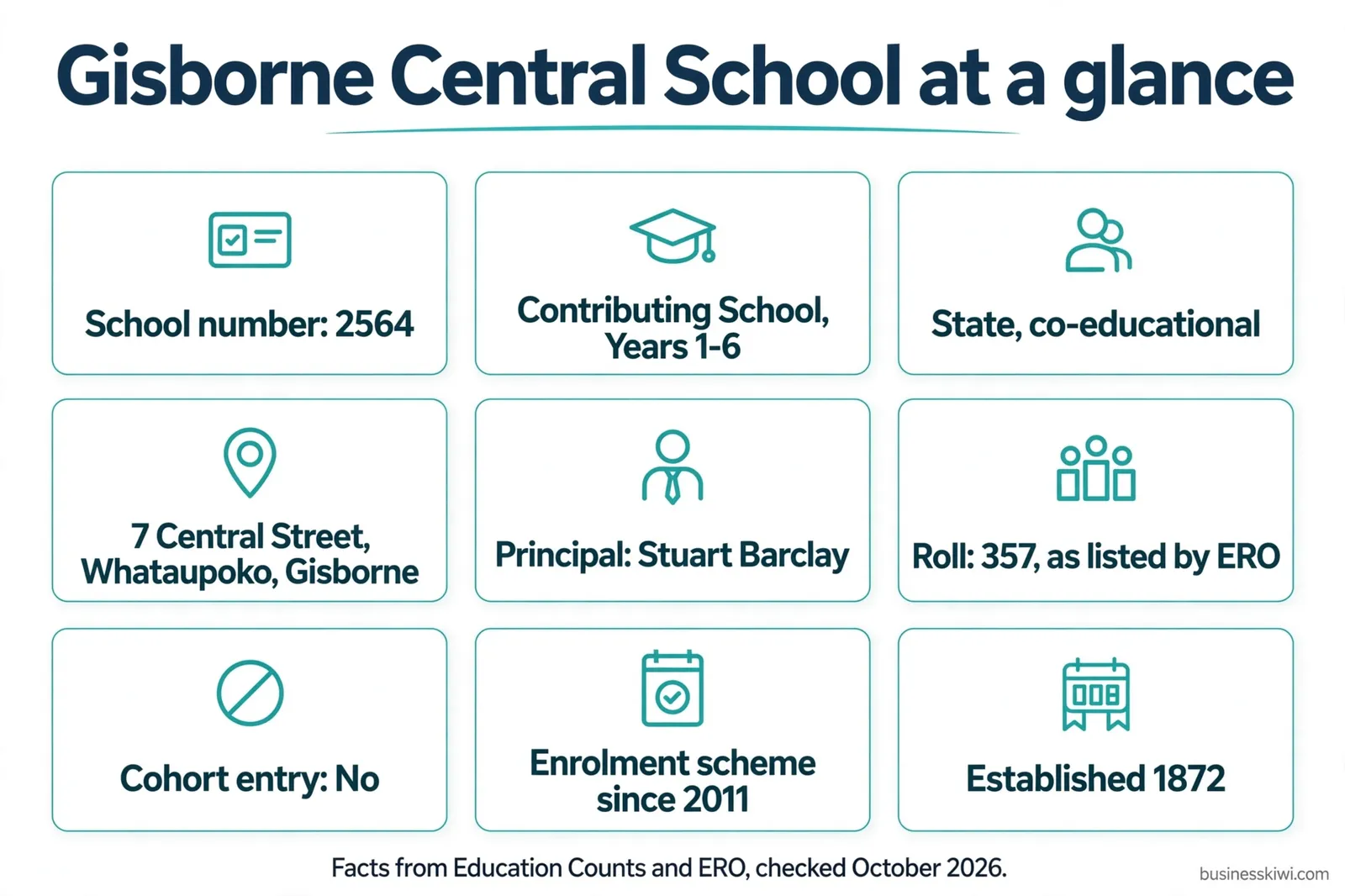
Gisborne Central School is a state contributing primary school for Years 1 to 6 in Whataupoko, in the heart of Gisborne. The Education Counts directory lists it as institution 2564, co-educational, with Stuart Barclay as principal. ERO lists the roll as 357. The school has had an enrolment scheme and a home zone since 2011, so where you live decides whether your child has a guaranteed place. ERO’s most recent evaluation, published in January 2025, found students engaged and achieving well, with the school approaching the Ministry of Education target for regular attendance. Its agreed next steps include lifting regular attendance further and continuing to improve writing outcomes for boys and for Māori learners. The school is in the government donations scheme, which means donations should not be requested, except for a school camp.
The school at a glance
| Fact | Detail |
|---|---|
| Institution number | 2564 |
| School type | Contributing School (Year 1–6) |
| Authority | State |
| Gender | Co-Educational |
| Address | 7 Central Street, Whataupoko, Gisborne |
| Principal | Stuart Barclay |
| Roll | 357 (as listed by ERO) |
| Cohort entry | No |
| Donations scheme position | Donations should not be requested, unless for a school camp |
| Boarding | No |
| Phone | 06-867 5073 |
| office@gisbornecentral.school.nz |
Enrolment and the zone
Gisborne Central School has an enrolment scheme. The school publishes the scheme on its enrolment information page, and it says the Board of Trustees put the scheme in place to avoid overcrowding. The scheme came into effect on 21 July 2011, under Section 11A of the Education Act 1989 as the school’s document records it. An enrolment scheme has two parts that matter to families: a home zone, and a set of rules for children who live outside it.
If your child’s usual place of residence is inside the home zone, your child is entitled to enrol. The zone covers the streets of Whataupoko around the school, in the area between the Waimata River and the Taruheru River. The school’s scheme describes the boundary road by road, and the Ministry’s Find a School service shows the zone on a map, so check your exact address there or ask the office before relying on being in zone. Proof of residence within the zone will be required. The Ministry’s guidance for parents says a school may ask for evidence such as a tenancy agreement, a certificate of title or utility bills showing the address, and that an enrolment can be refused or annulled if false information is given.
Living outside the zone does not close the door, but it does change the process. At the beginning and at the midway point of each year, and at other times the board decides, the board works out how many out-of-zone places are likely to be available for the following two terms and publishes that by notice in a daily or community newspaper circulating in the area. The notice says how to apply and the date applications must be received by.
Out-of-zone applications are processed in a fixed order of priority set by law. First priority goes to applicants accepted into a special programme run by the school, and the school’s scheme notes that no such programme exists at Gisborne Central School. Second priority goes to siblings of current students, third to siblings of former students, fourth to children of former students, and fifth to children of board employees or board members. Sixth priority covers all other applicants. If there are more applicants in the second, third, fourth or fifth priority groups than places available, places within that group are decided by ballot. Parents are told the ballot date by newspaper notice, and applicants claiming second or third priority may be required to give proof of the sibling relationship. The Ministry’s parent guide adds that unsuccessful out-of-zone applicants are placed on a wait list and told their place on it.
One point worth knowing if your family moves house: a child who has already started can generally continue at the school, but the Ministry advises telling the school about the move, because a board can review an enrolment it believes was gained through a temporary address.
Starting school
Children in New Zealand are entitled to free enrolment at a state school from their fifth birthday. Gisborne Central School does not use cohort entry, which is the system where new entrants start together on set dates during the term. Education Counts records cohort entry as No for this school, so children start individually, in discussion with the school, rather than waiting for a cohort date. Contact the office in good time before the birthday so the start can be planned with the junior team.
The school does not publish a set programme of pre-start visits on the pages it has online, so ask the office what visits are offered for new entrants and what your child should bring on the first day. That conversation is also the time to raise anything the school should know, such as medical needs, learning support or a transition from an early childhood service.
Children transferring from another school are handled differently. The school’s enrolment page says students already at school elsewhere need an appointment to meet the principal, Stu Barclay, arranged through the office on 06-867 5073. If you are enrolling from outside the zone at any year level, the out-of-zone process described above applies rather than a simple transfer, so raise your zone position in that first conversation.
What ERO found
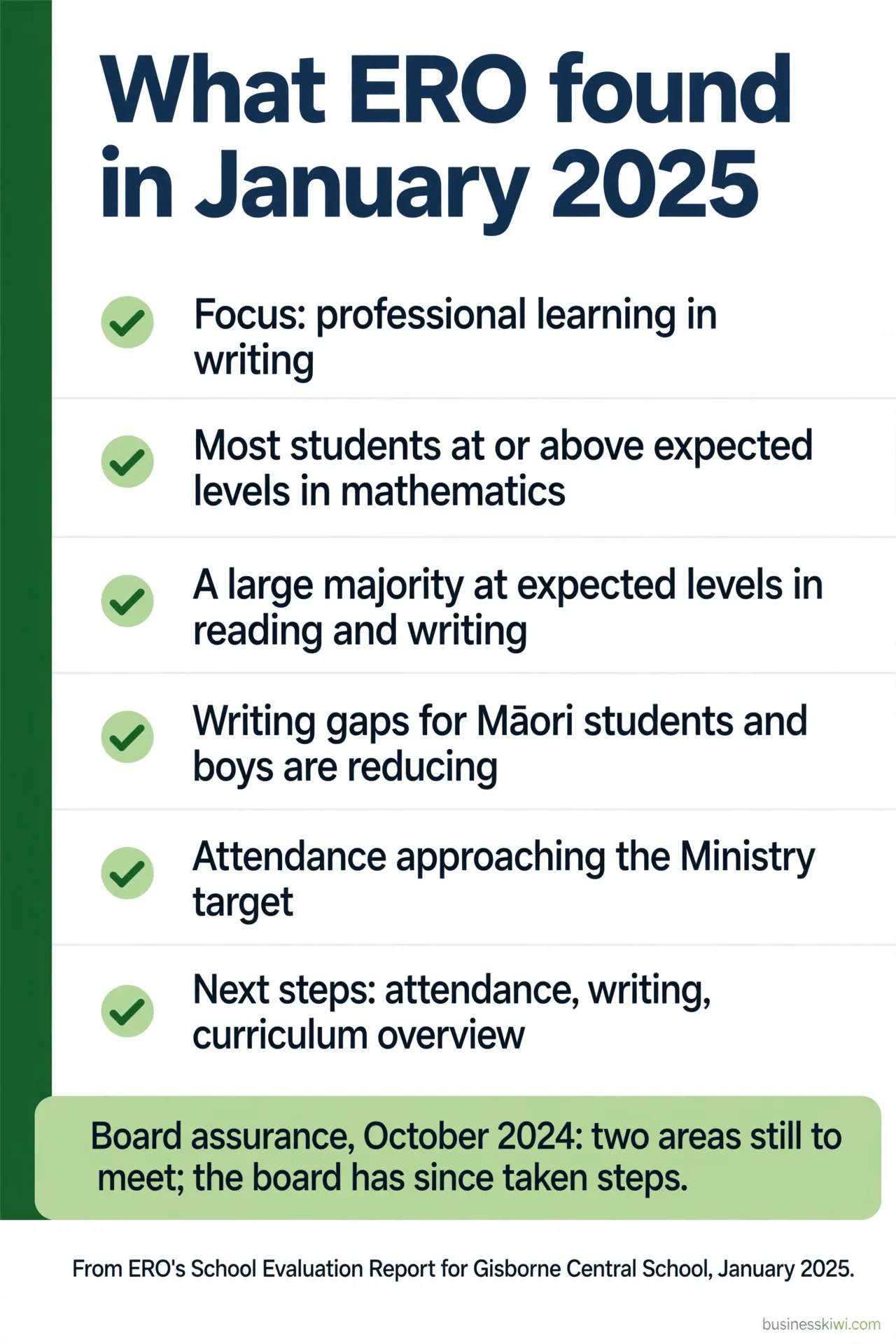
The Education Review Office works with the school under Te Ara Huarau, its evaluation approach for English medium state schools. The current report on ERO’s website is the School Evaluation Report dated 23 January 2025. It follows the earlier report of July 2022, and the school’s work between the two reports had a clear focus: evaluating how effectively professional learning in writing supported continuous improvement for all students.
Monitoring showed acceleration in achievement for most of the students identified as requiring support in writing. Effective practice in the teaching of writing is embedded schoolwide, and ERO names the strengthening of structured literacy practices as the greatest shift over the period, supported by robust assessment and monitoring. A comprehensive inquiry approach has been implemented, and teachers can demonstrate the effect of professional learning on their classroom practice. Initiatives are also in place to support learners at transition points within the school.
On the current state of the school, ERO reports that students are engaged in learning, make sustained progress and achieve well. Most students achieve at or above expected curriculum levels in mathematics, and a large majority achieve at expected curriculum levels in reading and writing. The disparity in writing achievement for Māori students and for boys is reducing. Learners benefit from an affirming and inclusive school environment that is increasingly responsive to their needs, and attendance information shows the school is approaching the current Ministry of Education target for regular attendance.
ERO also records the conditions behind those results. Leadership fosters a collaborative teaching culture, and leaders use evidence to plan and monitor the school’s strategic improvement plan, with professional learning measured by its impact on learner outcomes. Leaders increasingly involve whānau and iwi in decision making, so the school’s vision and goals reflect what the community wants for its children. Teachers use evidence-based teaching strategies and create collaborative, orderly learning environments. The curriculum increasingly reflects the local context, and te reo Māori, tikanga Māori and mātauranga Māori are increasingly woven through it. Supporting middle leaders to grow their leadership skills, and developing a curriculum overview that aligns with curriculum developments, are recorded as next steps within that work.
The agreed next steps for the school are to implement effective approaches to continue improving regular attendance; to embed evidence-based teaching approaches and assessment processes schoolwide, with a continued focus on improving writing outcomes for boys and for Māori learners; to develop an overview for curriculum delivery and content; to provide professional learning that supports teachers’ development as leaders; and to engage meaningfully with all groups within the school community. ERO will support the school through its evaluation for improvement cycle, and the next public report is due within three years of the January 2025 report.
The same ERO page carries the Board Assurance Report for 2024 to 2027. As of October 2024 the board attested that it meets the requirements for board administration, curriculum, finance and assets. It recorded that it did not yet meet the requirements in two areas, management of health, safety and welfare, and personnel management. The areas of non-compliance the board identified were ensuring all staff employed have a current police vet, undertaking the bi-annual health curriculum consultation with the community, notifying the Ministry of Education on the use of physical restraint, displaying no vaping signs at school entrances, and physical restraint training not being completed at the appropriate time. ERO records that the board has since taken steps to address the areas of non-compliance identified. In the earlier assurance report, covering 2022 to 2025 and attested in May 2022, the board recorded that it met the requirements in all six areas.

Roll and community
ERO lists the school’s total roll as 357. The Education Counts profile for the school does not publish a roll figure, so 357 is the number to use. It makes Gisborne Central a mid-sized urban primary: large enough to run separate syndicate teams across the year levels, small enough that the principal’s welcome talks about every child being known, supported and inspired to thrive.
The school sits in Whataupoko, in the heart of Gisborne, and it has been there a long time. The school’s own history page says it was established in 1872, and in its early days the school buildings were used for a time as a temporary museum of Māori artefacts. The school is guided by its vision, Learning for Life, and by four values: manaakitanga, mōhiotanga, whanaungatanga and māiatanga. In the principal’s welcome those values are explained as respect and care, knowledge, relationships and belonging, and perseverance and resilience.
ERO’s 2022 profile report recorded the school’s strategic priorities as: students enjoying academic success and achieving to the best of their ability; students having the knowledge to make good choices about their health and wellbeing; developing learning partnerships within the community; and students having the skills and knowledge to interact positively with others. The January 2025 report shows the community side of that plan in action, with leaders increasingly involving whānau and iwi in decision making, and engagement with all groups in the community reviewed every six months as part of the improvement cycle.
Donations, costs and the school day
Gisborne Central School is in the school donations scheme. Education Counts records its position in the standard form used for scheme schools: donations should not be requested, unless for a school camp. In practice that means the school does not ask parents for a general school donation, and any request connected with a camp is the recognised exception. Costs that sit outside the scheme, such as camps, trips and optional activities, can still arise during the year, so ask the office what is coming up for your child’s year level.
On uniform, the position is one to check rather than assume. The school has consulted its community on introducing a school uniform, following a recent rebrand. Its published consultation material said that current pricing quotes would put a standard uniform set, two pairs of shorts, two polo shirts, one pair of trousers and one fleece, at between $180 and $220. The school’s website does not publish a uniform list or a stationery list online, so confirm the current uniform position, and what stationery your child needs, with the office before you buy anything.
The school does not publish its bell times on the pages of its current website either, so the start of the day, break times and finishing times are another detail to confirm with the office when you enrol. What can be confirmed publicly is the term framework. The school has not published its own 2027 term dates on the pages read for this guide. Primary schools choose their own start and finish dates within the Ministry’s national windows. For 2027 those windows are: Term 1 starts between Thursday 28 January and Wednesday 3 February and ends Friday 9 April; Term 2 runs from Tuesday 27 April to Friday 2 July; Term 3 runs from Monday 19 July to Friday 24 September; and Term 4 runs from Monday 11 October to no later than Friday 17 December. The school’s own dates, including any teacher-only days, will fall inside that framework.
Facilities and programmes
The school organises its teaching into four syndicates, one for each stage of the Years 1 to 6 journey. The school’s story page explains that its logo carries four koru, following the Waiteata stream as it flows toward the Waimata River, then to Wai-weherua and out to Tūranganui-a-Kiwa, the ocean. The four koru stand for the school’s four values, and they also represent the four school syndicates, so the structure of the school and its story about children growing from a small stream to the ocean are deliberately tied together. The school colours are red and blue.
Within the classroom programme, the strongest published evidence is ERO’s. Structured literacy is the flagship: ERO found literacy practices well supported by robust assessment and monitoring, enabling teachers to adapt teaching to students’ learning needs. The local curriculum is a growing feature, reflecting the local context and building on learners’ experiences and knowledge, with te reo Māori, tikanga Māori and mātauranga Māori increasingly woven through it as teachers build their confidence and capability. A curriculum overview to align delivery with current curriculum developments is one of the school’s agreed next steps.
Treat anything more specific, such as particular sports, cultural groups or facility lists, as a question for the school. Its current website does not publish a facilities list, and this guide does not fill that gap from older school documents, which name a previous principal and out-of-date arrangements.
Two other school profiles from this week are our guides to Corinna School in Porirua and Fraser Crescent School in Upper Hutt. For help with the reading levels your child brings home, see our reading levels and ages NZ guide. More school and careers guides sit in our Jobs and Education section.
Frequently asked questions
Does Gisborne Central School have an enrolment zone?
Yes. The school has had an enrolment scheme with a home zone since 21 July 2011. Children who live in the home zone, which covers the Whataupoko area around the school, are entitled to enrol, and proof of residence is required. Check your address on the Ministry of Education’s Find a School map or ask the school office.
What happens if we live outside the zone?
You can still apply. The board decides how many out-of-zone places are available at the start and midway point of each year and advertises them in a newspaper notice. Applications are taken in a legal order of priority, from siblings of current students down to all other applicants, and a ballot is held within a priority group if applications exceed places. Unsuccessful applicants go on a wait list.
When can my child start at Gisborne Central School?
From their fifth birthday. The school does not use cohort entry, so new entrants do not wait for a set intake date; starts are arranged individually. Contact the school office ahead of the birthday to plan the start, and ask what pre-start visits the school offers, because it does not publish a visit programme online.
How many students does the school have?
ERO lists the total roll as 357. The school teaches Years 1 to 6, so children move on to an intermediate school for Year 7. Education Counts does not publish a roll figure on the school’s directory profile, so ERO’s listed roll is the figure used in this guide.
Does the school ask for a donation?
No general donation should be requested. The school is in the school donations scheme, and Education Counts records that donations should not be requested unless for a school camp. Separate costs, such as camp or trip charges, can still apply during the year.
What did ERO say about Gisborne Central School?
In its January 2025 evaluation report, ERO found students engaged, making sustained progress and achieving well, with most students at or above expected levels in mathematics and a large majority at expected levels in reading and writing. It noted attendance approaching the government target, and set next steps that include improving regular attendance and continuing to lift writing outcomes for boys and Māori learners.
Does Gisborne Central School have a uniform?
The school has consulted its community on introducing a uniform after a rebrand, and its consultation material quoted between $180 and $220 for a standard set of shorts, polo shirts, trousers and a fleece. It does not publish a uniform list on its website, so check the current position with the school office before buying.
The bottom line
Gisborne Central School is a long-established state primary in Whataupoko with a roll of 357, a values-led culture built around Learning for Life, and an ERO report from January 2025 that describes engaged learners, strong structured literacy teaching and achievement at or above expected levels for most students in mathematics. The two things parents most need to get right are the zone, because the enrolment scheme has real consequences for out-of-zone families, and the practical details the school does not publish online, such as bell times, stationery and the current uniform position. All of those are one phone call to the office away.
Sources
- Ministry of Education, Education Counts: Gisborne Central School profile and contact details (institution 2564, principal, type, cohort entry, donations position, address and contacts), https://www.educationcounts.govt.nz/find-school/school/profile?district=®ion=&school=2564
- Education Review Office: Gisborne Central School institution page, including the School Evaluation Report of 23 January 2025, the Board Assurance Report 2024 to 2027, and the Te Ara Huarau School Profile Report of 27 July 2022, https://www.ero.govt.nz/institution/2564/gisborne-central-school
- Gisborne Central School: homepage and principal’s welcome, https://www.gisbornecentral.school.nz/
- Gisborne Central School: Our Story (established 1872, values, four syndicates, school colours), https://www.gisbornecentral.school.nz/our-story
- Gisborne Central School: Enrolment Information, including the full text of the enrolment scheme in effect since 21 July 2011, https://sites.google.com/gisbornecentral.school.nz/gcs/enrolment-information
- Gisborne Central School: School Uniform Consultation (consultation on introducing a uniform, indicative set price of $180 to $220), https://docs.google.com/forms/d/e/1FAIpQLSdODEY3Cje4XZ6W1c27dpMOe4VKze7oX_Qb1aSYV2AfaHZKCw/viewform?usp=embed_facebook
- Ministry of Education: FAQs about Enrolment Schemes (parent guide to home zones, ballots, priority order, proof of residence and wait lists), https://web-assets.education.govt.nz/s3fs-public/2026-08/FAQs%20about%20Enrolment%20Schemes_English.pdf
- Ministry of Education: School terms and holidays dates (national term date framework, including the 2027 windows), https://www.education.govt.nz/school-terms-and-holidays-dates
This article is general information about Gisborne Central School in Gisborne, based on Ministry of Education, Education Review Office and school sources published at the time of writing. It is not published by or for the school. Enrolment, zoning and cost details can change, so confirm anything that matters for your family with the school office before you act on it.