GP Salary in NZ: What General Practitioners Earn and How GP Pay Works

Ask what a GP earns in New Zealand and you will find confident numbers all over the internet. Most of them cannot be traced to any official source. That is because general practice in this country does not work like a salaried profession. There is no national pay scale for GPs, no collective agreement covering doctors in private practice, and no government agency publishing an official average salary for the job. What exists instead is a patchwork: a training salary that is published in a real collective agreement, workforce survey data collected by the doctors’ own professional college, and a funding system that pays practices rather than people. This guide works through each of those pieces, states plainly what is and is not published, and explains how GP income is actually put together.
The short answer
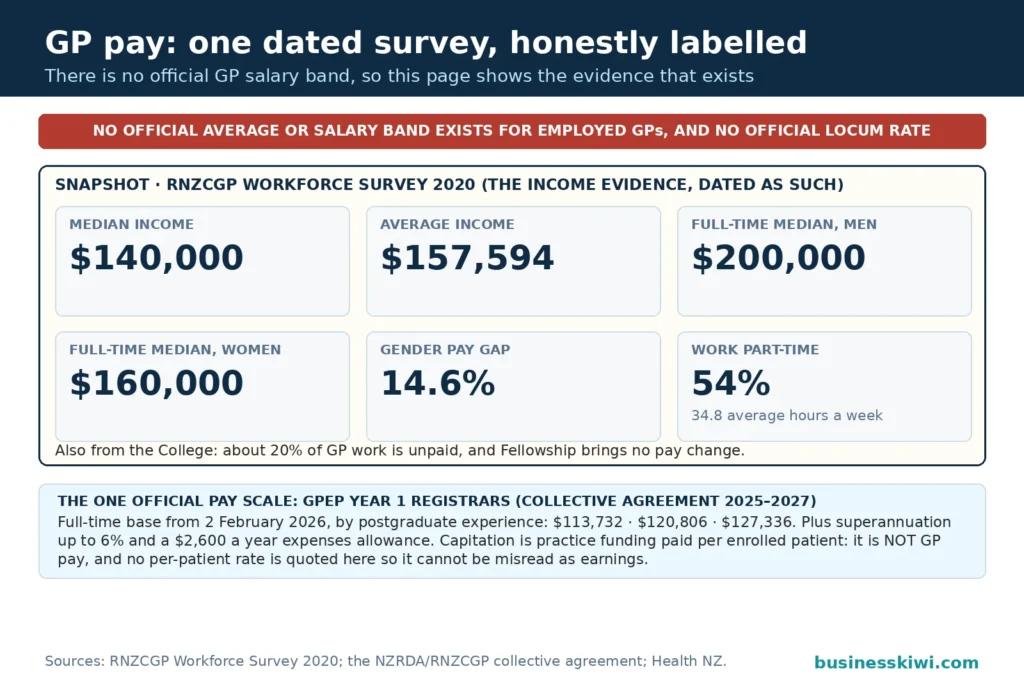
The most reliable income figures for New Zealand GPs come from the Royal New Zealand College of General Practitioners (RNZCGP), which surveys its members every two years. In its 2020 workforce survey, the College found that GPs’ average personal income before tax was $157,594 a year, with a median of $140,000. Those figures cover GPs in every kind of working arrangement, owners, employees and contractors alike, and they reflect a workforce in which most doctors work part-time hours. Among GPs working full-time hours (36 or more hours a week in general practice), the median income in 2020 was $200,000 for men and $160,000 for women.
Everything else you may have read needs treating with care. There is no official, current average GP salary published by any New Zealand government agency, and no official body publishes the sessional or hourly rates that practices pay employed and contractor GPs. Those rates are set in individual contracts between a GP and a practice, and they are not collected or released centrally. The one GP salary that is published in full is the training salary: GP registrars in the first year of the General Practice Education Programme (GPEP) are employed under a collective agreement that, from 2 February 2026, pays a full-time base salary of $113,732 to $127,336 depending on experience. The sections below explain each part of that picture.
Why GP pay is so hard to summarise
The starting point is that most GPs are not salaried employees of a health system. General practices in New Zealand are independent businesses, mostly owned by the GPs who work in them, and the doctors inside them work under several different arrangements at once.
The College’s 2020 survey shows the mix. Just over half of GPs (52 percent) described themselves as a long-term employee or a long-term contractor at the practice where they mainly worked. About a third (34 percent) held an ownership stake in their practice. A smaller group (11 percent) were short-term employees or contractors, the category that includes most locum-style work. The practices themselves were most often owned by GPs working in them: 69 percent of survey respondents worked in a practice owned by one or more GPs on site, while 10 percent worked in practices with full or partial corporate ownership and 7 percent in community, trust or charity owned practices.
Each arrangement produces income differently. An employee receives a salary or hourly pay agreed with the practice, with leave and other entitlements under employment law. A contractor invoices the practice for sessions or hours worked and handles their own tax, leave and retirement saving. An owner takes whatever is left of the practice’s income after every cost is paid, which can be more or less than a salary and carries business risk. Any single “average GP salary” blends all of these together, along with a workforce where part-time work is the norm. That is why the honest answer to the salary question is a range of evidence rather than one number.
Employed GPs: what the evidence actually shows
No official source publishes a salary scale, pay band or current average for employed GPs, and it is worth being direct about that, because many websites state one anyway. Unlike hospital specialists, who are covered by a national collective agreement, GPs working in private practices negotiate their own employment agreements. Pay arrangements vary: some employed GPs are salaried, others are paid by the hour or by the session (a session is usually a half day of clinical work, often around four hours). The rates in those agreements are commercially private.
What can be stated from the College’s survey work is what GPs across all arrangements reported earning. The 2020 average of $157,594 and median of $140,000 are the most recent income figures the College has published in a full survey report. Two features of those numbers matter. First, the average barely moved between surveys: it was $156,250 in 2018, and the College noted the 2020 figure had risen by less than inflation. Second, the figures are heavily shaped by working hours. The average GP worked 34.8 hours a week in general practice in 2020, and 54 percent of GPs worked part-time hours, outnumbering full-time GPs for the first time since the survey began. A median income of $140,000 across a mostly part-time workforce implies considerably higher full-time equivalent earnings, which is consistent with the full-time medians the College reported: $200,000 for men and $160,000 for women working 36 or more hours a week.
The College’s 2022 survey added two findings that matter for anyone assessing GP pay. It found that around 20 percent of GPs’ work time is unpaid, taken up by the paperwork, results and follow-up that sit outside booked appointments. It also found that gaining Fellowship of the College, the qualification that marks a fully trained specialist GP, attracts no change in remuneration. In most other medical specialties, completing vocational training moves a doctor onto higher pay. In general practice, it does not automatically do so.
Contractor and locum GPs: negotiated rates, not published ones
Contracting is the other main way GPs work, and it covers both long-term contractors who work regular sessions at one practice for years and locums who fill short gaps, cover leave and staff after-hours services. The College groups long-term employees and contractors together in its reporting (52 percent of GPs in 2020), which reflects how common long-term contracting is.
There are no official published rates for contractor or locum work. No government agency, and not the College either, releases a standard sessional rate, hourly rate or daily rate for GPs, because every rate is the product of a private negotiation between the doctor and the practice. Rates respond to local shortages, the type of work (routine sessions versus urgent or after-hours cover) and how hard a practice is to staff, and they can differ widely between regions and practices. Any website quoting a precise national locum rate is drawing on recruitment advertising or private surveys, not on an official source, and those figures should be treated accordingly.
What can be described accurately is the structure of the trade-off. A contractor’s headline rate is not comparable to an employee’s salary, because the contractor receives no paid annual leave, sick leave or employer retirement contributions, must set aside their own tax, and usually has no guaranteed income if sessions are cancelled. A locum covering a rural practice at short notice may command strong sessional pay for a few weeks and then have no work booked at all. Comparing contractor rates with salaries without adjusting for those differences produces the inflated impressions that circulate online.

GP registrar pay during training
GP registrars are the one group of general practice doctors whose pay is set out in a public document. Registrars in year one of GPEP, the College’s training programme, are employed by the College under the NZRDA and RNZCGP GPEP Year 1 Collective Agreement 2025–2027, negotiated with the New Zealand Resident Doctors’ Association. The agreement sets a full-time base salary by the registrar’s completed years of postgraduate experience as a qualified medical practitioner.
From 2 February 2026, the full-time base salaries are $113,732 for registrars with under five years of postgraduate experience, $120,806 for those with five or six years, and $127,336 for those with seven or more years. In the agreement’s first year, from 27 January 2025, the same steps paid $111,502, $118,437 and $124,839. Part-time registrars are paid pro rata. On top of the base salary, the employer contributes up to 6 percent of gross salary to superannuation (including KiwiSaver), matching the registrar’s own contribution dollar for dollar. Registrars also receive a non-taxable allowance of $2,600 a year toward programme expenses such as their practising certificate and indemnity insurance, and the College directly covers its own membership fee and the GPEP year one exam fees.
The agreement also recognises the cost of training in harder to staff areas. From 2 February 2026, a registrar working an attachment in a high needs or rural practice receives a 5 percent salary allowance for that attachment, replacing an earlier incentive allowance of $1,500 per attachment. A registrar who relocates to live within 30 kilometres of a rural attachment can claim a taxable relocation allowance of $350 a week, plus rural relocation assistance of up to $3,000 including GST per move. Ordinary hours are 40 to 45 a week, with full-time registrars averaging eight clinical sessions a week in practice.
Two changes frame where registrar pay is heading. First, not every registrar is College employed: some registrars self-fund their training, and the College advises that self-funded registrars pay GPEP fees of about $60,000 plus GST themselves, are employed directly by a practice on a salary the practice pays, and meet their own exam and membership costs. Second, from February 2027 Health New Zealand | Te Whatu Ora becomes the direct employer of GPEP year one registrars, a change the College announced in 2026, although training in a practice under College employment remains available as an option. Registrar pay is therefore the floor of the GP earnings story, not a guide to what experienced GPs earn, but it is the only part of GP pay fixed by a published agreement.
Practice ownership: income is what is left over
For the third of GPs who own their practice, there is no salary at all. An owner’s income is the practice’s profit share: the money remaining after the practice has paid its nurses, reception and management staff, rent or mortgage, equipment, insurance, software and every other operating cost. No official source publishes average practice profits, and this article will not guess at them, because they vary enormously with practice size, location, patient mix and how the ownership is structured.
What ownership changes is the nature of the income rather than its guaranteed level. Owners carry the financial risk when costs rise faster than funding, when a GP vacancy cannot be filled, or when patient fees have to be held down. They also build an ownership asset that employees and contractors do not. The College’s survey data hints at the shape of this: owners and partners showed the smallest gender pay gap of any group (4 percent, against 12 percent for employees and contractors), and the proportion of GPs holding an ownership stake has been drifting down, from 39 percent in 2014 to 34 percent in 2020, as more doctors choose employee and contractor roles instead.

Capitation explained: practice funding, not GP pay
Capitation is the funding mechanism underneath almost everything in this article, and it is widely misunderstood as a form of GP salary. It is not. Capitation is the main way the government funds general practice, and it is paid to practices, not to individual doctors.
Health New Zealand | Te Whatu Ora describes it simply: primary health organisations (PHOs) and their general practices are paid according to the number of people enrolled with them, not the number of times a practice sees patients. A practice receives a set amount per enrolled patient per year, calculated through a population based funding formula that reflects the characteristics of the people enrolled, and that funding flows through the PHO to the practice. Around 95 percent of New Zealanders are enrolled with a general practice, and GP teams deliver about 24 million patient encounters a year, according to the Ministry of Health. On top of the annual capitation increase, the government made extra funding of $95 million a year available from July 2025 to improve access and support practices to deliver more services and meet health targets.
Capitation is pooled practice revenue. Out of it, and out of the fees patients pay at the desk, a practice must fund everything: GP pay in whatever form it takes, nursing and administration salaries, premises, equipment and compliance costs. How much of that pool ends up as any individual GP’s income depends on the practice’s costs, its ownership and each doctor’s contract. Reading a capitation rate as a GP’s earnings, as some commentary does, mistakes business revenue for personal pay. The two are connected, but they are not the same thing, and the gap between them is where practice economics is decided.
What moves a GP’s earnings
The official evidence points to a consistent set of factors.
Hours worked is the largest one. With an average of 34.8 hours a week and a part-time majority, headline GP incomes understate full-time earning capacity. The College’s regression analysis of its 2020 data found weekly hours among the significant drivers of income, alongside employment status and Fellowship status.
Employment arrangement matters in both directions. Owners take residual profit and risk; employees trade some upside for paid leave and predictability; contractors sit between the two. The College found the gender pay gap differed sharply by arrangement, at 4 percent for owners and partners and 12 percent for employees and contractors.
Gender remains a documented factor in its own right. In 2020 the College measured a gender pay gap of 14.6 percent (based on median hourly pay), and an income gap of about $25,000 a year remained even after controlling for hours, employment status, Fellowship and experience. Among full-time GPs, the median gap was stark: $200,000 for men and $160,000 for women.
Location shows up in workload rather than in any published pay premium. No official source publishes higher average incomes for rural GPs, and this article does not claim one. What the College’s survey does show is that rural GPs were more likely to work full-time (54 percent, against 44 percent of urban GPs) and considerably more likely to carry after-hours commitments (74 percent, against 54 percent). After-hours work was held by 58 percent of all GPs in 2020, and it forms part of how many doctors build their income, particularly outside the main centres. At registrar level, location is explicitly paid for, through the 5 percent rural attachment allowance described above.
Finally, unpaid work dilutes every headline figure. The College’s 2022 finding that about 20 percent of GP work time is unpaid means effective hourly earnings are lower than any salary or sessional figure suggests, a point worth remembering whenever GP pay is compared with salaried professions whose hours are fully paid.
How GP pay compares with specialist pay
General practice is itself a medical specialty, and GPs complete vocational training just as hospital specialists do. The pay structures, though, are entirely different. Hospital specialists are salaried under national collective agreements, while GP income comes out of practice funding as described above. The College has campaigned on the consequence: it told the Minister of Health, following its 2022 survey, that Fellowship as a qualification attracts no change in remuneration, a position it contrasts with other specialties where completing training lifts pay.
The government’s careers service, Tahatū, illustrates the specialist side of the comparison. It publishes pay for ophthalmologists (eye specialists) of $206,000 to $247,000 as the most common range, within a wider span of $185,000 to $268,000, before tax. Several other hospital specialties listed by Tahatū carry the same most common range. Tahatū does not publish an equivalent band for GPs in a form this article could verify, which is itself part of the story: the transparency that exists for salaried specialist roles simply does not exist for general practice. Set against the College’s 2020 GP figures, an average income of $157,594 across all working arrangements, specialist GPs as a group earn less than many hospital based colleagues, and with far less published certainty about what they earn.
How GP training and vocational registration work
The path to GP pay starts with a medical degree, followed by at least two years of postgraduate work, typically as a house officer in hospitals and community attachments. Doctors then enter GPEP, the College’s three year training programme, working in general practices under supervision while completing College assessments. Year one registrars are salaried under the collective agreement described earlier. Completing the programme and its examinations leads to Fellowship of the College (FRNZCGP) and vocational registration in the scope of general practice with the Medical Council of New Zealand, which is what makes a doctor a specialist GP able to practise independently. From there, earnings depend on the choices this article has covered: employee, contractor or owner, full-time or part-time, town or country.
Frequently asked questions
What is the average GP salary in NZ?
No official current average exists. The most authoritative published figures are from the Royal New Zealand College of General Practitioners’ 2020 workforce survey, which found an average personal income before tax of $157,594 and a median of $140,000 across GPs in all working arrangements, most of whom worked part-time hours. Among full-time GPs, median income was $200,000 for men and $160,000 for women.
Are GPs paid by the government?
Not directly. The government funds general practices mainly through capitation, a per patient funding formula paid through primary health organisations. The practice then pays its GPs, as salaries, contract payments or owner drawings, out of that funding and the fees patients pay. The exception is GP registrars in training, whose employer is the College (and, from February 2027, Health New Zealand for year one registrars).
How much do GP registrars earn in NZ?
Under the NZRDA and RNZCGP collective agreement, a full-time GPEP year one registrar earns a base salary of $113,732 to $127,336 from 2 February 2026, depending on postgraduate experience, plus an employer superannuation contribution of up to 6 percent, a $2,600 annual expenses allowance, and a 5 percent allowance for high needs or rural attachments.
Do locum GPs earn more than employed GPs?
There are no official published locum rates to compare, because locum and contractor rates are negotiated privately between each GP and practice. Contractors may receive higher headline sessional pay, but they receive no paid leave, sick leave or employer retirement contributions, and their work is less secure. The two arrangements cannot be compared on the headline rate alone.
Is capitation the same as a GP’s salary?
No. Capitation is funding paid to a practice for each enrolled patient, regardless of how often that patient visits. It is practice revenue that must also cover nurses, staff, premises and running costs. A GP’s personal income is decided inside the practice and is only loosely related to the capitation the practice receives.
Do rural GPs earn more than urban GPs?
No official source publishes a rural versus urban income comparison for established GPs, so no premium can be stated. Rural GPs do work longer hours on average and are more likely to hold after-hours commitments (74 percent, against 54 percent of urban GPs, in the College’s 2020 survey), and GP registrars receive a specific 5 percent allowance for rural training attachments.
Does becoming a Fellow of the College increase a GP’s pay?
Not automatically. The College’s 2022 workforce survey found that Fellowship attracts no change in remuneration, which the College highlights as an anomaly compared with other medical specialties, where completing vocational training moves doctors onto higher pay scales.
How long does it take to become a GP in NZ?
After a medical degree and at least two years of postgraduate medical work, doctors complete the three year General Practice Education Programme. Fellowship of the Royal New Zealand College of General Practitioners and vocational registration with the Medical Council of New Zealand then allow them to practise as specialist GPs.
This article is general information about how GP pay works in New Zealand, based on the official and professional sources listed below. It is not financial or career advice, and individual earnings vary widely by arrangement, hours, location and practice. Figures from workforce surveys reflect the year they were collected.
Sources
- New Zealand Resident Doctors’ Association and Royal New Zealand College of General Practitioners, NZRDA and RNZCGP GPEP Year 1 Collective Agreement 2025–2027, nzrda.org.nz
- Royal New Zealand College of General Practitioners, 2020 General Practice Workforce Survey: Summary report, rnzcgp.org.nz
- Royal New Zealand College of General Practitioners, There’s 100 things to do (2022 Workforce Survey findings), rnzcgp.org.nz
- Royal New Zealand College of General Practitioners, GPEP year 1, rnzcgp.org.nz
- Royal New Zealand College of General Practitioners, Health New Zealand becomes the employer for GPEP year 1 registrars (media release, March 2026), rnzcgp.org.nz
- Health New Zealand | Te Whatu Ora, Primary care, tewhatuora.govt.nz
- Ministry of Health, Factsheet: Primary Care Funding Boost, health.govt.nz
- Tahatū, Ophthalmologist, tahatu.govt.nz