Nurse Salary NZ: Pay, Salary Range & Career Information

Registered nurses in New Zealand are paid on a national step scale, so nurse pay is more predictable than in most jobs. Where you sit depends mainly on your scope of practice, your years of recognised experience, and the type of role you hold.
Quick answer: A registered nurse (RN) employed by Health New Zealand | Te Whatu Ora starts on $77,667 a year as a new graduate and progresses to $109,407 a year at the top of the standard RN scale (step 7), under the rates that apply from 2 March 2026 in the Health NZ–NZNO Nursing and Midwifery Collective Agreement. Designated senior nurses start above that, from $116,876, and nurse practitioners earn $140,235 to $166,872. Enrolled nurses earn $71,682 to $87,433 on their own five-step scale. Penal rates for weekends, nights and public holidays are paid on top of base salary.

Registered nurse salary by step
The table below shows the full registered nurse scale from the Health NZ | Te Whatu Ora – NZNO collective agreement. The agreement runs from 1 March 2026 to 31 October 2027, and the rates shown are the ones applying from 2 March 2026. A further 2% increase applies from 2 March 2027: step 1 rises to $79,221 and step 7 to $111,596.
| RN step | Annual salary (from 2 Mar 2026) | Approx. hourly equivalent* |
|---|---|---|
| Step 1 (new graduate) | $77,667 | $37.34 |
| Step 2 | $83,725 | $40.25 |
| Step 3 | $88,682 | $42.64 |
| Step 4 | $93,458 | $44.93 |
| Step 5 | $103,370 | $49.70 |
| Step 6 | $106,344 | $51.13 |
| Step 7 | $109,407 | $52.60 |
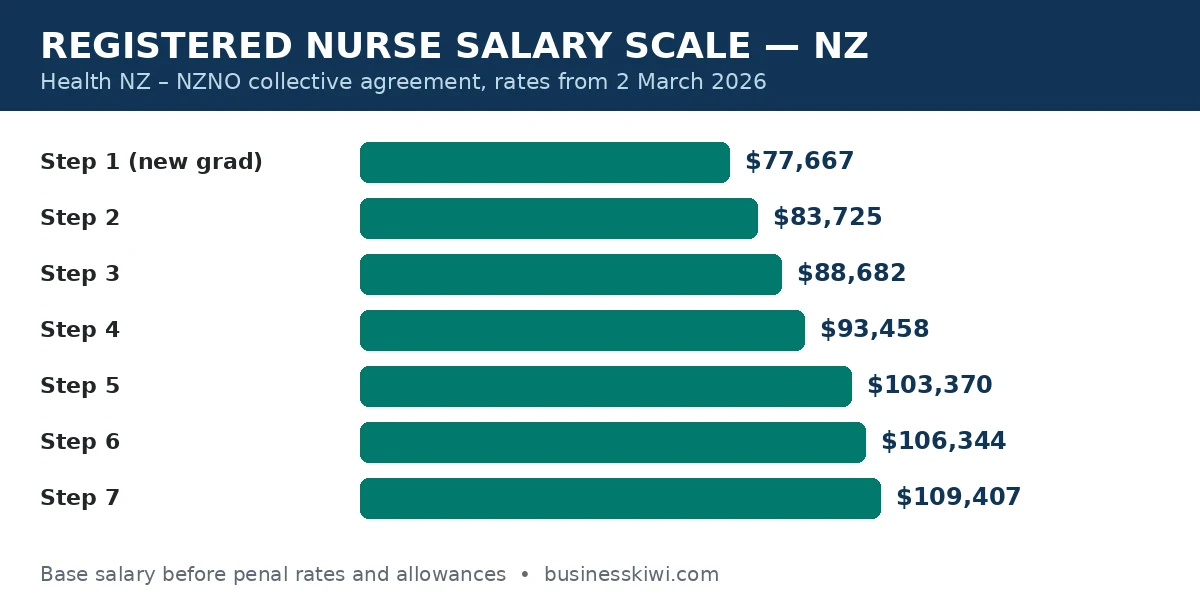
The collective agreement publishes annual salaries. Hourly equivalents are calculated on a standard 40-hour week (annual salary ÷ 2,080 hours) and are provided as a guide for comparing with hourly-paid roles.
Before March 2026, the same scale ran from $75,773 (step 1) to $106,739 (step 7). You may still see those figures, or Health New Zealand’s rounded summary of “$75,000 to $106,000”, in older job advertisements and articles. They are the previous rates, not errors.
For context, Tahatū (the Careers New Zealand platform) puts typical registered nurse pay at around $76,000 at the lower end, $83,000 to $99,000 as the most common range, and $107,000 at the upper end. Those bands cover nurses across all employers and settings, including penal-rate earnings in some roles, which is why they do not line up exactly with the public hospital base scale above.
How RN pay steps work
Nurse pay in the public system is not negotiated individually. When you are appointed, the employer places you on the step that matches your recognised experience, qualifications and the requirements of the position. A new graduate starts at step 1, which is why “new grad nurse salary NZ” searches return the step 1 figure of $77,667.
From there, progression is largely automatic:
- Steps 1 to 5 are reached by annual increment on the anniversary of your employment, provided your performance is satisfactory.
- Progression beyond step 5 is also annual, and satisfactory performance is assumed unless you are formally advised otherwise.
- Moving into a designated senior nurse role, or becoming a nurse practitioner, moves you onto a different and higher scale. That is a change of role, not just a step.
Two practical points follow from this. First, an experienced nurse joining Health NZ from another employer should have their previous service assessed at appointment, because starting on step 4 instead of step 2 is worth roughly $10,000 a year. Second, because most of the scale is climbed in the first five to six years, long-serving nurses at step 7 rely on collective agreement increases, penal rates, allowances and promotion into senior roles for further pay growth.
Enrolled nurses, senior nurses and nurse practitioners
Not every nurse is on the RN scale. The collective agreement sets separate scales for each scope of practice.
Enrolled nurses (ENs) work under the direction and delegation of a registered nurse and are paid on a five-step scale. From 2 March 2026, enrolled nurses earn from $71,682 at step 1 to $87,433 at step 5. The step 5 rate includes a $2,000 scale adjustment, on top of the general 2.5% increase, recognising the enrolled nurse scope of practice. Enrolled nursing is also a genuine pathway into the profession: many ENs later complete a Bachelor of Nursing and move onto the RN scale.
Designated senior nurses, roles such as clinical nurse specialists, nurse educators, charge nurses and nurse managers, are paid on designated senior nurse grades in the collective agreement, starting from $116,876 a year, with nurse practitioners on a separate scale from $140,235 to $166,872.
Nurse practitioners (NPs) are the highest-paid nursing scope in the agreement. Nurse practitioners are registered nurses with a master’s degree and advanced clinical training who can assess, diagnose and prescribe. From 2 March 2026 they earn between $140,235 and $166,872 a year, rising to $170,209 at the top step from March 2027.
Public hospitals, primary care, private sector and aged care
Health New Zealand is the largest employer of nurses, and its collective agreement sets the benchmark most other employers are measured against. Pay elsewhere works differently:
- Primary care (GP practices and community providers): Practice nurses are commonly covered by the NZNO Primary Health Care Multi-Employer Collective Agreement. That agreement expresses pay hourly rather than as an annual salary: from 1 July 2026, registered nurse steps run from about $35 per hour at step 1 to about $51 per hour at step 7, which is broadly comparable to, but structured differently from, the hospital scale.
- Private hospitals and clinics: Private providers set pay under their own collective or individual agreements. Many track the public scale closely because they compete for the same nurses, but there is no single national private rate, and allowances and penal rates vary.
- Aged residential care: Aged-care nurses are covered by separate agreements and pay varies by provider. Because rates differ between employers and are updated through separate bargaining, check the specific agreement attached to any aged-care role rather than assuming the hospital scale applies.
Wherever you work, the figure that matters is the step and rate written into your own employment agreement; headline salary ranges in job ads and practice websites do not always distinguish base pay from penal-inclusive earnings, and private and aged-care rates change on a different cycle from the public scale.
Penal rates, overtime and allowances
Base salary is only part of what a rostered nurse takes home. Under the Health NZ–NZNO agreement, penal rates are paid in addition to the ordinary hourly rate:
- Weekends: time one half (an extra 0.5× the hourly rate) for ordinary hours worked across the weekend period.
- Public holidays: time one (an extra 1.0× the hourly rate) for hours worked on the holiday.
- Nights: quarter time (an extra 0.25× the hourly rate) for ordinary hours worked during the defined night period.
Overtime and penal rates are not both paid on the same hours. The higher rate applies. Nurses who are rostered on call receive an on-call allowance ($8.60 per hour under the Health NZ agreement from 2 March 2026), and nurses who have worked a late shift can be called back if needed: check your agreement to see the recall allowance that applies, which is subject to a minimum payment of three hours at the single applicable rate.
Qualifications and registration
To work as a registered nurse in New Zealand you must be registered with the Nursing Council of New Zealand and hold a current annual practising certificate (APC). The usual route for New Zealand-trained nurses is:
- Complete a Bachelor of Nursing at an approved tertiary provider: Tahatū lists nursing training at three to five years, with the bachelor’s degree itself taking three years.
- Meet the Nursing Council’s requirements for registration, including its competence and fitness standards.
- Apply for registration and an annual practising certificate, and keep the APC current while you practise.
Internationally qualified nurses follow a Nursing Council assessment process instead; Health New Zealand points overseas nurses to the Council’s self-assessment tool as the first step. The Council also needs to be satisfied that internationally qualified applicants can communicate effectively in English, which is usually shown through an English language test such as IELTS, although waivers can apply where earlier registration in countries such as the United Kingdom, Ireland, Canada, the United States or Singapore already required an English test.
Enrolled nurses complete a diploma-level qualification (the New Zealand Diploma in Enrolled Nursing) and register in the enrolled nurse scope. Nurse practitioners must first be experienced registered nurses, then complete a master’s degree with a prescribing practicum and register in the nurse practitioner scope.
Career progression
A nursing career in New Zealand has several distinct pay levels, which is why “nurse salary NZ” has such a wide range:
- Enrolled nurse ($71,682–$87,433): diploma-qualified, working under RN direction and delegation.
- Registered nurse ($77,667–$109,407): degree-qualified, progressing through steps 1–7 with experience.
- Senior and designated roles (from $116,876): clinical nurse specialist, nurse educator, charge nurse, clinical nurse manager and similar positions, often supported by postgraduate study and a professional development recognition programme (PDRP).
- Nurse practitioner ($140,235–$166,872): master’s-qualified advanced practice role with prescribing rights.
Alongside vertical progression, registered nurses can specialise: emergency, intensive care, theatre, mental health and other areas, and many move into education and service leadership roles. Those who manage people as well as clinical work are covered in our guide to healthcare management jobs in New Zealand, and for a crossover/public-sector comparison, our guide to teacher salary NZ covers what beginning teachers earn and how their scale progresses.
Job outlook for nurses in NZ
Tahatū lists around 32,000 people employed as registered nurses in New Zealand, with employment change shown as steady. Nursing has featured on immigration and workforce shortage lists for years, and Health New Zealand recruits nurses continuously across hospitals and community services. Registered nurse roles in most specialities are also on Tier 1 of the Green List, which reflects ongoing demand rather than a short-term spike.
The realistic picture is that demand is strongest for experienced nurses and in areas such as aged care, mental health and rural services, while new graduates compete for a limited number of entry-level (NETP) places in some regions. Pay itself is set nationally, so location affects your chances of getting a role more than it affects the rate you are paid.
Nurse salary NZ FAQs
What is the starting salary for a new graduate nurse in NZ?
A new graduate registered nurse starting at Health New Zealand begins on step 1 of the RN scale: $77,667 a year from 2 March 2026 (about $37.34 an hour on a 40-hour week). That is base salary. Penal rates for rostered weekend, night and public holiday work are paid on top. New graduates are usually employed through NETP (Nurse Entry to Practice) programmes in their first year.
How much do registered nurses earn per hour in NZ?
The collective agreement sets annual salaries rather than hourly rates. Converted on a 40-hour week, RN pay runs from about $37.34 an hour at step 1 to about $52.60 an hour at step 7, using the March 2026 rates. In primary care, where the NZNO Primary Health Care agreement does publish hourly rates, registered nurses earn about $35 to $51 an hour from 1 July 2026.
What is the highest nurse salary in NZ?
Within the Health NZ–NZNO agreement, nurse practitioners sit at the top of the nursing scales, earning $140,235 to $166,872 a year from March 2026. Designated senior nurses in the highest grades also earn well above the standard RN scale, which tops out at $109,407. Executive nursing roles, such as directors of nursing, are usually on individual agreements outside these scales.
Do nurses get paid more for night shifts and weekends?
Yes. Penal rates are paid on top of the ordinary rate: an extra 0.5× for weekend hours, an extra 0.25× for night hours, and an extra 1.0× for public holiday hours worked. On-call and call-back payments apply on top of that again. A nurse working regular weekends and nights will therefore earn noticeably more than their base step salary suggests.
Is nurse pay the same across New Zealand?
For Health New Zealand employees, yes, the RN scale is national, so a step 5 nurse earns the same base salary in Invercargill as in Auckland. Pay only differs when you move to a different employer type, such as primary care, a private hospital or an aged-care provider, where separate agreements apply. Remember that all figures in this guide are before tax; you can estimate take-home pay with our NZ income tax calculator.
Sources
- Health New Zealand | Te Whatu Ora – NZNO Nursing and Midwifery Collective Agreement 2026–2027 (salary scales, clause 8.0; penal rates, clause 8.2.2; on-call allowance, clause 10.1): https://assets.nationbuilder.com/nzno/pages/4407/attachments/original/1777415243/20260422_NZNO_HNZ_CA_2026_Draft_Final_AW_review_%281%29.pdf?1777415243
- Tahatū Career Navigator (Careers New Zealand): Registered nurse profile, pay bands, training and employment numbers: https://tahatu.govt.nz/work/explore-career-ideas/occupation/T00454-registered-nurse
- Health New Zealand | Te Whatu Ora: Nurses careers and registration information: https://www.healthnz.govt.nz/careers/roles/clinical/nurses
- NZNO Primary Health Care Multi-Employer Collective Agreement 2026–2027 (hourly salary scales, clause 6.1): https://www.nzno.org.nz/Portals/0/Files/2026/2026_CA_DRAFT.pdf?ver=xOGaWklilXrJO_Ggvxde7w%3d%3d
- Health New Zealand registered nurse job listings quoting the RN scale (jobs.govt.nz): https://jobs.govt.nz/jobtools//jobs/Otago/HNZN03425
Pay figures are base salary rates from the collective agreements cited, before tax and before penal rates and allowances, and were checked in October 2026. Collective agreements are renegotiated over time, so confirm the current scale with the employer or union before relying on a specific figure.