Jewellery Insurance in NZ: Specified Items, Claim Limits and the Paperwork That Protects You
Most people in New Zealand do not buy a separate policy for their jewellery. Cover for rings, watches and other valuables usually sits inside a standard contents policy, and that is where the trouble starts. Contents policies place tight limits on jewellery that has not been individually listed, and those limits are often far lower than owners expect. A ring can be worth $12,000 and still be treated at claim time as if it were worth a small fraction of that.
This guide explains how jewellery cover actually works in New Zealand. It sets out the difference between unspecified and specified items, the real limits written into current policy wordings, what happens when you travel, and the records you need before a claim ever arises. Every figure below comes from an insurer’s own policy wording or official guidance, and each one is attributed to the insurer it belongs to.
The short answer
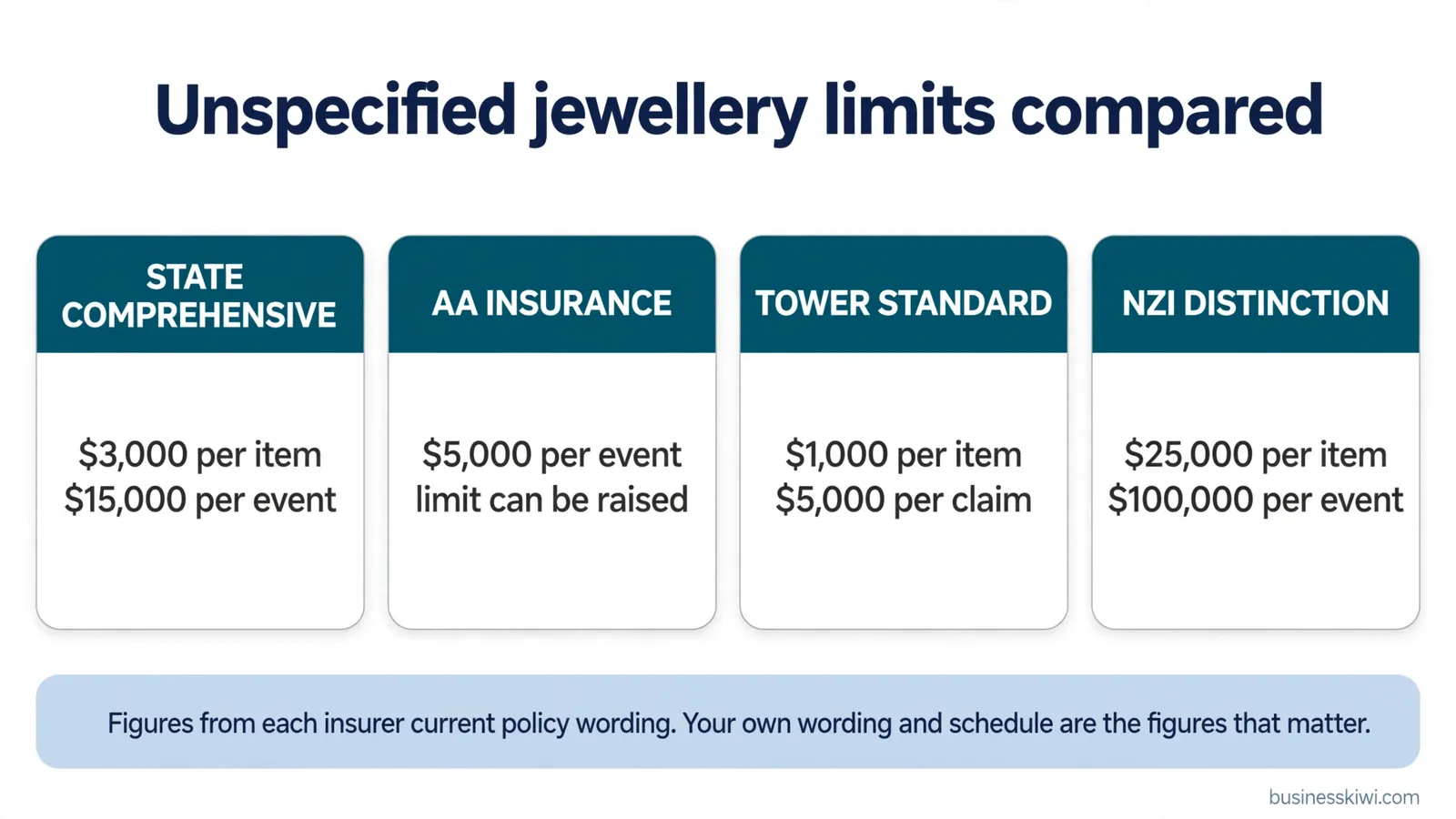
Jewellery is insured in New Zealand mainly through contents insurance. If a piece is not listed on your policy schedule, it is covered only up to a per item limit and a total limit for all jewellery in one event. Those limits vary widely between insurers and between cover levels. Under State’s Contents Comprehensive wording, an unspecified piece is capped at $3,000 per item and $15,000 in total per event. Under Tower’s Standard contents cover, the cap is just $1,000 per item and $5,000 in total per claim.
The one mistake that costs owners the most is assuming the full contents sum insured applies to their jewellery. It does not. The Insurance and Financial Services Ombudsman (IFSO) has dealt with case after case where a claim was settled at a low unspecified limit because the item was never listed. In one case the IFSO describes, a stolen watch was valued by a jeweller at $6,375 after the loss, but the insurer paid $3,000, the policy limit for items that had not been specified. The fix is simple. Get valuable pieces valued, list them on the schedule, and keep the paperwork.
Cover under a contents policy: unspecified versus specified
A contents policy covers sudden and accidental loss to your belongings. Jewellery falls inside that cover, but it is fenced in by its own limits. There are two ways a piece can sit on your policy.
Unspecified jewellery is everything you have not told your insurer about individually. It is covered automatically as part of your contents, subject to a limit per item and a limit for all jewellery and watches combined in a single event. If the loss is bigger than those limits, the limits are what you get.
Specified items are pieces you have named on your policy schedule with an agreed value for each one. State, NZI and Tower all describe the same basic rule in their wordings: the most the insurer will pay for a specified item is the sum insured recorded for it on the schedule. Specifying usually costs extra premium, because the insurer is taking on a known, larger risk. Tower’s wording adds a point worth noting: specified items sit in addition to your contents sum insured, rather than eating into it.
Specifying is not only about the amount. It also fixes the value argument before anything goes wrong. The insurer has accepted the item and its value in advance, so a claim starts from the agreed figure instead of a debate after the loss.
The limits in real policy wordings
Limits differ so much between policies that there is no honest single figure for the market. Read these as examples from current wordings, not as a standard.
- State Contents Comprehensive (IAG): $3,000 per item of jewellery or watch that is not specified, and $15,000 in total for all unspecified jewellery and watches in one event. The schedule can record a different maximum if you arrange one. State’s own example shows ten pieces worth $2,000 each producing a $20,000 loss and a payment of $15,000, less the excess.
- AA Insurance Contents: AA works with an adjustable event limit rather than a per item cap. Its help pages set the standard limit for jewellery including watches at $5,000 per event, or $2,500 under its Limited Contents cover. AA says the limit can be raised if you contact them, although some other items carry fixed limits in the policy document that cannot be adjusted.
- Tower Standard contents: $1,000 per item of jewellery including watches, and $5,000 in total for all jewellery per claim. Tower’s Plus cover raises those figures to $2,500 per item and $15,000 in total, and its Premium cover to $10,000 per item and $30,000 in total. Tower allows you to specify jewellery items or sets worth over $1,000.
- NZI Distinction Contents: a premium wording with much higher built in limits. Unspecified jewellery is capped at $25,000 per item and $100,000 in total per event.
The spread is the lesson. Two households can both say they have contents insurance and have jewellery cover that differs by tens of thousands of dollars. The only figure that matters is the one in your own wording and schedule.
Standalone jewellery insurance
The insurers whose wordings were reviewed for this guide do not sell jewellery cover as a separate retail policy. In New Zealand, jewellery protection is built inside contents insurance, and the specified item mechanism is the tool for valuable pieces. A small number of owners with very high value collections may arrange tailored cover through a broker, but for most households the practical choice is not between two products. It is between leaving jewellery unspecified inside a contents policy, or specifying it properly at agreed values.
Specifying makes sense when a single piece is worth more than your policy’s per item limit, when your total jewellery value passes the event limit, or when you travel with valuable pieces and need the wider cover some wordings attach to specified items. If everything you own sits comfortably under both limits, unspecified cover may be enough, but check the limits first rather than guessing.
What is covered and what is not
Theft and burglary. Contents wordings cover sudden and accidental loss, which includes theft. One NZI Distinction rule deserves attention. For burglary or theft, NZI caps the total paid for all jewellery and watches, specified and unspecified together, at $100,000 per event. That cap does not apply if the pieces were locked in a safe meeting the EN 1143-1:2019 standard and fixed to the building, stored in a bank safe deposit box, being worn or carried by you, or inside a home while you or a family member were physically inside it.
Accidental loss and damage away from home. NZI Distinction covers contents while temporarily away from home within New Zealand. Tower’s Standard cover is narrower: its wording insures contents for loss at your house, with accidental damage away from home limited under its higher cover levels. Where you wear your jewellery matters, so check whether your wording follows you out the door.
Overseas travel. This is where wordings split sharply. State’s standard overseas benefit covers jewellery and other personal items only in Australia and the South Pacific Islands, only on trips of no more than three weeks, and only up to $5,000 per trip. State also offers an optional worldwide benefit for specified jewellery and watches. It covers travel anywhere in the world for any trip length, costs extra premium, and the item must be specified even if it is worth $3,000 or less. NZI Distinction covers jewellery taken overseas anywhere in the world on trips of up to 90 days. A specified item with a sum insured over $350,000 is capped at $350,000 while overseas unless NZI was told in advance and agreed in writing to cover the full amount.
Wear and tear. No wording reviewed covers it. State excludes gradual damage, including wear and tear, and Tower lists wear and tear among its exclusions. The IFSO gives a sobering example. A woman’s claim for a ruby lost from her wedding ring was declined because the ring’s claws had worn down over 42 years of daily wear. Worn settings, thinning bands and loose stones are maintenance issues, not insured events.
Unexplained disappearance. A claim still needs an event. The IFSO describes travel claims declined where the owner could show no evidence that anything unexpected had happened to the jewellery. If a piece simply cannot be found and you cannot point to any loss event at all, expect hard questions, because the onus is on you to show a covered loss occurred.
Valuations: the document that does the heavy lifting
A valuation is a written assessment of a piece by a jeweller or valuer. It records what the item is, its materials and stones, its condition, and what it would cost to replace. Insurers use it to set a specified sum insured, and the IFSO treats a recent valuation as some of the strongest evidence you can hold.
The IFSO’s advice is to obtain regular valuations for high value items such as jewellery and keep them somewhere safe. Values move with gold prices, exchange rates and gemstone markets, so an old valuation can leave you under insured even if the cover was right when you took it out. State and NZI both warn in their wordings that specified sums insured are not reviewed or increased by the insurer at renewal. The value stays exactly where you set it until you ask for a change. If replacement costs have risen and you have not updated the schedule, the gap is yours.
A valuation also matters for pieces you did not buy. Inherited jewellery and gifts come with no receipt, so a valuation may be the only solid record of what you own and what it is worth.

Proving ownership at claim time
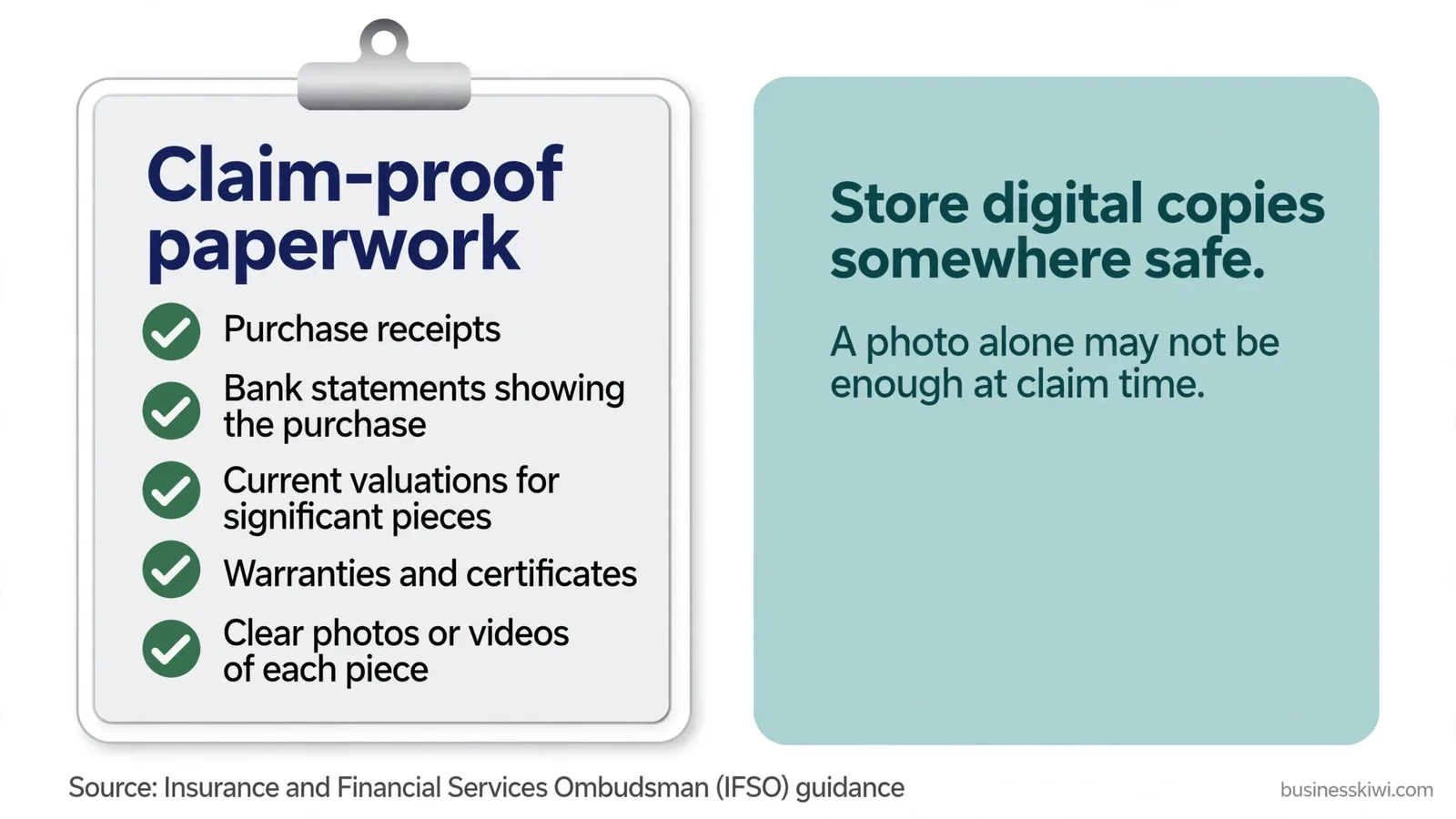
Insurers are entitled to ask you to prove that you owned what you are claiming for. The IFSO lists the kinds of proof insurers may require: purchase receipts, bank statements showing the purchase, valuations for jewellery and other high value items, warranties, and photographs or videos of the items.
Photographs help, but on their own they may not be enough. The IFSO publishes a case in which a woman’s only evidence for stolen jewellery was a photograph of herself wearing it. A report she arranged after the loss valued the jewellery at close to $57,000. With no better proof of ownership, the insurer had discretion over the settlement and offered about $27,000. The IFSO considered that outcome fair. The gap between those two figures is the price of thin paperwork.
Build the file before you need it. Keep receipts or photograph them and store copies digitally. Save online purchase confirmations. Photograph each valuable piece clearly, and hold a current valuation for anything significant. If you genuinely have no proof for an item, the IFSO says to tell your insurer why. The insurer then decides how that affects the claim, and a failure to meet proof obligations can see a claim declined.
Making a claim, step by step
State’s wording sets out the steps its policyholders must take, and they are typical of the market.
- Do what you can to protect the property and prevent further loss.
- Tell your insurer as soon as possible.
- Report it to the police promptly if an illegal act, such as theft or burglary, is involved.
- Keep anything that forms part of the claim, including damaged items.
- Let the insurer or its assessor inspect the property before repairs begin.
- Send through the documents and information the insurer asks for, such as receipts and valuations.
Tower’s claims guidance follows the same shape: make sure people and property are safe, call the police if needed, photograph damage if you can, gather your documents, and lodge the claim online or by phone. If you disagree with the outcome, you can use your insurer’s internal complaints process, and then take the dispute to the IFSO, which investigates for free.
Excesses on jewellery claims
An excess is the first part of a claim that you pay yourself. State’s wording says the excess shown on your schedule is deducted from your settlement for each incident, and if one incident touches several benefits, only the highest applicable excess is deducted. NZI Distinction works the same way: one excess per claim, and only the highest if several benefits are involved. Tower also promotes a one event, one excess approach. For small jewellery losses, the excess can swallow much of the payment, which is worth weighing before you claim for a minor loss that might also affect your claims history.
Keeping cover current
Jewellery cover drifts out of date quietly. Pieces are bought, inherited and given as gifts, and values move while the schedule stays still. The IFSO advises discussing specification with your insurer when you take out the policy, during the term if your circumstances change, and at renewal. Insurers often ask for a recent professional valuation for specified items and may ask for updated valuations over time.
Three habits keep cover honest. Tell your insurer when you acquire a valuable piece, rather than waiting for renewal. Refresh valuations on your significant items regularly. And read the renewal schedule each year, remembering that specified values stay frozen unless you change them.
Watch-outs
- Under insurance by default. The biggest risk is not having no cover. It is having cover with limits far below the value of what you own.
- The single item limit discovered too late. Owners usually meet the per item cap for the first time in a claim letter. Check yours today.
- Frozen specified values. A specified sum set years ago may no longer replace the piece. The insurer will not lift it for you.
- Travel limits. A policy that covers you at home may cover you overseas only in limited places, for limited days, or not at all for unspecified pieces.
- Wear and tear. A stone lost because its setting wore out is not an insured event. Have settings checked, especially on rings worn daily.
- Thin proof. A photograph alone may leave the insurer free to set the settlement. Receipts and valuations close that gap.
Insuring the house itself is a separate policy: our house insurance guide explains building cover. For more money guides, browse the Finance section.
Frequently asked questions
Is jewellery covered by contents insurance in NZ?
Yes, jewellery is covered as part of contents insurance, but only within set limits. State caps unspecified jewellery at $3,000 per item and $15,000 per event. Tower’s Standard cover caps it at $1,000 per item and $5,000 per claim. Check your own wording, because limits differ widely.
What does it mean to specify a piece of jewellery?
Specifying means listing the item individually on your policy schedule with an agreed value. The most the insurer will pay for that item is the sum insured recorded for it. You normally pay extra premium, and Tower notes that specified items sit in addition to your contents sum insured.
Do I need a valuation to insure jewellery?
A current valuation is the strongest way to support both the specified value and a later claim. The IFSO advises regular valuations for high value jewellery. For inherited pieces or gifts with no receipt, a valuation may be the only real evidence of ownership and worth.
Is my jewellery covered overseas?
It depends on the wording. State’s standard benefit covers trips to Australia and the South Pacific of up to three weeks, capped at $5,000 per trip, with an optional worldwide benefit for specified items. NZI Distinction covers trips anywhere in the world for up to 90 days. Many owners are covered for far less travel than they assume.
What proof do I need if my jewellery is stolen?
Insurers can ask for receipts, bank statements showing the purchase, valuations, warranties, or photographs and videos. The IFSO warns that photographs alone may not be enough. Without reasonable proof, an insurer may settle for less or decline the claim.
Does jewellery insurance cover wear and tear?
No. The wordings reviewed exclude wear and tear and gradual damage. The IFSO describes a claim for a ruby lost from a ring worn daily for 42 years being declined because the claws holding the stone had worn out.
What happens if my claim is declined?
Ask for a review through your insurer’s internal complaints process first. If you are still unhappy with the response, the IFSO can investigate your complaint for free.
The bottom line
Jewellery cover in New Zealand is real, but it is narrower than most owners think. The protection sits inside contents insurance, guarded by per item and per event limits that can be as low as $1,000 a piece. Valuable items need to be valued, specified on the schedule at a realistic figure, and backed by receipts and records you keep up to date. Do those three things and a claim becomes a paperwork exercise. Skip them, and you may learn your policy’s limits at the worst possible moment.
Sources
- State Insurance, Contents Comprehensive Insurance policy wording (SI6995/1, 03/24), IAG New Zealand
- NZI, Distinction Contents Insurance policy wording
- Tower, Contents Insurance Standard Cover policy wording, including the benefits comparison table
- AA Insurance, help article: What items do I need to specify on my contents policy?
- Insurance and Financial Services Ombudsman (IFSO), Value your jewellery? Check your insurance policy
- Insurance and Financial Services Ombudsman (IFSO), Lack of proof of ownership information page
- Insurance Council of New Zealand (ICNZ), Guide to Insurance for Renters, Flatters and Students
This article is general information about jewellery insurance in New Zealand. It is not personalised financial advice, and it does not recommend any insurer or policy. Policy wordings, limits and benefits change over time and differ between insurers, so read your own policy wording and schedule, and talk to your insurer or a licensed financial adviser before making decisions about your cover.