Jobs in Kaitaia: Working in the Far North and How to Find Work

Kaitaia is the main town of the northern Far North, the service centre for a wide farming district and the coastal settlements around Doubtless Bay, Ahipara and the Karikari Peninsula. If you are thinking about working there, whether you already live in the district, are weighing up a move north, or are looking for seasonal work, it helps to start with an honest picture. This is a small labour market. There is no single big employer and no deep bench of office jobs. Work clusters around the land, around public services such as health and education, and around the shops and services a rural town needs to function.
This guide sets out what official sources say about that labour market: the industries that dominate, the pay figures published nationally by Tahatū (the government’s careers service, formerly Careers New Zealand) for the main occupations, the official channels people use to find work, and the basics of your rights once you are in a job. Where a figure is national rather than local, the guide says so. Kaitaia-specific pay rates are not published by any official source, and no honest guide can invent them.
The Far North economy, and Kaitaia’s place in it
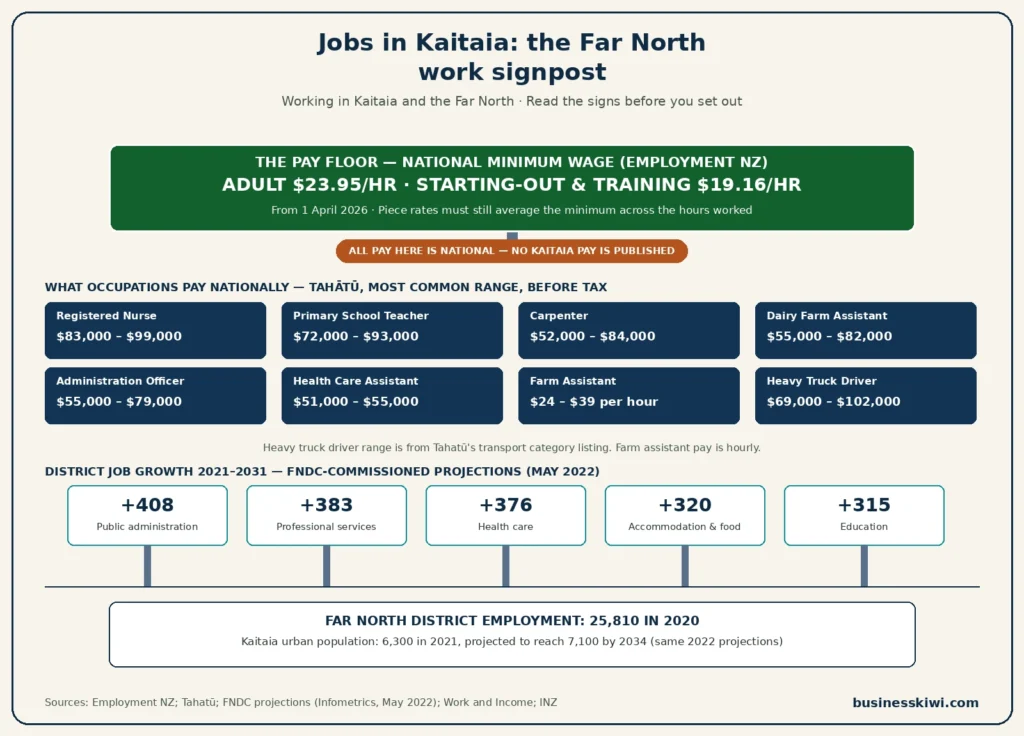
The Far North District is one of the largest districts in New Zealand by land area, and its people are spread across small towns and rural settlements rather than concentrated in one city. Kaitaia sits at the northern end of that pattern. A population projections report prepared for Far North District Council by Infometrics, published on the council’s website in May 2022, put the population of the Kaitaia urban area (the Kaitaia East and Kaitaia West statistical areas) at 6,300 in 2021, and projected it to reach 7,100 by 2034, with growth spilling over into Ahipara and Awanui.
The same report gives the clearest official picture of how the district earns its living. District employment grew steadily in the years before Covid-19, averaging 2.8 percent growth a year between 2014 and 2020 to reach 25,810 jobs, and the district did not record a fall in job numbers during the Covid disruption. For the years after that, the report forecast employment growth driven mainly by services. Its largest projected growth industries for 2021 to 2031 were public administration (408 additional jobs), professional services (383), health care (376), accommodation and food services (320) and education and training (315). Those are 2022-vintage projections, not guarantees, but they underline the shape of the district’s economy: services and the public sector growing, on top of a long-standing base in farming, forestry and fishing.
For a job seeker, that shape matters more than any headline. Kaitaia’s work is practical and place-based. Farms need staff in every season. The town’s health services, schools, council services, shops and trades firms employ steadily but in small numbers at a time, which means vacancies appear one or two at a time rather than in big intakes. Knowing that rhythm is the first step to finding work there.
Farming, horticulture and work on the land
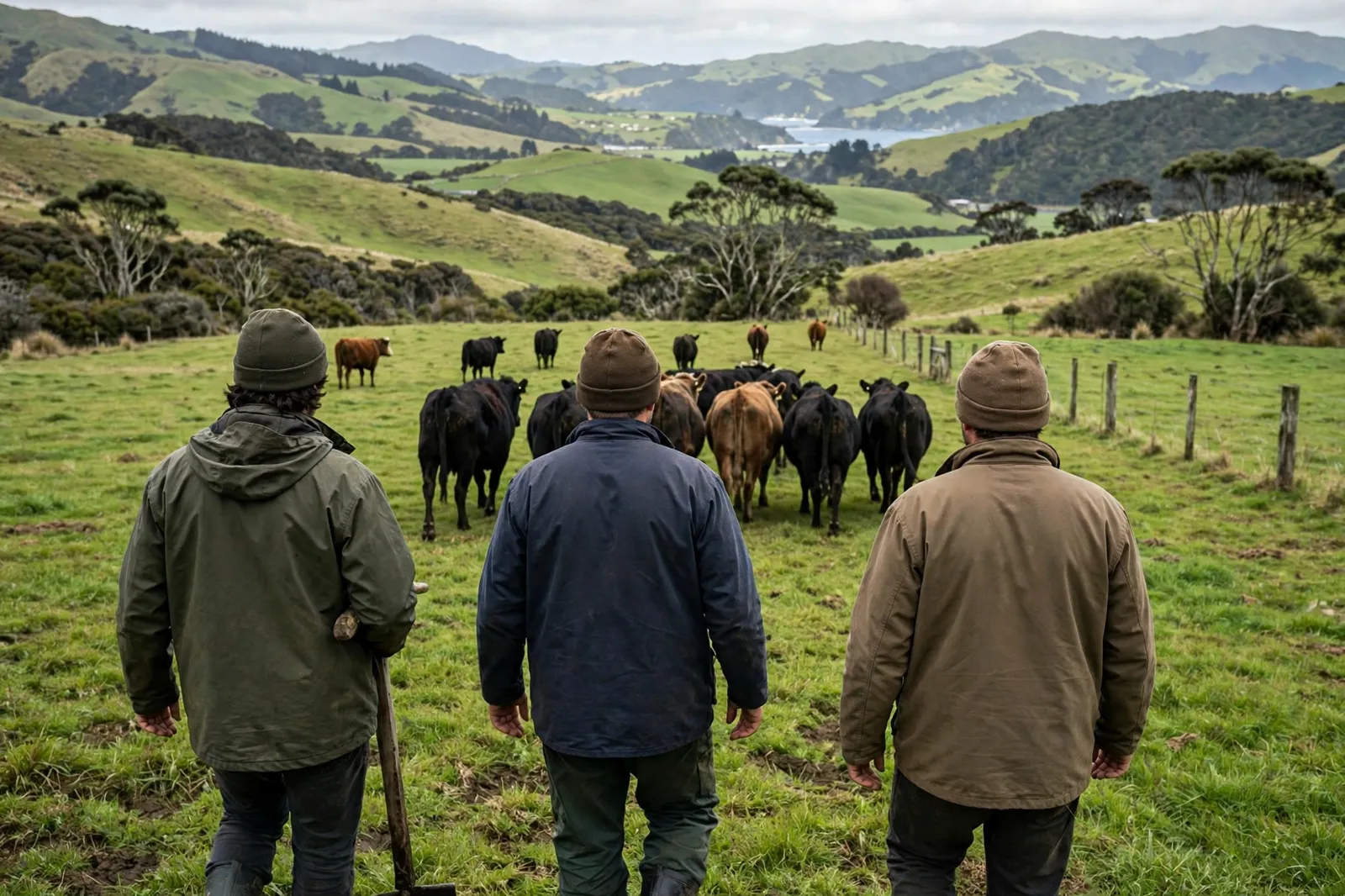
The land still underpins the northern Far North. Beef and sheep farming, dairying, forestry and horticulture occupy most of the country around Kaitaia, and farm work remains one of the most reliable entry points into the district’s labour market.
Tahatū’s farm assistant profile describes the general farmhand role: feeding and caring for stock, fencing, tractor and machinery work, and the day-to-day maintenance a farm always needs. Tahatū publishes the pay for farm assistants as an hourly range: $24 an hour at the lower end, $24 to $39 an hour as the most common range, and $51 an hour at the upper end. Those are national figures published by Tahatū, not Kaitaia rates, and experienced staff with machinery, fencing or stock skills sit higher in the range than new entrants. Tahatū puts the number of farm assistants employed nationally at about 15,000 and describes employment change in the occupation as steady.
Dairy farm assistants are a separate Tahatū occupation, covering milking, animal care, repairs and maintenance on dairy units. Tahatū publishes pay of $50,000 at the lower end, $55,000 to $82,000 as the most common range and $104,000 at the upper end, again as national figures, and notes that training typically takes under a year. Dairy work in the Far North follows the dairy calendar: calving in late winter and spring is the busiest and most physically demanding period, and farms commonly look for staff ahead of it.
Horticulture works to a different calendar again. Planting, crop care, harvest and packhouse work peak at different points in the year depending on the crop, so seasonal demand rises and falls rather than running evenly. The council-commissioned projections report noted horticultural zoning being expanded in parts of the district, which points to the sector’s continuing place in the local economy. If you are looking for seasonal work, the practical approach is to approach growers and packhouses before the season you are targeting, not after it has started.
Health care and social assistance
Health is one of the largest and most stable employers in any rural district, and the Far North is no exception. The district’s hospital and community health services, general practices, aged care providers and home support services all draw on the same small local workforce. Health care was one of the largest projected growth industries in the council-commissioned projections, with 376 additional jobs forecast across the district between 2021 and 2031.
Registered nurses are the backbone of that workforce. Tahatū publishes national pay for registered nurses of $76,000 at the lower end, $83,000 to $99,000 as the most common range and $107,000 at the upper end, before tax. It puts training at three to five years and the national nursing workforce at about 32,000, with employment change described as steady. Rural services work hard to recruit nurses, and the qualification is portable: a registered nurse can move between districts without retraining.
Health care assistants work alongside nurses in hospitals, aged care and community settings, helping with personal care, mobility and daily tasks. Tahatū puts national pay at $50,000 at the lower end, $51,000 to $55,000 as the most common range and $57,000 at the upper end, with training of under a year, and it describes employment in the occupation as showing a strong increase nationally. For people entering the health workforce without a degree, it is the most common first step, and experience in the role is a recognised pathway toward further training.
Education
Every settlement in the northern Far North has a school, and together the district’s primary and secondary schools, kura and early childhood services form a steady block of employment. Education and training was another of the larger projected growth industries in the council-commissioned projections, at 315 additional jobs between 2021 and 2031.
Primary school teachers are the largest single teaching group. Tahatū publishes national pay of $61,000 at the lower end, $72,000 to $93,000 as the most common range and $103,000 at the upper end, and puts the national workforce at about 31,000 with employment change steady. Teaching is a registered profession, so entry runs through an approved teaching qualification and registration, and rural schools can be an accessible first posting for new graduates as well as a deliberate lifestyle move for experienced teachers.
Around the teachers sits a wider education workforce: teacher aides, administrators, caretakers, cleaners and early childhood staff. These roles are seldom advertised in large numbers, which is why the direct approach described later in this guide matters so much in this sector.
Retail, hospitality and tourism
Kaitaia’s shops, supermarkets, cafés and accommodation providers serve two markets at once: the local population year-round, and visitors moving through the Far North in the warmer months. Doubtless Bay, Ahipara and the road north to Cape Reinga draw steady visitor traffic, and the council-commissioned projections describe dwellings in coastal areas such as Doubtless Bay greatly outnumbering households, reflecting the prevalence of holiday houses. That pattern supports seasonal work in hospitality, cleaning and property services on top of the year-round retail base.
The projections put accommodation and food services among the district’s largest growth industries, with 320 additional jobs forecast between 2021 and 2031. In practice, retail and hospitality roles in Kaitaia are often part-time or casual, hours expand over summer, and employers frequently hire through walk-ins and word of mouth. Tahatū does not publish a Far North rate for these occupations, and this guide does not quote one: the floor for any such job is the minimum wage covered later in this guide, and the actual rate is a question to ask the employer directly.
Construction and trades
Building work in the Far North is mostly small-scale: new homes, farm buildings, renovations and maintenance rather than large commercial projects. Carpenters are the core trade. Tahatū publishes national pay for carpenters of $50,000 at the lower end, $52,000 to $84,000 as the most common range and $103,000 at the upper end, and describes employment in the occupation as increasing nationally. Training takes three to four years, usually through an apprenticeship that combines on-the-job work with block courses.
That apprenticeship route matters in a district like this one. A qualified carpenter in the Far North can choose between employment with a local builder and self-employment, and the projections picture of continued population growth in the Kaitaia urban area supports ongoing demand for housing work. Around carpentry sit the other trades a rural town needs: electricians, plumbers, drainlayers, mechanics and engineers servicing farm and forestry machinery. Numbers in each trade are small, so training providers and employers both tend to recruit locally and personally.
Public services and administration
Public administration was the single largest projected growth industry in the council-commissioned projections, at 408 additional jobs across the district between 2021 and 2031. The Far North District Council itself, government agency offices, courts, police and community services all maintain a presence in Kaitaia, and each of them needs administrative staff to function.
Administration officers are the generalists of that world: scheduling, files, records, front-desk and customer work. Tahatū publishes national pay of $50,000 at the lower end, $55,000 to $79,000 as the most common range and $99,000 at the upper end, and puts the national workforce at about 69,000 with employment change steady. Because administration skills transfer between employers, these roles are often the most contested in town when they do come up, and they reward local knowledge and reliability.
Transport and driving work
A district this spread out runs on road transport. Stock trucks, logging and forestry haulage, freight, fuel, couriers and school and community transport all pass through Kaitaia, and driving work is a recurring feature of the local job market. Tahatū publishes national pay for heavy truck drivers as a range of $69,000 to $102,000 a year, and notes that getting into the occupation typically takes under a year, centred on gaining the right licence classes and experience. As with every figure in this guide, that is a national range published by Tahatū, not a Far North rate: pay varies with licence class, the type of unit driven and whether the work is local or long-haul.
What the work pays
It is worth gathering the pay picture in one place, with the warning attached to all of it. Tahatū publishes pay nationally, by occupation. It does not publish a Kaitaia rate for any occupation, and neither does any other official source. Treat the figures below as national benchmarks published by Tahatū, before tax, to test a job offer against, not as a promise of what a Far North employer will pay.
Farm assistants are paid hourly in Tahatū’s data: $24 an hour at the lower end, a most common range of $24 to $39 an hour, and $51 an hour at the upper end. Dairy farm assistants: $50,000 at the lower end, $55,000 to $82,000 most commonly, and $104,000 at the upper end. Registered nurses: $76,000 at the lower end, $83,000 to $99,000 most commonly, and $107,000 at the upper end. Health care assistants: $50,000 at the lower end, $51,000 to $55,000 most commonly, and $57,000 at the upper end. Primary school teachers: $61,000 at the lower end, $72,000 to $93,000 most commonly, and $103,000 at the upper end. Carpenters: $50,000 at the lower end, $52,000 to $84,000 most commonly, and $103,000 at the upper end. Administration officers: $50,000 at the lower end, $55,000 to $79,000 most commonly, and $99,000 at the upper end. Heavy truck drivers: a published range of $69,000 to $102,000 a year.
Tahatū also publishes the outlook it sees for each occupation, and two stand out for this district: it describes employment change for health care assistants as a strong increase nationally, and employment for carpenters as increasing, while it describes nursing, primary teaching and administration as steady. Outlooks are national descriptions, not local forecasts, but they are a reasonable guide to which skills are broadly in demand.
How people actually find work in Kaitaia
In a labour market this small, method matters as much as qualifications. Tahatū’s job search guidance makes a point that fits Kaitaia exactly: many jobs are never advertised at all. Its advice is to build the search in steps. Start by working out your strengths and skills so you can describe them clearly. Get a current CV ready, and tailor a short cover letter to each job rather than sending the same one everywhere. Prepare for interviews before you are called to one. And tidy your social media, because employers commonly look applicants up online and your profiles should only show what you would be happy for an employer to see.
From there, Tahatū points job seekers at several channels at once: vacancy websites, employers’ own websites, local newspapers, industry events and job expos, and direct contact with employers you would like to work for. In Kaitaia that direct channel carries unusual weight. The guide’s networking advice is to talk to everyone you know: friends and whānau, previous employers and colleagues, and local business people. It also suggests asking an employer for a meeting or a kōrero even when no vacancy is advertised, or sending your CV with a cover letter explaining the work you are looking for. In a town where the farm supplier, the school principal and the café owner all know each other, that approach is not pushy. It is how hiring often happens.
Work and Income is the other official channel. Its MyMSD Jobs service lets you search and apply for jobs online at any time: you choose a CV to send with your application, answer questions about references and pre-employment checks, and submit. Work and Income staff review applications and, where they judge an applicant a good fit, add them to a short list that goes to the employer, who then makes contact about next steps. Work and Income can also support people who are between jobs, so if you have lost work or your hours have been cut, it is worth talking to them early rather than waiting.
If a health condition or disability makes job hunting harder, Tahatū points to Workbridge, which offers free support with job searching and interviews. Tahatū’s free Job Hunters’ Workbook is also worth downloading: it works through the practical steps of a job search as a set of activities.
Seasonal work and the RSE scheme
Seasonal horticulture work in New Zealand sits partly inside a formal national scheme. Immigration New Zealand describes the Recognised Seasonal Employer (RSE) scheme as a way for approved employers to recruit seasonal workers from Pacific countries, including Samoa, Tonga, Vanuatu, the Solomon Islands, Fiji, Kiribati, Tuvalu and Papua New Guinea, when there are not enough local workers available. The scheme supports the horticulture and viticulture industries, and employers under it must provide the work itself plus pastoral care, accommodation and return travel for their workers. Research released by Immigration New Zealand in November 2025 found many RSE employers also voluntarily support workers’ goals in their home communities, well beyond what the scheme requires.
For New Zealanders, the RSE scheme’s significance is simpler: it is the formal structure behind a large share of seasonal harvest and packhouse employment nationally, and it exists because seasonal peaks genuinely outrun the local workforce. If you are a local looking for seasonal work, you are not competing with the scheme so much as working alongside it, and growers still recruit locally first for many roles. Either way, seasonal work should still come with a proper employment agreement and at least the minimum wage, covered next.
Your rights at work
Whatever the job, the same legal floor applies in Kaitaia as in Auckland. Employment New Zealand publishes the minimum wage rates, and from 1 April 2026 they are $23.95 an hour for adult workers and $19.16 an hour for starting-out and training workers. No employer can pay less than the rate that applies to you, whatever the job or the season.
Farm and harvest work is often paid by piece rates, a set amount per bin, tray or row. Employment New Zealand is clear that piece rates do not override the minimum wage: across the hours you work, your pay must still come to at least the minimum wage for each hour, and your employer must top it up if the piece rate falls short. Keep your own record of hours and output so you can check.
Every employee must have a written employment agreement. Get it before you start, read it, and keep a copy. Farm roles sometimes include accommodation or board as part of the package. Employment New Zealand publishes the default deductions an employer can make where there is no written agreement covering it: 15 percent of your pay for board and 5 percent for lodging. If accommodation is part of your arrangement, make sure what is being deducted, and why, is written down in your agreement.
Moving to Kaitaia for work: practical notes
Relocating to the Far North for work is a bigger decision than the job itself, so treat it as two projects: landing the work, and setting up a life at the top of the country.
Line up work first wherever you can. The channels above all work at a distance: MyMSD Jobs applications are online, Tahatū’s guidance and workbook are online, and employers in small towns are used to an introductory phone call or a CV arriving by email before a meeting in person. A short trip to meet employers face to face, timed before a season or a school term, is money well spent.
Think about timing. Farm recruitment builds before calving and before harvest and planting peaks. School roles follow the school year. Hospitality hours build toward summer. Arriving just before the relevant peak, with work already arranged, is a very different experience from arriving in the quiet months and hoping.
Plan for distance and transport. Kaitaia serves a large rural catchment, and many jobs, particularly farm work and shift work in health, sit outside the town itself. A full driver’s licence and reliable transport are close to essential for most roles, and some farm positions come with accommodation on the farm as part of the package, which should be covered in your written agreement as described above. Arrange your own accommodation before you arrive if the job does not include it, and do not sign up for housing costs until you have seen the property and have the work confirmed.
Finally, be realistic about the trade-off and clear-eyed about the upside. The Far North labour market is small, pay benchmarks are national rather than local, and you will not find the depth of choice a city offers. What it does offer is steady demand in essential work, employers who hire on reputation and reliability, and a district where the main growth areas, health, education, public services and the land, are the ones that do not disappear in a downturn.
Frequently asked questions
What are the main industries in Kaitaia?
Official projections prepared for Far North District Council describe a district economy built on farming, forestry and fishing, with employment growth driven by services. The largest projected growth industries for 2021 to 2031 were public administration, professional services, health care, accommodation and food services, and education and training. In Kaitaia itself, most work sits in farming and horticulture, health, education, retail and hospitality, construction and the trades, public services and transport.
How much do jobs in Kaitaia pay?
No official source publishes Kaitaia-specific pay rates. Tahatū publishes national pay ranges by occupation, and those are the benchmarks used in this guide: farm assistants $24 to $39 an hour at the most common range, registered nurses most commonly $83,000 to $99,000, carpenters most commonly $52,000 to $84,000, all before tax. Any job must pay at least the minimum wage, which is $23.95 an hour for adults from 1 April 2026.
Do I need qualifications to get farm work around Kaitaia?
Not for entry-level roles. Tahatū puts the training for a dairy farm assistant at under a year, and farm assistant work is generally learned on the job. Practical skills carry weight in this district: stock handling, fencing, tractor driving and a full driver’s licence all make you more employable, and experience is the main route into the higher end of Tahatū’s published pay ranges.
How do I find a job in Kaitaia?
Use several channels at once. Search and apply through Work and Income’s MyMSD Jobs service, check employers’ own websites, and follow Tahatū’s advice to approach employers directly and use your networks, because many jobs in a small town are never advertised. Have a current CV ready, tailor your cover letter to each role, and be ready for an informal kōrero as much as a formal interview.
Is there seasonal work in the Far North?
Yes. Horticulture and farming work peaks at different times of year depending on the crop and the farming calendar, with dairy calving in late winter and spring and harvest and packhouse work at other points in the year. Some seasonal horticulture employment sits inside the Recognised Seasonal Employer scheme described by Immigration New Zealand, which brings Pacific workers in when there are not enough local workers, and growers also recruit locally. Approach growers and packhouses before the season starts.
Can Work and Income help me find work in Kaitaia?
Yes. Through MyMSD Jobs you can search and apply for jobs online at any time. Work and Income staff review applications and pass a short list of suitable applicants to the employer. Work and Income can also support people who are between jobs, so it is worth contacting them early if you have lost work.
What is the minimum wage in New Zealand?
Employment New Zealand publishes the rates. From 1 April 2026 the adult minimum wage is $23.95 an hour and the starting-out and training rates are $19.16 an hour. Piece rates for harvest and farm work must still average out to at least the minimum wage across the hours worked.
Sources
- Employment New Zealand, “Minimum wage rates and types”, employment.govt.nz (minimum wage rates from 1 April 2026, piece rate rules, board and lodging deduction defaults).
- Tahatū Career Navigator, occupation profiles: Farm Assistant; Dairy Farm Assistant; Registered Nurse; Health Care Assistant; Primary School Teacher; Carpenter; Administration Officer; Taxi Driver (Road and rail transport category, including the Heavy Truck Driver profile), tahatu.govt.nz. All pay figures are national figures published by Tahatū, before tax.
- Tahatū Career Navigator, “How to look for a job”, tahatu.govt.nz (job search steps, CV and cover letter guidance, networking, Workbridge, Job Hunters’ Workbook).
- Work and Income, “Find jobs” and MyMSD Jobs, workandincome.govt.nz (how applications and short lists work).
- Far North District population projections, Infometrics report prepared for Far North District Council, May 2022, fndc.govt.nz (district employment to 2020, industry growth projections 2021 to 2031, Kaitaia population projections).
- Immigration New Zealand, “Beyond the season: How RSE employers are voluntarily supporting Pacific workers”, immigration.govt.nz, November 2025 (description of the Recognised Seasonal Employer scheme and employer obligations).
This article is general information about working in Kaitaia and the Far North, based on official sources at the time of writing. Pay figures are national benchmarks published by Tahatū and are not local rates or guarantees of what any employer will offer. Employment arrangements, minimum wage rates and support services change over time, so check the official sources listed above and get advice for your own situation before making decisions.