Maungaturoto Primary School: A Parent’s Guide to Enrolment, the School Day and What ERO Found
The short answer
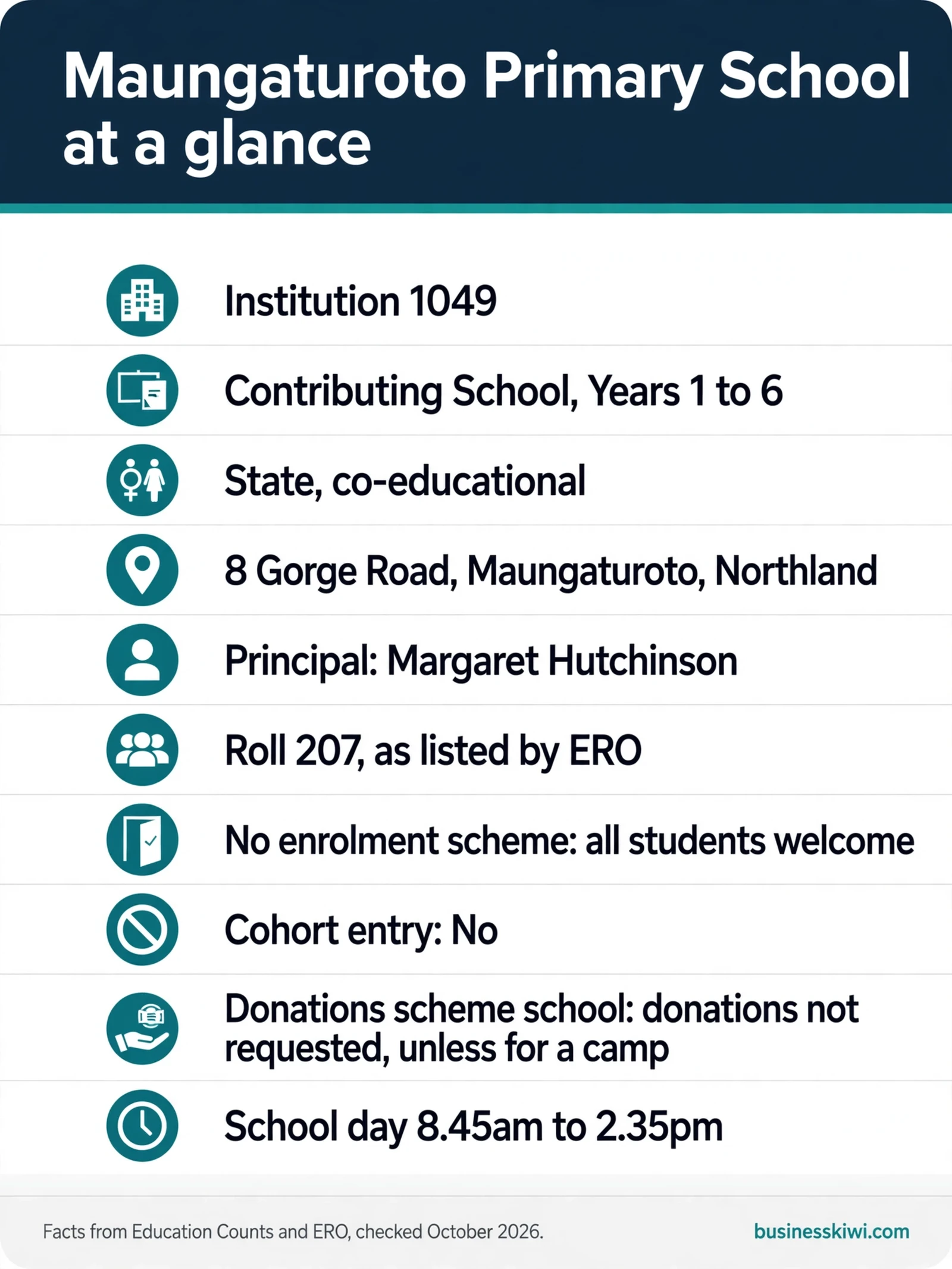
Maungaturoto Primary School is a state contributing primary school for Years 1 to 6 in Maungaturoto, in the Kaipara district of Northland. The Education Counts directory lists it as institution 1049, co-educational, with Margaret Hutchinson as principal. ERO lists the roll as 207. The school has no enrolment zone, so any child is welcome to enrol. The one boundary that does apply is a bus transport entitlement zone, which affects school bus eligibility rather than enrolment. ERO’s current public report, a Te Ara Huarau School Profile Report from July 2023, records strengths in the school’s CARE values culture, its whānau and community engagement, its stable staff and a board focused on equity and excellence. The school is in the government donations scheme, which means donations should not be requested, except for a school camp.
The school at a glance
| Fact | Detail |
|---|---|
| Institution number | 1049 |
| School type | Contributing School (Year 1-6) |
| Authority | State |
| Gender | Co-Educational |
| Address | 8 Gorge Road, Maungaturoto 0520 |
| Principal | Margaret Hutchinson |
| Roll | 207 (as listed by ERO) |
| Enrolment scheme | None in force |
| Cohort entry | No |
| Donations scheme position | Donations should not be requested, unless for a school camp |
| Boarding | No |
| Phone | 09-431 8106 |
| office@maungaturoto.school.nz |
Enrolment and the bus zone
The first thing to know about enrolling at Maungaturoto Primary School is what is not there. The school states plainly on its enrolment information page that it does not have a school enrolment zone, and that it welcomes all students and whānau. Its parent handbook says the same thing in slightly different words: the school does not have an enrolment policy, which means any child is welcome at the school. There is no home zone to check, no out-of-zone ballot to enter and no priority list to work through. If you want your child at this school, you can enrol them.
What the school does have is a Bus Transport Entitlement Zone, usually shortened to TEZ. This is a transport boundary, not an enrolment boundary, and the two are easy to confuse. The zones are set by the Ministry of Education at the halfway point between Maungaturoto and its neighbouring schools. A child who lives inside the school’s TEZ is entitled to school bus transport. A child who lives outside it is still entitled to attend the school, but the family is expected to bring the child to the halfway point, or to a safe pick-up and drop-off place inside the zone, to meet the bus. If bus transport matters to your family, ask the office where your address sits before you rely on a bus run.
The enrolment process itself is handled through the school office at 8 Gorge Road. The school publishes an enrolment pack and a pre-enrolment form on its enrolment page, and the forms can also be filled in at school on the day of enrolment. For pre-school children who are turning five this year or next year, the school asks parents to print and complete the pre-enrolment form and deliver it to Kerry, the office administrator, at the school office. If you cannot print the form at home, you can pick up a copy from the office instead. During the school holidays, enrolment enquiries go to the principal by email, and the school says the email will be answered within 48 hours.
Children in New Zealand are entitled to free enrolment at a state school from their fifth birthday. Maungaturoto does not use cohort entry, the system where new entrants start together on set dates during the term. Education Counts records cohort entry as No for this school, so each child’s start is arranged individually with the school rather than waiting for a cohort date. The sensible approach is to lodge the pre-enrolment form well before the birthday, then confirm the start date and any pre-start arrangements with the office.
Roll and community
ERO lists the school’s total roll as 207. The Education Counts profile does not publish a roll figure, so ERO’s 207 is the number used in this guide. That makes Maungaturoto a mid-sized rural primary: big enough to run ten classes, small enough that the principal’s welcome describes a school where staff, students and whānau share the learning journey together. The school says it presently has ten classes, with a teaching team of ten full-time teachers and a group of support staff.
The school sits in the heart of the Kaipara, about 45 minutes south of Whangārei in the principal’s description, and it describes itself as an integral part of the Maungaturoto community. In its welcome, the school stresses that it is inclusive and welcomes all families and children. ERO’s earlier 2019 review, written when the roll was larger, recorded that generations of local families had attended the school.
Children are placed in one of four tribes when they enrol, and they earn tribe points for positive behaviour, with weekly winners announced at assembly. The tribes are Arawa (green), Ngāpuhi (yellow), Maniapoto (blue) and Whatua (red).
What ERO found
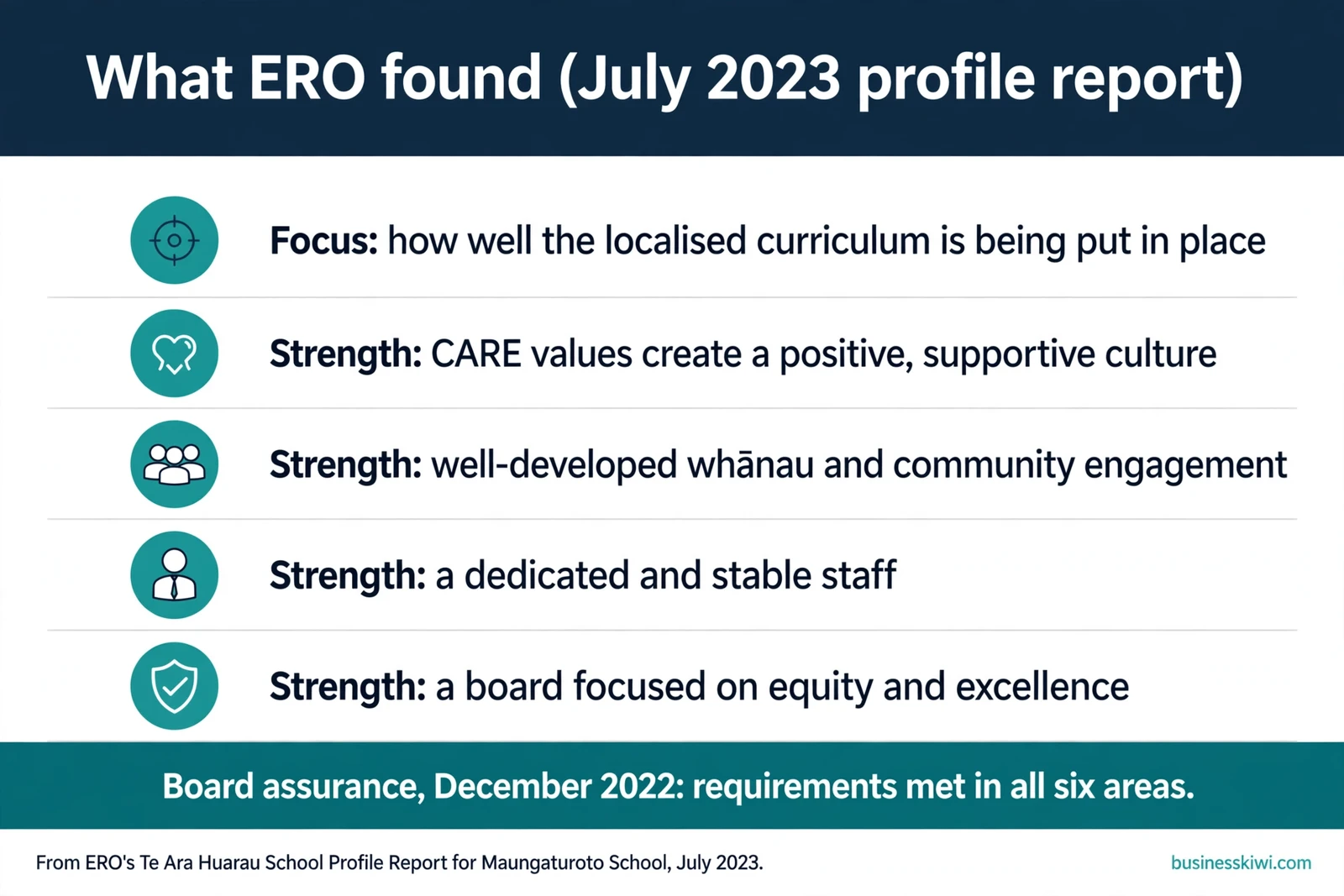
The Education Review Office works with Maungaturoto School under Te Ara Huarau, its evaluation approach for English medium state schools. The current public report on ERO’s website is the Te Ara Huarau School Profile Report dated 4 July 2023. It is a profile report rather than a full evaluation report, and ERO says the next public report will be a School Evaluation Report, due within three years of the profile report.
The evaluation focus the school and ERO chose was the effectiveness of the school’s localised curriculum, with an emphasis on helping children become more environmentally connected and take greater ownership of their learning. The school expected to see greater learning connections to the local environment, more student ownership of learning, explicit connections to children’s language, culture and identity, and stronger learning relationships with whānau.
ERO recorded four strengths the school can draw on. The first is the CARE values framework, which stands for community (whanaungatanga), a can-do attitude (kia kaha), respect (manaakitanga) and excellence (hiranga), and which ERO says creates a positive, supportive school culture. The second is well-developed whānau and community engagement, which supports the development of the localised curriculum. The third is a dedicated and stable staff who continuously look to improve outcomes for all children. The fourth is a board of trustees focused on achieving equity and excellence for all.
The school’s mission, as ERO records it, is “Uplift our children, for they are our future”. Its vision is for students to be resilient, effective communicators, actively involved, lifelong learners, summed up in the word REAL. Its strategic priorities are to provide rich, child-centred learning opportunities so all children achieve to their potential, to provide an environment where everyone feels safe and appreciated, and to keep growing positive whānau and community relationships.
The next steps ERO and the school agreed were community consultation to establish whānau and iwi aspirations for the school’s children, work to identify local resources in the environment that can support curriculum delivery, and a localised, culturally responsive curriculum that keeps learning highly relevant and engaging for all children. ERO’s role is to support the school through its evaluation for improvement cycle and to support it in reporting progress to the community.
The same ERO page carries the Board Assurance Report for 2022 to 2025. As of December 2022 the board attested that it meets the requirements in all six areas: board administration, curriculum, management of health, safety and welfare, personnel management, finance and assets. There were no areas recorded as not met in that report.
For context, ERO’s previous full review, dated 8 February 2019, found the school increasingly effective in achieving equitable and excellent outcomes, with most students achieving at or above expected curriculum levels in reading, writing and mathematics, and accelerated progress for most students who needed it. That report is now several years old, so treat it as background. The current picture is the July 2023 profile report described above.

Donations, costs and the school day
Maungaturoto Primary School is in the school donations scheme. Education Counts records its position in the standard wording used for scheme schools: donations should not be requested, unless for a school camp. In practice, the school does not ask parents for a general school donation. Camps sit outside that position. The school’s parent handbook says all children are involved in camps, usually in Term 1, and that the Year 5 and 6 children have a major camp every second year, which the school fundraises for. Safety plans are completed and signed off by the board for all camps.
Two food programmes keep other costs down. The school is part of the government’s healthy school lunches programme, Ka Ora, Ka Ako, and lunches are available to all students every day. The lunches are not compulsory, and children can bring their own lunch from home instead. Each class is also provided with fresh fruit daily at morning tea. Separately, the school runs a breakfast club between Rooms 5 and 6, offering Weet-Bix and milk each morning to any child who would like breakfast, and it welcomes parent helpers to supervise.
The school day is shorter than many parents expect. Classes begin at 8.45am. Morning tea runs from 10.15am to 10.40am, lunch from 12.45pm to 1.25pm, and school finishes at 2.35pm. Children should not be at school before 8.00am, and the school suggests about 8.30am is a good arrival time, so children can settle before classes start. The pedestrian crossing on the main street is patrolled from 8.15am to 8.35am, and the school asks that children cross within those times. The school office hours published on the website are 8.15am to 2.45pm, Monday to Friday.
If your child will be absent, the school asks you to let it know beforehand or on the day, by phone, text, email or the report-an-absence link on its website. The handbook explains that a student is marked as having an unjustified absence unless they are sick or there has been a bereavement, in line with Ministry of Education requirements, and that at about 10.00am the office administrator tries to contact caregivers of absent children if the school has not heard from them. After-school arrangements run on a permanent roll that a duty teacher marks each afternoon. Any change must go to Kerry at the office before 2.00pm, and the school acknowledges texts so you know the message has landed. After school care is available on site through the school, and the office can give you the details.
The school’s own term dates page was not relied on for this guide because the dates on it are not internally consistent, so confirm the school’s dates in its newsletter or with the office. What can be stated is the national framework. Primary schools choose their own start and finish dates within the Ministry of Education windows. For 2027, Term 1 starts between Thursday 28 January and Wednesday 3 February and ends Friday 9 April. Term 2 runs from Tuesday 27 April to Friday 2 July, Term 3 from Monday 19 July to Friday 24 September, and Term 4 from Monday 11 October to no later than Friday 17 December. The school’s own dates, including any teacher-only days, will fall inside that framework.
Uniform, stationery and the everyday extras
Maungaturoto does not publish a uniform list, and its parent handbook does not describe a compulsory uniform. What the handbook does require is practical. Children need a change of clothes in their bag at all times, because physical education is a big part of the curriculum and children sometimes need to change after being outside in wet weather. Every child is expected to take part in physical education.
Sun safety has one specific requirement. Under the school’s sun protection policy, children must wear the school hat when playing outside during Terms 1 and 4, and children without a hat must play in a shaded area only. School hats are available from the office. The first hat is free, and replacements cost $10. Swimming is part of the physical education programme too. Classes have daily swimming instruction in summer through the Swim Safe programme, and board policy makes swimming caps and suitable swimming outfits compulsory for all pupils. The school sells its own swimming caps at the office for $5.50 each.
Stationery is straightforward. Class stationery lists are published on the school website, and they can be printed out or bought online. The school runs a stationery shop for replacements during the year, and it offers online ordering through Office Products Depot and the myschool.co.nz ordering site for the start of the year. If your child needs dental care during the year, the dental therapist is based at Maungaturoto for one block of about ten weeks each year, working from the caravan between 8.30am and 4.00pm.
Learning and school life
The clearest window into classroom teaching is the school’s structured literacy programme. Maungaturoto teaches early literacy through a structured literacy approach, using Little Learners Love Literacy decodable books and resources. The programme is sequenced in seven stages, teaching the 44 sounds of English and how letters and letter groups represent them. Children start with the simple code in the first four stages, building phonics and phonemic awareness alongside vocabulary, oral language, comprehension and writing. The school says this approach is generally needed until the middle to the end of Year 3, with children progressing at different rates. Decodable books stay at school because numbers are limited, so homework sheets carry the same words home for practice instead.
Beyond literacy, the principal’s welcome points to small class sizes, plenty of one-to-one teacher time, kapa haka and sporting opportunities as features of the school. The school has a library that all classes visit regularly, and it is open most lunchtimes. The wider calendar is unmistakably rural: a Flower Show held with Pet Day each October, when children can bring a calf, lamb, chicken or goat, sports days through the year, and Grandparents Day in the last week of Term 3, when grandparents are invited to a show and lunch with their grandchildren.
Parents comparing schools can also read our Corinna School guide and our Fraser Crescent School guide, and our reading levels and ages guide explains the levels children read at. More school guides are in our Jobs and Education section.
Frequently asked questions
Does Maungaturoto Primary School have an enrolment zone?
No. The school states on its enrolment page that it does not have a school enrolment zone and that it welcomes all students and whānau. The boundary it does have is a bus transport entitlement zone, which decides bus eligibility only. It does not affect who can enrol.
How many students does the school have?
ERO lists the total roll as 207. The school teaches Years 1 to 6 across ten classes, so children move on to another school for Year 7. Education Counts does not publish a roll figure on the school’s directory profile, so ERO’s listed roll is the figure used in this guide.
Does the school ask for a donation?
No general donation should be requested. The school is in the school donations scheme, and Education Counts records that donations should not be requested unless for a school camp. The handbook confirms camps run through the year, including a major Year 5 and 6 camp every second year that the school fundraises for.
What are the school hours at Maungaturoto Primary School?
Classes begin at 8.45am and school finishes at 2.35pm. Morning tea is from 10.15am to 10.40am and lunch is from 12.45pm to 1.25pm. Children should not arrive before 8.00am, and the school suggests about 8.30am is a good time to arrive.
Does Maungaturoto Primary School have a uniform?
The school does not publish a uniform list, and its parent handbook sets no compulsory uniform. Children do need a change of clothes in their bag each day. They must wear the school hat outside in Terms 1 and 4; the first hat is free from the office and replacements cost $10. Swimming caps are compulsory for swimming and cost $5.50 at the office.
Are school lunches provided?
Yes. The school is part of the Ka Ora, Ka Ako healthy school lunches programme, so a lunch is available to every student each day at no charge to families. The lunches are not compulsory, and children may bring their own lunch instead. Each class also gets fresh fruit daily, and a breakfast club offers Weet-Bix and milk each morning.
When can my child start, and how do we enrol?
From their fifth birthday. The school does not use cohort entry, so starts are arranged individually. Complete the pre-enrolment form on the school’s enrolment page and deliver it to the school office at 8 Gorge Road, or pick up an enrolment pack from the office and fill the forms in at school. During the holidays, email the principal and the school says you will get a reply within 48 hours.
The bottom line
Maungaturoto Primary School is a rural Kaipara primary of 207 students with an open door: no enrolment zone, no general donation, free healthy lunches for every child and a short, early-finishing school day. ERO’s current profile report describes a school with a strong values culture, deep community engagement and a deliberate focus on a localised, environmentally connected curriculum. The practical points to confirm with the office are the bus entitlement position for your address, your child’s stationery list, and the school’s own term dates, because the dates page on its website is not reliable as published.
Sources
- Ministry of Education, Education Counts: Maungaturoto School profile and contact details (institution 1049, principal, type, cohort entry, donations position, address and contacts), https://www.educationcounts.govt.nz/find-school/school/profile?district=®ion=&school=1049
- Education Review Office: Maungaturoto School institution page, including the Te Ara Huarau School Profile Report of 4 July 2023, the Board Assurance Report 2022 to 2025, and the Education Review report of 8 February 2019, https://www.ero.govt.nz/institution/1049/maungaturoto-school
- Maungaturoto Primary School: homepage and principal’s welcome (Margie Hutchinson), https://www.maungaturoto.school.nz/
- Maungaturoto Primary School: Enrolment Information (no enrolment zone, bus transport entitlement zones, pre-enrolment form and holiday contact), https://www.maungaturoto.school.nz/information/enrolment-information/
- Maungaturoto Primary School: Parent Handbook (bell times, absences, camps, hats and swimming caps, stationery, tribes, Pet Day and school life), published by the school and linked from its enrolment page, https://docs.google.com/document/d/10DwcTbbgOP1mcDh1YAwAUh0AY7dy-IVPeZUspnVFC3Q/edit?tab=t.0
- Maungaturoto Primary School: School Hours and Term Dates (bell times and office hours), https://www.maungaturoto.school.nz/information/term-dates/
- Maungaturoto Primary School: School Lunches (Ka Ora, Ka Ako programme and fresh fruit), https://www.maungaturoto.school.nz/information/school-lunches/
- Maungaturoto Primary School: Structured Literacy (approach, seven stages, decodable texts and homework), https://www.maungaturoto.school.nz/learning/structured-literacy/
- Ministry of Education: School terms and holidays dates (national term date framework, including the 2027 windows), https://www.education.govt.nz/school-terms-and-holidays-dates
This article is general information about Maungaturoto Primary School in Maungaturoto, Northland, based on Ministry of Education, Education Review Office and school sources published at the time of writing. It is not published by or for the school. Enrolment, transport and cost details can change, so confirm anything that matters for your family with the school office before you act on it.