NZ Welding School: Courses, Fees and How Welding Training Works
Welding is one of those trades where nobody cares much about your school grades, but everybody cares what you can actually do with a torch in your hand. NZ Welding School has built its whole operation around that idea. It is a private training establishment that teaches welding and related trades in working workshops, mostly to people who want a practical route into the fabrication and engineering industries rather than a classroom-heavy one.
This profile explains what NZ Welding School is, where it teaches, which qualifications it delivers, what those courses cost, and how welding training fits into the wider New Zealand trades system. It also covers the funding picture, because the rules on fees support are changing at the end of 2026 and the timing of an enrolment now matters more than it used to.
Who runs NZ Welding School
The organisation’s registered name with the New Zealand Qualifications Authority is NZ Welding School Limited. It trades under two names: NZ Welding School, and NZ Welding, Trades & Services. You will see both names used across its website and course material, and they refer to the same provider.
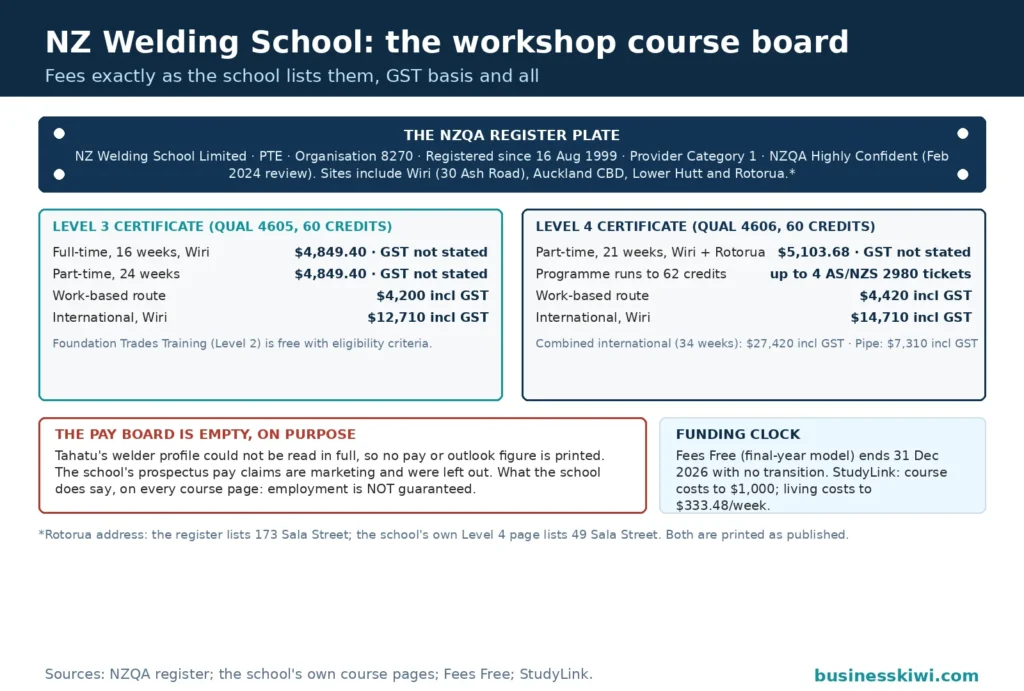
NZQA lists it as a private training establishment (PTE) with Education Organisation number 8270. It was first registered with NZQA on 16 August 1999, so it has been operating for well over two decades. It is a signatory to the Education (Pastoral Care of Tertiary and International Learners) Code of Practice, which matters if you are an international student, because signatories commit to a set standard of care and support.
On quality, NZQA’s most recent external evaluation and review, dated 20 February 2024, recorded that NZQA was Highly Confident in the provider’s educational performance and Highly Confident in its capability in self-assessment. That places NZ Welding School in Provider Category 1, the top category NZQA awards. Those judgements are worth knowing about because they are independent: they come from NZQA’s own review process, not from the school’s marketing.
One thing catches people out. Despite the Rotorua roots covered below, the school’s NZQA contact address is a PO Box in Auckland, and its current published course intakes are centred on Auckland. The name travels further than any single campus.
Where it teaches
NZ Welding School started in Rotorua, and older NZQA reports describe a Rotorua site on Sala Street in Whakarewarewa. The Rotorua connection is still there. NZQA’s register currently lists a Rotorua delivery site at 173 Sala Street, Whakarewarewa, and the school’s Level 4 part-time course page lists evening and Saturday classes at 49 Sala Street, Rotorua.
The register lists several other delivery sites, all in the upper North Island:
- Wiri, South Auckland: a warehouse site at 30 Ash Road, Wiri, which is the main campus named on current course pages, plus a site in Kellow Place, Wiri, and a youth justice residence site, also in Wiri.
- Auckland Central: Floor 10, 62 Victoria Street, and Swanson Towers at 20 Hobson Street in the Auckland CBD.
- Lower Hutt: 1A Parkside Road, Seaview.
In practice, the live course pages tell the clearest story about where you would actually study right now. The current full-time and part-time welding intakes are advertised at Wiri in South Auckland, with the part-time Level 4 programme also running classes in Rotorua. If you are outside Auckland or Rotorua, check the delivery site for your specific intake before you commit, because the register lists approved sites rather than a promise that every course runs at every site.
The qualification ladder
Welding qualifications sit on the New Zealand Qualifications and Credentials Framework, which runs from Level 1 to Level 10. The school’s welding programmes are built around two national certificates.
The New Zealand Certificate in Welding (Level 3), qualification number 4605 on NZQA’s register, is a 60-credit certificate. It is the entry point: a programme for people with little or no welding experience that covers basic welding techniques across the main processes, workshop safety, measurement, hand and power tools, reading drawings, and weld quality. NZQA lists the qualification as current, and only a small number of organisations nationally can deliver it.
The New Zealand Certificate in Welding (Level 4), qualification number 4606, is also listed by NZQA at 60 credits and current. It is the specialised step up. It builds on the Level 3 certificate and is aimed at people heading into engineering fabrication, steel construction and mechanical engineering work. Graduates are expected to work independently within their discipline and follow the written welding procedures their employer uses. The school’s own Level 4 programme carries up to 62 credits on completion, a couple more than the base qualification, because of the way its programme is assembled.
From Level 4, the published pathway continues to the New Zealand Certificate in Engineering Fabrication (Trade) (Level 4), which has strands in Heavy Fabrication, Light Fabrication and Steel Construction. That trade certificate is the qualification usually completed through work-based training and apprenticeship-style arrangements with an employer, so the school’s role is often to get you to the point where an employer will take you on. The school itself says its programmes are designed to put learners on the road to apprenticeships and employment, and its tutors support learners in the workplace as well as on campus in its work-based training option.
Alongside the welding certificates, NZQA records the school as able to assist with a handful of other qualifications, including the New Zealand Certificate in Foundation Skills (Level 2), the New Zealand Certificate in Building, Construction, and Allied Trades Skills (Level 2), the New Zealand Certificate in Commercial Road Transport Skills (Level 3), and the New Zealand Certificate in Study and Employment Pathways at Levels 3 and 4. Its consent to assess against welding unit standards runs to Level 4.
The courses on offer
Foundation Trades Training, Level 2
This is the starter course, built around the New Zealand Certificate in Foundation Skills (Level 2). It runs for 16 weeks at Wiri and is advertised as free, with eligibility criteria applying. Students sample several trades rather than specialising straight away: gas welding, arc and MIG welding, workshop safety, tools and machinery, construction skills, and a trades project they plan and produce themselves. Safety gear, daily breakfast and transport assistance are included. Entry is open to people aged 16 or over who are New Zealand citizens or permanent residents and are physically fit. Think of it as a taster and a foundation: it suits school leavers and career changers who are not yet sure welding is their trade.
Welding, Level 3
The full-time Level 3 course is the school’s core programme. It runs for 16 weeks at Wiri in South Auckland, with new intakes starting most months. The provider describes around 70 percent of the course as hands-on workshop time. Students learn the four main arc welding processes, known by their abbreviations MMAW (manual metal arc, or stick), GMAW (gas metal arc, or MIG), FCAW (flux cored arc) and GTAW (gas tungsten arc, or TIG), through industry-related projects. Around the welding itself sits the supporting knowledge: health and safety, job ergonomics and risk assessment, safe use of tools and machinery, industry terminology, identifying and repairing weld defects, calculations and measurements, and workplace documentation.
On completion, students gain the New Zealand Certificate in Welding (Level 3), worth up to 60 NZQA credits. Free safety gear is provided, including overalls, gloves, a welding helmet and safety glasses, along with breakfast and transport assistance, and CV and job search support.
Entry requirements are straightforward: you must be 16 or over, a New Zealand citizen or permanent resident, physically able to complete workshop activities, and have the literacy and numeracy to read, write, understand text and make simple calculations.
There is also a part-time version of the same certificate for people who need to keep earning. It runs for 24 weeks at Wiri, with classes on Monday to Thursday evenings from 6.00pm to 9.15pm and on Saturdays from 8.00am to 4.00pm. The content and the qualification are the same as the full-time course; only the timetable differs.
Specialised Welding, Level 4
The Level 4 programme is for people who already weld. The domestic part-time version runs for 21 weeks, with classes on Monday to Thursday evenings from 6.00pm to 9.20pm and Saturdays from 8.00am to 4.30pm, at both 30B Ash Road, Wiri and 49 Sala Street, Rotorua.
The content steps up in independence and precision. Students complete welding projects across all four processes, learn the purpose of welding regulations in the New Zealand fabrication industry, work to engineering drawings, present welds to industry standards for certification, build a portfolio of specialised welds, and learn quality assurance and how to critique weld testing. A distinctive feature is the chance to sit up to four industry-recognised welding tickets during study. Those tickets are the AS/NZS 2980 certification tests for MMAW vertical up or overhead, GMAW vertical up or overhead, FCAW vertical up or overhead, and GTAW in the 6G pipe position.
Entry to Level 4 requires the New Zealand Certificate in Welding (Level 3), or the Career Preparation for Engineering Trades (Level 3), or the New Zealand Certificate in Mechanical Engineering (Level 3), or equivalent skills, which the school assesses with a trade test. The general entry conditions about age, residency, physical ability and literacy and numeracy also apply.
Work-based training
If you are already employed in the industry, the school can train you in your workplace, mixing on-the-job learning with time on campus and online, supported by a tutor. Both certificates are offered this way: the Level 3 certificate for workers building basic technique, and the Level 4 certificate for those specialising. Entry requirements mirror the campus versions. This route suits employers wanting to upskill existing staff and welders who cannot afford to stop earning for a full-time course.
International students
The school enrols international students at its Wiri campus, and NZQA records it as a Code of Practice signatory. International applicants must be 18 or over, meet visa conditions, and show reasonable literacy and numeracy. The international course list includes the Level 3 certificate (16 weeks), the Level 4 certificate (16 weeks), a combined 34-week programme that packages the Level 3 and Level 4 certificates together, and a Pipe Welding course that prepares students for the ASME IX welding ticket. The combined programme requires IELTS 5.5 overall with no band below 5.0, and every applicant completes an interview. International students on the welding programmes also complete a Site Safe Passport.
Fees, and how to pay for training
Fees differ between domestic and international students, and between delivery modes, so read the right line for your situation.
For domestic students, the published course fees are:
- Foundation Trades Training (Level 2): free, with eligibility criteria applying.
- New Zealand Certificate in Welding (Level 3), full-time at Wiri: $4,849.40. The part-time evening and Saturday version is listed at the same price, $4,849.40.
- New Zealand Certificate in Welding (Level 4), part-time specialised programme: $5,103.68.
- Work-based training: $4,200 including GST for the Level 3 certificate, and $4,420 including GST for the Level 4 certificate.
Safety clothing and gear are included in these fees rather than added on top, which is worth noting if you are comparing providers, because helmets, overalls and gloves are a real cost in this trade.
International fees at the Wiri campus are higher, as they are everywhere in New Zealand tertiary education. The school publishes $12,710 including GST for the Level 3 certificate, $14,710 including GST for the Level 4 certificate, $27,420 including GST for the combined 34-week Level 3 and Level 4 programme, and $7,310 including GST for Pipe Welding. Each includes all safety clothing.
Two public funding systems can help domestic students, but both need care in 2026.
The first is Fees Free. The scheme has changed shape: it now pays back fees for the final year of a first qualification, or the final two years of work-based learning, rather than the first year. You pay your fees when you enrol and claim the entitlement back through Inland Revenue in myIR once you have completed the qualification. Two conditions are critical. You generally must be starting tertiary study or work-based learning for the first time, and for the current settings you must start your final year on or after 1 January 2025 and complete your qualification by 31 December 2026. The government has confirmed Fees Free ends on 31 December 2026 with no transitional arrangements, so anyone banking on it needs to complete in time and apply before the deadline. The school will check your eligibility when you apply, and the Fees Free website has the full criteria.
The second is a student loan through StudyLink. A loan can cover compulsory course fees, course-related costs of up to $1,000, and, for full-time students, living costs of up to $333.48 a week. There is a one-off establishment fee of $60. To be eligible you generally need to be a New Zealand citizen, or ordinarily resident here for at least three years while holding a residence class visa for at least three years, and your course must be an approved course at an approved provider. Short courses have limits: a loan is not available if you are studying for less than 32 weeks and your course carries less than 0.25 EFTS, so check your specific course with StudyLink before relying on loan funding for a 16-week programme. StudyLink also administers the Student Allowance, which is worth checking at the same time. One more practical point from the school’s course pages: you may be able to train while receiving a benefit, but you should check with your case manager before enrolling.
The job at the end
What does a welding qualification actually lead to? The school’s own pathway material maps the Level 3 certificate to entry-level work such as trades assistant roles, and the Level 4 certificate to more specialised welding jobs. Roles it names across its career pathways include production welder, structural welder, pipe welder, aluminium boat builder and automotive welder, with supervisory roles in structural steel further along. Welding work itself spans fabrication workshops, engineering firms, construction sites, maintenance teams and manufacturing plants, and the day-to-day tasks are those taught on the courses: reading drawings, setting up and running the four main welding processes, checking finished welds against a standard, and repairing defects.
Certification matters in this industry beyond the certificate itself. Many employers require welders to hold current AS/NZS 2980 tickets for specific processes and positions, which is why the opportunity to sit up to four tickets inside the Level 4 programme is a practical selling point rather than a bonus extra.
A word of caution about outcomes, because the school is unusually upfront about it and you should be too. Every course page carries the same note: the school’s team will work with you to find an employment placement, but employment is not guaranteed after training, and employer suitability criteria apply. Treat any training provider’s job help as support, not a promise.
For current pay rates and employment outlook for welders, the place to look is the welder profile on Tahatū Career Navigator, the Tertiary Education Commission’s careers service, which publishes occupation pay data and outlook information. Pay varies a lot with the tickets you hold, the industry you work in and where in the country you are, so check the current figures there rather than relying on any single advertised salary.
How to apply and enrol
The process is simple compared with larger institutions. You can register your interest or sign up through the school’s website, or call the team on 0800 236 765. Intakes for the main welding courses start most months, with the published Level 3 dates running through the year and part-time intakes starting a few times a year, so you rarely have to wait long for a start date.
Expect the school to check your eligibility at application, including your residency status, your literacy and numeracy, and, for Fees Free, whether you meet the first-time learner criteria. Level 4 applicants should have their Level 3 certificate or be ready to sit a trade test to demonstrate equivalent skills. International applicants complete an interview and need to sort their visa conditions with the school’s team.
Before you sign anything, confirm four things in writing: the delivery site for your intake, the total fee and what it includes, your start and finish dates, and what happens to your fees if you withdraw early. With Fees Free ending on 31 December 2026, your completion date is not a detail; it decides whether the entitlement exists at all.
Frequently asked questions
Is NZ Welding School a legitimate, NZQA-registered provider?
Yes. NZQA’s register lists NZ Welding School Limited, trading as NZ Welding School and NZ Welding, Trades & Services, as a private training establishment first registered on 16 August 1999. In its most recent external evaluation and review in February 2024, NZQA recorded that it was Highly Confident in the school’s educational performance and in its capability in self-assessment, which places the school in Provider Category 1.
Is NZ Welding School based in Rotorua or Auckland?
Both, historically and now. The school began in Rotorua and NZQA still lists a Rotorua delivery site on Sala Street in Whakarewarewa, where the part-time Level 4 programme runs classes. Its head office contact address is in Auckland, and its current full-time and part-time course intakes are centred on its campus at 30 Ash Road, Wiri, in South Auckland. Check the delivery site for your specific intake before you enrol.
What is the difference between the Level 3 and Level 4 welding certificates?
The New Zealand Certificate in Welding (Level 3) is the entry-level qualification: 60 credits, no experience needed, covering basic technique across the MMAW, GMAW, FCAW and GTAW processes. The Level 4 certificate is the specialised step up. It assumes you already hold the Level 3 certificate or equivalent skills, teaches you to work independently to written procedures, and builds towards certification-standard welding, including the chance to sit up to four AS/NZS 2980 welding tickets.
How much does it cost to train at NZ Welding School?
For domestic students, the Foundation Trades Training course at Level 2 is free if you meet the eligibility criteria. The Level 3 welding certificate costs $4,849.40 full-time or part-time, the part-time Level 4 specialised programme costs $5,103.68, and work-based training costs $4,200 including GST at Level 3 or $4,420 including GST at Level 4. Safety gear is included. International fees are higher and are published separately on the school’s website.
Can I keep working while I study welding?
Yes, in two ways. The part-time Level 3 and Level 4 programmes run on weekday evenings and Saturdays, designed for people with day jobs. Alternatively, the work-based training option lets you complete the Level 3 or Level 4 certificate in your own workplace, with tutor support on the job, on campus and online.
What are welding tickets, and why do they matter?
Tickets are the industry’s own certification tests. In New Zealand the main standard is AS/NZS 2980, and welders sit tests for individual processes and positions, such as GMAW vertical up or GTAW in the 6G pipe position. Employers use current tickets as proof a welder can produce sound welds to a set standard, so holding them widens the range of jobs you can be put on. The school’s Level 4 programme includes the opportunity to sit up to four tickets.
Will I get a job after I finish?
The school will help, but it does not promise a job, and it says so plainly on every course page. Its team supports graduates with CV help, job search support and employer connections, and it will work with you to find a placement. Employment itself is not guaranteed and depends on employer suitability criteria. That honesty is worth weighing alongside any provider’s marketing when you compare options.
Can international students enrol at NZ Welding School?
Yes. The school is a signatory to the Code of Practice for the pastoral care of international learners and offers the Level 3 and Level 4 welding certificates, a combined 34-week programme, and a Pipe Welding course at its Wiri campus. International students must be 18 or over, meet visa requirements, and complete an interview; the combined programme also requires IELTS 5.5 overall with no band below 5.0.
Sources
- NZQA, Education Organisation details for NZ Welding School Limited (organisation number 8270), nzqa.govt.nz
- NZQA, NZQF qualification search results for NZ Welding School Limited, nzqa.govt.nz
- NZ Welding School, Welding Level 3 course page, nzweldingschool.co.nz
- NZ Welding School, Welding Part Time Level 3 course page, nzweldingschool.co.nz
- NZ Welding School, Specialised Welding Part Time Level 4 course page, nzweldingschool.co.nz
- NZ Welding School, Work-based Training page, nzweldingschool.co.nz
- NZ Welding School, Foundation Trades Training Level 2 course page, nzweldingschool.co.nz
- NZ Welding School, International Students page, nzweldingschool.co.nz
- Fees Free, feesfree.govt.nz
- StudyLink, Student Loan, studylink.govt.nz
This article is general information about NZ Welding School and welding training in New Zealand, based on information published by NZQA, the provider and government agencies at the time of writing. Course details, fees, intake dates and funding rules change, and Fees Free in particular ends on 31 December 2026, so confirm the current position directly with the provider, NZQA, Fees Free or StudyLink before you enrol or make financial decisions.