Plumber Costs in NZ: What You Pay per Hour, and What Plumbers Actually Earn
The short answer
There is no official price list for plumbing work in New Zealand. No government agency and no industry body sets or publishes a standard hourly rate, so every plumbing business sets its own charges. A typical bill is built from a minimum call-out charge, labour billed in short time blocks, a vehicle fee, and materials on top, with GST added. That is the money a plumber charges. What a plumber earns is a different number again. Tahatū, the government careers service, puts plumber pay at $56,000 to $91,000 a year, well below what a busy firm turns over in charge-out fees, because the difference goes on vehicles, tools, licensing, insurance and unpaid quoting and travel time. This guide keeps the two sets of figures separate, because mixing them up is where most confusion starts.
Two questions that sound the same but are not
When people ask how much a plumber costs, they usually mean one of two things. Homeowners want to know what they will be charged for a job. People thinking about the trade want to know what they could earn doing it. The figures are related, but they are not interchangeable. A firm might bill labour out at more than $100 an hour while the licensed plumber on the tools earns closer to half that as wages, with the rest absorbed by running the business. Both sets of numbers are covered below, each labelled for what it is.
What plumbers charge
Because there is no regulated rate, the only honest way to show charges is through what firms publish themselves. Most plumbing businesses do not publish a rate card at all and price each job after seeing it. A minority publish their charges in their terms of trade. One example is Hayes Plumbing and Gas Ltd, a residential firm that publishes its full charges schedule. Its minimum call-out is $155 plus GST, which covers the first 15 to 60 minutes on site. Labour after that is $27.50 plus GST per 15 minutes for plumbing and gasfitting, which works out at $110 an hour. After-hours work carries a minimum charge of $200 plus GST. A separate vehicle fee covers vehicle running costs, booking administration and travel, with the first 30 minutes of travel included.
Treat those figures as one firm’s published prices, not a market average. Another firm in another town will charge differently, and larger jobs are usually quoted as a fixed price rather than billed by the clock. The example is still useful, because it shows the shape of almost every plumbing bill:
-
A minimum charge gets the plumber to your door and covers the first block of time.
-
Labour is billed in small increments, often 15 minutes, once the minimum is used up.
-
Travel and vehicle costs are either built into a fee or charged on top.
-
Materials, parts and any specialist equipment are extra.
-
GST is usually quoted on top of the rate, not inside it, so ask whether a figure includes GST before you compare it with another quote.
What pushes the price up or down
When the work happens. Emergency and after-hours work costs more because firms pay overtime and keep staff on call. In the published example above, the after-hours minimum is $200 plus GST against a $155 standard minimum, and that pattern of a higher entry price outside normal hours is standard practice across the trade.
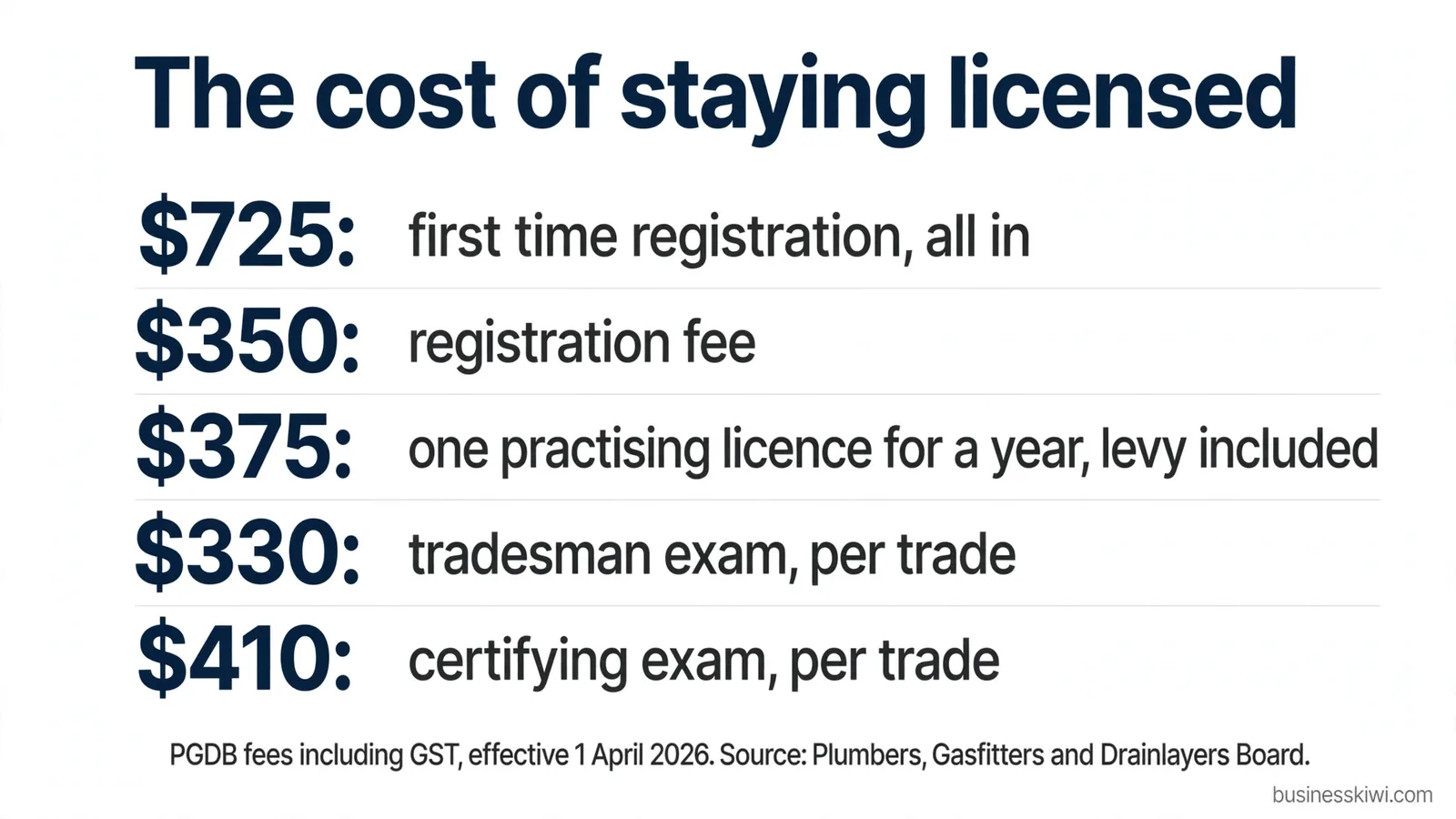
Whether the job is restricted work. Sanitary plumbing, gasfitting and drainlaying are restricted trades in New Zealand. By law, that work must be done by someone authorised by the Plumbers, Gasfitters and Drainlayers Board (PGDB), or supervised by a certifying practitioner. Licensed work carries real compliance costs. A practitioner pays $350 to register, $725 in total for first-time registration with a practising licence and levy, then $375 a year to hold one practising licence once the annual $275 disciplinary and prosecution levy is included. Registration exams cost $330 per trade, and the certifying exam costs $410 per trade. Those costs sit behind every legitimate rate.
Travel and access. Rural jobs, long travel and difficult access all add time that has to be paid for. Firms handle this differently: some include a travel allowance in a vehicle fee, others charge for extra travel time.
Materials and parts. Labour is often the smaller half of a bigger job. A hot water cylinder, a pump or a length of drainage pipe can cost more than the hours spent fitting it, and firms may add a margin to parts they supply and guarantee.
Shortage of plumbers. Careers NZ rates job opportunities for plumbers, gasfitters and drainlayers as good because there are not enough workers to meet demand. When a trade is short-staffed, firms can be booked out for weeks and have little reason to discount. Booking non-urgent work ahead is the simplest way to avoid emergency pricing.
What plumbers earn
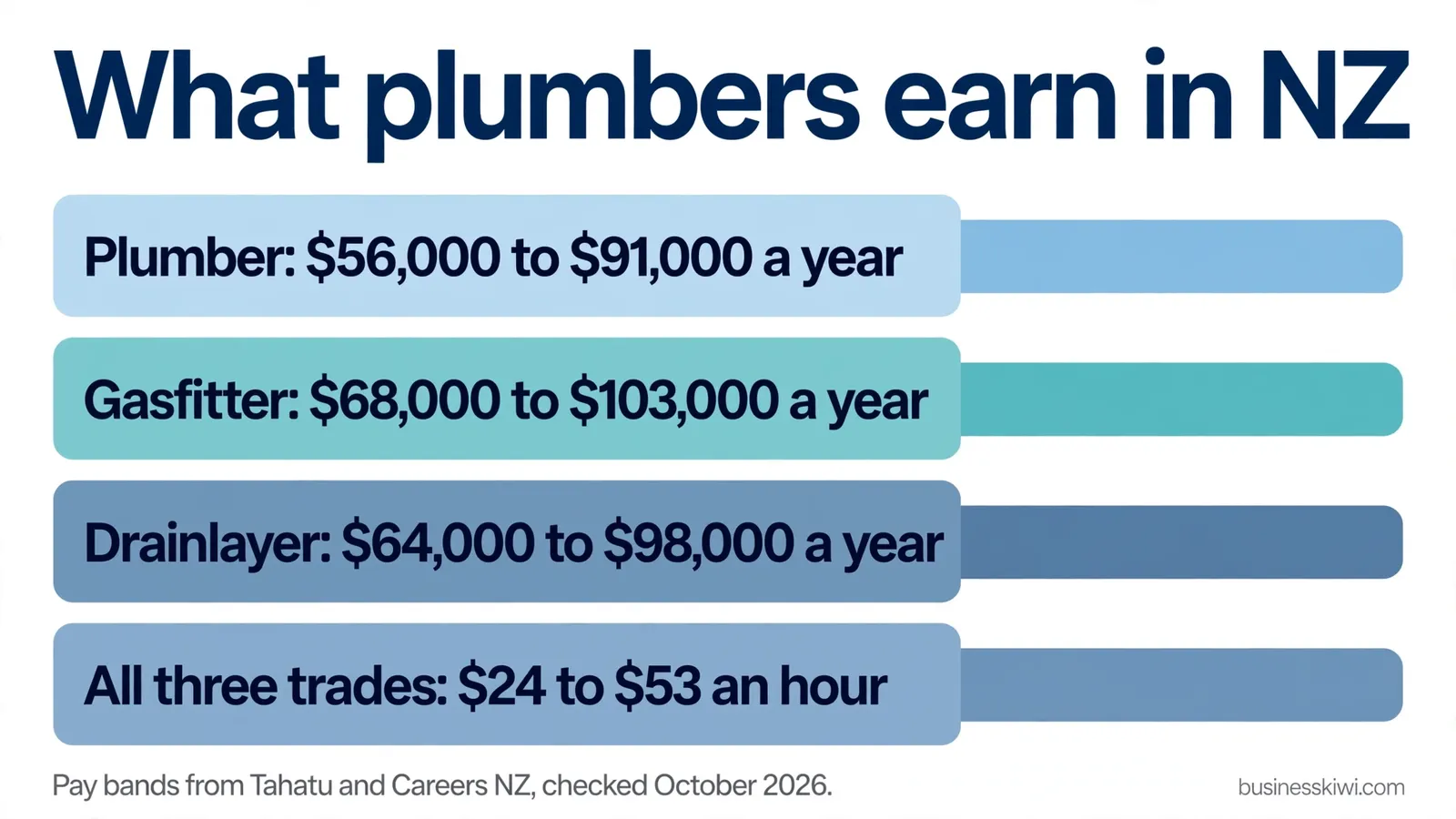
Tahatū lists pay for plumbers at $56,000 to $91,000 a year before tax, with training taking three to four years. The related trades sit in similar bands on the same service: gasfitters at $68,000 to $103,000 a year, and drainlayers at $64,000 to $98,000 a year.
Careers NZ, looking at plumbers, gasfitters and drainlayers as a group, says they usually earn $24 to $53 an hour. The bottom of that range is where apprentices start, and the top is reached by experienced, licensed tradespeople. Careers NZ also notes that about 90 percent of plumbers and gasfitters are self-employed or work for small companies with up to five employees. For that majority, income is business revenue first and personal earnings second. Rent, a ute, tools, PGDB fees, insurance, ACC levies and hours spent quoting jobs that never go ahead all come out before the owner takes a wage.
That is why the charge-out rate and the pay rate never match, and why comparing the two directly is misleading. The homeowner pays for the whole system that gets a licensed, insured, equipped tradesperson to the door, not just the hour spent under the sink.
The licence behind the price
The PGDB register has three main levels of qualification, plus trainees. Certifying plumbers, gasfitters and drainlayers sit at the top: they can do all the work in their trade, supervise others, and certify or verify completed work. The middle level, registered plumbers, gasfitters and drainlayers, can do the work under the supervision of a certifying practitioner, but cannot certify it. Restricted practitioners, called journeymen before April 2025, work under supervision too, and restricted gasfitters cannot connect a gas appliance to the supply. Trainees work under supervision, and in their first 12 months they can only work in the direct presence of their supervisor.
For homeowners, the practical point is simple. Before work starts, ask for the tradesperson’s name and licence number and check them on the PGDB public register. The register shows what each person is authorised to do. The Board prosecutes people who do restricted work without authorisation, and the outcomes are not cheap for anyone involved. In one case prosecuted by the Board, a man who advertised as a plumber and replaced a hot water cylinder without ever being registered was fined $7,500 and ordered to pay $3,770.74 in reparation to the homeowner, whose replacement cylinder leaked from three joints the night it was installed. The Board also warns that unauthorised work can put a home’s insurance cover at risk if something goes wrong later.
How to get a fair price
Know the difference between a quote and an estimate. Consumer Protection, part of MBIE, explains that a quote is an offer to do a job for a specified price. Once you accept it, the business cannot charge more unless you agree to extra work or the scope changes, which becomes a variation to the contract. An estimate is only the provider’s best guess. The final price can be higher or lower, but it should generally land within 10 to 15 percent of the estimate.
Get more than one price. Consumer Protection suggests getting quotes or estimates from at least three businesses where you can. A good quote or estimate should show what work will be done, any other costs such as materials, the hourly rate for the people doing the work, and how long the work will take. If a business charges a fee to prepare a quote, it must tell you beforehand.
Be careful with deposits. There is no legal requirement to pay a deposit when you accept a quote. Consumer Protection advises that if you are asked for one, you should not pay more than 10 percent of the total cost.
Know your Consumer Guarantees Act rights. For services, the Act guarantees work will be done with reasonable care and skill, within a reasonable time if no timeframe was agreed, and at a reasonable price if no price was agreed. Extra work must be agreed before it is carried out, and agreed as a variation in writing. If a tradesperson misleads you, for example by claiming work is needed when it is not, or claiming a trade association membership they do not have, the Fair Trading Act can give you a refund and compensation.
Check for a workmanship guarantee. Members of Master Plumbers carry the Master Plumbers Guarantee. It is a 12-month residential guarantee of up to $20,000 including GST that protects you against substandard workmanship, and against losing an advance payment if the contractor goes into liquidation or bankruptcy. If you are unhappy with a service, an invoice or charges from a member firm, Master Plumbers says the first step is to contact the business owner and give them at least five working days to respond.
If it goes wrong anyway. Raise the problem with the business first, with your quote or estimate in hand. If you cannot reach agreement, options include a disputes resolution scheme, the Disputes Tribunal or the District Court. Misleading behaviour can be reported to the Commerce Commission.
Becoming a plumber: the training path in brief
Plumbers qualify through an apprenticeship, combining on-job work with block courses and online learning, and gaining a New Zealand Certificate (Level 4) in their trade. Through Masterlink, the national group training scheme for the industry, plumbing alone takes about 36 months. Plumbing and drainlaying together take about 42 months, and all three trades together take about 60 months. Drainlaying alone takes about 24 months.
Apprentices are paid from day one, and their pay rises as their skills build. Masterlink apprentices have their qualification fees paid through weekly wage deductions across the apprenticeship rather than as an upfront lump sum, and new apprentices receive a starter tool kit worth $2,000. Once qualified, a tradesperson registers with the PGDB, paying the registration, exam and annual licensing costs set out earlier. From there, the path runs from restricted registration, to full registration, to certifying level, where a plumber can sign off work, supervise others and, if they choose, run their own business.
Watch-outs
-
Unlicensed operators. Restricted work done by an unauthorised person is illegal, can be unsafe, and can put your insurance at risk. A cheap cash price is no saving if the work has to be ripped out and redone.
-
Vague verbal estimates. If the price is only a rough guess given over the phone, get it in writing before work starts, or agree a firm price limit.
-
Large deposits. There is no legal need to pay one, and guidance is to stay at or below 10 percent of the total if you do.
-
Unagreed extras. Work you did not agree to is not work you have to pay for. Agree variations, and their cost, before the extra work happens.
-
Quotes with no hourly rate shown. Consumer Protection says a proper quote should show the hourly rate for the people doing the work. If it is missing, ask.
Related guides: our septic tank guide explains the on-site wastewater work drainlayers are involved in, and our how to write an invoice guide covers the paperwork side for tradespeople running their own business. For more business guides, browse the Business & Industry section.
Frequently asked questions
How much does a plumber charge per hour in NZ?
There is no set rate. Each firm sets its own charges, and most do not publish them. One firm that does publish its charges, Hayes Plumbing and Gas Ltd, bills labour at $27.50 plus GST per 15 minutes, which is $110 an hour, after a $155 plus GST minimum call-out. Use that as an example of how pricing is structured, and rely on written quotes for the real figure for your job.
Why is there a minimum call-out charge?
The minimum covers the cost of getting a licensed tradesperson, a stocked vehicle and tools to your door, plus the first block of work time. In the published example above it covers the first 15 to 60 minutes on site. Even a ten-minute fix carries the same travel and setup costs as a longer job.
How much do plumbers earn in NZ?
Tahatū puts plumber pay at $56,000 to $91,000 a year before tax. Careers NZ gives a wider hourly range of $24 to $53 an hour across plumbers, gasfitters and drainlayers, from apprentice level up to experienced and licensed. Many plumbers run their own small business, so their income also depends on how the business performs.
Can I legally do my own plumbing at home?
Sanitary plumbing, gasfitting and drainlaying are restricted work. In general, that work must be done by a person authorised by the Plumbers, Gasfitters and Drainlayers Board, or by someone working under a certifying practitioner. Doing restricted work without authorisation is an offence, and the Board prosecutes. Simple tasks that do not touch the sanitary plumbing, gas or drainage systems, such as changing a tap washer, sit outside the restricted categories, but if you are unsure, check the PGDB register guidance or ask a licensed plumber.
Should I ask for a quote or an estimate?
Ask for a quote where the job can be defined, because an accepted quote fixes the price unless you agree to a variation. An estimate is a guide only, and the final price should generally be within 10 to 15 percent of it. For bigger jobs, Consumer Protection suggests getting written quotes from at least three businesses.
Why do after-hours plumbers cost more?
Firms pay overtime rates and keep staff on call, so they charge a higher entry price outside normal hours. In the published example used in this article, the after-hours minimum is $200 plus GST compared with a $155 plus GST standard minimum. If a problem can safely wait until morning, it usually costs less.
What can I do if I think I have been overcharged?
Start by raising it with the business, with your quote or estimate in hand. Under the Consumer Guarantees Act, if no price was agreed, you only have to pay a reasonable price, and you can check what is reasonable by asking other tradespeople. If you cannot agree, you can use a dispute resolution scheme or the Disputes Tribunal, and misleading conduct can be reported to the Commerce Commission.
The bottom line
A plumber’s bill is not just an hourly rate. It is a minimum charge, time in small blocks, travel, materials and GST, charged by a business that carries licensing, training and compliance costs set by the PGDB. No official body publishes a standard rate, so written quotes are the only reliable comparison. On the other side of the invoice, a plumber’s own pay of roughly $56,000 to $91,000 a year on Tahatū’s figures is a much smaller number than the firm’s charge-out turnover, and the gap between the two is simply what it costs to run a licensed trade business.
Sources
-
Tahatū Career Navigator, Plumber occupation data (pay and training): https://tahatu.govt.nz
-
Careers NZ, Plumber, Gasfitter and Drainlayer job profile (hosted by Wintec): https://www.wintec.ac.nz/future-you/explore/jobs/construction/plumber-gasfitter-and-drainlayer
-
Plumbers, Gasfitters and Drainlayers Board, Fees for registration and licensing: https://www.pgdb.co.nz/apply_for_registration/fees/
-
Plumbers, Gasfitters and Drainlayers Board, Registration class name changes (licence levels explained for consumers): https://www.pgdb.co.nz/about_the_board/news-and-podcasts/registration-class-name-changes/
-
Plumbers, Gasfitters and Drainlayers Board, media release on prosecution of unauthorised plumber: https://www.pgdb.co.nz/about_the_board/news-and-podcasts/media-release-240724-unauthorised-man-fined-7-500-for-posing-as-plumber/
-
Consumer Protection (MBIE), Quotes and estimates: https://www.consumerprotection.govt.nz/general-help/guide-to-buying-smart/quotes-and-estimates
-
Consumer Protection (MBIE), Repair damage after normal use (Consumer Guarantees Act rights): https://www.consumerprotection.govt.nz/general-help/common-consumer-issues/repair-damage-after-normal-use
-
Master Plumbers, Master Plumbers Guarantee: https://masterplumbers.org.nz/Web/Web/Homeowner/Master-Plumbers-Guarantee.aspx
-
Hayes Plumbing and Gas Ltd, Terms and Conditions of Trade (published charges schedule): https://img1.wsimg.com/blobby/go/77946db0-9401-4c41-b718-7bc437eae00a/downloads/Hayes%20Plumbing%20and%20Gas%20-%20Terms%20of%20Trade.pdf
-
Masterlink, Apprenticeship Costs: https://www.masterlink.co.nz/apprenticeship-costs/
-
Masterlink, How a plumbing, gasfitting and drainlaying apprenticeship works: https://www.masterlink.co.nz/become-an-apprentice/
This article is general information about what plumbers charge and earn in New Zealand. It is not a quote, a price list or personalised advice. Prices change over time and vary between firms and regions, so get written quotes for your own job and check a tradesperson’s licence on the PGDB public register before work starts.