Retirement Villages NZ: Licence to Occupy, Freehold, Fees and Exit Rules

Search for a freehold retirement village in New Zealand and you will mostly find villages that are not freehold at all, at least not for the person moving in. The large payment that buys your place in a village usually buys a right to live in a unit, not the unit itself, and that difference drives everything else: the fees, what your family receives when you leave, and how long they wait. This guide explains how the system actually works, using the Retirement Villages Act 2003, the Code of Practice, the Retirement Commissioner’s published work, and the cost documents of two of the largest operators, Ryman Healthcare and Summerset.
What you are actually buying: the tenure models
Licence to occupy
The licence to occupy is the standard arrangement, and it has been the sector’s dominant model for decades. The Retirement Commissioner’s 2020 white paper records the Retirement Villages Association’s estimate that about 95 per cent of all occupation right agreements are licences to occupy, and that almost all residents pay a lump sum for a licence without receiving any interest in their unit or in the land it sits on.
Under a licence, your occupation right agreement (ORA) is a contract with the operator, giving you the right to occupy a unit for life, or until the agreement ends under its terms, and to use the village’s facilities. The operator owns the land and buildings throughout. The money you pay becomes fully available to the operator, and is repayable only after your licence ends, once the unit has been re-licensed to a new resident and that new resident’s cooling-off period has expired.
Three consequences follow, and they surprise people who assume they have bought a small house. There is no title in your name, and any capital gain is made by the property’s owner, the operator: residents entering ORAs generally give up rights to an asset capable of appreciating in value. Your capital is also tied up for as long as the exit process takes.
Unit title and freehold-style units
Most of the remaining agreements, roughly 5 per cent on the Association’s estimate reported by the Commissioner, relate to unit titles within a village. A unit title resident does own something real: a stratum estate in the unit, broadly the freehold-style ownership used for apartments and townhouses under the Unit Titles Act 2010. Even here, village life is not ordinary ownership. Several important sections of the Unit Titles Act do not apply to retirement villages, the Retirement Villages Act generally prevails where the two conflict, the ORA still sets the terms for payments and services, and an operator can restrict how a unit title resident disposes of their interest. Unit titles have fallen out of favour because the documentation is complex and villages can end up with residents holding different rights side by side, and some operators have bought titles back and re-offered the units on a licence basis. Genuinely freehold units, owned outright with no occupation right agreement over the top, are rare in the village sector.
Rental villages
Renting is a small part of the sector. The Commissioner’s white paper recorded that of roughly 30,000 units in 410 registered retirement villages around July 2018, only about 600 units were occupied on a rental-type basis, across 52 villages. Village renters are covered by the Residential Tenancies Act, unlike licence holders, whose agreements sit outside that Act. Renting involves no large capital sum and no deferred management fee, but it also builds no repayment entitlement.
Why the licence model won
As the Commissioner explains, the Act’s definition of a retirement village requires residents to pay a capital sum for their accommodation, offered only under an occupation right agreement. A licence satisfies that while letting residents fund the village’s development and the operator keep ownership of the asset, and the Act and Code were largely drafted with this model in mind.
The legal framework that governs every village
The Retirement Villages Act 2003 and registration
Every retirement village that meets the Act’s definition must be registered with the Registrar of Retirement Villages, with the registration recorded against the land through a memorial on the titles. The Act’s stated purpose is to protect the interests of residents and intending residents, and an operator must not offer occupation rights, or advertise a village, unless it is registered.
The disclosure statement and the occupation right agreement
Before an occupation right agreement can be entered into, the operator must give the intending resident four things: a disclosure statement that complies with Schedule 2 of the Act, the Code of Residents’ Rights, the Code of Practice, and a copy of the occupation right agreement itself. The disclosure statement sets out, for that specific village, the type of occupancy right offered, the ownership structure, the entry cost, the ongoing charges, the fixed deduction (the deferred management fee) and what happens on termination. If an agreement is entered into in substantial breach of the disclosure or legal advice requirements, the Act makes it voidable by the resident, with refund entitlements covering capital sums, interest, and reasonable costs such as legal expenses and removal costs.
The Code of Practice 2008, in force under the Act and varied in 2017, sits between the Act and your contract. It sets the minimum requirements occupation right agreements must include, covering staffing and safety, accounts, maintenance, the complaints facility and, critically, termination and payment rules. Where this guide describes how complaints, resale and repayment must work, it is usually describing the Code. The Code of Residents’ Rights, in Schedule 4 of the Act, summarises the minimum rights every resident has.
The statutory supervisor
Unless the Registrar grants an exemption, every village’s operator must appoint a statutory supervisor, an independent licensed supervisor. Under section 42 of the Act, the supervisor must provide the stakeholder facility that holds residents’ deposits and progress payments, monitor the financial position of the village, and report annually to the Registrar and to residents. If a supervisor believes the village’s financial position, the security of residents’ interests or its management is inadequate, it can direct the operator to inform residents or to run the village in a specified manner. In any case, section 29 requires deposits and progress payments to be held in an interest-bearing account by the supervisor, or by a lawyer nominated by both sides where there is no supervisor, until settlement or cancellation.
The Retirement Commissioner
The Retirement Commissioner, who heads Te Ara Ahunga Ora Retirement Commission, has a monitoring rather than an enforcement role. Section 36 of the Act gives the Commissioner functions that include monitoring the effects of the Act, the regulations and the Code of Practice, advising the Minister, promoting education about retirement village issues, and collecting and publishing information. Operators must report formal complaints from each village to the Commissioner every six months, and the Commission publishes summaries and monitoring reports.
Before you sign: legal advice and the cooling-off period
Parliament did not leave the signing process to chance. Section 27 of the Act requires that an intending resident receive independent legal advice before signing the occupation right agreement. Your signature must be witnessed by a lawyer, and that lawyer must certify that, before you signed, they explained the general effect of the agreement and its implications, in a manner and language appropriate to your age and understanding. It is the one structured opportunity to have the entry price, weekly fee, deferred management fee and exit terms tested by someone who acts only for you.
Section 28 then builds in a cooling-off period. Every occupation right agreement must allow the resident to cancel, without giving any reason, by notice given no later than 15 working days after signing. An operator may offer more, but not less: an agreement that omits the statutory provision, or includes a weaker one, is treated as containing it. If the unit is still to be built and is not finished to the point of practical completion within six months after its proposed completion date, you may cancel at any time after that period expires. On a cooling-off cancellation, the operator is entitled only to reasonable compensation for services actually provided and for any damage you are responsible for, and your deposit and progress payments are refundable with interest, without deduction other than tax, within 10 working days of your request.

The money while you live there: entry price and weekly fees
The entry price, called the ingoing contribution or capital sum, is set by the operator for each unit and recorded in your occupation right agreement. It buys the occupation right and access to the village’s facilities. Prices vary enormously by location, unit size and village, and are published unit by unit rather than as a sector-wide schedule, so the disclosure statement for the village you are considering is the authoritative source.
On top of the entry price sits the weekly fee, which covers the village’s outgoings, the running costs recovered from residents as a group. How that fee behaves over time differs sharply between operators. Summerset’s published cost guide states that its weekly fee increases annually at the same rate as the increase in the Consumer Price Index, and guarantees that increases in any year will not exceed that percentage. Its fee covers items such as grounds maintenance, maintenance of your home, exterior cleaning, rubbish collection, building insurance, call bell monitoring, activities, village management and council rates, while residents pay separately for contents insurance, power, phone and, in independent units, water. Ryman’s published terms offer a choice made at signing: a fixed weekly fee, or an indexed fee that rises once a year in line with the annual increase in New Zealand Superannuation. Both operators charge extra for optional user-pays services and serviced apartment packages.
Two villages with identical entry prices can have very different lifetime costs, because fixed, CPI-linked and superannuation-linked fees diverge over a long residency. The disclosure statement is where the mechanism is recorded.

The deferred management fee
The deferred management fee, or DMF, is the deduction that defines the economics of village living. The Code of Practice calls it a fixed deduction, also known as a facilities fee or village contribution. It is not paid as you go: it accrues against your capital sum over the first years of your residency, up to a stated maximum, and is deducted from the amount repaid when you leave. Operators use it to recover the cost of communal facilities, management, long-term maintenance, and refurbishing and reselling your unit.
The Retirement Commissioner’s white paper describes the standard shape of the charge: operators keep between 20 per cent and 30 per cent of the entry value, deducted after the licence ends, usually without the departing resident or their estate receiving any share of the unit’s increased value. The two largest operators sit at different points in that range.
Summerset’s cost guide sets its standard DMF at a maximum of 25 per cent of the ingoing contribution. For independent living units it is charged at 5 per cent on entry, then a further 5 per cent per year, accrued daily, over the next four years, so the maximum is reached after five years. For assisted living apartments the same 25 per cent maximum accrues faster: 5 per cent on entry, then 10 per cent per year over the next two years. Summerset states that the cost of marketing and refurbishing your home, other than damage beyond fair wear and tear, is covered by the DMF rather than charged on top.
Ryman’s published terms set its standard DMF at 30 per cent of the entry price, covering the village’s continued maintenance and management, your unit and amenities, and the cost of refurbishing and reselling your home. Ryman also states that your DMF will not increase if you transfer to another home within the village or to another Ryman village, a point worth checking with any operator.
Names vary: a village contribution, facilities fee, amenities fee or membership fee in a disclosure statement performs the same function, and the Code requires the details, including how the fee accrues and its maximum, to be set out there. Compare the maximum, the accrual period, and what the fee absorbs, such as marketing and refurbishment, rather than headline percentages alone.
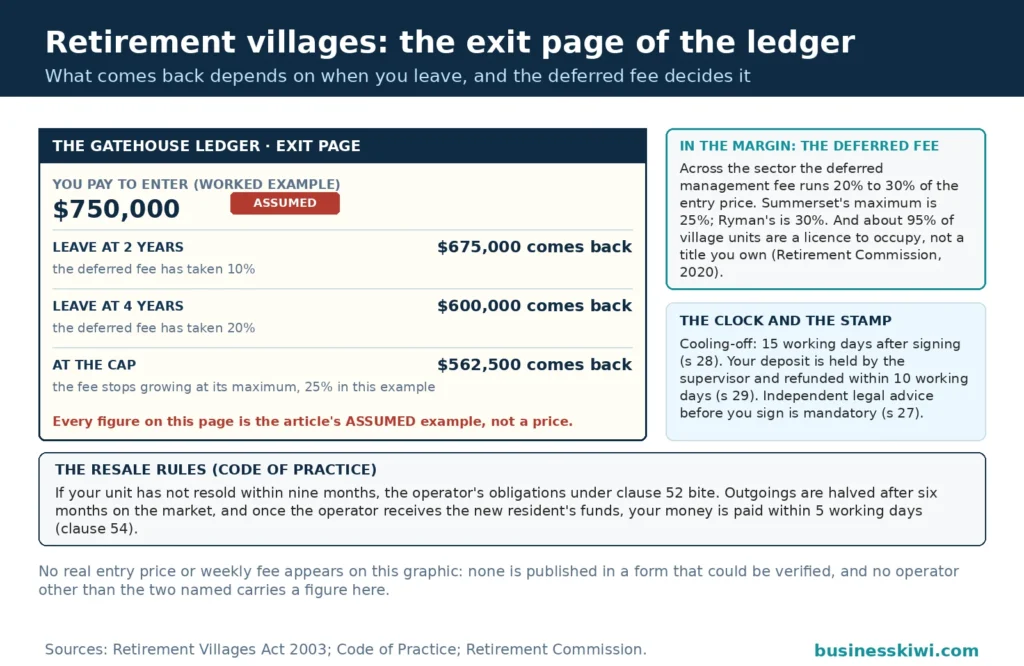
A worked example on assumed figures
The figures in this section are assumed for illustration only and are not a quote from any operator. The structure, a 25 per cent maximum accruing at 5 per cent a year over five years, mirrors structures operators publish, but your disclosure statement governs your actual numbers.
Assume an entry price of $750,000, and a deferred management fee accruing at 5 per cent of the entry price for each of the first five years, capped at 25 per cent. Each year of accrual is $37,500.
If the resident leaves after two years, the accrued fee is 10 per cent, or $75,000, and the amount repayable is $675,000, before any outstanding charges. After four years, the accrued fee is 20 per cent, or $150,000, and the repayment is $600,000. From five years on, the fee sits at its 25 per cent cap of $187,500 and the repayment is $562,500, however long the residency continues.
The example excludes any share of capital growth, because under this assumed licence the resident is not entitled to one, and any interest on the capital while held. Weekly fees paid across the residency are a separate cost and are not deducted again at exit.
Leaving the village: exit and repayment rules
An occupation right agreement ends when the resident leaves permanently, moves into care under a new arrangement, or dies. The question families ask most is simple: when does the money come back? Under the licence model the honest answer is: when the unit is re-licensed, subject to Code of Practice backstops and any better terms your own agreement offers.
Where the operator is responsible for selling the unit, Code clause 51 requires the operator to promptly start the re-licensing process, take proper steps to market the unit, and take all reasonable steps to complete a new agreement in a timely manner for the best price reasonably obtainable. The operator must consult you or your estate about the marketing, keep you informed at least monthly, and report in writing if no new agreement has been entered into within three months of termination, and monthly after that. If six months pass without a new agreement, the operator must obtain, at its own expense, a valuation from an independent registered valuer experienced in retirement village units, and market the unit at that valuation; you may obtain a second valuation at your own cost that the operator must consider. You may also introduce a buyer yourself, and if a person you introduce buys, any sales costs charged to you are limited to actual costs incurred. The operator may instead agree to buy your interest itself, and must then pay within 20 working days of that agreement.
Code clause 54 then governs the money during the wait. Charges for personal services stop on the date the resident stops living in the unit permanently. Outgoings, the weekly fee element, can continue after termination, but if no new occupation right agreement has been entered into, the operator must reduce the outgoings charged to the former resident by at least 50 per cent once six months have passed since the later of the termination date and the date the resident left and removed all their possessions. The fixed deduction must not keep accruing past the date the former resident is actually paid. Where the operator sells the unit, it must pay everything owing no later than five working days after it receives the new resident’s payment in full.
Individual operators may contract for better terms than the Code floor, and the largest do. Summerset’s published terms promise that the repayment sum is paid once the home has been resold and settled, or within six months of you vacating, whichever is earlier, and that your weekly fee ceases when the keys are handed back and the property is vacant. Ryman’s published terms promise a refund of the entry payment less the DMF when a new resident settles, or within 12 months of leaving, whichever comes first, with interest paid if a new resident has not settled within six months of your departure, and no capital gains or losses for residents.
On death, the agreement terminates under its terms and the repayment entitlement forms part of the estate, paid once the exit process completes. Because the wait for re-licensing can run for months, executors should not promise beneficiaries a distribution date based on the village money. Note too that, under clause 52 of the Code, a complaint about the operator’s handling of the disposal can be brought at any time, but a dispute notice about the disposal itself cannot be given until nine months after the unit became available for reoccupation.
Change is coming to this part of the system. The Commission’s monitoring page records that a reform package has been announced under which operators would have to repay net termination proceeds within a nine-month statutory timeframe, make an initial 10 per cent repayment to former residents who leave to live elsewhere, and stop weekly fees and deductions accruing once a resident vacates. The Commission notes the repayment changes would apply only to agreements signed one year after the new Act is passed. Those are announced reforms, not current law.
Complaints and disputes
Every operator must run a complaints facility and make it known to residents. The Code of Practice requires a written complaints policy in plain English, sets out how a formal complaint is made (in writing, signed and dated, with help available if you cannot write it yourself), and requires the operator to acknowledge it in writing within five working days and keep you informed of progress. The operator first works directly with you, aiming to resolve the complaint within 20 working days. If that fails, the operator must refer it to the village’s statutory supervisor, who gives an impartial perspective and recommends a way forward. If it is still unresolved 20 working days after that referral, the operator must offer mediation by an independent mediator from an agency approved by the Retirement Commissioner; where the dispute is between a resident and the operator, the operator pays the mediator’s costs.
If a complaint cannot be resolved, Part 4 of the Act provides dispute resolution by a disputes panel. A resident gives a dispute notice to require resolution, but generally only after the dispute has been through the complaints facility and 20 working days have elapsed since that referral. A resident can take disputes about decisions affecting their occupation right or access to services, changes to charges, deductions imposed when an occupation right ends, and alleged breaches of the Code of Residents’ Rights or the Code of Practice. Panel members are drawn from people the Retirement Commissioner has approved as eligible for appointment, the operator must appoint the panel and secure its independence, and, unless the panel decides otherwise, the operator meets the panel’s costs, although the panel can award costs in favour of a successful applicant. Panel decisions are recorded in writing and are enforceable.
Residents can also raise concerns informally at any time, and take an alleged breach of the Code of Residents’ Rights directly to the statutory supervisor instead of, or as well as, a formal complaint.
Frequently asked questions
Do you own a retirement village unit?
Under a licence to occupy, no. You hold a contractual right to occupy the unit while the operator owns the land and buildings. A minority of residents hold unit titles, a genuine ownership interest, but even those sit under an occupation right agreement and the Retirement Villages Act.
What is a deferred management fee, in plain terms?
It is the slice of your entry payment the operator keeps when you leave. It accrues over your first years in the village up to a capped percentage of what you paid in, covering long-term costs such as communal facilities, management, maintenance, and refurbishing and reselling your unit. Published standard maximums from the two largest operators are 25 per cent at Summerset and 30 per cent at Ryman.
Do weekly fees stop when I move out?
Charges for personal services must stop the day you stop living in the unit permanently. Outgoings, the main weekly fee element, can continue under the Code of Practice after termination, but must be cut by at least half once six months have passed without the unit being re-licensed. Some operators promise more: Summerset states its fee ceases when the keys are handed back and the property is vacant, and Ryman states its fee stops as soon as you move out.
When do I, or my estate, actually get repaid?
Your capital sum is repaid once the unit is re-licensed and that sale settles; the Code requires payment no later than five working days after the operator receives the new resident’s payment in full. Some operators add a long-stop date: Summerset publishes six months from vacating, whichever is earlier, and Ryman publishes 12 months from leaving, whichever comes first, with interest if settlement has not happened within six months. You do not share in any capital gain: the repayment is based on your original entry price, less the deferred management fee.
Can I change my mind after signing?
Yes. The Act requires every agreement to let you cancel without giving a reason by notice within 15 working days of signing, and some operators voluntarily offer longer change-of-mind periods. Your deposit is held independently in the meantime and, on cancellation, is refundable with interest within 10 working days of your request, less tax and any reasonable compensation for services provided or damage.
Who do I complain to if something goes wrong?
Start with the village’s complaints facility, which every operator must run under a written policy. Unresolved complaints go to the statutory supervisor for an impartial view, then to mediation, and finally to a disputes panel under Part 4 of the Act, whose members are approved by the Retirement Commissioner.
This article is general information about how retirement villages in New Zealand are structured and regulated. It is not legal or financial advice, and it does not describe any individual village’s terms. Retirement village contracts are significant long-term financial commitments. Before signing an occupation right agreement, take independent legal advice, as the Retirement Villages Act 2003 requires, and consider independent financial advice about whether the costs and exit terms suit your circumstances.
Sources
- New Zealand Parliamentary Counsel Office, Retirement Villages Act 2003, legislation.govt.nz
- Ministry of Housing and Urban Development, Retirement Villages Code of Practice 2008 (incorporating variations 2017), hud.govt.nz
- Te Ara Ahunga Ora Retirement Commission, Retirement Villages Legislative Framework: Assessment and Options for Change 2020, cffc.govt.nz
- Te Ara Ahunga Ora Retirement Commission, Monitoring and reports, retirement.govt.nz
- Te Ara Ahunga Ora Retirement Commission, Code of Residents’ Rights, retirement.govt.nz
- Ryman Healthcare, Financial certainty, rymanhealthcare.co.nz
- Ryman Healthcare, What is a deferred management fee, rymanhealthcare.co.nz
- Summerset Group, Understanding the costs, October 2025, assets.ctfassets.net