Spanish Classes Online: How to Choose and Learn from NZ
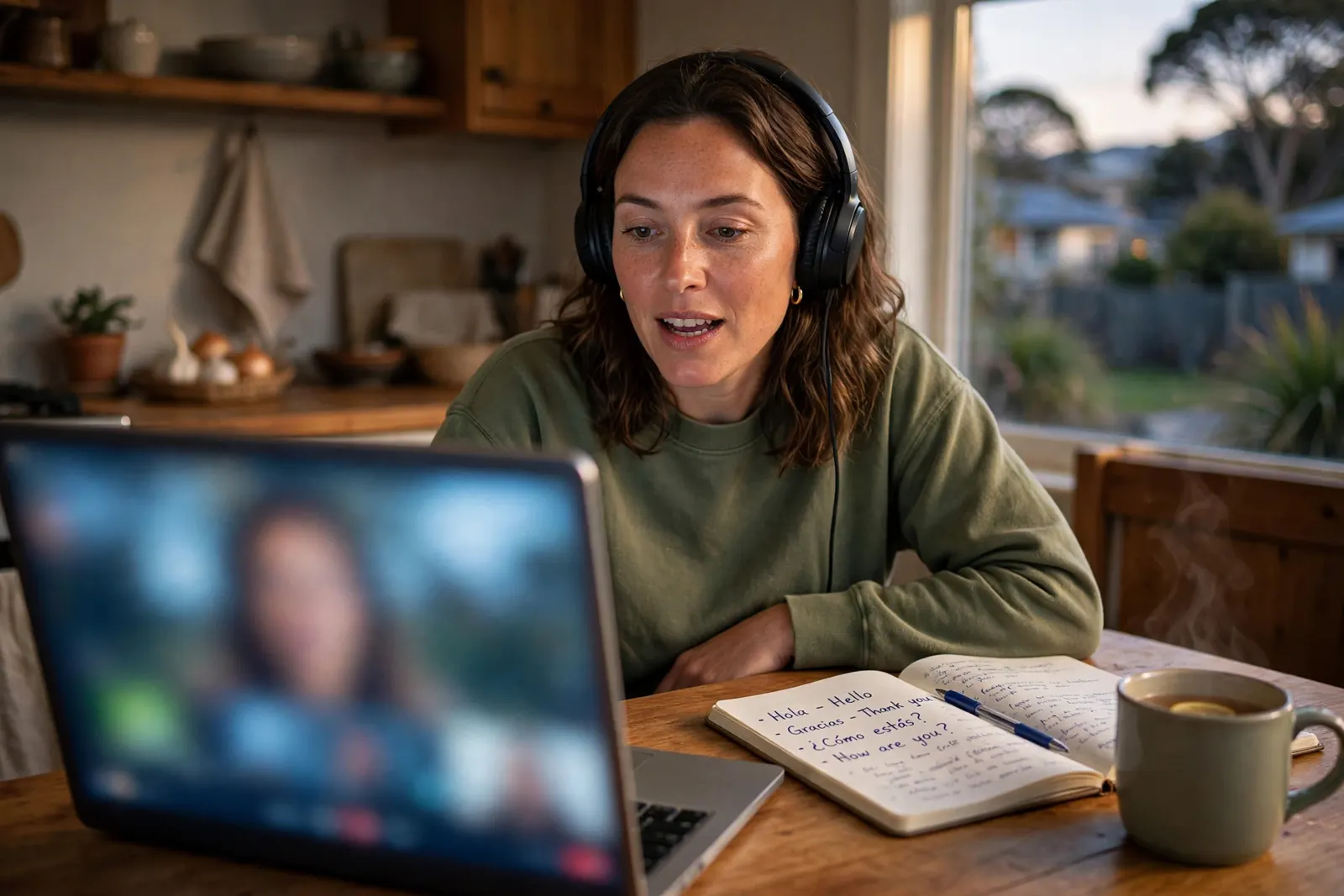
Search for Spanish classes online and the results blur together. A 25-minute video call with a tutor in Bogotá, a term of evening group lessons run from Auckland, a self-paced course built by Spain’s national language institute and a phone app with a cartoon owl all get sold under the same label. They are not the same product, and the differences matter more than the branding.
From New Zealand you can reach all of them. This guide sorts the options by format, explains how the main providers in each format actually work and charge, and lists the checks worth making before you hand over money. For the wider picture of how adults learn the language, what the levels mean and how long progress realistically takes, see our guide to learning to speak Spanish. This page stays with the classes themselves: what you are buying, and how to buy well.

Four formats, four different products
One-to-one tutoring marketplaces. You choose an individual tutor, book lessons at times that suit you, and pay per lesson or through a lesson subscription. The tutor sets the pace and content around your goals. Flexibility is the selling point, and so is speaking time: in a private lesson, roughly half the talking is yours.
Live group classes with an online language school. You join a small class by video, follow a set curriculum and learn alongside other students at the same level. Lessons run to a timetable, though the bigger international schools teach across time zones, so early morning and late night slots exist for New Zealanders.
Term courses from institutions and local schools. Universities, cultural institutes and New Zealand language schools run structured courses over a set number of weeks, usually following the CEFR levels described below. You enrol for a term, attend at the same time each week, and work through a textbook or course platform. Less flexible, more structured, and often the easiest option to stick with.
Self-paced apps and courses. No teacher, no timetable. You work through lessons on your phone or computer whenever you like, with exercises marked automatically. Apps are the cheapest way in and a useful daily habit, but nobody corrects your pronunciation in real time or notices when you quietly stop showing up.
Many learners end up combining formats: an app for daily practice, a live lesson each week for speaking. That mix is worth keeping in mind as you read the provider details, because the formats complement each other rather than compete head-on.
One-to-one lessons: italki and Preply
The two biggest tutoring marketplaces work in broadly the same way. You browse tutor profiles, filter by price, availability and specialisation, watch introduction videos, read reviews from other students, then book a trial lesson before committing.
italki is the pay-as-you-go option. Each tutor sets their own per-lesson price, and you pay for lessons individually rather than through a subscription. Profiles are labelled by tutor type, which is a distinction worth understanding. Professional Teachers are qualified language teachers. Community Tutors are native or near-native speakers who offer conversation practice and informal tuition, usually at lower prices. Lessons take place in italki’s own Classroom platform, which handles scheduling, payment and reminders. Many tutors offer a shorter trial lesson at a reduced rate so you can test the fit. Because tutors are based everywhere from Madrid to Mexico City, their availability is shown against your time zone, and New Zealand learners often find the best overlap with Latin American tutors in our morning and with Spanish tutors late at night.
Preply runs on a subscription of lessons with one tutor. You start with a trial lesson, offered at 25 or 50 minutes in Preply’s virtual classroom, then subscribe to a lesson plan built around how many sessions a week you want. Preply states that you can reschedule, pause or switch tutors, and unused lessons sit in your balance while the plan runs. The practical difference from italki is commitment: a subscription suits people who want a fixed weekly rhythm with the same teacher, while pay-as-you-go suits irregular schedules.
With either platform, the quality control is mostly yours. Read the profile properly. Look for teaching qualifications, how many lessons the tutor has taught, and whether reviews mention the kind of learning you want, whether that is grammar groundwork, conversation confidence or DELE exam preparation.
Group classes by video: Lingoda and a New Zealand option
Lingoda describes itself as an online language school rather than a marketplace, and the structure shows it. Spanish classes follow a set curriculum aligned to the CEFR, with downloadable materials and a short quiz after each class. Group classes are capped at five students, so you join two to four classmates from around the world for a 60-minute lesson on Zoom with a certified, native-level teacher. Spanish is offered from A1 (absolute beginner) to B2 (upper intermediate). A free placement test, which Lingoda says takes about five minutes, points you at a starting level.
You buy classes through a subscription. The Flex plan lets you adjust the intensity every four weeks and choose between group and private classes. The Sprint is a two-month challenge of 15 or 30 group classes a month, with half your money back if you complete it under Lingoda’s rules. A seven-day trial covers up to three group classes or one private class, depending on the plan. Because teachers work across time zones, classes run around the clock, which is genuinely useful from New Zealand.
The local alternative looks quite different. The Spanish Institute, based in Auckland, teaches online group classes across New Zealand by Google Meet, at fixed times each week. Courses run for eight weeks with one 90-minute class a week (12 hours in total), follow the CEFR from A1 through to C2, and are taught by certified native-speaking teachers from Spain and Latin America. Groups are small, materials are included, and the institute is also New Zealand’s only online examination centre for the SIELE Spanish proficiency exam. A set timetable in New Zealand time is the trade-off: you gain a routine and classmates on the same clock, and lose the book-any-hour freedom of the global platforms.
Structured courses: Instituto Cervantes and university study
If you want a course designed by the institution that also runs Spain’s official Spanish exams, AVE Global is it. Built by the Instituto Cervantes, it offers 16 courses covering CEFR levels A1 to C1. Each full course is about 30 hours of work, which you access for three months and complete at your own pace, with videos, interactive exercises and self-assessment built in. Shorter 10-hour topic lessons, with three weeks of access, suit a quick refresh. A proficiency test on the site helps you pick a level, and if you complete at least 65 percent of a course’s activities you can request an academic notification of completion from the Instituto Cervantes.
AVE Global is self-study by default, but individual Cervantes centres sell tutor-supported versions. The Sydney centre, the closest to New Zealand, pairs the online course with written tasks corrected by a tutor and four 30-minute Zoom tutoring sessions. Centres set their own prices for this, so check what the tutor support includes before assuming it matches the self-study version.
New Zealand universities teach Spanish too. Auckland, Victoria University of Wellington and Waikato all run staged Spanish papers, from beginners’ courses such as Auckland’s SPANISH 104 upwards, and the Spanish Institute’s course pages treat those papers as equivalent entry points to its own levels. University study is the heavyweight option: assessed, credit-bearing and priced like university study. Continuing education and short course offerings change from term to term, so check the institution’s own catalogue for what is running online in the semester you want, rather than relying on a course listing from a previous year.
One clarification that saves confusion later. A course completion certificate, from any provider, is evidence you finished a course. It is not an official language qualification. If an employer, university or immigration process needs formal proof of your Spanish, the recognised routes are exams: DELE, run by the Instituto Cervantes, and SIELE, which can be sat online through the Spanish Institute in New Zealand.
Apps for daily practice: Duolingo, Babbel and Busuu
Apps are the self-paced end of the market, and the three best-known names take slightly different approaches.
Duolingo is free to use, with an optional paid tier called Super Duolingo. Lessons are short and game-like, built around points, streaks and reminders, and Duolingo says its courses teach reading, writing, listening and speaking. It is the easiest habit to start and the hardest to mistake for a class: there is no teacher, and feedback is automated.
Babbel organises Spanish into CEFR-labelled levels, from Newcomer (A1) to Advanced (C1), and starts you with a free assessment quiz. A free account gives access to selected lessons at every level; a subscription unlocks the full course. Babbel leans harder on grammar explanation and review, using spaced repetition to resurface vocabulary before you forget it, and its Babbel Speak tool offers AI conversation practice.
Busuu sits between the two. Its Complete Spanish course runs from A1 to C1 across more than 510 lessons, and a separate Latin American Spanish course is available if that is the variety you are aiming for. The distinguishing feature is its community: exercises can be corrected by native Spanish speakers who are themselves learning other languages. Busuu works to a personalised study plan based on the days and minutes you say you can manage.
Treat apps as the practice layer. Ten or fifteen minutes a day builds vocabulary and keeps structures fresh between live lessons, which is where speaking confidence actually comes from.
What you will pay
Pricing models differ enough that comparing headline figures across formats misleads. What to expect, format by format:
- Tutor marketplaces: a per-lesson price set by each tutor. Professional teachers charge more than community tutors, and popular tutors charge more than new ones. italki takes payment per lesson; Preply sells a recurring lesson subscription. Most prices are displayed in US dollars.
- Lingoda: a subscription bought in four-week cycles of class credits. The price per class falls as the plan gets bigger, and private classes cost more than group ones. Lingoda directs buyers to the live pricing selector on its site, since prices vary by currency and promotion.
- Spanish Institute (NZ): NZ$180 for an eight-week online group course, including materials, with no membership fees or contracts (checked October 2026). Private online lessons are listed at NZ$40 on the same page.
- Instituto Cervantes Sydney, AVE with tutor support: A$280 for 90 days of course access including tutor-corrected written work and four Zoom sessions (checked October 2026).
- Apps: a free tier or free sample lessons first, then a monthly or annual subscription. Annual plans are usually much cheaper per month than rolling monthly ones.
Two money details apply across the board. First, most international platforms bill in US dollars or euros, so the figure on your card statement will move with the exchange rate and may include a bank conversion fee. Second, free trials on subscription services generally convert to paid plans automatically. More on that in the checks below.
Checks to make before you pay
- Use the trial first. Nearly every provider in this guide offers a low-risk first step: a discounted trial lesson on italki, a trial lesson on Preply, a seven-day trial at Lingoda, free lessons on Babbel, a free account on Duolingo and Busuu, a level test and demo on AVE Global. Take it. Teaching style is a personal fit, and one lesson tells you more than any review page.
- Read the cancellation and refund terms before subscribing, not after. Check how much notice a lesson cancellation needs, what happens to unused lesson credits if you pause, and whether a refund window exists. These terms sit in each provider’s help centre or terms page, and they vary more than the marketing does.
- Set a diary reminder for every trial end date. Subscription traps are a known problem with online services generally. Consumer Protection New Zealand advises checking the terms before you buy online, and notes that while the Fair Trading Act can apply to overseas sellers, enforcing your rights against a business on the other side of the world is harder in practice. Cancelling two days early beats arguing later.
- Check the tutor’s actual qualifications. On marketplaces, anyone profiled as a Community Tutor may be a wonderful conversation partner without any teaching training. If you want structured teaching, look for Professional Teacher status, a language teaching qualification (often listed as ELE, meaning Spanish as a foreign language), and, for exam goals, DELE examiner or preparation experience.
- Confirm the CEFR alignment, and take the placement test. The CEFR is the six-level scale, A1 to C2, maintained by the Council of Europe and used across the industry to describe what learners can do at each stage. A course that names its CEFR levels gives you a map and a way to change providers later without starting again. If you have some Spanish already, a placement test beats guessing: Lingoda, Babbel and AVE Global all offer one free.
- Check class size, lesson length and the timetable in New Zealand time. A group class of five is a different experience from a group class of fifteen. Lesson lengths run from 25-minute trials to 90-minute term classes. And a class advertised for “evenings” may mean European evenings, which land in the small hours here.
- Decide which Spanish you are learning. Tutors and courses come in both European and Latin American varieties. Neither is better, but vocabulary and pronunciation differ in everyday words. If your goal is travel in Mexico, a course in Latin American Spanish (Busuu has one) or a tutor from the region makes sense. If it is Spain, choose accordingly.
- Ask what happens if a course does not run, and what the technology demands. Term courses occasionally cancel for low enrolments; know whether you get a refund or a transfer. For live classes generally, you need a stable connection, a device with a camera and microphone, and whatever video tool the provider uses, such as Zoom or Google Meet.
Getting value once you have enrolled
The learners who progress are rarely the ones with the most expensive plan. They are the ones whose lessons actually happen. Book a regular weekly slot and treat it like any other appointment. If your schedule is chaotic, pay-as-you-go tutoring or a 24-hour class timetable fits better than a fixed term course you keep missing.
Use the material between lessons. Lingoda provides downloadable class materials and quizzes. italki tutors commonly set homework or share resources, and its optional Plus subscription turns lessons into summaries and flashcard sets. Ten minutes of app practice on the days between live lessons is usually enough to arrive at the next class with last week’s Spanish still warm.
Tell your tutor or teacher what the Spanish is for. A trip to Peru, a job application, a DELE exam and a partner’s family in Chile all call for different lessons, and a good teacher will adjust vocabulary, pace and homework once they know. Finally, reassess yourself against the CEFR can-do descriptions every few months. Knowing you have genuinely moved from A2 to B1 is motivating, and it tells you when a course has stopped stretching you.
Common questions
Will I get a certificate?
Most providers issue a completion record of some kind. AVE Global learners who finish at least 65 percent of course activities can request an academic notification from the Instituto Cervantes. For formal, externally recognised proof of level, sit an official exam instead: DELE or SIELE.
How many classes a week should I take?
One live lesson a week, backed by short daily practice, is a sustainable rhythm for most working adults and enough for steady progress. Intensive options exist, such as Lingoda’s Sprint at 15 or 30 classes a month, if you have a deadline and a clear run of weeks.
Spain Spanish or Latin American Spanish?
They are mutually intelligible, and the grammar you learn is the same. The differences sit in pronunciation and everyday vocabulary. Choose the variety that matches where you will use the language, and do not lose sleep over it at beginner level.
Can school students take online Spanish classes?
Yes, with the right provider. Marketplace tutors teach children as well as adults, and the Spanish Institute offers private online lessons aimed at students preparing for NCEA, IB, SIELE and DELE assessments. Check each provider’s age policy before booking.
Sources
- italki, Spanish tutors and how italki works: https://www.italki.com/en/teachers/spanish and https://www.italki.com/en/blog/what-is-italki
- Preply, online Spanish tutors: https://preply.com/en/online/spanish-tutors
- Lingoda, live online Spanish classes: https://www.lingoda.com/en/spanish/
- Spanish Institute (New Zealand), online Spanish courses: https://www.spanishinstitute.co.nz/classes/spanish-online-courses.html
- Instituto Cervantes, AVE Global online Spanish courses: https://ave.cervantes.es/en/content/what-ave-global
- Instituto Cervantes Sydney, AVE online courses with tutor support: http://sidney.cervantes.es/en/courses_spanish/spanish_courses_online_ave/spanish_online_courses_ave.htm
- Duolingo, Spanish course: https://www.duolingo.com/course/es/en/Learn-Spanish
- Babbel, learn Spanish: https://www.babbel.com/learn-spanish
- Busuu, learn Spanish online: https://www.busuu.com/en/course/learn-spanish-online
- Council of Europe, the CEFR levels: https://www.coe.int/en/web/common-european-framework-reference-languages/level-descriptions
- Consumer Protection New Zealand, online shopping and your rights: https://www.consumerprotection.govt.nz/general-help/ways-to-buy-and-pay/online-shopping
Browse more study and career guides in our Jobs and Education section.