Traffic Cones in NZ: Sizes, Road Rules and What to Buy
The traffic cone is the most recognised piece of safety gear in New Zealand, and one of the most misunderstood. Kiwis joke about the sheer number of cones on our roads, yet behind every properly run roadwork site sits a set of rules dictating how tall a cone must be, what colour, how reflective at night, and who may put it on the road in the first place. Buy the wrong cones, or put the right ones out without a plan, and you can fail an audit or put workers at risk.
This guide explains traffic cones the New Zealand way: what they are used for, the types and sizes sold here, the requirements under NZ Transport Agency Waka Kotahi (NZTA) guidance, how weight and base design affect stability, what cones are made from, and what they cost, using prices published by NZ suppliers on their own websites. It is an explainer for businesses, contractors and event organisers, not a substitute for a traffic management plan or professional TTM advice.
The short answer
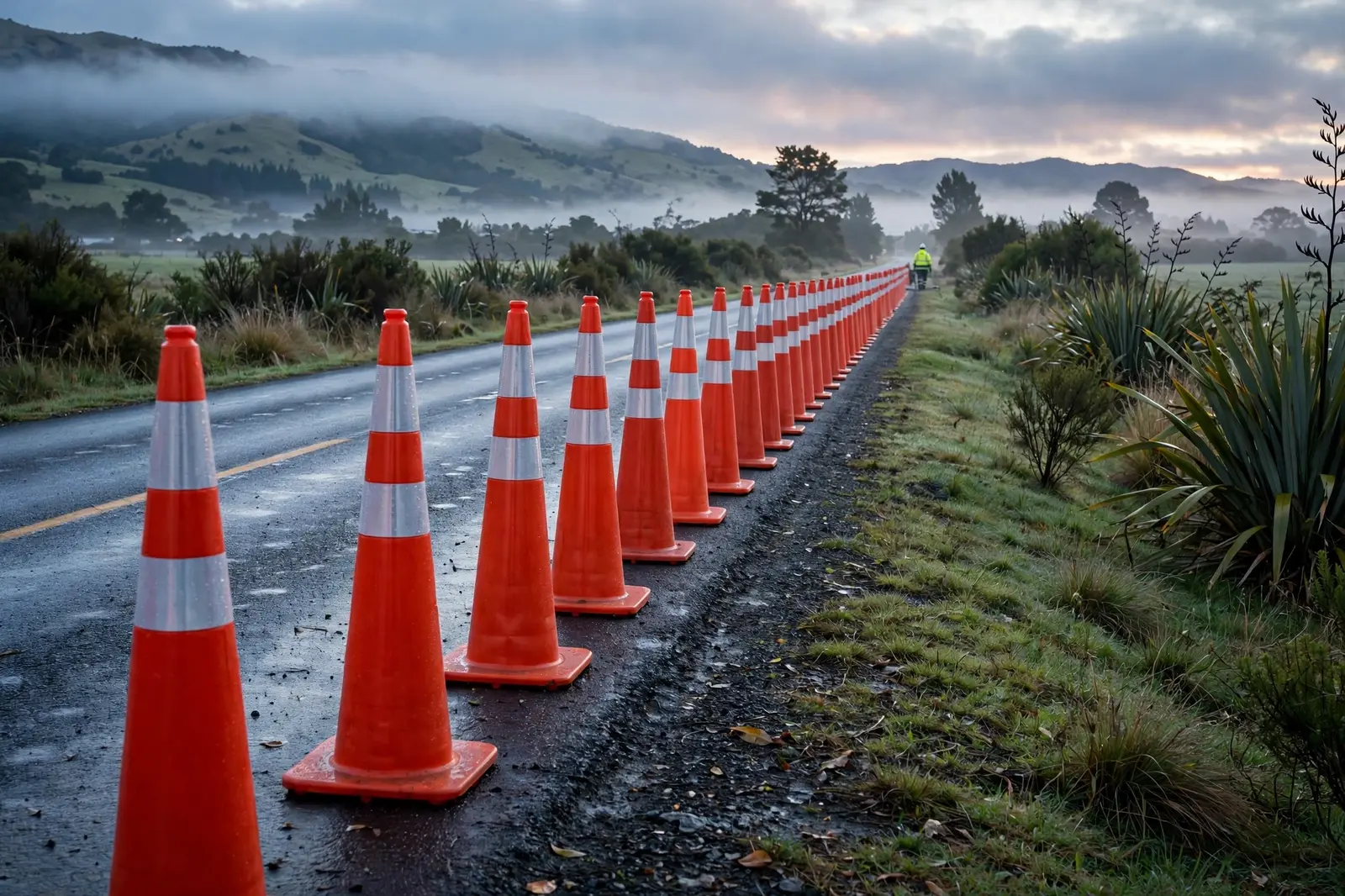
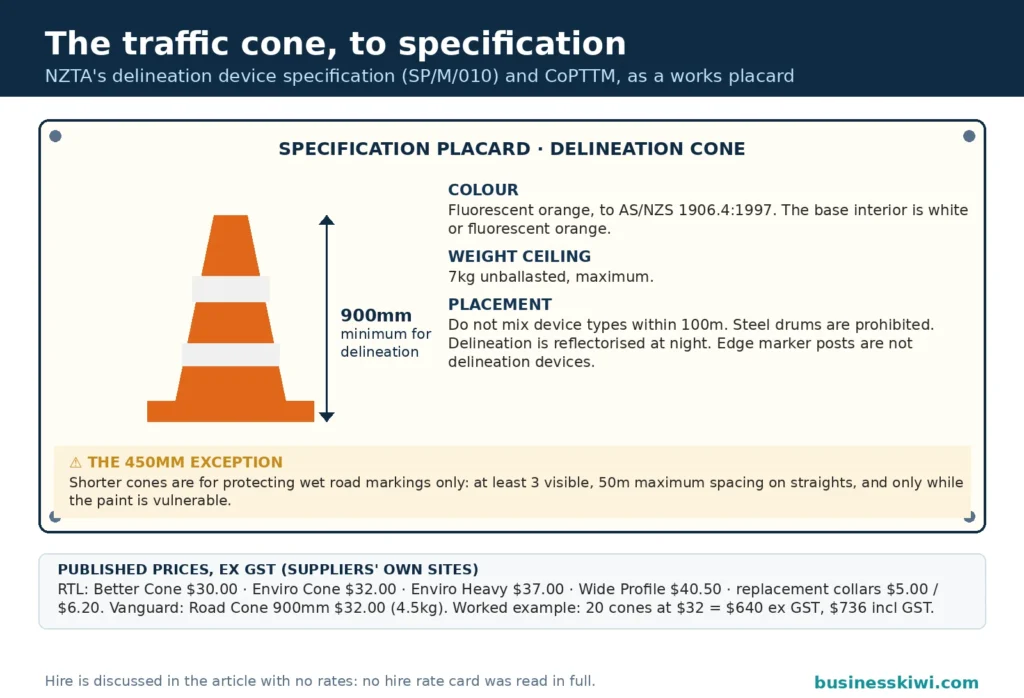
If you only remember three things, make them these. First, cones used to delineate traffic on New Zealand roads need to be at least 900mm tall, fluorescent orange, and fitted with retro-reflective collars for night visibility. Small cones sold for driveways and sports fields do not meet the road standard, with one narrow exception: 450mm cones may be used on roads only to protect fresh, wet road markings. Second, a cone is a delineation device, not a safety barrier: it guides road users and marks out a work area, but it will not stop a vehicle, so it sits inside a wider system of signs, temporary speed limits and planning. Third, putting cones on a road is regulated work: any activity that changes how a road normally operates needs temporary traffic management planned by competent people, usually under an approved traffic management plan, and businesses have duties under the Health and Safety at Work Act 2015 for everyone affected.
What traffic cones are used for
Roadworks and temporary traffic management. This is the cone’s main role in New Zealand. Cones are classed as delineation devices: they mark tapers guiding traffic around a closed lane, form temporary lanes, edge a working space, and show drivers which side of a hazard to pass on. NZTA guidance notes that cones and tubular delineators are mainly used to mark tapers and form temporary lanes, while larger barrels are used where bulk is needed.
Work sites off the road. On construction sites, depots and yards, cones mark exclusion zones, pedestrian routes, delivery areas and hazards such as open excavations or fresh paint. WorkSafe’s guidance on managing work site traffic recognises road cones as a simple way to indicate traffic routes within a site.
Events, parking and emergencies. NZTA’s guide to temporary traffic management expressly covers events as well as roadworks. Cones mark closures, detours, parking areas and pedestrian channels at everything from school galas to marathons, and businesses use them on private land to reserve parks, protect loading zones and keep fire lanes clear. Linked with cone bars, lightweight poles connecting the tops of two cones, they form a quick pedestrian channel, although NZTA is clear that cone bars guide pedestrians and must not replace a safety fence. Collapsible cones are carried by breakdown services and motorists as temporary emergency hazard indicators around a crash or a stalled vehicle until proper traffic management arrives.
Types and sizes of traffic cones
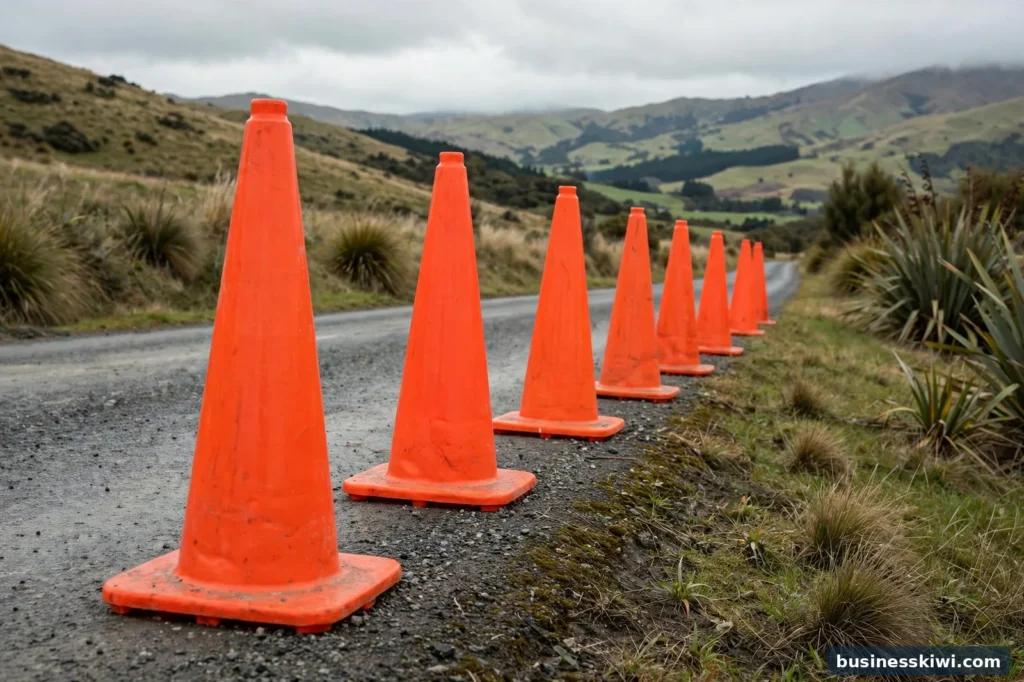
A standard 900mm road cone from a mainstream supplier weighs around 4.5kg, and that weight is deliberate. NZTA’s device specification pairs the 900mm minimum height with an unballasted weight limit of 7kg, because a cone must be stable in traffic wash and wind, yet light and flexible enough to be knocked down or run over without damaging a vehicle or becoming a projectile.
The New Zealand rules for traffic cones
The framework: NZGTTM first, CoPTTM behind it
NZTA is responsible for setting the requirements for temporary traffic management on all New Zealand roads. Its newer guide, the New Zealand Guide to Temporary Traffic Management (NZGTTM), takes a risk-based approach: assess the risks at each site first, plan how to manage them, and only then decide on control types and equipment. It is written for road construction and maintenance, events, emergency response and any other activity that needs a temporary road design.
The older Code of Practice for Temporary Traffic Management (CoPTTM) is the detailed rulebook the industry worked to for years, with prescriptive layouts and device specifications. NZTA has been clear about the direction of travel: the NZGTTM will eventually replace CoPTTM, CoPTTM is no longer the preferred guidance for managing risk at worksites, and since 1 November 2024 it has remained available on the NZTA website but is not updated or maintained. NZTA recommends that road controlling authorities and contractors follow the NZGTTM. In practice, the detailed cone specifications suppliers build to come from the CoPTTM era and NZTA’s safety hardware specification (suppliers commonly cite NZTA M23 Appendix F and CoPTTM compliance, often described as TTMC compliance), while the planning philosophy is now the risk-based NZGTTM, aligned with WorkSafe’s good practice guidelines.
Height, colour and reflectivity
The core physical requirements for cones used as delineation devices on the road are consistent across NZTA guidance and the products built to it:
- Height. At least 900mm for delineation on roads. In road marking operations, CoPTTM states that cones protecting new markings must be at least 450mm high and every other cone at least 900mm, which sums up the general position: 900mm is the road cone, 450mm a specialist exception.
- Colour. Fluorescent orange. NZTA’s device specification ties the colour to AS/NZS 1906.4:1997, the joint standard that sets chromaticity coordinates and minimum luminance factors for fluorescent materials, so the orange is a defined, testable colour rather than a matter of taste. The inside of a cone’s base must be white or fluorescent orange, so the cone stays visible even when knocked flat.
- Reflective collars. Road cones carry retro-reflective collars, typically an upper and a lower collar, so they show up in headlights at night. Suppliers state that their collars meet AS/NZS 1906.1, the standard for retro-reflective materials and devices for road traffic control. Collars are often recessed into the cone body or made from tear-resistant material, because the collar is the part most likely to be damaged when a cone is clipped.
How cones are used in a compliant setup
Owning compliant cones is only half of compliance. The other half is how they are laid out, and that is set by the site’s traffic management plan rather than by the person unloading the truck. CoPTTM’s rules on use and placement are clear: devices are placed in accordance with the layout distances for the road, installed in straight lines or smooth curves so drivers can read the intended path at a glance, and different types of device should not be mixed over distances of less than 100 metres. Edge marker posts, the white posts with red reflectors on rural roads, do not meet the requirements for temporary delineation and must not be pressed into service as substitutes, and steel drums are prohibited as delineation devices.
For wet paint protection the placement rules are specific: at least three cones visible to approaching road users at any time, spacing no more than 50 metres on straights and closer on curves, and deployment only while the markings are vulnerable. At night, suitable reflectorised delineation devices must be installed parallel to the direction of traffic, and every temporary warning sign needs a delineation device at its base, on the side drivers are expected to pass.
Your legal duties, beyond the cones themselves
Cones sit inside a legal framework that catches most businesses long before they think about buying hardware. Under the Health and Safety at Work Act 2015, a business or undertaking (a PCBU) must ensure, so far as is reasonably practicable, that workers and other people are not put at risk by its work. WorkSafe’s good practice guidelines, Keeping healthy and safe while working on the road or roadside, explain what that means beside live traffic: working near live traffic will usually require temporary traffic management, and a documented traffic management plan describing its design, implementation, maintenance and removal, created by a suitably qualified planner, with all equipment consistent with the specifications in the plan.
WorkSafe’s guidance also puts cones in their place in the pecking order of controls. The preferred option, where reasonably practicable, is to eliminate the risk by closing the road. Failing that, businesses should physically isolate workers from road users where they can, using measures such as temporary road safety barriers or truck-mounted attenuators, and control how road users move through the site with temporary speed limits, stop/go control or temporary lanes. Cones appear in the guidance as an administrative control, used to keep road users within their lanes and narrow a lane so drivers slow down: they support a safe setup, but on their own they are not the setup. On state highways Waka Kotahi will usually require the NZGTTM to be followed, and on local roads the road controlling authority sets the requirements, so most suburban approvals sit with councils.
Weights, bases and stability
Stability comes from three things. The first is base design: compliant road cones carry their weight low, in a broad base, and some NZ designs shape the feet so water flows under the cone rather than pooling against it and shifting it. The second is weight distribution: a one-piece cone with a thicker, heavier lower section stands better than a tall, thin shell. The third is choosing the heavy option where conditions demand it. Suppliers sell heavy or motorway versions of their 900mm cones with a heavier base than the standard model, aimed at motorways, expressways and high-wind areas, and a heavier base also suits long-term sites, reducing the need for double stacking, placing a second cone against the first to hold it down.
Sandbag weights exist for problem spots, but they are a supplement rather than a design feature. If every cone on a site needs a sandbag, the better answer is usually a heavier cone, a different device such as a delineator post or barrel, or a rethink of the layout. And heavier is not always better: the 7kg unballasted ceiling exists because delineation devices are designed to be hit. A cone that folds, flexes or topples absorbs a mistake; a rigid, overweight object turns the same mistake into vehicle damage or worse.
Materials: PVC, rubber and fabric
PVC is the material of modern New Zealand road cones. The mainstream compliant ranges from NZ suppliers are one-piece PVC designs, meaning the cone and its base are moulded as a single unit with no joint to separate on impact. PVC flexes when struck and springs back to shape, handles being run over better than rigid plastics, and takes screen-printed branding well. Suppliers build in improved UV resistance, which matters under New Zealand sun, and test their cones for impact and temperature performance. A good PVC cone should feel supple rather than brittle, and stand square without a lean.
Rubber is the traditional material overseas and still appears in general-purpose cones, often as a moulded rubber base under a plastic body. Rubber bases add weight and grip, but two-piece cones can separate, and cheaper compounds crack and perish in the sun. If you buy rubber-based cones for off-road use, check the base is firmly locked to the body, and expect to retire them sooner than quality PVC.
Fabric and composite designs appear in collapsible cones. RTL’s PortaCone pairs a fluorescent orange nylon outer shell with an internal high-impact PVC inner and base, folds flat enough to fit in a car boot, and includes an internal waterproof LED light for night use. Collapsible cones trade some everyday ruggedness for storage and speed, the right trade for emergency kits. The 900mm version is designed within CoPTTM parameters for height, reflective band width, colour and weight, and the smaller sizes conform to the CoPTTM provision for temporary emergency traffic hazard indicators, so a collapsible cone is legitimate emergency gear rather than a novelty.
Whichever material you choose, look for the same quality tells: even colour, collars sitting flat in their recesses, a hand grip at the top, and internal ribs that stop stacked cones vacuum-locking together.
What traffic cones cost in NZ
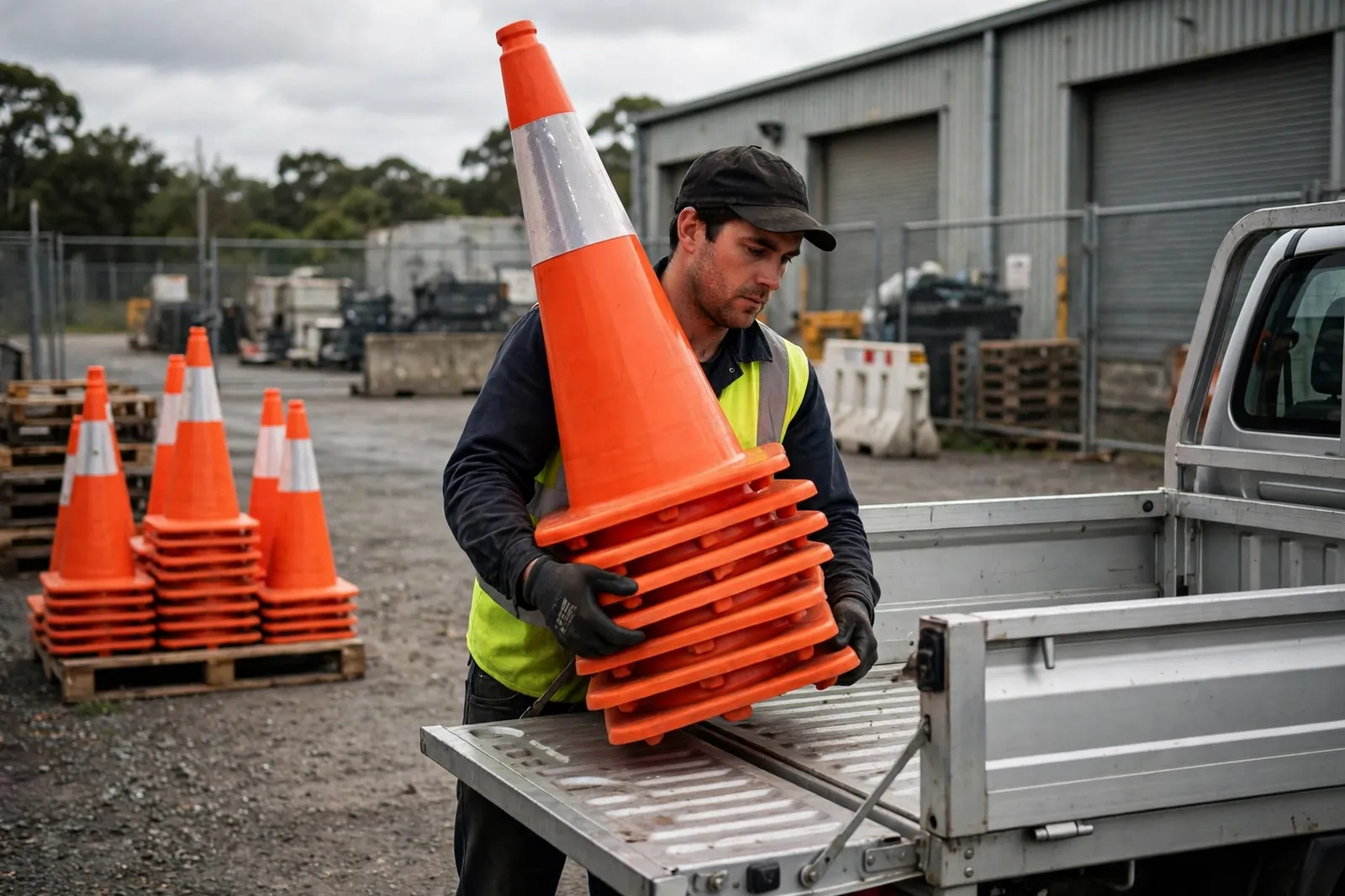
Prices below are the list prices published on each supplier’s own website when this guide was prepared. They exclude GST, freight is extra, and suppliers can change them at any time. The compliant end of the market is tightly priced: a standard 900mm road cone from either supplier profiled here is $32 plus GST.
Example one: equipping a small crew. A drainage contractor wants 20 compliant cones for local road work. Twenty RTL Enviro Cones at $32.00 plus GST come to $640 plus GST, or $736 including GST at 15 percent. Stepping up to the Enviro Heavy adds $5 a cone, taking the fleet to $740 plus GST, cheap insurance on a wind-exposed site.
Example two: maintaining instead of replacing. Collars take the worst of the wear. Replacing the collars on 20 slim profile cones at $5.00 plus GST each costs $100 plus GST, against $640 plus GST for new cones. If the bodies are sound, a collar refresh restores night visibility and compliance for a fraction of the replacement cost.
Budget for the whole system, not just the cones. A working road setup also needs signs, stands and high-visibility gear, plus planning and training costs that dwarf the hardware. Keep road and site fleets separate and clearly marked, because the day a site cone wanders onto a road job it becomes a compliance problem. If you run sites weekly, ownership pays for itself quickly; for occasional use, hiring through a traffic management provider bundles gear with a plan and trained people. Either way, factor in running costs: public liability insurance, storage, transport and replacements.
Care, cleaning and lifespan
A traffic cone has a hard life, and how long it lasts depends mostly on ultraviolet exposure, impacts and storage. There is no official expiry date: the standard is condition-based, so a cone stays in service while it still meets its specification, and comes out when it does not. Build these habits into your operation:
- Inspect on the truck, not at the audit. Check cones as they are loaded and unloaded, and pull out any with split bodies, crushed bases, torn or peeling collars, or colour faded from fluorescent orange towards pale peach. Faded colour and tired reflectors are not cosmetic issues: the specification is written around colour and reflectivity, so a washed-out cone has quietly stopped complying, and CoPTTM covers device quality through its maintenance standards.
- Wash road film off. Diesel soot, dust and overspray dull both the fluoro body and the collars. Warm soapy water and a soft brush restore most of the brightness. Avoid solvents, which can attack PVC and reflective film.
- Store out of the sun where you can. Cones work outdoors, but storing the fleet under cover between jobs slows UV fade. Stack them properly rather than forcing stuck cones apart with a boot.
- Refresh collars before bodies. As the worked example showed, collar replacement is the cheapest life-extension a cone fleet can get.
- Retire and recycle. Cracked, brittle or deformed cones should leave the fleet. At least one NZ supplier runs a recycling programme (RTL’s 2:1 Better Cone Recycling Programme lets customers return old cones when buying its NZ-made Better Cones), which beats landfill and keeps non-compliant gear out of circulation.
Frequently asked questions
What size traffic cone do I need for roadworks in NZ?
For delineation on New Zealand roads, 900mm is the standard: NZTA guidance sets it as the minimum height for cones used as delineation devices, and it is what NZ suppliers build their road ranges around. Smaller cones are for off-road use, with one exception. A 450mm cone may be used on the road only to protect fresh, wet road markings, and even then under rules requiring at least three cones visible to approaching drivers, maximum 50 metre spacings on straights, and deployment only while the paint is vulnerable.
Do traffic cones need reflective collars?
Road cones do. Daytime visibility comes from the fluorescent orange body, and night visibility from retro-reflective collars, typically an upper and lower collar, that return headlight beams to the driver. Suppliers state their collars meet AS/NZS 1906.1, the standard for retro-reflective materials for road traffic control. A cone with missing or shredded collars is not fit for road use at night.
How much does a traffic cone cost in NZ?
A compliant 900mm road cone from a mainstream NZ supplier lists at $30 to $40.50 plus GST depending on the model, with standard cones at $32 plus GST from both RTL and Vanguard Group at the time of writing. Heavy motorway versions cost a few dollars more, and replacement reflective collars start at about $5 plus GST.
Can I put cones on the road myself for a small job?
Not lawfully as a casual exercise. Work that affects a road needs temporary traffic management, usually under an approved traffic management plan prepared by a suitably qualified planner, with the road controlling authority’s requirements met and Health and Safety at Work Act duties covered. For a small business, the practical route is to engage a traffic management provider, or get the training and approvals your council requires. Cones on private land are a different matter.
What does TTMC compliant actually mean?
It is the supplier’s statement that the cone meets NZTA’s temporary traffic management device specifications, commonly cited as NZTA M23 Appendix F and CoPTTM compliance, covering height, colour and reflective collars. It is the phrase to look for when buying cones for road use, and reputable suppliers publish testing certificates. No compliance claim means the cone should be treated as off-road only.
How long do traffic cones last?
There is no fixed lifespan, because retirement is based on condition rather than age. A quality PVC cone, cleaned regularly, stored out of the sun where possible and fitted with fresh collars when the old ones wear, should last for years of regular work. Cones are retired when the body cracks, the base deforms, the colour fades beyond the fluorescent standard, or the collars lose reflectivity.
This guide is general information about traffic cones and temporary traffic management in New Zealand, based on guidance published by NZTA and WorkSafe and on product information from the suppliers named. It is not legal, engineering or safety advice, and it does not replace a site-specific risk assessment or traffic management plan. Requirements change as guidance is updated, and prices were list prices at the time of writing, so check current guidance and confirm prices before you buy or deploy cones.
Sources
- NZ Transport Agency Waka Kotahi, New Zealand guide to temporary traffic management (NZGTTM), nzta.govt.nz
- NZ Transport Agency Waka Kotahi, About the NZGTTM, nzta.govt.nz
- NZ Transport Agency Waka Kotahi, Code of practice for temporary traffic management, nzta.govt.nz
- NZ Transport Agency Waka Kotahi, Code of Practice for Temporary Traffic Management (CoPTTM), 4th edition, sections C and D, nzta.govt.nz
- NZ Transport Agency Waka Kotahi, Code of Practice for Temporary Traffic Management, SP/M/010 delineation device specification (Section B), nzta.govt.nz
- WorkSafe New Zealand, Keeping healthy and safe while working on the road or roadside: guidance for PCBUs, worksafe.govt.nz
- RTL, Road Cones and Delineators range, rtl.co.nz
- RTL, 900mm Enviro Road Cone (TC14 72B2 and TC14 70B2), rtl.co.nz
- RTL, PortaCone Collapsible Road Cone 900mm, rtl.co.nz
- RTL, Enviro Cone and Slimline Cone product brochures, rtl.co.nz
- Vanguard Group, Road Cone 900mm, vanguardgroup.co.nz