Visitor Visa NZ for Parents: Visitor Visa and Parent and Grandparent Options

If your mum or dad lives overseas and you have settled in New Zealand, the first question is usually simple. Which visa lets them come and stay with you for a while? Immigration New Zealand (INZ) has more than one answer, and picking the wrong one can mean a declined application, a shorter stay than the family expected, or medical paperwork nobody warned you about.
This guide walks through the visitor routes that matter for parents: the general Visitor Visa, the Parent and Grandparent Visitor Visa built specifically for this situation, and a short note on the newer Parent Boost Visitor Visa. It covers who sponsors, what evidence INZ asks for, how long parents can stay, and where visiting stops and residence begins. Everything here comes from INZ’s own published pages, checked on 7 October 2026.
Quick answer
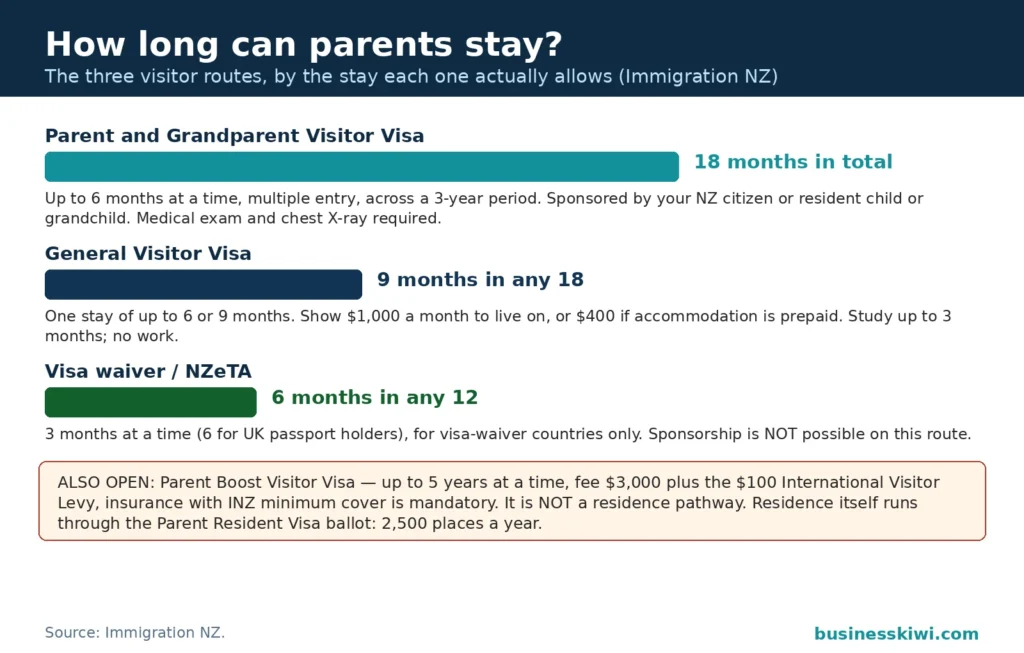
Parents who want to visit, rather than live, in New Zealand generally use one of two visas. The general Visitor Visa suits a one-off trip of up to six or nine months. The Parent and Grandparent Visitor Visa is designed for parents and grandparents of New Zealand citizens and residents who expect to come and go over a longer period: stays of up to six months at a time, up to 18 months in total across a three year visa, with a family member in New Zealand as sponsor. Neither visa is a way to live in New Zealand, and neither leads to residence.
The Parent and Grandparent Visitor Visa in depth
This is the visa INZ built for exactly the situation most readers of this page are in: a multiple entry visitor visa for parents and grandparents, sponsored by their child or grandchild in New Zealand.
Who can apply
The applicant must be the parent or grandparent of a New Zealand citizen or resident, and must be living outside New Zealand when they apply. A partner can be included in the application, provided INZ is given evidence of the relationship, such as a marriage certificate or proof that the couple live together.
The sponsor is the New Zealand based child or grandchild. Where the child or grandchild is aged 17 or younger, their own parent acts as sponsor instead. The sponsor has to meet INZ’s acceptable sponsor requirements, and cannot be sponsoring anyone else at the same time. INZ asks the sponsor for a certified copy of one of the following as evidence of their status: a New Zealand passport, a New Zealand birth certificate, a certificate of New Zealand citizenship, a New Zealand Resident Visa, or an Australian passport. The relationship itself has to be evidenced too, with documents such as a birth certificate, adoption papers or a household registration record showing how the applicant and sponsor are related.
Worth knowing early: INZ itself notes that a parent who only wants a single visit may find the general Visitor Visa the better fit, because it carries fewer requirements. The parent and grandparent visa earns its keep when repeat travel over several years is the plan.
How long parents can stay
The visa works on a pattern rather than one long stay. Each stay can be up to six months. Across the whole visa, the total time in New Zealand cannot exceed 18 months within a three year period. It is a multiple entry visa, so the holder can travel in and out of New Zealand during those three years, but the 18 month cap keeps adding up in the background. The holder must also arrive in New Zealand within 12 months of the visa being granted.
Those limits are the heart of the visa and they are not negotiable at the border. A family planning an 18 month stay in one block is planning something this visa does not allow: six months at a time is the maximum for any single stay, however the trips are arranged.
Money, sponsorship and health care costs
Unlike the general Visitor Visa, this visa does not set a per month funds figure for the applicant on the page INZ publishes. Support runs through the sponsor instead, who completes a Sponsorship Form for Temporary Entry and takes on the undertakings described in the sponsorship section below.
Health care costs sit with the family, not the New Zealand health system. INZ states that the applicant, or their sponsor, will need to pay for any health care or medical assistance the applicant needs in New Zealand. INZ does not make medical insurance a condition of this visa, but it recommends full medical insurance for the stay, and most families will treat that recommendation seriously given what a hospital stay can cost someone who is not eligible for publicly funded care.
Health requirements for this visa
The health evidence for this visa is heavier than many families expect, and it applies even for a first application. INZ requires a chest X-ray and a medical examination. Two qualifications apply. If the applicant has already provided a chest X-ray or medical examination with an earlier application, issued within the last 36 months, they may not need to provide it again. And any evidence provided must be less than three months old when INZ receives it, so timing the medical too early can mean paying for it twice. The reason is the length of stay involved: a visa that can put someone in New Zealand for 18 months across three years is a different health proposition from a three week holiday.
Character requirements for this visa
Police certificates are not required from every applicant. INZ requires them where the applicant is aged 17 or older and the total time they will be in New Zealand, including time spent here in the past, will be 24 months or longer. Certificates are needed from the applicant’s country or countries of citizenship, and from any country where they have spent five or more years since turning 17. A certificate must be less than six months old when INZ receives it, and there is an exemption where one was provided with an earlier application within the last 24 months.
Being a genuine visitor
Like every visitor category, this visa turns on genuine intentions. INZ looks at the information in the application, the applicant’s personal circumstances, and anything the applicant has previously given INZ. The applicant must intend to visit their children or grandchildren, and those family members must intend to be in New Zealand during the visit. Travel that looks like living here in instalments is exactly what the stay limits are designed to prevent.
Fees and processing times
INZ does not print a fee or a processing time on the visa page itself. It publishes both in its online fees and decision times tool, which shows the cost for the applicant’s country and the timeframe INZ is currently working to. Check that tool before budgeting or booking flights.
The general Visitor Visa route
The general Visitor Visa is the standard temporary visa for visiting New Zealand, whether the purpose is a holiday, seeing friends and family, or business visitor activities. For parents, it suits the shorter or one-off trip: a few months with the grandchildren, a family wedding, a first look at the country.
How long parents can stay
INZ describes the stay as up to either six months or nine months, depending on the visa granted. Its Visitor Visa Guide (form INZ 1018) explains the limits behind those numbers. Nine months is the maximum stay on a visitor visa. In some cases a further three months can be allowed, where the visitor has supported themselves financially and has not worked, studied or been sponsored during their stay. Across any 18 month period, a person cannot spend more than nine months in total in New Zealand as a visitor, counted backwards from the last day they intend to be here. Someone who has spent a total of 12 months in New Zealand as a visitor must then remain outside the country for 12 months before a further visitor visa can be approved.
Visitor visa holders cannot work in New Zealand. Study is limited: as INZ puts it when describing visitor visas generally, holders may study for up to three months in each year.
Money: the funds figures INZ publishes
This visa does carry published funds figures. An applicant paying their own way must have at least NZD $1,000 for each month of the stay, or NZD $400 for each month where their accommodation has already been paid for. Evidence can include bank statements, credit card statements, bank drafts or traveller’s cheques, plus proof of any accommodation prepayment, such as hotel vouchers or receipts. INZ sets conditions on bank evidence too: the account must be in the applicant’s name, and the evidence must show which bank the account is with and which currency the money is in.
As with the parent and grandparent visa, the applicant or their sponsor pays for any health care needed here, and INZ recommends full medical insurance.
Sponsorship instead of own funds
An applicant who cannot meet the funds requirement alone can be supported by an acceptable sponsor instead. The sponsor completes a Sponsorship Form for Temporary Entry and can support the application with documents such as recent bank statements, pay slips, an employment agreement, and ownership papers for the applicant’s accommodation or receipts for rent payments. The sponsorship section below explains what the sponsor is actually signing up for.
Partner and children on a general Visitor Visa
A general Visitor Visa application can include the applicant’s partner and dependent children aged 19 or younger, or family members can apply for their own visas. INZ asks for evidence of the relationships and of each person’s identity, and each person included must be of good character and in good health. Family members are assessed in their own right against those standards, rather than simply riding along on the main applicant’s eligibility.
Visa waiver travel and the NZeTA are different things
Parents who hold a passport from a visa waiver country may not need a Visitor Visa at all for a short trip. They travel with a New Zealand Electronic Travel Authority (NZeTA) and are given a Visa Waiver Visitor Visa on arrival. INZ is clear that this is a separate arrangement with tighter limits, not a granted Visitor Visa by another name. A visa waiver visitor can stay for up to three months, or up to six months if they are from the United Kingdom, and visa waiver visitors are limited to six months in any 12 month period in total. They must hold an onward ticket paid for before they travel, with a departure date within three months of arrival, or six months for travellers from the United Kingdom. Partners and dependent children travelling this way each need their own NZeTA and must meet the same requirements themselves.
One difference matters for families planning around sponsorship: a person travelling on a visa waiver cannot have a sponsor pay their expenses. If a parent needs sponsorship to make the trip work, INZ’s position is that they must apply for a visa before travelling.

Sponsorship, explained properly
Sponsorship is the mechanism that makes many parent visits possible, and it is a legal undertaking, not a letter of moral support.
Who can be a sponsor
For temporary entry visas, INZ’s Sponsorship Form for Temporary Entry (INZ 1025) sets out who can sponsor: a New Zealand citizen, or the holder of a New Zealand residence class visa, though a resident visa holder whose visa carries conditions under section 49(1) of the Immigration Act 2009 is not eligible. Organisations, such as New Zealand registered companies, incorporated societies and charitable trusts, can also sponsor, as can government agencies. For the Parent and Grandparent Visitor Visa specifically, the sponsor must be the applicant’s child or grandchild, or that person’s parent where the child or grandchild is 17 or younger, and must meet INZ’s acceptable sponsor requirements.
What the sponsor undertakes
By sponsoring, a person agrees to make sure the person they sponsor has financial support for the duration of their stay, covering maintenance costs such as food, clothing and health care, and to make sure they have suitable accommodation for the whole stay, either by providing it directly or paying for it. The sponsor also guarantees the cost of the sponsored person’s return airfare if that person cannot or will not pay it themselves, and guarantees the costs associated with deportation if the sponsored person is deported, including locating, detaining and maintaining them, and travel costs.
Two features of sponsorship catch people out. First, INZ states plainly that even if the sponsored person has agreed to pay some or all of their own expenses, the sponsor is still legally responsible for those expenses. A private family understanding does not override the undertaking given to INZ. Second, sponsorship cannot be withdrawn. It starts on the day the sponsored person arrives, or the day their visa is granted if they are already here, and it continues until they leave New Zealand or are granted a new visa, even if they stay on after their visa expires. A sponsor of a multiple entry visa is responsible every time the holder is in New Zealand on that visa. Sponsors can also sponsor the partner and dependent children of the person they are sponsoring, covering the same costs for them.
How sponsorship works in an online application
INZ has moved the process online. A sponsor gets a RealMe sharing ID from their own Immigration Online account, and the applicant enters it on the Supporting documents page of their online application. Once the application is submitted, INZ emails the sponsor a link to complete an online sponsorship form, recording their details and their agreement to meet the sponsorship requirements. A sponsor can also apply on the applicant’s behalf using their own sharing ID.
Health and character: the general standards
Every visitor applicant must be in good health and of good character, and INZ scales the evidence to the length and nature of the stay. For short general visits, many applicants provide no medical evidence at all. Longer stays attract more scrutiny, because the potential cost to health services grows with time spent here.
The Parent and Grandparent Visitor Visa sits at the demanding end of that scale: a chest X-ray and medical examination are required up front, and police certificates are required where the applicant’s total time in New Zealand, past and planned, will reach 24 months. Applicants for long or repeated general visits should likewise expect INZ to ask for health or character evidence, and should check the current requirements on the INZ website before applying.
Character is not only about criminal history. INZ’s assessment of genuine intentions draws on the applicant’s circumstances and history, which is why two parents with identical bank balances can receive different decisions. The application should tell a consistent story: a genuine reason to visit, the means to support it, and clear reasons the visitor will leave when it ends.
A short note on the Parent Boost Visitor Visa
Families researching parent visas will also come across the Parent Boost Visitor Visa, a newer option INZ has published detailed information about, with applications open from 29 September 2025. It is a multiple entry visitor visa for parents of New Zealand citizens and residents that allows a stay of up to five years, with the possibility of a second visa taking the total to ten years. It is explicitly not a pathway to residence, and it carries heavier requirements than the two visas above: income or asset tests for the sponsor or the parent, a health standard aligned with the residence standard, and comprehensive health insurance with specified minimum levels of cover, held and maintained throughout. INZ publishes the fee as NZD $3,000 for most applicants, plus the International Visitor Conservation and Tourism Levy of NZD $100, and estimates most applications will be processed within four months. Read INZ’s own pages on it carefully before treating it as the default option; for a straightforward visit, the two routes above remain the usual starting point.

Applying, step by step
Most applications are made online through Immigration Online, using a RealMe account. The documents INZ lists for the Parent and Grandparent Visitor Visa give a good picture of a complete application: a copy of the applicant’s passport or travel document, an acceptable photo, proof of the relationship to the sponsor, the sponsor’s evidence of their New Zealand status, a completed Sponsorship Form for Temporary Entry, and any health or police evidence the visa requires. Documents that are not in English need full translations. Visitor visas are issued electronically as eVisas rather than as a label in the passport.
If an application is declined, INZ’s decision letter sets out the reasons. Declines usually come back to the same handful of issues: unconvincing relationship or sponsorship evidence, health or character evidence that was missing or out of date, or INZ not being satisfied the applicant was a genuine visitor who would leave at the end of the stay. Resubmitting the same evidence and hoping for a different reader achieves nothing. The realistic options are to address the specific gap INZ identified in a fresh application, or to take advice first. Immigration advice in New Zealand can only be given by a licensed immigration adviser or an exempt person such as a New Zealand lawyer, and INZ publishes a register of licensed advisers.
Visiting is not residence: the boundary
Worth being blunt about, because misunderstanding it causes real harm: visitor visas, including the parent and grandparent visa and Parent Boost, are temporary. They do not put a parent on a pathway to residence, time spent here as a visitor does not count toward residence, and using back to back visitor visas to effectively live in New Zealand runs directly into the stay limits and the genuine visitor test. Parents are expected to keep their lives and connections in their home country and to leave when their visa requires it. A parent who stays past their visa expiry becomes unlawful and liable for deportation, and that history will damage any future application.
Parents who genuinely want to live in New Zealand permanently need the residence route. The Parent Resident Visa is that route: it provides 2,500 places per year allocated through a ballot system, with a New Zealand citizen or resident child as sponsor who must meet income requirements. Our guide to the Parent Resident Visa in New Zealand works through how that category operates, including the ballot and the sponsor income settings. Families often run both tracks at once, visiting on a visitor visa while an expression of interest sits in the parent ballot, which INZ’s published information allows, provided the visiting itself always stays within visitor rules.
FAQs
Can my parents live in New Zealand on a Parent and Grandparent Visitor Visa?
No. The visa allows stays of up to six months at a time and no more than 18 months in total over three years. It is a visiting visa, and INZ expects holders to keep their home and connections in their own country.
How much money does a parent need for a general Visitor Visa?
INZ publishes the figures: at least NZD $1,000 for each month of the stay, or NZD $400 for each month if accommodation has already been paid for. An acceptable sponsor can meet this requirement instead.
Does the Parent and Grandparent Visitor Visa need a medical?
Yes. INZ requires a chest X-ray and a medical examination, unless equivalent evidence was provided with an earlier application within the last 36 months. Evidence must be less than three months old when INZ receives it.
Can my parent travel on an NZeTA instead of applying for a visa?
Only with a passport from a visa waiver country, and only for short visits: up to three months, or six months for United Kingdom passport holders, with no more than six months in any 12 month period. Sponsorship is not available under visa waiver travel, so a parent who needs a sponsor must apply for a visa before travelling.
What does it cost to apply for the Parent and Grandparent Visitor Visa?
INZ publishes the fee and current processing times in its online fees and decision times tool rather than on the visa page, and fees vary by the applicant’s country. Check the tool for the current figure before applying.
Sources
Immigration New Zealand, Parent and Grandparent Visitor Visa, immigration.govt.nz
Immigration New Zealand, Visitor Visa, immigration.govt.nz
Immigration New Zealand, Visitor Visa Guide (INZ 1018), immigration.govt.nz
Immigration New Zealand, Visa Waiver Visitor Visa, immigration.govt.nz
Immigration New Zealand, Sponsorship process for a visa, immigration.govt.nz
Immigration New Zealand, Your responsibilities as a sponsor, immigration.govt.nz
Immigration New Zealand, Sponsorship Form for Temporary Entry (INZ 1025), immigration.govt.nz
Immigration New Zealand, Parent Boost Visitor Visa FAQs, immigration.govt.nz
Disclaimer
This article is general information about how these visa categories work, based on Immigration New Zealand’s published pages as at 7 October 2026. It is not immigration advice and does not assess anyone’s eligibility. Visa settings, fees and processing times change, so confirm the current requirements on the INZ website before applying. For advice on your own situation, use a licensed immigration adviser or a New Zealand lawyer.
For more guides in this area, see our Visa & Immigration hub.