Permanent Resident Visa NZ: Eligibility, How to Apply and Processing Times

For most people who settle in New Zealand, residence comes in two stages. The first is a resident visa, which lets you live here permanently but puts an expiry date on your right to come and go. The second stage is the Permanent Resident Visa (PRV). It removes that expiry date for good. This guide explains who qualifies, the five ways Immigration New Zealand (INZ) lets you show commitment to New Zealand, how the application works, and how long a decision takes, based on what INZ itself publishes.
The short answer
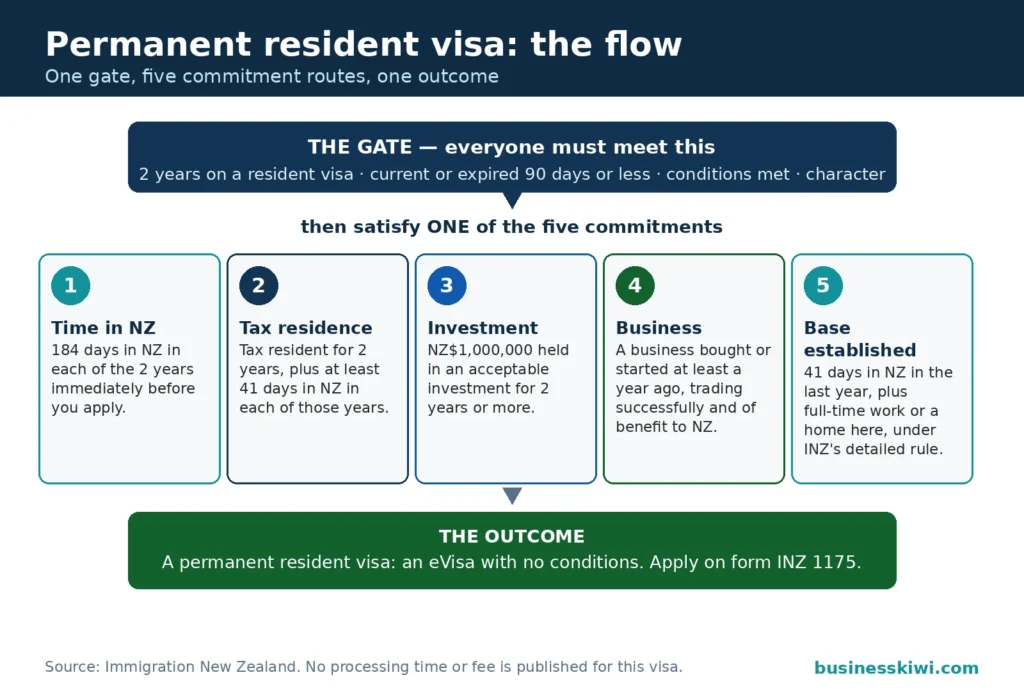
A Permanent Resident Visa lets you live in New Zealand indefinitely and travel in and out of the country whenever you like, with no conditions attached. You can generally apply once you have held a resident visa for at least 2 years in a row. Your resident visa must be current, or have expired no more than 90 days ago, you must have met any conditions on it, you must show commitment to New Zealand in 1 of INZ’s 5 recognised ways, and you must be of good character.
On timing, INZ does not print a processing timeframe on the Permanent Resident Visa page itself. Instead it publishes wait times for resident visas on a separate page that it updates weekly, drawn from applications it has actually processed. The section on processing times below explains how those figures work and where to find the current ones.
If you are still working towards residence itself, our resident visa guide covers the first stage.
Resident visa versus Permanent Resident Visa
The two visas sound alike and both let you live in New Zealand permanently. The practical difference comes down to travel.
A resident visa lets you live, work and study in New Zealand, but it carries travel conditions. Your visa shows an “expiry date travel”, the last date you can leave and still return as a resident. For most resident visas, travel conditions run for 2 years from the date you first arrived in New Zealand as a resident, or from the date the visa was granted if you were already here. If you are outside New Zealand after that date, your resident visa expires and you cannot return on it.
A Permanent Resident Visa has no conditions at all. Once you hold one, you can travel in and out of New Zealand indefinitely. The one practical duty is to keep the visa in a valid passport. If your passport expires, you need to transfer the visa to your new passport before you travel.

Who can apply
INZ sets five core requirements. You must:
- have held a resident visa for at least 2 years in a row
- hold a current resident visa, or one that expired 90 days ago or less
- have met the conditions of your resident visa, if it has any
- have shown a commitment to New Zealand in 1 of the 5 ways INZ recognises
- be of good character
The 2-year clock
Your 2 years start from the date you first arrived in New Zealand from overseas, or the date your visa was issued if you were already in New Zealand. INZ is firm that you cannot apply early. Its visa page warns that you should not apply until you have held a resident visa continuously for at least 2 years and meet every other requirement, and that an application lodged too soon may be declined even if you reach the 2-year mark while it is being processed.
You will need to show evidence of your resident visa or residence permit with your application.
Meeting your visa conditions
Some resident visas carry conditions, including conditions imposed under section 49 of the Immigration Act 2009. A common example from the skilled categories is a requirement to take up skilled employment within a set time after arriving. Whatever your conditions are, you must provide evidence that you have met them. They are recorded in your eVisa, and INZ directs you to check them if you are unsure what applies to you.
Character
You, and anyone else included in your application, must be of good character. INZ says it will let you know if you need to provide police certificates as proof. If you have a criminal conviction, or you are a security risk to New Zealand, INZ may not grant the visa.
The 5 ways to show commitment to New Zealand
This is the heart of the application. You need evidence of at least 1 of the 5 options below. Only the principal applicant has to meet a commitment criterion.
1. You have spent enough time in New Zealand
You have spent at least 184 days in New Zealand on a resident visa in each year of the 2 years immediately before you apply. The days do not need to be in a row. You can leave and return as often as your visa conditions allow. Note the window carefully: it is the 2 years right before you apply, which may not be the same 2 years since your resident visa was granted. INZ already holds your travel records, so it uses those as the evidence.
2. You have New Zealand tax residence status
For the 2 years immediately before you apply, you have been in New Zealand as a resident for 41 days or more in each of the two 12-month periods, and you are assessed as having tax residence status for those 2 years. The evidence is a statement from Inland Revenue, or a Confirmation of Tax Resident Status form with Inland Revenue’s section completed. Tax residence in another country cannot be used, even if that country has a tax treaty with New Zealand.
3. You have invested in New Zealand
You have had NZD $1,000,000 invested in New Zealand in an acceptable investment for 2 years or more. Evidence of the value and ownership of the funds and assets can include bank documents, property deeds and reports, share certificates, and business ownership documents and valuation reports.
4. You have a business in New Zealand
You bought or started a business in New Zealand at least 1 year ago. The business must be trading successfully and of benefit to New Zealand in some way. If you bought into an existing business, you must hold at least a 25% share. INZ needs to see your latest business accounts certified by a New Zealand chartered accountant, together with a letter or email from a New Zealand chartered accountant confirming the business is a going concern.
5. You have established a base in New Zealand
You meet this option if you have lived in New Zealand as a resident for at least 41 days in the 12 months before you apply, and everyone else included in your residence application has been living in New Zealand for at least 184 days in the 2 years before you apply. On top of that, you must have either worked full-time in New Zealand for at least 9 months in the 2 years before you apply, or purchased a home within 12 months of your first day in New Zealand as a resident and still own it when you apply.
Evidence of home ownership can include your house deed, mortgage documents, rates invoices, home insurance papers and household bills. Employment evidence can include an employment agreement, pay slips or confirmation from your employer. INZ notes that work paid by commission or retainer cannot be used as the employment evidence for this option.
The first option is the most direct route for people who have been based in New Zealand throughout the 2 years, because INZ checks its own travel records. The other options exist for people whose lives are genuinely based here but whose travel patterns do not meet the 184-day test.

Including your partner and children
Whether family members can join your application depends on whether they were part of your original resident visa application. Partners who gained residence through the partnership category have their own first-stage route, which our partnership resident visa guide explains.
If your partner or dependent children were included in your original resident application, you can include them in your PRV application. They do not need to meet the commitment requirement themselves, because that applies only to the principal applicant, but each person is still assessed individually for identity and character and may need to provide updated information. Normally INZ cannot grant a Permanent Resident Visa to a non-principal applicant before the principal applicant. A non-principal applicant must either be included in the principal applicant’s application, or apply at the same time or later. INZ lists exceptions where a non-principal applicant may apply first, including where the partnership has ended, the principal applicant has died, the principal applicant has become a New Zealand citizen, and family violence situations. If you were a dependent child in the original application but are no longer a dependent child, you must apply for your own Permanent Resident Visa.
If you want to include family members who were not in your original resident application, each person is assessed independently. Each must have held a resident visa continuously for at least 24 months and meet all the standard requirements, including character, identity and commitment to New Zealand. INZ is clear that adding family members does not guarantee them residency even if your own application is granted. There is a specific exception to this independent-assessment rule for certain dependent children of Active Investor Plus and Investor 1 or 2 visa holders, as set out on INZ’s visa page.
How to apply
Start by checking that every requirement is met before you lodge anything, including for any family members you will include. Because an early application can be declined outright, the safest trigger is the date your 2 years are complete and your commitment evidence is in place.
You apply to Immigration New Zealand, online through Immigration Online. If you cannot apply online, INZ’s paper form for this application is the Application from a Resident or Former Resident Visa Holder (INZ 1175), which covers permanent resident visas, second or subsequent resident visas and variations of travel conditions.
With the application you provide evidence of your resident visa or residence permit, evidence that you met any conditions on it, and the evidence for the commitment option you are relying on, following the lists in the commitment section above. For the time-in-New-Zealand option, INZ uses its own travel records. INZ will tell you during processing if police certificates are needed. It may also ask to see your original passport.
INZ does not state the fee for this visa in the criteria text of its visa page. It publishes current fees, decision times and where to apply through its fees, decision times and where to apply tool, so check the fee there before you apply, as fees change.
Once granted, the visa is issued electronically as an eVisa. Keep it in a current passport, and transfer it to a new passport before travelling if yours is renewed.
How long does a Permanent Resident Visa take?
The honest answer is that there is no single fixed timeframe, and INZ does not promise one. What INZ does publish is actual decision data. Its resident visa wait times page covers applications processed in the last 4 weeks and is updated weekly. For each resident visa type, including the Permanent Resident Visa, it shows two figures:
- an average wait time, which is how long it took for 50% of applications to be processed
- a “most completed within” figure, based on 80% of applications processed
Both figures are calculated using working days, which exclude Saturdays, Sundays and public holidays. INZ also notes that if your application includes all the documentation it needs, it will be processed closer to the average wait time. Because the figures are refreshed weekly from live processing, they move around. We have not quoted a specific number of days or weeks here, because any figure printed in an article would be out of date quickly and the figures published by adviser and media sites are snapshots that quickly stop matching INZ’s own page. Check the resident visa wait times page on immigration.govt.nz for the current position before you plan around a date.
While you wait, you can check the status of your application by logging into your Immigration Online account. If your case is urgent, INZ runs a visa escalation process under which you can ask for your application to be allocated urgently for assessment, subject to its criteria.
One timing point matters more than processing speed: you cannot lodge early to get a head start. Apply once you qualify, with complete evidence, so your application is decided within the weekly wait-time cycle INZ reports rather than being declined for jumping the gun.
If your travel conditions are about to expire
Plenty of people reach the 2-year mark with travel planned before their PRV is decided, or find they do not yet meet a commitment option. INZ offers a variation of travel conditions, often called extending your travel conditions, as the bridge.
You can apply to extend your travel conditions before you travel out of New Zealand if you plan to stay on a resident visa for more than 2 years, or if you have applied for a Permanent Resident Visa after 2 years on a resident visa but it has not been approved yet. Depending on your situation, the extension of your multiple entry travel condition may be for 1 year or 2 years. If INZ cannot extend it for 1 or 2 years, it may give you an extension of 14 days. Applications can be made online or on paper, with a copy of your passport, an acceptable photo and supporting evidence.
Do not let the date slip past while overseas. If you leave New Zealand with expired travel conditions, or they expire while you are away, your resident visa expires and you cannot return to New Zealand and continue your residence. If you have been outside New Zealand for only a short time, you may still be able to return as a resident by applying for a Permanent Resident Visa or a second or subsequent resident visa, but that is a rescue route, not a plan.
What a Permanent Resident Visa does and does not give you
A Permanent Resident Visa gives you residence with no conditions. You can live, work and study in New Zealand permanently, and travel in and out indefinitely. There is no further renewal cycle for the visa itself, only the practical need to keep it in a valid passport.
It is not citizenship. New Zealand citizenship is a separate status granted by the Department of Internal Affairs under its own rules, and it is not something INZ decides. INZ also notes that you do not need to hold a Permanent Resident Visa before applying for citizenship, since citizenship has its own residence and presence requirements assessed by the Department of Internal Affairs.
Why applications are delayed or declined
INZ publishes general guidance on what slows applications down. A straightforward application, in its description, includes all the required evidence, has no mistakes or typos, and clearly shows you meet the requirements. Things that slow processing include evidence supplied in the wrong format, evidence that is out of date, documents that are not in English, and extra evidence INZ did not ask for. Declared character issues also take time, because INZ must assess whether you are of good character. Sending your original passport when you applied online can cause delays too. For online applications, INZ only needs a photo of your passport unless it asks for the original.
Declines on this visa usually come back to the requirements themselves rather than paperwork. The recurring causes are applying before the 2 years are complete, being unable to show a commitment option with the evidence INZ specifies, not having met a condition of the resident visa, or a character issue such as a criminal conviction. INZ does not publish refusal statistics for this visa, so treat any decline-rate figure you see quoted elsewhere with caution.
FAQs
When can I apply for a Permanent Resident Visa?
Once you have held a resident visa continuously for at least 2 years, your resident visa is current or expired within the last 90 days, you have met its conditions, and you can show commitment to New Zealand in 1 of the 5 ways. Do not apply early. INZ warns that applications lodged before all requirements are met may be declined.
How many days do I need to spend in New Zealand to qualify?
Under the time-based commitment option, at least 184 days in New Zealand on a resident visa in each of the 2 years immediately before you apply. The days do not have to be consecutive. Other commitment options have different day counts: the tax residence and base established options each involve 41 days in New Zealand in set periods, as explained above.
How long does INZ take to decide a Permanent Resident Visa application?
INZ does not publish a fixed timeframe on the visa page. It publishes weekly wait times for resident visas based on applications processed in the last 4 weeks, showing an average wait time (50% of applications) and a most completed within figure (80% of applications), counted in working days. Check the resident visa wait times page on immigration.govt.nz for the current figures.
Can my partner and children be included in my application?
Yes, if they were included in your original resident visa application. They do not need to meet the commitment requirement themselves, but they are assessed individually for identity and character, and normally they cannot be granted a Permanent Resident Visa before you. Family members who were not in your original application are assessed independently and must each have held a resident visa for at least 24 months and meet all the requirements.
What happens if my travel conditions expire while I am overseas?
Your resident visa expires and you cannot return to New Zealand on it. If you have been away only a short time, you may be able to return as a resident by applying for a Permanent Resident Visa or a second or subsequent resident visa. If you know your travel conditions will expire before your PRV is decided, apply to extend them before you leave.
Sources
All information in this article comes from Immigration New Zealand, checked on 7 October 2026:
- Immigration New Zealand, Permanent Resident Visa, immigration.govt.nz
- Immigration New Zealand, Showing your commitment to New Zealand for permanent residence, immigration.govt.nz
- Immigration New Zealand, Becoming a permanent resident of New Zealand, immigration.govt.nz
- Immigration New Zealand, Check or change your resident visa conditions, immigration.govt.nz
- Immigration New Zealand, Resident visa wait times, immigration.govt.nz
- Immigration New Zealand, Why some applications are processed faster than others, immigration.govt.nz
Disclaimer
This article is general information only and is not immigration advice. Visa requirements and fees change, and your own circumstances can affect which rules apply to you. Check the current requirements on the Immigration New Zealand website before you apply. For advice about your personal situation, consult a licensed immigration adviser or an immigration lawyer.
More guides for migrants and residents are in our Visa & Immigration hub.