Where to Buy Gold in NZ: Dealers, the Mint, Costs and Safety

Buying physical gold in New Zealand is simpler than it used to be, and easier to get wrong than it looks. There is no official shopfront for gold, no single regulated exchange you must use, and no fixed price. What you get instead is a small market of bullion dealers, one Auckland mint, and a long tail of overseas websites that would love your money. This guide works through where Kiwis actually buy gold, what the different forms cost and why, the GST and tax position as Inland Revenue states it, and the checks that keep a purchase safe.
The short answer
Most New Zealanders who own physical gold bought it from a specialist bullion dealer, either over the counter or online. The main routes are:
- Bullion dealers with premises, mostly in Auckland, where you can walk in, pay, and walk out with metal, or order through their websites for insured delivery.
- New Zealand Mint in Auckland, the country’s only mint, which sells its own bars and coins plus bullion from overseas mints, and runs a buyback desk.
- Dealers who sell and store, where the gold never comes home with you and sits in a vault under your name.
- Second-hand routes, such as auctions and private sales, which can be cheaper per gram and much riskier.
Ordinary high street banks are not a realistic route. Physical gold is not something you can buy over the counter at a bank branch in New Zealand, and this guide names no bank as a gold seller because none of the major banks markets bullion as a retail product. If gold is part of a bigger plan, it also helps to read it alongside the wider picture in our Investing in New Zealand guide, because physical metal behaves very differently from funds or term deposits.

Route one: bullion dealers
A bullion dealer is a business whose trade is buying and selling precious metal. Some are refiners as well. Morris and Watson, for example, describes itself on its own website as a refiner and bullion dealer that has operated in Australasia for more than 90 years, and it sells its own cast bars alongside coins. Regal Castings in Auckland describes itself as the official New Zealand distributor for Perth Mint bullion bars and coins. Other dealers trade mainly online and ship nationwide.
The buying process is fairly standard across the established dealers, and Morris and Watson sets its version out step by step on its site:
- You browse the product range and check the live or indicative price list.
- You order online, or phone or email to confirm a live price and lock it in.
- You pay the invoice within the time the dealer allows, 24 hours in Morris and Watson’s published process, because the locked price only holds while you pay promptly.
- You collect from their office, or the dealer ships the gold securely to your address.
That price lock matters. Gold moves constantly, so a dealer’s quoted price is only ever a snapshot. Morris and Watson states that its online price lists are indicative and updated every five minutes. Any guide, including this one, that printed a per-ounce price would be out of date before you finished reading it, which is why reputable dealers quote live and why you should be suspicious of any website advertising a fixed bargain price for gold.
Route two: New Zealand Mint
New Zealand Mint, based in central Auckland, is the country’s only mint and has traded since 1967. Its bullion side is now a separate website from its collectable coin business. It sells gold and silver bars and legal tender coins, some produced itself and some sourced from recognised overseas mints and refiners such as the Perth Mint.
Two features make the Mint worth understanding even if you buy elsewhere. First, its product pages and guides are unusually clear about pricing: the Mint states that its prices are the live global spot price plus a premium that depends on the product. Second, it operates a proper buyback desk, covered in the selling section below, and offers a storage service you can add to a purchase. Its site lists a storage add-on on product pages, priced per year, so storage through the seller is a real option rather than an afterthought.
Note the difference between the Mint’s bullion and its collectable coins. The same company sells licensed character coins and limited editions aimed at collectors. Those carry design and licensing premiums that have nothing to do with the gold price, and they are a poor vehicle if what you want is metal by weight.
Route three: auctions and second-hand gold
Gold changes hands privately all the time: estate sales, auctions, coin dealers’ second-hand stock, and private listings. The attraction is price. A private seller has no shop overheads, and used bars sometimes change hands close to the metal value.
The risks are equally plain. You have no practical way to confirm purity without testing, no comeback if a bar turns out to be plated or underweight, and none of the paperwork that makes resale easy later. If you buy this way, buy recognisable products in sealed assay packaging, keep them sealed, and expect a dealer to test anything you later sell. Treat this route as one for experienced buyers, not a starting point.
What you are actually buying
Bars: minted and cast
Bars are the default choice for most buyers. They come in two broad styles:
- Minted bars are cut and stamped from rolled sheet, usually sold sealed in an assay card that states the weight, purity and a serial number. They look tidy and the packaging itself is part of the authentication.
- Cast bars are poured into moulds, so each one looks slightly different. They are common at larger sizes and typically carry lower premiums than minted bars of the same weight.
New Zealand Mint describes its gold bars as .9999 fine, in sizes from 1 gram through to 1 kilogram, serial numbered and supplied with assay certificates in sealed protective packaging. Morris and Watson’s own range is built around cast bars from small weights up to 1 kilogram, plus a 1 ounce Kiwi coin. In practice the market runs from tiny 1 gram bars up to the standard 1 troy ounce (about 31.1 grams) and on to 100 gram, 250 gram, 500 gram and 1 kilogram bars.
Smaller bars cost more per gram. A 1 gram bar is a gift or a novelty, not an efficient way to own gold, because the making cost is spread over very little metal. Larger bars are cheaper per gram but harder to sell in part: you cannot shave a corner off a kilogram bar when you need some of the money back.
Coins
Bullion coins are struck by government or licensed mints and usually carry a face value, which is nominal compared with the metal value. The designs Kiwi buyers meet most often include the local 1 ounce gold Kiwi, Australian Perth Mint issues sold here through distributors, and the big international names such as the Canadian Maple Leaf, American Eagle, Austrian Philharmonic and South African Krugerrand, all of which appear in New Zealand dealer ranges.
Coins generally cost more over spot than bars of the same weight, because striking a detailed coin costs more than pouring a bar. In return they are instantly recognisable anywhere in the world, and dealers anywhere can authenticate them quickly. New Zealand Mint makes the same trade-off on its format guide: bars for metal content and value per ounce, coins for recognition, flexibility and ease of authentication.
Purity: what counts as investment gold
Investment gold is defined by purity. Bullion bars and coins sold as investments are almost always .9999 fine, meaning 99.99 percent pure gold. That figure matters for tax as well as quality, because Inland Revenue’s GST position turns on a slightly lower threshold, covered below. Anything described as gold but well under that purity, such as jewellery at 9, 14 or 18 carat, is a different product with a different tax treatment and much worse resale economics.
How the price works
There is one world gold price, called the spot price, quoted in US dollars per troy ounce and converted into New Zealand dollars. Dealers do not set it. What a dealer sets is the margin around it.
When you buy, you pay spot plus a premium. The premium covers refining or minting, assay and packaging, distribution, insurance and handling, and the dealer’s margin. Premiums are highest on small bars and popular coins, and lowest on large cast bars.
When you sell, the direction reverses. New Zealand Mint states that dealers typically offer a price close to spot, minus a small margin, and its buyback pricing is based on live market rates. So the same ounce costs you spot plus a premium on the way in and returns spot minus a margin on the way out. That gap, called the spread, is the real cost of owning physical gold. The gold price has to climb by more than the spread before you are ahead at all.
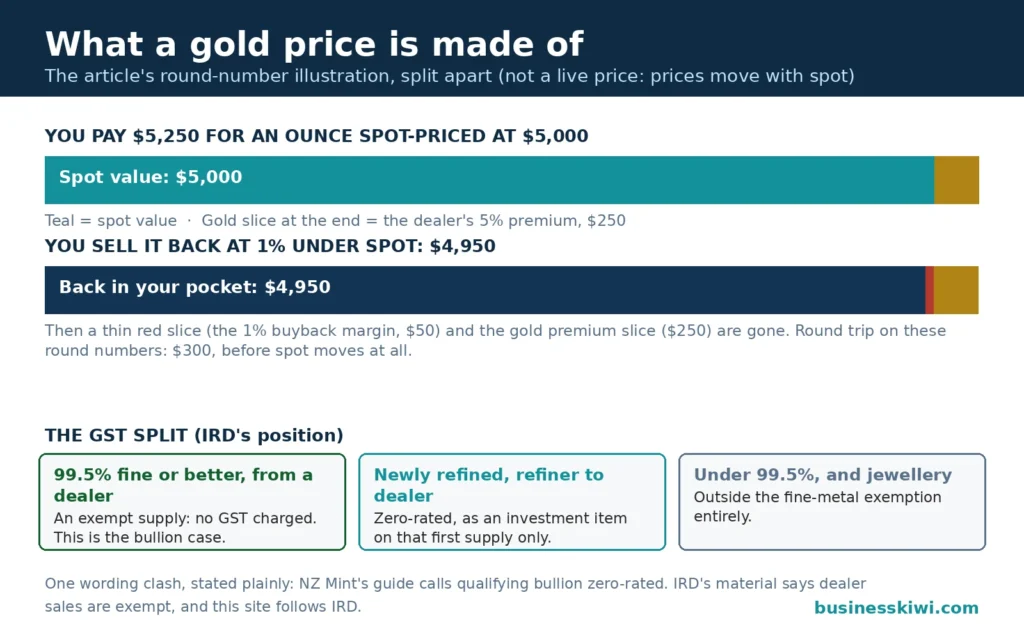
A worked illustration, using round numbers only. These are not quoted prices; today’s real figures will differ:
- Illustrative spot price: NZD $5,000 per troy ounce.
- You buy a 1 ounce bar at a 5 percent premium: you pay $5,250.
- You sell it back the same week and the dealer buys at 1 percent under spot: you receive $4,950.
- The round trip has cost you $300, about 5.7 percent of what you paid, with the gold price itself unchanged.
That is the maths every physical gold buyer should do before purchase. It is also why gold suits holding periods measured in years, and why churning in and out of physical metal is an expensive hobby.

GST on gold: the Inland Revenue position
New Zealand’s GST treatment of gold is unusually favourable, and it is worth stating precisely because loose claims circulate online.
Inland Revenue’s GST guide (IR546) defines fine metal as metal in any form with a fineness of not less than 99.5 percent for gold (99.9 percent for silver, 99 percent for platinum). The guide states that the sale of fine metal by a dealer, or by anyone importing fine metal, is an exempt supply, meaning GST is not charged on it. The exception is the first step in the chain: newly refined fine metal supplied by a refiner to a dealer as an investment item is zero-rated instead.
Two practical consequences follow. First, a .9999 fine investment bar or coin bought from a New Zealand dealer carries no GST, which is one reason physical gold here is cheaper to buy than in some other countries. Second, the exemption turns on purity, not on the seller’s description. Gold below 99.5 percent fineness is not fine metal, so GST can apply to lower purity products, and jewellery sits outside the exemption entirely. Inland Revenue’s tax policy material on GST makes the same point: metal below the specified purity is generally taxed like other goods.
Note that one New Zealand Mint learning article describes qualifying bullion as zero-rated. Inland Revenue’s own guide is the authority readers should rely on, and it describes the dealer sale as exempt. The practical effect for a buyer is the same, no GST in the price, but the terminology in this guide follows Inland Revenue.
On imports, Inland Revenue’s published position is that GST is not charged on fine metal when it is imported into New Zealand. That does not make importing casual: Customs still requires import entries for high-value goods, freight and insurance are real costs, and an overseas seller’s bargain can evaporate in shipping risk. Buying from a dealer who has already imported the stock moves those problems onto the dealer.
Income tax when you sell
GST is only half the tax story. Inland Revenue has published guidance on the income tax treatment of gold bullion, and its position is direct: where gold bullion is acquired for the purpose of disposal, it is revenue account property, and the amount you get when you sell it is income. Inland Revenue’s reasoning, set out in its Tax Information Bulletin material, is that bullion produces no income while you hold it and only has investment value because it will eventually be sold, so describing the purchase as an investment or a hedge does not by itself change that analysis. The same treatment cuts both ways: if gold acquired for disposal is sold for less than it cost, the loss is generally deductible, and costs such as storage and insurance may be deductible as part of the same picture.
Two cautions. First, purpose is a question of fact in each case, judged on your circumstances at the time you bought. Second, this is a general summary of published guidance, not advice about your position. If you hold significant amounts, get advice from a tax professional before you sell, not after.
Delivery, storage and insurance
Physical gold creates a problem no other common investment has: you have to put it somewhere.
Delivery. Dealers who sell online ship by courier with insurance and secure handling built into their process, and sellers state that product prices include storage, insurance and secure handling costs on their side. When you sell by courier the risk flips: New Zealand Mint warns people posting bullion to it that shipping is at the sender’s risk and recommends a reputable courier and insuring the parcel.
Dealer and vault storage. Several sellers will keep your gold for you. New Zealand Mint offers storage as an add-on to a purchase, and specialist vault businesses such as BullionStar New Zealand and Commonwealth Vault describe allocated, segregated storage on their own sites, meaning specific bars recorded as yours rather than a share of a pool, with insurance and audit arrangements described on those sites. Storage fees are ongoing and vary by provider and amount stored, so treat the fee schedule as part of the purchase decision. Stored gold also trades convenience for control: you cannot hold what sits in someone else’s vault, and you are relying on that business staying sound.
Home storage. Keeping gold at home avoids fees and keeps the metal in your hands. It also concentrates risk. A burglary target is exactly what a recognisable store of value is, and standard contents insurance is written for household goods, not bullion portfolios. Policies commonly limit cover for high-value items unless they are specified, and no insurer figure is quoted here because limits differ by policy. If you hold meaningful value at home, tell your insurer and ask what is actually covered before you need to claim.
Selling your gold back
Selling is normally easier than buying, because the same dealers compete to buy stock back.
New Zealand Mint’s published buyback process shows what to expect. It buys back all gold and silver bullion originally sold by it, plus selected .999 or better coins and bars from elsewhere. In person at its Auckland premises you bring photo identification, such as a driver licence or passport, and the bullion. Staff create a profile, weigh and authenticate your items, prepare a buyback invoice, and pay by bank transfer or cash subject to availability and limits. From outside Auckland you can courier items in with your details, a copy of your ID and an itemised list; once items are received and verified, it confirms live market pricing and typically pays by bank transfer within 24 hours.
Morris and Watson’s process is simpler still: contact an office for a quote to buy your bullion, with pricing fixed at settlement. Either way, expect identification, testing and pricing against the live spot rate on the day, not the price you paid. Sealed assay packaging and recognisable brands speed the process up; loose or obscure items may be discounted or sent for assay, which costs money and time.
Jewellers and pawnbrokers also buy gold, generally priced as scrap by weight and purity. That suits broken jewellery. It is a poor way to sell investment bullion, where the bar itself, its brand and its packaging carry resale value beyond melt.
Staying safe: scams and checks
Gold attracts fraud because it is valuable, portable and easy to promise. The Financial Markets Authority publishes a steady stream of warnings about entities, several of them using gold in their names, that falsely claim to be New Zealand companies or registered providers and then withhold investors’ money. Its scam guidance gives the checks that matter:
- Search the Financial Services Providers Register before sending money, and check the FMA warnings list for the name.
- Be wary of any offer that arrives uninvited. Cold calling to sell financial products is illegal in New Zealand.
- Treat pressure as a warning sign: limited-time offers, secrecy, and promises of high returns at low risk are the FMA’s classic red flags.
- Refuse requests to pay into an account in a different name, or by wire service or foreign transfer to release your own money.
A bullion dealer is a shop, not a bank, and buying a bar is a purchase rather than a deposit, so your protection is the business itself. Sensible checks are ordinary ones: confirm the company exists on the Companies Register, that the website and phone numbers match its registered details, that it has real premises you could visit, and that it publishes a buyback route as well as a price list. A seller who will happily take your money but cannot explain how you sell back is telling you something.
Above all, keep perspective on what gold is. It pays no interest or dividends, its price can fall and stay down for years, and the spread means you start every purchase behind. People buy it as a store of value and portfolio ballast, and for those jobs it can work. Bought in a hurry, from the wrong seller, at the wrong size, it is an expensive lesson.
Frequently asked questions
How much does gold cost per gram in New Zealand right now?
No article can answer that honestly, because the price is recalculated continuously. Dealer price lists move with the global spot price, in one case updated every five minutes on the dealer’s own site. Check live dealer prices on the day you intend to buy, and compare the premium over spot, not just the headline figure.
Do I pay GST when I buy gold in NZ?
Not on investment-grade gold. Inland Revenue treats gold of at least 99.5 percent fineness as fine metal, and the sale of fine metal by a dealer is an exempt supply, so no GST is charged. Gold below that purity, including jewellery, can carry GST.
Where is the cheapest place to buy gold in NZ?
The cheapest metal per gram is usually a larger cast bar from an established dealer, because premiums per gram fall as bar size rises. The difference between reputable dealers is smaller than the difference between product types, so compare premiums over spot on the same product before worrying about which shopfront is cheapest.
Can I buy gold from a bank in New Zealand?
Not in the way most people mean. New Zealand banks do not sell physical gold bars or coins as a standard retail product, so a dealer or the Mint is the realistic route. Some gold-linked investments exist through financial markets, but those are paper products with their own rules, not metal you hold.
Will I pay tax when I sell my gold for a profit?
Quite possibly. Inland Revenue’s published guidance treats gold bullion acquired for the purpose of disposal as revenue account property, so the sale proceeds are income. Your purpose when you bought is the deciding factor, and anyone with a significant holding should get tax advice before selling.
Sources
- Inland Revenue, GST guide IR546, including the definition of fine metal and the supply of fine metals, ird.govt.nz
- Inland Revenue Tax Policy, GST: Current issues, officials’ issues paper, chapter on GST treatment of alloy gold, taxpolicy.ird.govt.nz
- Inland Revenue, Tax Information Bulletin material on gold bullion acquired for the purpose of disposal, taxtechnical.ird.govt.nz
- Inland Revenue, Questions We’ve Been Asked QB 22/03, GST and importation of goods, taxtechnical.ird.govt.nz
- New Zealand Mint, bullion website: product pages, FAQs, pricing and format guides, and How to Sell page, newzealandmint.com
- Morris and Watson, Buy and sell bullion pages and bullion product pages, morrisandwatson.com
- New Zealand Customs Service, fact sheet on importing goods for business or commercial use, customs.govt.nz
- Financial Markets Authority, Scam basics and warnings and alerts, fma.govt.nz
- BullionStar New Zealand, vault storage overview, bullionstar.co.nz
- Commonwealth Vault, bullion storage, commonwealthvault.co.nz
More guides like this one sit in our Finance hub.
Disclaimer
This article is general information only. It is not financial advice, tax advice, or a recommendation to buy gold or to use any named business. Prices, premiums and dealer terms change constantly, and tax outcomes depend on your own circumstances. Check current prices and terms with the dealer, and get professional advice before buying or selling significant amounts.