Depreciation Rates NZ: How to Find Your Rate and Claim Correctly

Buy a ute, a laptop or a piece of machinery for your business and you cannot simply deduct the full price in the year you pay for it. Inland Revenue treats long-lasting assets differently from day-to-day running costs. Their cost is spread across the years the asset is expected to earn its keep: that spreading process is depreciation. Each year’s slice reduces your taxable income, so getting it right has a direct effect on how much tax you pay. If you want a sense of what a deduction is worth to you, our guide to tax rates in NZ sets out the current personal and company rates it offsets.
The catches are that you do not choose your own rate, and the right rate depends on exactly what the asset is and when you bought it. This guide explains how IRD’s system works, walks through finding a rate step by step, works two examples in full, and covers the areas people most often get wrong, including buildings, pooled assets and what happens when you sell.
Quick answer
IRD sets a depreciation rate for every class of asset, based on how long that type of asset is expected to last, and most assets have two published rates, one for the diminishing value method and one for straight line. You pick a method for each asset. You find your rate in IRD’s depreciation rate finder and calculator on its website, or in the IR265 General depreciation rates guide. Assets costing $1,000 or less can usually be deducted in full at once instead. Buildings currently have a 0% rate. Keep depreciation records for at least seven years.
What depreciation is, and what it is not
Depreciation recognises a simple fact: assets wear out, date or become obsolete. A delivery van bought this year will not be worth its purchase price in six years, and the tax system lets you recognise that decline gradually rather than all at once. IRD’s depreciation guidance describes it as a deduction claimed each tax year for the loss in value of capital assets, meaning assets kept for longer than a year.
Three things are worth separating out, because confusion here causes real mistakes.
First, depreciation is not a valuation. IRD does not ask what your asset would fetch if you sold it. The rates are standardised for each asset class, so two businesses with the same model of machine use the same rate even if one machine is pampered and the other is flogged.
Second, it is not a cash expense. No money leaves your bank account when you claim depreciation: the cash went out when you bought the asset. Depreciation simply matches the cost of the asset against the income it helps produce, year by year.
Third, the figure you track is the adjusted tax value. That is the asset’s cost less all the depreciation claimed on it so far. The adjusted tax value matters because it is the starting point for diminishing value calculations, and because it determines the tax outcome when you eventually sell the asset.
One more rule sits underneath everything: if you are registered for GST, you depreciate the GST-exclusive price, because you have already claimed the GST back. If you are not registered, you depreciate the full price including GST, since that is your real cost.
Who claims depreciation
Anyone who uses capital assets to earn income claims depreciation. That covers sole traders with a work vehicle and tools, partnerships, and companies. A limited company claims depreciation on the assets it owns in its own tax return, which is one reason the company structure separates business assets from personal ones so cleanly.
Landlords are in the system too, but in a narrower way. The residential building itself earns no depreciation, as explained below, yet the chattels inside it, such as carpets, appliances and curtains, are separate depreciable assets with their own rates.
IRD’s guidance covers assets you own outright, lease, or buy under hire purchase, provided you use them (or intend to use them) in the business. Claiming is generally compulsory rather than optional, and if there is an asset you decide not to depreciate, IRD expects you to tell it.
Assets that do not depreciate
Some things never enter the depreciation system at all. IRD lists land as the obvious example: land is not treated as wearing out. Trading stock is excluded, because stock is dealt with under its own rules. Franchise fees and intangible assets such as goodwill are also on IRD’s list of items you cannot depreciate. If an asset is not expected to decline in value, or its value is handled elsewhere in the tax rules, there is no depreciation claim, no matter what it cost.
The $1,000 low-value asset threshold
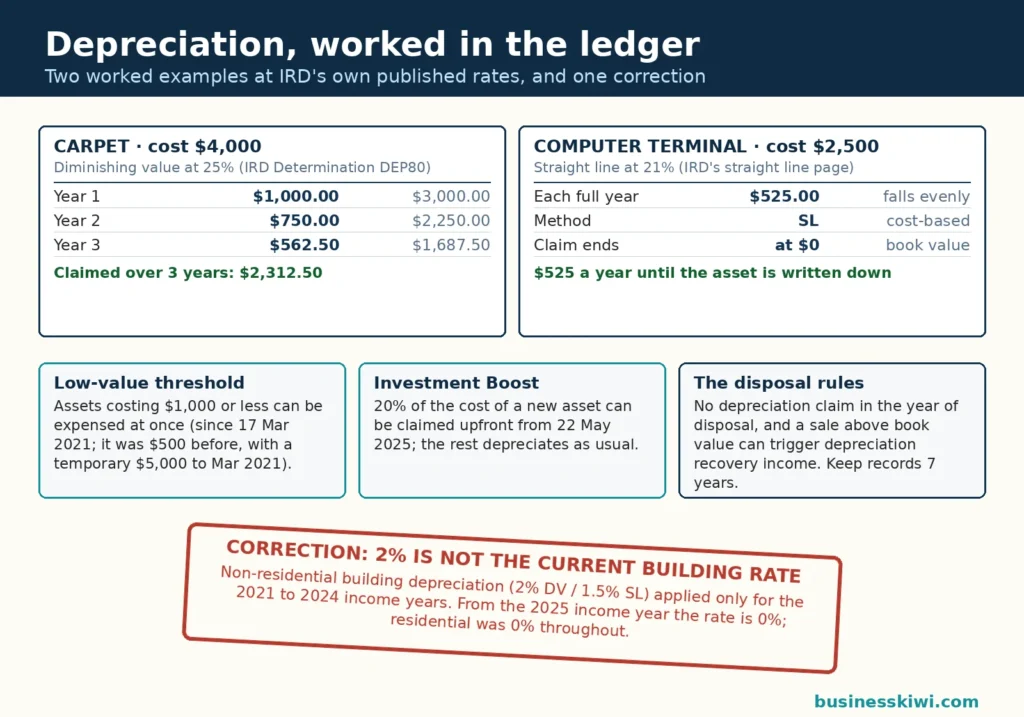
If an asset costs $1,000 or less, you can claim its full cost as an expense in the year you buy it instead of depreciating it over several years. IRD calls these low-value assets, and the threshold has moved around: it was $500 up to 16 March 2020, rose temporarily to $5,000 from 17 March 2020 to 16 March 2021, and has been $1,000 from 17 March 2021 onwards.
The threshold is per asset, and it saves a lot of pointless administration. A $900 office chair is simply expensed. A $1,400 desk is not: it goes on the asset register and is depreciated at the published rate for its class. Where several low-value assets are bought together, pooling is another option, covered further down.
Investment Boost: a newer deduction to know about
For new assets bought from 22 May 2025, IRD’s guidance introduces Investment Boost. In outline, you claim 20% of the cost of a new asset as an expense straight away, then depreciate the remaining 80% in the usual way using the published rates. It does not change which rate applies to the asset. It changes the starting value you apply that rate to, so your first year ends up with the 20% deduction plus a depreciation claim on the balance. Because it only started in May 2025, it does not appear in older guides.

The two methods: diminishing value and straight line
Every general rate comes in two versions, and you choose one method per asset.
Diminishing value (DV) applies the rate to the adjusted tax value, which shrinks every year. The formula is: adjusted tax value × DV rate = depreciation to claim. Because the base keeps falling, the claims are largest in the first year and taper off. In the first year, the adjusted tax value is simply the cost of the asset.
Straight line (SL), which IRD also calls the cost price basis, applies the rate to the original cost. The formula is: cost value × SL rate = depreciation to claim. The claim is the same amount every year, and you stop once you have claimed the asset’s full cost, which sometimes means a smaller final claim in the last year.
Over the whole life of the asset, the total depreciation claimed is the same under both methods. What changes is the timing. DV hands you bigger deductions sooner, which many businesses prefer for assets that lose value fastest when new. SL suits people who want predictable, even claims.
You do not have to use one method across everything you own. Each asset can be on a different method, and IRD allows you to change the method for an asset at the end of a year. If you switch, the new calculation starts from the asset’s current adjusted tax value, not from its original cost.
Two adjustments apply under either method. If you only had the asset for part of a year, the claim is scaled by months: full-year depreciation × months used ÷ 12, and part months count as whole months. If the asset is used partly for private purposes, you multiply the claim by the business-use percentage and claim only that share.

How to find your rate, step by step
Finding the rate is a process of narrowing down, and the order matters.
Step 1: Identify the asset precisely. Vague descriptions produce wrong rates. “Computer” is not one asset class: IRD’s tables separate hardware, terminals, software and more, each with its own rate. Note what the asset is and how you use it.
Step 2: Note when you acquired it. The acquisition date decides which set of tables applies. Assets acquired on or after 1 April 2005 use the general rates in the IR265 guide. Older assets fall back to the historic rates in IR267. A rate copied from the wrong era is a wrong rate, even if the asset description matches.
Step 3: Search IRD’s rate finder, or work through IR265. IRD’s depreciation rate finder and calculator on its website is the quickest route: describe the asset, and it returns the rates. In the IR265 guide, you look first for an industry category that covers your type of business, because those categories carry rates tailored to that sector’s equipment. If nothing fits, you move to the general asset categories, which classify assets by what they are rather than who uses them.
Step 4: Record the estimated useful life and both rates. The tables list each asset class with its estimated useful life in years and the DV and SL rates that follow from it. Write both rates down in your asset register even if you only use one, because you may switch methods later.
Step 5: If there is no general rate, do not guess. Some assets, typically new technology or items new to New Zealand, have no general rate yet. For those, the Commissioner can set a provisional rate. IRD’s Tax Technical material explains that provisional rates apply where less is known about an item than a general rate requires, and that they are reviewed after a period and often replaced by a general rate. You can also apply for a special rate where a general rate exists but does not fit how you actually use the asset.
Example rates from IRD’s published tables
A small sample shows how much rates vary. These figures are for residential rental property chattels, taken from IRD’s Determination DEP80, the Commissioner’s determination for that industry category, which has applied from 1 April 2011 and sits within the general rates framework.
Business equipment sits in different categories with different rates. To take one example from IRD’s own worked guidance, the IR265 guide’s Computers section gives computer terminals a straight line rate of 21%. The spread across the table, from 13.5% up to 40%, is the lesson: rates are specific, they differ between DV and SL for the same asset, and they are tied to when the asset was acquired. Always confirm your own asset in the rate finder before claiming.
Worked example: diminishing value over three years
Say a landlord fits out a rental property and buys carpet for $4,000 at the start of an income year. Carpets in the residential rental chattels category carry a DV rate of 25%. The carpet is used for the full year each year, so no part-year adjustment is needed.
Year 1: $4,000 × 25% = $1,000 claimed. Adjusted tax value falls to $3,000.
Year 2: $3,000 × 25% = $750 claimed. Adjusted tax value falls to $2,250.
Year 3: $2,250 × 25% = $562.50 claimed. Adjusted tax value falls to $1,687.50.
Total claimed across the three years is $2,312.50. The pattern is pure DV: the biggest deduction lands first, and each later claim shrinks because the rate is applied to a balance that has already shrunk.
Worked example: straight line
Now a business asset. A small firm buys a computer terminal for $2,500. IRD’s IR265 guide gives terminals a straight line rate of 21%, as noted above. The claim each year is $2,500 × 21% = $525.
Four full claims of $525 account for $2,100, leaving $400 of cost unclaimed, so the fifth year takes a smaller final claim of $400 and the adjusted tax value reaches zero. That tidy finish is characteristic of straight line: once the full cost has been claimed, depreciation stops, even if you keep using the terminal.
Buildings: where things stand now
Buildings have had a stop-start history, and a lot of older material online is now out of date. IRD’s current depreciation guidance sets it out plainly. Buildings with an estimated useful life of 50 years or more had a 0% rate for the 2012 to 2020 income years. Depreciation for non-residential buildings was then brought back for the 2021 to 2024 income years (the general rates in that period were 2% DV and 1.5% SL). From the 2025 income year, the non-residential building rate returned to 0%. Residential buildings are 0% throughout.
So as things stand, if you own a commercial warehouse or a rental house, there is no depreciation claim on the building itself. Anyone telling you commercial buildings currently depreciate at 2% is working from the settings that applied between 2021 and 2024.
Two qualifications matter. Some buildings with genuinely shorter lives, such as barns or portable buildings, can have specific rates of their own, so check the finder rather than assuming 0% covers every structure. Fit-out is a separate question: items of commercial fit-out that are separate assets in their own right are depreciated at their own rates, which is why IRD’s Interpretation Statement IS 22/04 deals with buildings and commercial fit-out separately. When you buy a commercial property, the split between building and fit-out in the purchase price is worth real money, because only the fit-out portion can still be depreciated.
Pooling, and buying second-hand
Pooling. Instead of tracking lots of small assets individually, you can group low-value assets into a pool and depreciate the pool as one item. IRD’s rules for pools are firm: once an asset goes into a pool it cannot come out again, pooled assets are depreciated using the diminishing value method only, the pool uses the lowest rate among the assets in it, and buildings cannot be pooled. Pooling trades precision for simplicity, and the lowest-rate rule means it will not always produce the biggest claim.
Second-hand assets. Buying used equipment does not change which rate applies: the asset class rate is the same. What changes is your starting point: your cost is the price you paid, not what the first owner paid new. A second-hand machine is depreciated at the standard rate for its class, applied to your purchase price. Keep the purchase documentation, because your cost figure is what every later calculation stands on.
When you sell or dispose of an asset
IRD’s guidance on managing depreciation makes several points that catch people out.
You cannot claim depreciation in the year you dispose of an asset. The claim stops at disposal, whatever part of the year you sell in.
If you sell an asset for more than its adjusted tax value, the profit is not a windfall: it is depreciation recovery, and it goes into your tax return as income. You claimed deductions on the basis the asset was losing value; if it turns out to have held its value better than the schedule assumed, the excess comes back into income. Selling below the adjusted tax value produces a loss instead, which is also detailed in the return.
The same thinking applies when a business ceases, and where an asset has mixed use the gain or loss is split in proportion to its business and private use. If you simply stop using an asset in the business and keep it privately, it is valued at market value at the start of the next income year, which can itself trigger an adjustment.
Record keeping
IRD requires depreciation records to be kept for at least seven years. For each asset, your records should show its purchase value, the depreciation claimed in each year, the current adjusted tax value, and any depreciation recovered when assets are sold. A simple fixed asset register, updated yearly, covers all of this. Without one, reconstructing an adjusted tax value years later, when IRD asks or when you sell, becomes guesswork.
Common mistakes
Claiming on land. Land does not depreciate. Where a purchase price covers land, buildings and fit-out together, only the depreciable components can be claimed on.
Using the GST-inclusive price while GST registered. If you claimed the GST back on purchase, your depreciation base is the GST-exclusive price. Depreciating the full invoice total double counts the GST portion.
Using book rates instead of tax rates. Financial accounting depreciation, set by you or your accounting policy, is not the same thing as IRD’s tax rates. The tax return needs IRD’s published rates for the asset class and acquisition period.
Claiming in the year of sale. There is no depreciation claim in the year of disposal, and forgetting this overstates the deduction.
Ignoring private use. A vehicle or laptop used 70% for business supports only 70% of the calculated depreciation. Claiming the full amount is a common and avoidable error.
Skipping the rate check. Rates differ by asset class, by method and by acquisition date. A rate remembered from a previous asset, or read on a non-IRD website, is not a substitute for checking the finder.
Frequently asked questions
Can I use diminishing value for some assets and straight line for others?
Yes. IRD does not require one method across your whole asset register. You choose per asset, and you can change an asset’s method at the end of a year, with the new calculation starting from its adjusted tax value at that point.
What happens if an asset costs $1,000 or less?
You can claim the whole cost as an expense in the year of purchase instead of depreciating it. That threshold has applied since 17 March 2021. Before that it was $500, apart from a temporary $5,000 threshold that ran from 17 March 2020 to 16 March 2021.
Can I claim depreciation on a rental property?
Not on the residential building itself: its rate is 0%. You can claim on the chattels inside it, such as carpets at 25% DV or a dishwasher at 30% DV under IRD’s residential rental chattels determination, provided the items are separate assets rather than part of the building.
Do I get a depreciation claim in the year I sell an asset?
No. IRD’s guidance is that no depreciation is claimed in the year of disposal. If the sale price beats the adjusted tax value, the difference up to the depreciation you claimed is depreciation recovery income in that year’s return.
What if IRD has not published a rate for my asset?
Do not invent one. Where no general rate exists, typically for new technology or items new to New Zealand, the Commissioner can set a provisional rate, and a special rate can be sought where a general rate exists but does not suit your actual use of the asset.
Sources
Inland Revenue, Claiming depreciation, ird.govt.nz
Inland Revenue, Depreciation, ird.govt.nz
Inland Revenue, Work out straight-line depreciation, ird.govt.nz
Inland Revenue, Work out diminishing value depreciation, ird.govt.nz
Inland Revenue, Managing depreciation, ird.govt.nz
Inland Revenue Tax Technical, The Commissioner’s Table of Depreciation Rates, taxtechnical.ird.govt.nz
Inland Revenue Tax Technical, Determination DEP80: Residential Rental Property Chattels, taxtechnical.ird.govt.nz
Inland Revenue Tax Technical, IS 22/04 fact sheet: Claiming depreciation on buildings, taxtechnical.ird.govt.nz
Disclaimer
This article is general information about how depreciation works in New Zealand. It is not tax advice and it does not account for your individual circumstances. Depreciation rates and rules change, so confirm your asset’s rate in IRD’s depreciation rate finder and consider professional advice before filing.
Browse more of our guides in the Finance category.