Same Day Loans with Bad Credit in NZ: Real Costs, Rules and Safer Options

When money runs out days before payday and a bill, car repair or power disconnection notice will not wait, an advertisement promising cash today, with no judgement about your credit history, is easy to click on. These loans are legal in New Zealand, and they sit inside a set of rules designed to limit the damage they can do. But they remain some of the most expensive credit on the market, and they are aimed squarely at people who are already struggling.
This guide explains what same day and bad credit loans actually are, what they can lawfully cost, the protections the law gives you before and after you sign, and the cheaper options worth trying first. It does not point you towards any lender. If a loan of this kind is on your mind, the most useful thing you can take from this page is an understanding of the ceiling on what you can be charged, and of the help that costs nothing.
Quick answer
A same day loan is a small, short-term loan marketed on speed: apply online, get a decision quickly, and have money in your account the same day or the next business day. “Bad credit OK” means the lender targets people whose credit record includes defaults or missed payments. Most of these loans are high-cost under New Zealand law, which means the annual interest rate is 50 percent or more. The law caps the total you can ever repay at twice what you borrowed, limits interest and fees to an average of 0.8 percent of the unpaid balance per day, and caps a default fee at $30. No lender can lawfully promise approval, because every lender must first check that a loan is affordable for you. Cheaper help exists: Work and Income advances and grants, no-interest community loans, and free financial mentors through MoneyTalks.
What “same day” and “bad credit OK” really mean
The word “same day” describes how fast money can move after a loan is approved. It says nothing about whether you will be approved. Lenders use it because urgency is what sells these products: the person searching for one usually needs money within hours, not weeks.
“Bad credit OK” works the same way. It does not mean your credit history is ignored. It means the lender is willing to consider applications from people whose records would see them turned away by a bank. Your history can still count against you, and it usually shows up in the price: borrowers seen as higher risk are charged at the expensive end of an already expensive market.
These loans are part of the wider small loans market, where amounts are typically in the hundreds or low thousands of dollars and terms run from a few weeks to a year or so. Our guide to small loans in NZ covers that market generally, including how to compare small loans safely. This article focuses on the sharp end of it: loans sold on speed, to people with defaults behind them.
One thing to hold on to: a lender offering you money is not doing you a favour, and a fast yes is not a compliment. It is a business decision, made because the price of the loan protects the lender even when some borrowers cannot pay.
How these loans are priced
Three features combine to make this credit expensive.
First, the interest rate. New Zealand law draws a line at an annual interest rate of 50 percent: at or above it, a loan is a high-cost consumer credit contract, and extra rules apply. Same day and bad credit loans commonly sit well above that line. An annual rate in the hundreds of percent looks shocking, and lenders sometimes argue it misleads because the loan only runs for a few weeks. Both things can be true. The annual rate is a standardised measure that lets you compare one loan with another, and a short term does not make the dollar cost small, as the figures below show.
Second, the fees. On top of interest there can be an establishment fee when the loan is set up, administration or monthly fees while it runs, and default fees and default interest if a payment is missed. Under the Credit Contracts and Consumer Finance Act (CCCFA), credit fees must be reasonable and tied to the lender’s actual costs; a lender is not allowed to treat fees as a profit stream, as Consumer Protection explains. Reasonable, however, is not the same as small, and on a small loan even modest fees are a large slice of what you borrowed.
Third, the way the price is presented. Advertisements for this kind of credit tend to lead with the repayment rather than the cost: a figure per week, or a total of a few hundred dollars to borrow a few hundred dollars. Weekly numbers are chosen because they look manageable. The number that matters is the total amount you will repay over the whole loan, compared with the amount you received. By law that total must appear in the disclosure statement you are given before you sign, which is the document worth reading slowly.

The high-cost rules: a legal ceiling on the total cost
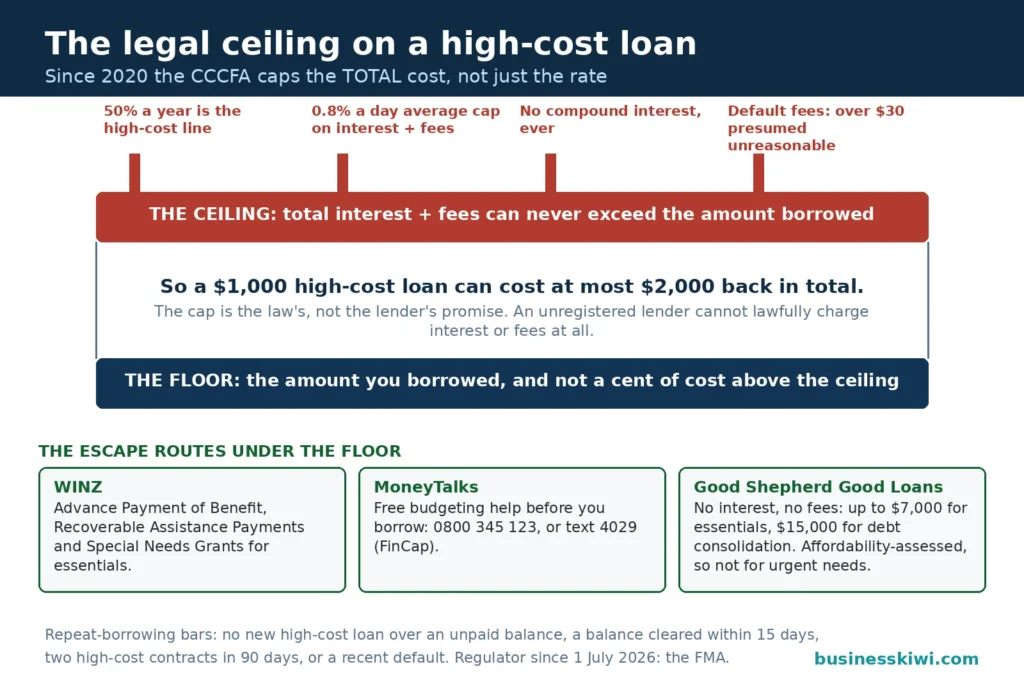
Since 2020, high-cost loans have carried special protections under the CCCFA. Consumer Protection, part of the Ministry of Business, Innovation and Employment, sets them out for borrowers. In summary, for a loan with an annual interest rate of 50 percent or more:
- The total of all interest and fees over the life of the loan cannot exceed the amount you first borrowed. Borrow $500 and the interest and fees combined can never legally pass $500, so the most you can ever be asked to repay is $1,000.
- Interest and fees together cannot exceed 0.8 percent of the unpaid balance per day, averaged across the term of the loan.
- Compound interest is banned. You cannot be charged interest on interest.
- Interest cannot be charged in advance.
- A default fee for a missed payment cannot exceed $30.
- Default interest, the higher rate charged when you fall behind, can only be charged on the amount that is overdue, and only while it is overdue. It cannot be applied to the whole loan.
The table below shows what those caps mean on a $500 loan. These are legal maximums, not a quote and not a typical price. A lender charging less is not doing anything unusual; a lender charging more is breaking the law.
The caps limit the worst outcomes, but they do not make the loan cheap. Repaying $1,000 for $500 of spending money is still a heavy cost, and the cap is reached faster than many borrowers expect because short loans burn through it quickly at the permitted daily rate.
Two further rules target the debt spiral directly. Under the CCCFA and its regulations, as the Responsible Lending Code published by the Ministry of Business, Innovation and Employment explains, a lender must not give you a new high-cost loan if you still have an unpaid balance on another high-cost loan, if you had an unpaid high-cost balance within the previous 15 days, if you have already taken two or more high-cost loans in the previous 90 days, or if you have recently been in default. Borrowing from a second lender to pay the first is exactly the pattern these rules exist to block.
Advertising is regulated too. Advertisements for high-cost credit must carry a prominent warning that high-cost credit should not be used for long-term borrowing. If an advertisement you are looking at has no warning and no interest rate, that absence tells you something about the advertiser.
The checks a real lender must run
Every consumer lender in New Zealand, including the fastest online ones, works under the lender responsibility principles in the CCCFA. Consumer Protection summarises what those principles require. Before lending, a lender must ask what the loan is for, check that the type of loan suits your needs, and make reasonable inquiries into your income and expenses so it is satisfied you can make the repayments without suffering substantial hardship. It must give you clear disclosure in writing before you sign, including the annual interest rate, all fees, the total amount to repay, and details of its dispute resolution scheme. It must treat you fairly afterwards, including when you cannot pay.
This has a consequence worth understanding: approval cannot lawfully be guaranteed in advance. A lender that advertises “no checks” or “everyone approved” is either misleading you, which the Fair Trading Act prohibits, or skipping inquiries the law requires. Either way it is a warning sign, not a benefit. The checks protect you as well as the lender, because a loan you cannot afford is a problem for you long before it is a problem for them.
You can check a lender’s status yourself. Lenders must be registered on the Financial Service Providers Register and, since 1 July 2026, licensed by the Financial Markets Authority (FMA), which took over regulation of the CCCFA from the Commerce Commission on that date. They must also belong to an approved dispute resolution scheme. Consumer Protection makes a point that matters if you are dealing with an obscure website: an unregistered lender cannot lawfully make you pay interest, default fees and other borrowing costs. If a lender is not on the register, walk away.
You also get time to change your mind. After signing a credit contract you have a cooling-off period of five working days to cancel in writing, extended to seven working days if the documents were emailed to you and nine if they were posted. And if a lender failed to give you proper disclosure, or the statement was wrong or incomplete, Consumer Protection advises the lender cannot charge you interest or fees for that period and cannot enforce the contract until it is fixed.
If you fall behind
Missing a payment on a high-cost loan is expensive, but the caps still apply. Default fees cannot exceed $30 each, default interest applies only to the overdue amount while it is overdue, and the overall ceiling never moves: interest and fees combined still cannot pass the amount you originally borrowed.
Beyond the numbers, the lender has duties in how it deals with you. It must treat you reasonably and in an ethical manner, and the CCCFA protects you from oppressive contracts and oppressive behaviour. Consumer Protection gives examples of what can be oppressive: pressuring you to borrow more than you can afford, pressuring you to sign on the spot, or letting fees and interest pile up by sitting on an overdue account instead of acting. Debt collectors are bound by the same standards of fair dealing, and no lender or collector may mislead you about what you owe or what they can do.
Repossession is narrower than many people fear. A lender can only repossess an item if your contract pledges that item as security and names it, and you are in default. Many small cash loans are unsecured, which means there is nothing to repossess. Where repossession does apply, the lender must warn you in writing first, agents may only take the items listed as security in the contract, and they cannot take household necessities such as beds, a fridge or your passport. Once a repossessed item is sold, your account is frozen: no further interest or fees can be added.
If a loan has gone wrong, complain first to the lender, then to its dispute resolution scheme, which is free. You can also report concerning behaviour to the FMA.
Hardship: your right to ask for a change
If something you could not reasonably have foreseen, such as illness, injury, losing your job or a relationship ending, makes repayments unmanageable, the CCCFA gives you the right to apply to the lender in writing to change the contract. The changes you can ask for are extending the term so each payment is smaller, postponing payments for an agreed period, or a combination of both.
The lender must acknowledge your application within five working days, ask for any further information within 10 working days, and decide within 20 working days. Timing matters: if you are two months or more behind, have missed four or more consecutive payments, or have been in default for two weeks or more after a repossession warning notice, you must bring payments up to date before you can apply. That is a strong reason to contact the lender early, while you are still current or only just behind. You can only make one hardship application on the same grounds within a four-month period unless the lender agrees to another, so it is worth getting a financial mentor to help you put the application together.
Even outside the formal hardship process, a lender can agree to change your payments informally, and Consumer Protection encourages talking to the lender as soon as you see trouble coming. Silence is the expensive option.
Red flags to walk away from
- A promise of approval before any questions are asked, or advertising that boasts about no credit checks and no affordability checks. The checks are legally required.
- A fee demanded before the loan is paid out, especially one you are told will unlock or guarantee the money. Legitimate lenders deduct or charge their fees under the contract, after disclosure.
- Pressure to sign immediately, countdown timers, or warnings that the offer disappears if you stop to think or take the documents away.
- A lender that cannot be found on the Financial Service Providers Register, has no dispute resolution scheme named in its documents, or operates only through social media or messaging apps.
- An overseas lender with no New Zealand presence. Your CCCFA protections are far harder to use against a business outside New Zealand law’s reach.
- Being asked for your internet banking password, or to hand your login details to a third-party service so it can look inside your account. Lenders can ask for bank statements, and there are safer statement-sharing services, but your password is yours alone: sharing it can breach your bank’s terms and leaves you exposed if anything goes wrong.
- Encouragement to borrow more than you asked for, or to take a new loan to clear the one you are struggling with.

Safer options to try first
Fast loans feel like the only option mainly because they are the loudest. Before signing anything, work through the alternatives; several of them are also quick.
Work and Income help. If you receive a main benefit or a pension, an Advance Payment of Benefit is a one-off payment for an essential or emergency cost you cannot pay another way. It is income and asset tested, and you repay it from your benefit over time, but Work and Income charges no interest and no fees, so you repay exactly what you received. If you are not on a benefit, a Recoverable Assistance Payment covers similar ground for people on low incomes with an essential or emergency cost who have no other way to pay. Work and Income also makes Special Needs Grants for urgent needs such as food and emergency medical care, which usually do not have to be repaid. Our guide to benefit advances and how they compare with payday-style loans works through these options in detail.
Talk to whoever you owe. Power companies, landlords, councils and other lenders all deal with people in hardship every week, and many will agree to a payment plan or a short extension if you ask before the due date. A creditor would usually rather be paid late than send a debt to collection. A financial mentor can make these calls with you or for you.
Community finance. Good Shepherd New Zealand provides Good Loans: no-interest, fee-free loans for people on low incomes, for essentials such as car repairs or purchase, appliances, dental treatment, and consolidating high-interest debt. Amounts run up to $7,000 for an essential item and up to $15,000 for debt consolidation, paid to the supplier rather than as cash. Applications are assessed for affordability and take time, so this is not an emergency option, but for a planned essential cost it replaces the most expensive credit in the country with the cheapest: none.
Your bank, carefully. An arranged overdraft or a standard personal loan from a bank will usually cost far less than high-cost credit, even for a customer with an imperfect record, and banks work under the same responsible lending duties. Unarranged overdrafts are a different story: fees and higher interest on money you were not approved to spend add up fast, so ask rather than drift.
Free financial mentoring. MoneyTalks, run by FinCap, connects you with free financial mentors across New Zealand. Call 0800 345 123 or free text 4029. A mentor can check whether a loan contract you already have was made lawfully, help with a hardship application, deal with creditors, and build a plan that stops the same emergency recurring. The service is free, confidential and independent of any lender.
Frequently asked questions
Can a lender really approve me without any checks?
No. The law requires every lender to make reasonable inquiries about your income, expenses and what the loan is for, and to be satisfied you can repay without substantial hardship. A lender claiming to skip checks entirely is admitting it does not follow the law, which is a reason to avoid it, not a convenience.
What is the most a $500 high-cost loan can cost me?
By law, the interest and fees combined over the whole loan cannot exceed the $500 you borrowed, so the maximum you can ever be asked to repay is $1,000. On top of that ceiling, interest and fees cannot average more than 0.8 percent of the unpaid balance per day, and a default fee cannot exceed $30.
I already have one of these loans and cannot pay. What should I do first?
Contact the lender now, before you fall further behind, and ask about changing your payments. If an unforeseen change such as illness or job loss caused the problem, you can make a written hardship application, which the lender must acknowledge within five working days and decide within 20 working days. A free financial mentor from MoneyTalks (0800 345 123) can help you apply and deal with the lender.
Can the lender take my belongings if I miss payments?
Only if your contract names specific items as security for the loan, and only after written warning. Many small cash loans are unsecured, meaning there is nothing to repossess. Even where security exists, agents cannot take household necessities such as beds, a fridge or your passport, and once an item is sold no more interest or fees can be added to your account.
Is it safer to borrow from a lender I found on social media?
No. Social media advertising is a common channel for unregistered and offshore operators. Check that any lender is on the Financial Service Providers Register, is licensed, and names its dispute resolution scheme in its documents. An unregistered lender cannot lawfully charge you interest or borrowing fees at all, and an offshore one may be beyond the reach of New Zealand consumer law in practice.
Sources
Consumer Protection, Credit Contracts and Consumer Finance Act, consumerprotection.govt.nz
Consumer Protection, What lenders must do, consumerprotection.govt.nz
Ministry of Business, Innovation and Employment, Responsible Lending Code, mbie.govt.nz
Financial Markets Authority, CCCFA transfer frequently asked questions, fma.govt.nz
Work and Income, Advance Payment of Benefit, workandincome.govt.nz
Work and Income, Recoverable Assistance Payment, workandincome.govt.nz
FinCap, MoneyTalks, moneytalks.co.nz
Good Shepherd New Zealand, No-interest loans: Good Loans, goodshepherd.org.nz
Disclaimer
This article is general information about how same day and high-cost loans work in New Zealand and the protections that apply to them. It is not personalised financial advice, and it does not recommend any lender or product. Rules, thresholds and lender practices can change; the figures here were read on the official sources listed above on 7 October 2026. If you are in financial difficulty, free and confidential help is available from a financial mentor through MoneyTalks on 0800 345 123.
You can find more guides on borrowing, debt and everyday money decisions in our Finance section.