Businesses for Sale in Auckland: A Buyer’s Guide to Finding and Buying Well

Auckland is the easiest place in New Zealand to find a business to buy, and one of the easiest places to buy the wrong one. The region holds the country’s largest pool of cafés, retailers, workshops, franchises and professional practices changing hands. A good purchase gives you customers, staff, systems and income from the first week. A careless one hands you someone else’s problems, priced as goodwill.
This guide is for the hands-on buyer: the person looking at a suburban café, a trade business with three vans, a small retail store or a service firm, rather than a corporate acquisition. It covers how the market is organised, where genuine opportunities surface, what proper due diligence looks like, how the standard sale agreement and its conditions work, and the council and tax steps that catch buyers out.
Quick answer
Most Auckland small businesses are sold as assets (goodwill, plant, stock and the right to trade from the premises) rather than as company shares, usually through a licensed business broker engaged by the seller, and usually documented on the standard ADLS/ReINZ agreement for the sale and purchase of a business. Expect the process to run: search and shortlist, sign a confidentiality agreement, read the information memorandum, make a conditional offer, complete due diligence, satisfy conditions such as finance and landlord consent, then settle with a stocktake and handover period. The asking price is only the starting point. What the business is worth to you depends on verified earnings, lease security, and how much of the income walks out the door with the seller.
Who buys Auckland businesses, and what comes up for sale
Buyers tend to fall into a few groups: owner-operators buying themselves a job with more upside than a wage, experienced operators adding a second or third site, migrants whose business plans involve ownership, and investors who install a manager. Each group is really buying a different thing, even when looking at the same listing.
The stock of businesses for sale reflects the region’s economy:
- Hospitality. Cafés, bakeries, takeaways, restaurants and bars make up a large share of listings. They are lease-dependent, licence-dependent and often owner-dependent, which makes them the category where due diligence matters most.
- Retail. Dairies, liquor stores, pharmacies, gift and homeware shops, and e-commerce operations with a small warehouse attached.
- Services. Salons, gyms, childcare centres, cleaning and lawn-care runs, rent rolls, and professional practices such as accounting, dental and veterinary clinics.
- Trades and industrial. Workshops, panel beaters, plumbing and electrical firms with staff and forward bookings, small manufacturers and distributors, mostly in industrial areas such as East Tāmaki, Penrose, Wiri and Albany.
- Franchises. Resales of existing outlets and new territories both circulate. A franchise adds a franchisor approval step, and Franchise Association of New Zealand disclosure rules apply only where the franchisor belongs to that association.
Where listings actually appear
There is no single marketplace; serious buyers work several channels at once.
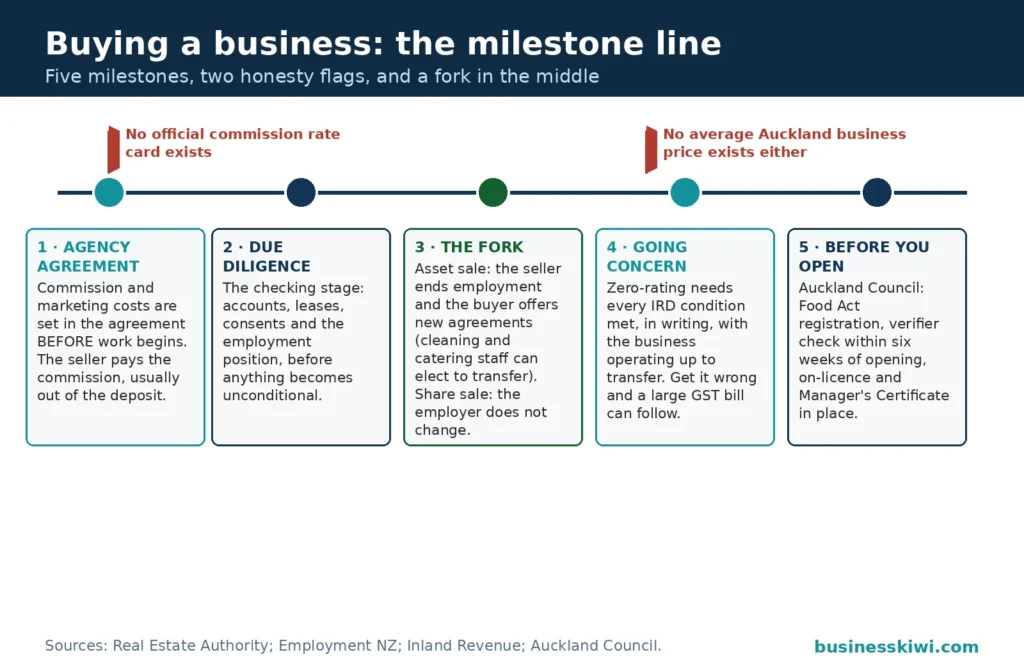
Licensed business brokers handle the bulk of marketed sales. A seller signs an agency agreement with a brokerage, the broker prepares an information memorandum, and the business is promoted through the brokerage’s database and the main online listing portals. Under the Real Estate Agents Act 2008, selling businesses is real estate agency work, so the broker must be licensed, and the Real Estate Authority’s guides explain that the agency agreement sets out the commission rate and marketing plan before any work begins. The portals carry most of the public stock, searchable by suburb, category and price band; treat asking prices as marketing, not evidence.
Plenty of sound businesses never reach a public listing. Owners sell quietly to staff, competitors, suppliers or people in their industry network, because a public process can unsettle customers and employees. Buyers who know a sector often do better by identifying businesses they would like to own and approaching the owners directly.
The broker’s role, and whose side they are on
Business.govt.nz advises buyers to register their interest with the person managing the sale, and in most marketed sales that is the seller’s broker. The broker is engaged and paid by the seller. The Real Estate Authority’s consumer guides make the position plain: the professional is working for the seller, must treat the buyer fairly, and is paid commission by the seller once the sale completes, ordinarily out of the deposit held in the agency trust account. Commission is set in the agency agreement; there is no official rate card.
A good broker is still useful to a buyer: they control access to information, coordinate the process, and have a practical interest in a deal that survives due diligence. What they cannot do is advise you. The information memorandum is a sales document prepared for the seller, and anything in it that matters needs to be verified by your own accountant and lawyer.
First steps: confidentiality, the information memorandum, and the offer
Expect to sign a confidentiality agreement before you receive detailed financials. That is standard: sellers are handing over commercially sensitive information, and most will want some evidence that you can fund a purchase first.
The information memorandum typically sets out the business’s history, what is included in the sale, lease details, staffing, and several years of financial summaries. Business.govt.nz’s advice at this point is a good discipline: research the business, its suppliers, its market and its industry, and ask the owner why they are selling, then compare the answer with what the sales documents show.
If the business still stacks up, the next step is a written offer on the standard agreement, made conditional on the checks described below. Do not sign an unconditional offer on a business you have not yet investigated.
The sale and purchase agreement and its usual conditions
The Real Estate Authority’s training resources note that agencies commonly use standard forms published by the Auckland District Law Society and the Real Estate Institute of New Zealand, which include a dedicated agreement for the sale and purchase of a business. Many solicitors use that standard agreement and tailor it. REA’s guidance to consumers is to get legal advice before signing, not after.
For a small business purchase, the conditions that do the protective work usually include:
- Due diligence. A defined period to investigate the business, with the seller obliged to provide access to records, and a right to withdraw within the clause’s terms if the investigation turns up something unacceptable.
- Finance. The purchase is conditional on your lender approving the loan on terms you can accept.
- Landlord consent. Occupation almost always depends on the lease being assigned to you, or a new lease granted, and commercial leases generally require the landlord’s written consent. Make the purchase conditional on that consent.
- Restraint of trade. The seller agrees not to compete, solicit customers or poach staff for a stated period and within a stated area. Check the restraint binds the actual individuals behind the business, not just a company that will be wound up.
- Licence and contract transfers. Where the business depends on licences, supply agreements, equipment leases or key contracts, the agreement should deal with which transfer, which need a third party’s consent, and what happens if consent is refused.
- Stocktake and stock valuation. Stock is usually valued at settlement by a stocktake under the method the agreement specifies, with the figure adjusting the final amount payable.
- Vendor assistance and training. A defined handover period in which the seller trains you and introduces key customers and suppliers. For owner-dependent businesses this carries real value, so specify days and duration.
- Employee arrangements. Who is offered employment, on what terms, and how accrued leave entitlements are dealt with.
Price allocation matters too: the agreement should record how the price is split between goodwill, plant and equipment, and stock, because that allocation affects both parties’ tax positions. Wider questions of valuation method and deal structure sit beyond this guide’s scope; our separate guide to business acquisitions covers that strategic ground in depth.

Due diligence: what to check, and how
Due diligence is where purchases are saved. It is the disciplined testing of everything the seller claims against primary documents. Verify from independent records wherever you can: financial statements should agree with tax returns, and claimed takings should agree with bank deposits and till or platform reports. Unexplained gaps between those records are the most common reason sensible buyers walk away.
The lease and landlord consent
For most Auckland small businesses, the lease is the asset everything else hangs off. Goodwill in a café or retail store is largely location goodwill, and the location belongs to the landlord. Your purchase should be conditional on the landlord consenting to the existing lease being assigned to you, or to your buying entity, for the balance of its term including any rights of renewal. Landlords will usually want financial information about you and evidence of relevant experience, and they are entitled to have their reasonable legal costs of considering the assignment met. A slow landlord or solicitor can consume most of a due diligence period, so the request should go in early.
Read the lease for the points that decide value: the total secure term remaining, how and when rent is reviewed, what outgoings you are liable for, whether the permitted use covers everything the business does, and whether relocation, demolition or redevelopment clauses could cut the term short. If the secure term is short, negotiate an extension or a new lease, or pay a price that reflects the risk.
Buying the assets or buying the company
Most small business sales in New Zealand are asset sales: you buy the goodwill, plant, stock and trading name, and leave the seller’s company and its history behind. The alternative is buying the shares in the seller’s company, which keeps contracts and licences in the same legal entity but also brings across the company’s liabilities, known and unknown. Buying through a company of your own is the most common structure for an asset purchase, because it separates the business’s risks from your personal assets; our limited company guide explains how a company is set up and what it involves. Employment law draws the same distinction: as Employment New Zealand explains, an asset sale where staff are offered work by the buyer is a restructuring with specific rules, while a share sale does not change the employer at all.
Staff: what happens to the people
Staff are often the real purchase: the customers come back because of them, and the systems live in their heads. Employment New Zealand sets out the framework for business sales, starting with the employee protection provision that every employment agreement must contain for when the business is sold or transferred. In an asset sale, the seller’s employees are technically redundant when their employment with the seller ends and they take up an offer from the buyer. In practice, the buyer normally offers employment to the staff they want to keep, the seller gives notice of termination, and the buyer provides the proposed new agreement for employees to sign before they start.
Some employees have stronger statutory protection. Workers in specified categories, which include cleaning and food catering services in any workplace, laundry services for the education, health and aged care sectors, orderly services in health and aged care, caretaking in education, and a range of security services, have the right to elect to transfer to the new employer on their existing terms and conditions. If you are buying a cleaning or catering business in Auckland, your lawyer should map this before you commit.
GST and the going concern rules
GST produces the nastiest surprises in business purchases, usually because the parties assumed the treatment rather than confirming it.
Inland Revenue’s position is strict. A sale of a business as a going concern, from one GST-registered person to another, is zero-rated, meaning GST is charged at 0 percent rather than at the standard rate. Inland Revenue requires all of the following: the supply of the whole of a taxable activity, or a part that can operate on its own; everything necessary for the business to keep operating; both parties agreeing it is a supply of a going concern, recorded in a document; both parties intending the business to be capable of being carried on by the buyer as a going concern; and the business actually operating as a going concern at the time of supply and right up to the transfer.
Miss one element and the treatment fails. If the seller has already shut the doors and is selling the fit-out and stock from a closed shop, that is not a going concern sale, and GST may apply in the ordinary way. Inland Revenue warns that getting the treatment wrong can produce a large tax bill for either side, so the agreement should state expressly how the price is treated for GST.
Auckland Council practicalities: food, alcohol and the premises
Auckland adds a local layer on top of the national rules, and it bites hardest in hospitality, which is also where first-time buyers concentrate.
If the business makes or sells food, it must be registered under the Food Act 2014. Auckland Council’s guidance for starting a café or restaurant puts food registration first: most restaurants and cafés operate under a template food control plan, while lower-risk operations sit under a national programme instead. A change of ownership means the registration position needs to be sorted for the new operator, and Council notes that every food business must be checked by a recognised verifier within six weeks of opening. Ask the seller for the current registration and verification history during due diligence.
Selling alcohol brings a second regime: a buyer needs an on-licence, at least one staff member holding a Manager’s Certificate, and, before applying, certificates confirming the premises meet Building Code and Resource Management Act requirements. An existing licence does not simply become yours, so build the licensing timetable into the settlement plan. Renovations may also need building and resource consent, outdoor dining on public land needs its own licence, and signage is subject to bylaw controls. A Land Information Memorandum and the Council property file will show what was consented.
Money: what it costs beyond the price, and funding the purchase
No official source publishes what an Auckland business should cost, and anyone quoting average prices or standard earnings multiples is selling something. Prices are set deal by deal, off verified earnings, lease security, asset condition and risk. What can be planned for is the cost sitting around the price:
- Legal fees for advice on the agreement, the lease assignment and settlement.
- Accounting fees for financial due diligence and help structuring the purchase and price allocation.
- Lender costs. Banks lending on a business purchase will want your own financial position, a business plan and the business’s verified financials, and may require valuations or other reports at your cost.
- Working capital. The least budgeted item and the most common cause of a hard first year. You need cash for stock, wages and rent from day one, plus a buffer for repairs.
- Registration and licensing costs where the business needs fresh registrations in your name.
- Insurance from settlement day, arranged before you take possession.

Settlement and the handover
Settlement day is mostly mechanics handled by the lawyers: the balance of the price is paid, the lease assignment is completed, keys and codes change hands, and stock is dealt with as the agreement provides, usually by a stocktake with the final figure adjusting the payment. Utility accounts, eftpos facilities, supplier accounts, the business phone number and website logins all need to transfer or be re-established in your name, so make a written list during due diligence.
Then comes the handover period you negotiated. Be introduced to key customers and suppliers by the seller while they are still the friendly incumbent, learn the ordering rhythms and the quiet problems, and write down everything the seller does from memory.
Red flags that should slow you down or stop you
- The seller will not provide tax returns, or the financials offered cannot be reconciled with bank records.
- A large share of the profit is cash takings that leave no trace anywhere.
- The owner is the business: customers ask for them by name, suppliers deal only with them, and nothing is written down.
- The lease has a short secure term left, a demolition clause, or a rent review structure the earnings cannot carry.
- One or two customers account for a large share of revenue, with no contracts.
- The reason for selling keeps changing, or does not match what the documents show.
- Pressure to sign quickly, skip conditions, or shorten due diligence. Time pressure in a business sale almost always protects the seller, not you.
Frequently asked questions
Do I pay the business broker’s commission as the buyer?
No. The seller engages the broker under an agency agreement and pays the commission when the sale completes, as the Real Estate Authority’s consumer guides describe. Your costs are your own lawyer, accountant and lender.
Can I get out of the deal if due diligence turns up problems?
That depends on the agreement you signed. A properly drafted due diligence condition lets you withdraw within its terms if the investigation shows the business is not what it was represented to be. Without that condition, or after it has been confirmed, you are committed, so have your lawyer check the wording.
Does the lease automatically come with the business?
No. Commercial leases generally require the landlord’s written consent to an assignment, and the landlord can ask for financial information, evidence of experience and sometimes a guarantee. Make your purchase conditional on that consent, and start early, because landlord consent is a common cause of delay.
Do I have to keep the existing staff?
In an asset sale, staff do not transfer automatically. As Employment New Zealand describes, the seller ends their employment and the buyer offers new agreements to the staff they want. The exception is employees in specified categories, such as cleaning and food catering workers, who can elect to transfer on their existing terms. In a share sale, the employer does not change.
Will I have to pay GST on top of the purchase price?
Usually not, if the sale is structured as a going concern and both parties are GST-registered. Inland Revenue zero-rates a going concern sale where the whole business, or a self-contained part of it, is supplied with everything needed to keep it running, both parties agree in writing that it is a going concern, and it is still operating up to the transfer. If those conditions are not met, GST can apply.
Sources
Ministry of Business, Innovation and Employment, Starting a business, business.govt.nz
Employment New Zealand, Restructuring when a business is sold or transferred, employment.govt.nz
Inland Revenue, Zero-rated supplies, ird.govt.nz
Real Estate Authority, Read our guides, rea.govt.nz
Real Estate Authority, Sale and purchase agreements and lease agreements: contractual obligations (CPD resource), rea.govt.nz
Auckland Council, Start a cafe or restaurant, aucklandcouncil.govt.nz
Auckland Council, Food registration and alcohol licence fees and charges, aucklandcouncil.govt.nz
Disclaimer
This article is general information about buying a small business in Auckland. It is not legal, accounting or financial advice on a specific transaction. Engage a lawyer and an accountant experienced in business sales before you sign an agreement, and verify licence and registration requirements with Auckland Council for the business you are buying.
More guides for owners and buyers are in our Business and Industry section.