Propane and LPG in NZ: Uses, Bottle Sizes, Costs and Safety Rules
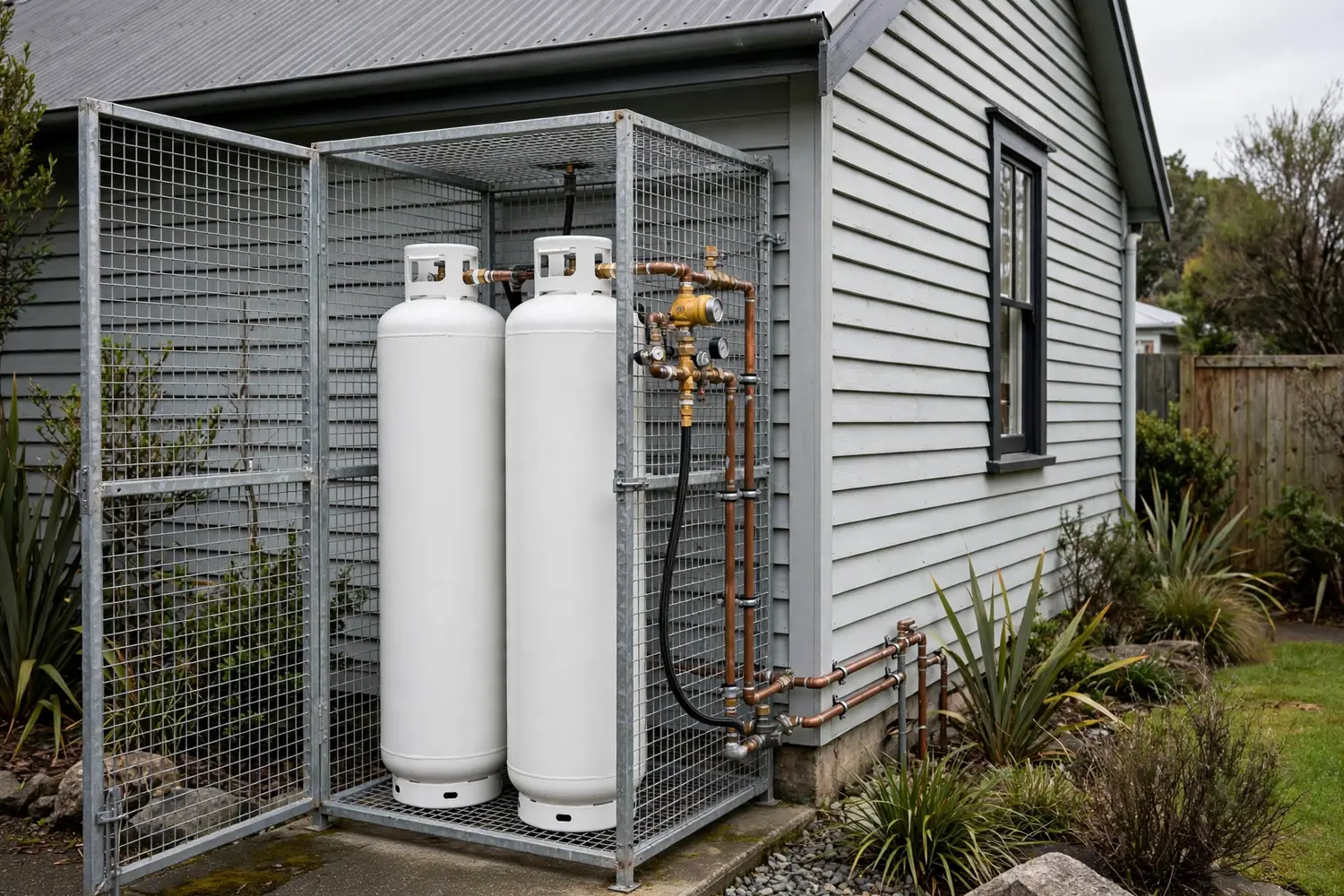
If your home sits beyond the natural gas network, or your business needs serious heat without a pipeline, there is a good chance the fuel doing the work is LPG. It is the gas in the pair of tall bottles beside thousands of New Zealand houses, in the swap cages outside service stations, and in the tanks feeding commercial kitchens, warehouses and farms. Propane is its main ingredient, which is why the two names are often used interchangeably, but they are not quite the same thing.
This guide explains what LPG is, how it differs from natural gas, what it is used for, how it is supplied and stored, what the common bottle sizes are, what it costs, and the safety rules that apply in New Zealand, including the WorkSafe storage thresholds that affect businesses.
The short answer
LPG (liquefied petroleum gas) is a mixture of propane and butane, made mainly during natural gas processing, that turns to liquid under moderate pressure so it can be stored and delivered in cylinders. In New Zealand it is sold by weight. The standard home setup is two 45 kg bottles, one in use and one in reserve, swapped by your supplier when one runs empty. Small 9 kg bottles cover barbecues and portable appliances, and larger users take 210 kg bottles or bulk tanks filled by tanker. Installing or altering any fixed gas installation is restricted work that only a licensed gasfitter can legally do. Businesses storing more than 100 kg of LPG step into certification territory under the hazardous substances rules.
What propane and LPG actually are
Propane is a single hydrocarbon gas (C3H8). LPG is the commercial product: according to Rockgas, it is a mixture of propane and butane, and those hydrocarbons are mostly derived from natural gas processing, which is where all of New Zealand’s domestically produced LPG comes from. The propane share gives LPG its cold weather performance, but the bottled gas sold in New Zealand is the mixture.
The “liquefied” part matters. Propane and butane become liquid under moderate pressure at normal temperatures, so a cylinder holds a dense store of energy as a liquid, with gas vapour sitting above it. As you draw gas off the top, more liquid boils off to replace it. Elgas puts the energy content at about 49 megajoules per kilogram, and one kilogram of LPG occupies about 1.96 litres as a liquid. A full 45 kg bottle therefore holds roughly 88 litres of liquid LPG and about 2,205 megajoules of energy.
Two properties shape everything about how LPG is handled. First, it is heavier than air, so leaked gas does not drift away and disperse the way natural gas does. WorkSafe warns that leaking LPG evaporates into a large cloud of gas that settles in low spots such as drains and basements, creating a fire and suffocation hazard. Second, LPG in its natural state is colourless and almost odourless, so an odorant is added before sale to give it a strong, unpleasant smell (GasNZ, Safe Handling of LPG). If you can smell gas, treat it seriously.
LPG is also quite different from natural gas. Natural gas is mostly methane, delivered by pipeline in the parts of the North Island that have a network, and it is lighter than air. Methane cannot be liquefied by pressure alone; it has to be cooled to about minus 162 degrees Celsius to become LNG. Appliances are built and jetted for one gas or the other and run at different pressures, so never connect an appliance set up for natural gas to LPG, or the reverse. Changing an appliance from one gas to the other is gasfitting work, covered below.
What LPG is used for in New Zealand
In homes, LPG does the jobs that need instant, controllable heat: continuous flow hot water, space heating, gas hobs and ovens, and gas fireplaces. It is the default option for households that want gas cooking or hot water but have no natural gas in their street, and often the only gas option for rural properties.
Hospitality is a heavy user. Cafes, restaurants and fast food outlets cook with it, run water heating and space heating on it, and use it in patio heaters outdoors. WorkSafe publishes dedicated LPG guidance for hospitality because so many of these businesses store and use it daily, including at market stalls and food trucks.
Commercial and industrial uses are broader still. Elgas lists the 45 kg and 210 kg bottles as the common business sizes, and Rockgas points to water heating, high intensity heat, refrigeration and fuelling forklifts and other machinery across hospitality, agriculture and manufacturing. Forklifts commonly run on LPG using purpose built 15 kg aluminium or 18 kg steel cylinders. LPG has also long been used as a vehicle fuel, sold as autogas at some service stations, although it is now a small niche.
How LPG is supplied and stored
There are four main ways LPG reaches a property.
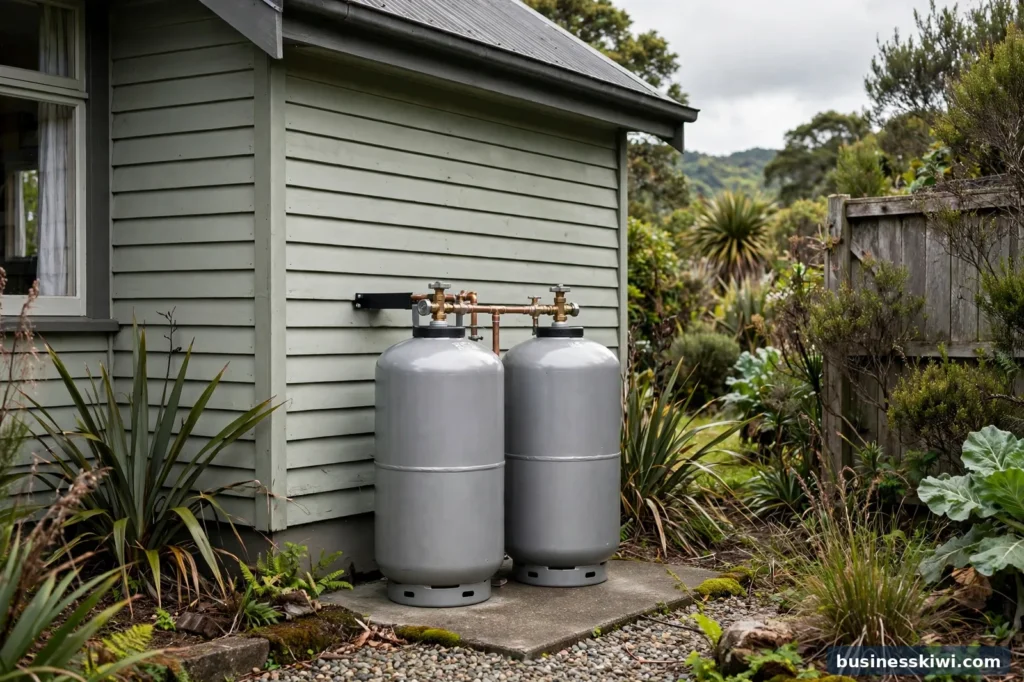
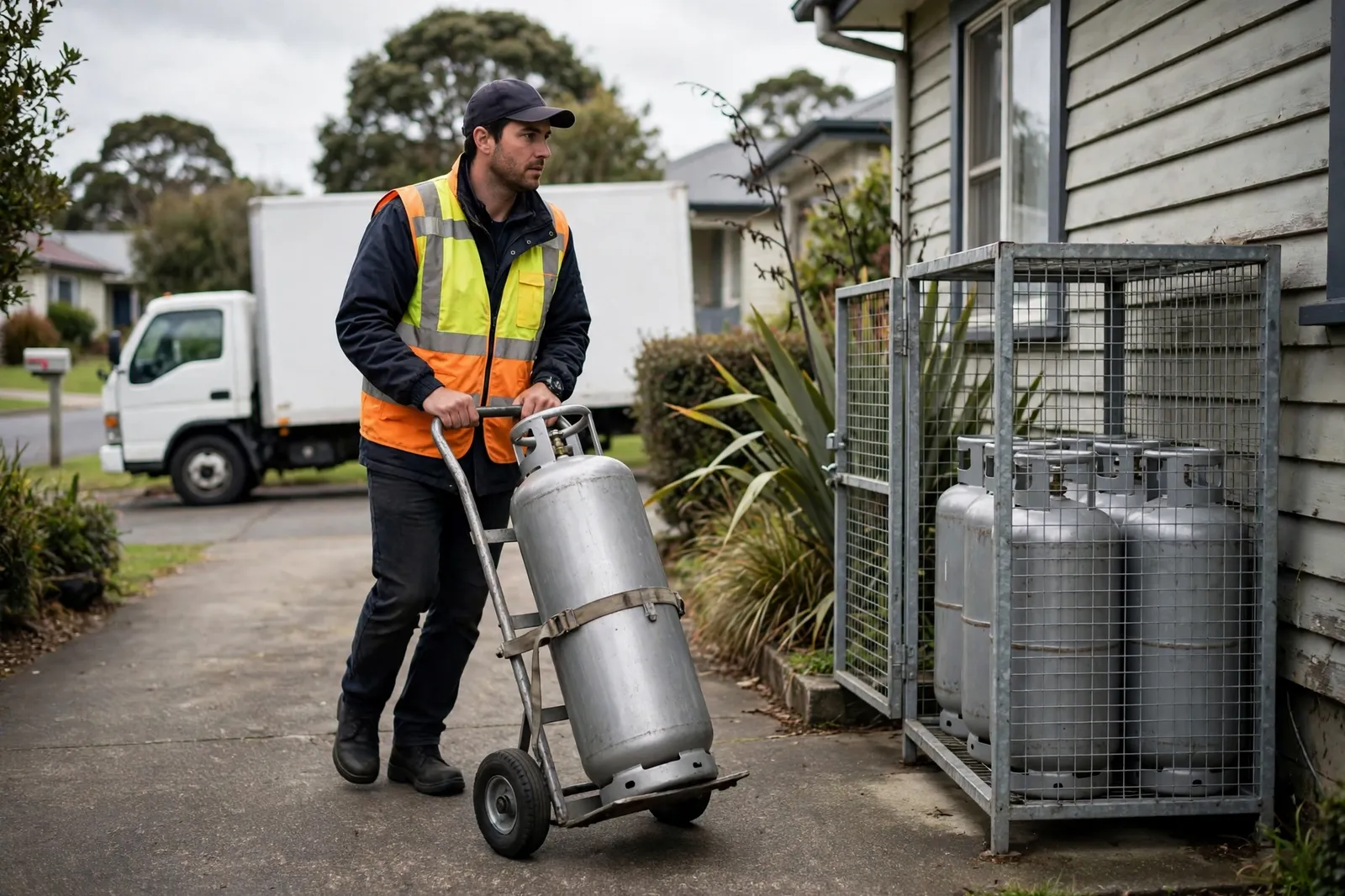
Bottle exchange. This is the standard home model. Two 45 kg bottles stand outside the house connected to a regulator, usually with an automatic changeover valve that switches to the full bottle when the first empties and shows a red indicator. You order a replacement, and the delivery driver disconnects the empty bottle and connects a full one. In the usual rental model the supplier owns the bottles, and handles their maintenance, testing and inspection, as Elgas describes it.
Onsite tanker refill. For larger bottles and tanks, a tanker fills the vessel where it stands. Elgas offers this as an automatic delivery service, monitoring usage and topping up on site, and its 210 kg bottles are filled this way. High volume commercial and industrial users generally take bulk tanks on the same principle.
Small bottle swap and refill. The 9 kg bottle is the barbecue and camping standard, exchanged through swap schemes at service stations and hardware retailers, or refilled at filling stations. Rockgas says it has more than 200 bottle and vehicle refuelling sites around New Zealand.
Piped LPG. In a few areas, parts of Canterbury, Queenstown and Wanaka, Rockgas pipes LPG to properties from a central supply, metered much like natural gas. This is the exception rather than the rule.
Wherever bottles are installed, the basics are the same. Cylinders stand upright, outdoors, on a firm base, in a ventilated spot, secured against tipping and tampering, and clear of drains, openings into the building and ignition sources such as heat pumps and air conditioning units. The supplier checks the installation when bottles are delivered, and suppliers will not fill an installation that is not compliant. Bottles must never be stored inside a house or garage in quantity, and a full 45 kg bottle weighs about 78 kg, so delivery access matters: suppliers need a safe path and cannot be expected to haul bottles up difficult stairs.
Cylinder and bottle sizes
Sizes are described by the weight of gas they hold, not the weight of the bottle. The table below uses Elgas’s published figures; dimensions are approximate and vary a little between manufacturers.
A few details worth knowing. The 9 kg bottle’s empty (tare) weight is stamped on it and runs from about 7.8 to 10.4 kg, so a full one weighs roughly 17.5 kg. The 45 kg bottle has a tare weight of about 33 kg, which is how you get to the 78 kg full weight mentioned above. Note that Elgas does not offer the smallest 4 kg size through its swap scheme in New Zealand, although 4 kg bottles exist here.
How long a bottle lasts depends entirely on the appliance. Elgas gives these illustrations, all at maximum settings: a 45 kg bottle runs a 16 litre per minute continuous hot water unit used 20 minutes a day for about 52 days, a 9 megajoule cooktop burner used an hour a day for about 244 days, a 15 megajoule heater used three hours a day for about 49 days, and a 25 megajoule gas fireplace used two hours a day for about 44 days. Real usage on lower settings lasts longer.
What LPG costs
Here is the honest answer first: most New Zealand LPG suppliers do not publish a fixed per bottle price list on their websites. Pricing depends on your plan, your address and how much you use, and suppliers such as Genesis Energy and Rockgas set the price in the quote or customer agreement rather than on a public page. Anyone quoting you a single national price per bottle is glossing over how the market actually works.
One major supplier does publish indicative figures. Elgas states on its own website, with prices dated 5 May 2025, that 45 kg bottle pricing starts at around $175 per bottle for the first five bottles on promotional pricing, and that typical standard pricing starts at around $195 per 45 kg bottle. Elgas says supplier pricing typically includes delivery at no extra charge. Treat those numbers as a starting point from May 2025, not a quote: check the current price with suppliers before you commit, because LPG pricing moves with international prices and local competition.
Beyond the gas itself, budget for these cost elements:
- Bottle rental or account fees. In the rental model you do not buy the bottles, and some plans carry a rental or monthly charge on top of the gas price.
- Delivery terms. Standard delivery is often bundled into the bottle price, but urgent or out of cycle deliveries can attract extra fees.
- Appliances and installation. The one off cost of the hot water unit, heater or hob, plus the gasfitter’s installation work and certification, which usually dwarfs the first bottle order.
- Servicing. Appliances need periodic servicing by a gasfitter; Rockgas suggests having appliances checked at least once every two years.
Elgas does not publish a 9 kg swap price on its website either, and swap prices at retail counters vary by outlet, so the only way to know the current price is to check at the point of sale.
Worked examples: turning bottle prices into running costs
Using Elgas’s indicative standard figure of $195 for a 45 kg bottle, the arithmetic looks like this. One bottle holds about 2,205 megajoules, so $195 works out at roughly 8.8 cents per megajoule, or about 31.8 cents per kilowatt hour of energy (one kilowatt hour is 3.6 megajoules). That is an illustration built from one supplier’s published figures, not a tariff, and it excludes rental and account fees.
Take the hot water example. If a 45 kg bottle lasts about 52 days running your hot water on Elgas’s usage assumptions, a household would order roughly seven bottles a year. At $195 a bottle that is about $1,365 a year for gas hot water, before any rental or account charges. A household also running a gas heater through winter would use more, which is why suppliers ask about your appliances and usage before quoting.
Safety and the NZ rules for LPG
LPG is a hazardous substance, classified as an extremely flammable gas, and the rules sit in the Health and Safety at Work (Hazardous Substances) Regulations 2017, administered by WorkSafe. The core hazards, per WorkSafe, are that LPG catches fire easily, that leaked gas forms a cloud which pools in low places and can suffocate as well as burn, and that liquid LPG causes cold burns on skin contact.
At home. Keep cylinders upright and outdoors, never in bedrooms or living areas, and keep them away from ignition sources. Never use outdoor appliances such as patio heaters and barbecues indoors, and never use a cooking appliance as a heater. Unflued portable heaters release their combustion products into the room, so they need ventilation, and they must never be used in bedrooms or bathrooms. Have appliances serviced regularly, and check connections with soapy water if you suspect a leak: bubbles mean escaping gas. If you smell gas strongly, turn the supply off at the cylinder if it is safe to do so, avoid flames and electrical switches, get everyone out, and call your supplier’s emergency line or 111.
In workplaces. WorkSafe’s industry and hospitality guides set out the duties that apply to any business (a PCBU) using or storing LPG:
- Train workers who handle LPG, label cylinders, and keep a first aid kit and trained first aiders on site.
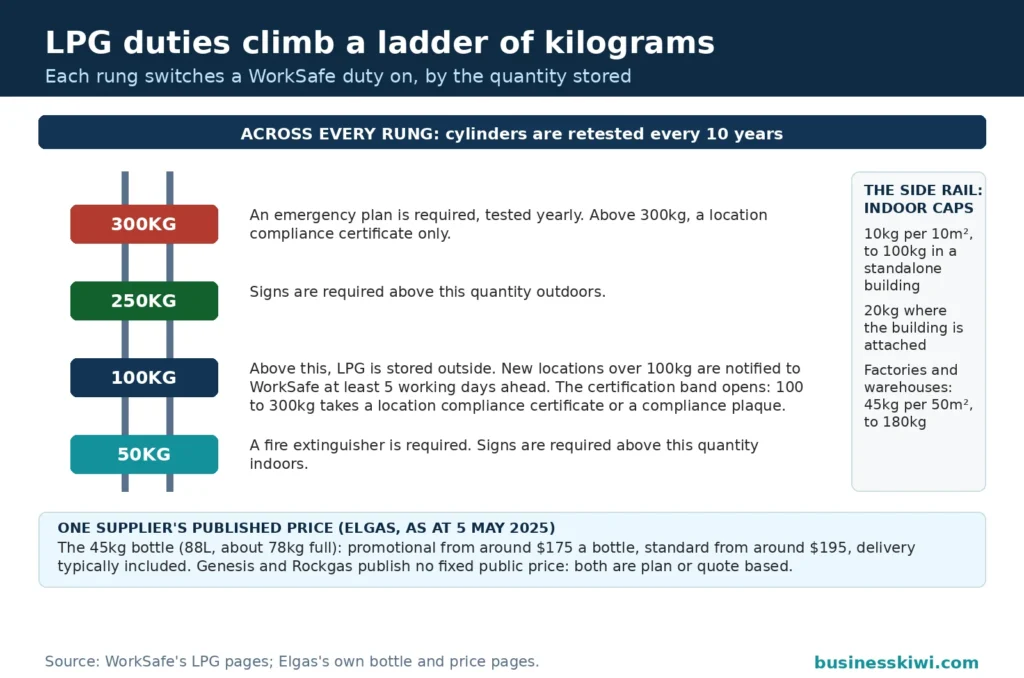
- Hold a 2 kg dry chemical fire extinguisher if you store more than 50 kg of LPG.
- Put up hazard signs if you store more than 50 kg indoors or more than 250 kg outdoors.
- Have an emergency response plan, tested at least every year, if you store more than 300 kg.
- Keep cylinders secured against unauthorised access, away from combustible materials and ignition sources, upright and ventilated.
- Use only an approved filler to fill cylinders, and have cylinders tested every 10 years at an authorised test station.
Indoor storage limits are tight. In a standalone commercial building, WorkSafe’s industry guide allows up to 10 kg of LPG per 10 square metres of floor area, to a maximum of 100 kg, in cylinders of no more than 10 kg each. In a building attached to another occupied building, the indoor maximum is 20 kg no matter how big the floor area is, which in practice means two 9 kg cylinders. Factories and warehouses can hold up to 45 kg per 50 square metres, to a maximum of 180 kg, in cylinders up to 45 kg. Anything over 100 kg on site must be stored outside.
Compliance certificates. Once a workplace stores more than 100 kg of LPG in one location, certification enters the picture. Between 100 kg and 300 kg, WorkSafe says the site needs either a location compliance certificate or a valid compliance plaque, which a gas supplier can issue after checking the installation where a location compliance certificate was previously granted. At 300 kg or more, a location compliance certificate is required outright. Certificates are issued by compliance certifiers listed on WorkSafe’s register, generally run for 12 months for flammable substances and can extend to a maximum of 36 months where the requirements are met. A new LPG location storing more than 100 kg must also be notified to WorkSafe at least five working days before it starts operating. Because quantities are assessed using a quantity ratio sum across all hazardous substances on site, WorkSafe directs businesses to its online hazardous substances calculator and to a compliance certifier rather than to guesswork. Two 45 kg bottles on a home do not trigger any of this; these are workplace quantities, although very large home or farm installations should still take advice.
Getting connected: installation and gasfitters
Gasfitting is restricted work in New Zealand. The Plumbers, Gasfitters and Drainlayers Board (PGDB) is blunt about the split. A homeowner can work on a portable gas appliance with its bottle attached, such as a barbecue, a cabinet heater or a patio heater, although the Board strongly recommends using a gasfitter even then. Everything else is off limits: installing, altering or repairing gas appliances and pipework, fixing or unfixing gas pipes, working on flue and ventilation pipes, commissioning appliances, and work on bottle supplied fixed installations in buildings. Doing restricted gas work without a licence is illegal, and it can also void your house insurance if something goes wrong.
The licensing class that matters most is the certifying gasfitter, the highest level, who takes responsibility for their own work and for work they supervise. Before any work starts, check that your gasfitter holds a current NZ Practising Licence: the PGDB maintains a public register you can search, and every licensed gasfitter carries a licence card you can ask to see.
A typical new connection runs like this. You choose your appliances and supplier, the gasfitter assesses the site, positions the bottle station where it meets the clearance and access requirements, installs the regulator and pipework, fits and commissions the appliances, and pressure tests the installation. By law, the certifying gasfitter must give you a signed gasfitting certificate for the work within 20 working days of it being connected to the gas supply. Keep that certificate: you may need it when you sell the property or make an insurance claim, and the PGDB notes that gas suppliers may require a copy before they will supply gas or refill your bottles. If a certificate for existing work cannot be found, another certifying gasfitter can inspect the installation and issue a certificate of verification, for a fee.
Frequently asked questions
Is propane the same thing as LPG?
Not exactly. Propane is one gas. LPG is the bottled product sold in New Zealand and is a mixture of propane and butane, with propane as the main component. When people say “propane” at a New Zealand supplier, they are almost always talking about LPG.
How long does a 45 kg gas bottle last?
It depends on what it is feeding. On Elgas’s published examples at maximum settings, about 52 days for hot water in a typical pattern of use, about 49 days for a heater run three hours a day, and several months for cooking alone. Lower settings stretch those figures considerably.
How much does a 45 kg LPG bottle cost in NZ?
Most suppliers do not publish a fixed price, because it depends on your plan, address and usage. Elgas, which does publish indicative figures, listed promotional pricing from around $175 per bottle and standard pricing from around $195 per bottle as at 5 May 2025, typically including delivery. Always confirm the current price before ordering.
Can I install my own LPG hot water unit or pipework?
No. Gasfitting is restricted work in New Zealand, and installing, altering or repairing gas appliances, pipework and flues can only be done by a licensed gasfitter. The exception is portable appliances with the bottle attached, such as a barbecue or patio heater, and even then the PGDB recommends using a gasfitter.
How much LPG can a business store before it needs a compliance certificate?
The certification threshold starts above 100 kg in one location. Between 100 kg and 300 kg a workplace needs a location compliance certificate or a valid compliance plaque, and at 300 kg or more a location compliance certificate is required. Signs are needed above 50 kg indoors, an extinguisher above 50 kg, and an emergency response plan above 300 kg.
Is LPG cheaper than electricity or natural gas?
There is no single answer, because LPG is priced per bottle, electricity per kilowatt hour, and natural gas per unit plus a daily charge. Using Elgas’s indicative $195 bottle price, LPG works out at roughly 31.8 cents per kilowatt hour of energy before rental and fees, which you can compare against your own electricity prices. Homes with a natural gas connection available usually find piped gas competitive, while LPG is often the practical choice where no pipeline exists.
What should I do if I smell gas?
If it is safe, turn the gas off at the cylinder. Do not light anything, and avoid operating electrical switches near the leak. Get people out of the area, let the gas disperse, and call your supplier’s emergency number or 111. Do not re-enter a space where gas has pooled, such as a basement, until it has been cleared.
Can LPG appliances be converted from natural gas, or the other way round?
Appliances are built for one gas type and run at different pressures, so they must never simply be connected to the other gas. Any conversion is specialist gasfitting work, so ask a certifying gasfitter whether your appliance can be converted and what it would cost before you plan around it.
This article is general information only, based on official New Zealand guidance and supplier information available at the time of writing. It is not safety advice for your specific situation. Gas work is restricted: installing, altering or repairing gas appliances, pipework and flues must be done by a licensed gasfitter. For storage and compliance questions, check WorkSafe’s guidance or talk to a compliance certifier, and confirm current prices with suppliers before ordering.
Sources
- WorkSafe New Zealand, Liquified petroleum gas (LPG), worksafe.govt.nz
- WorkSafe New Zealand, LPG in industry, worksafe.govt.nz
- WorkSafe New Zealand, LPG in hospitality, worksafe.govt.nz
- WorkSafe New Zealand, Location compliance certificates, worksafe.govt.nz
- Plumbers, Gasfitters and Drainlayers Board, Advice for consumers, pgdb.co.nz
- Elgas New Zealand, LPG Gas Bottle Sizes NZ, elgas.co.nz
- Elgas New Zealand, 45kg Gas Bottle: 45 kg Gas Bottle Price NZ, elgas.co.nz
- Rockgas, What is the difference between LPG and LNG?, rockgas.co.nz
- Rockgas, Your Go-To for Gas: The Complete Guide to Rockgas LPG, rockgas.co.nz
- GasNZ, Safe Handling of LPG: Best Practice Guide, gasnz.org.nz