Tax Invoices in NZ: What Must Be On One and When You Need It

If you are GST-registered, the humble tax invoice carries more legal weight than most people give it credit for. It is the evidence behind the GST you charge, the GST your customers claim back, and the figures in every return you file. Get the details wrong and the problems surface later, usually when a customer cannot claim a credit, or when Inland Revenue asks you to substantiate a return and the paperwork does not stack up.
Since 1 April 2023 the document itself has also changed in the eyes of the law. What used to be called a tax invoice is now part of a wider concept called taxable supply information, and the rules about what has to be recorded, who has to provide it, and how corrections are made are more flexible in some ways and more specific in others. This article works through the requirements in depth: the value bands, the exact fields each band requires, buyer-created arrangements, credit and debit notes, the awkward cases, and how long everything has to be kept. General invoicing practice is a separate topic; here, the focus is the compliance detail on the document itself.
The short answer
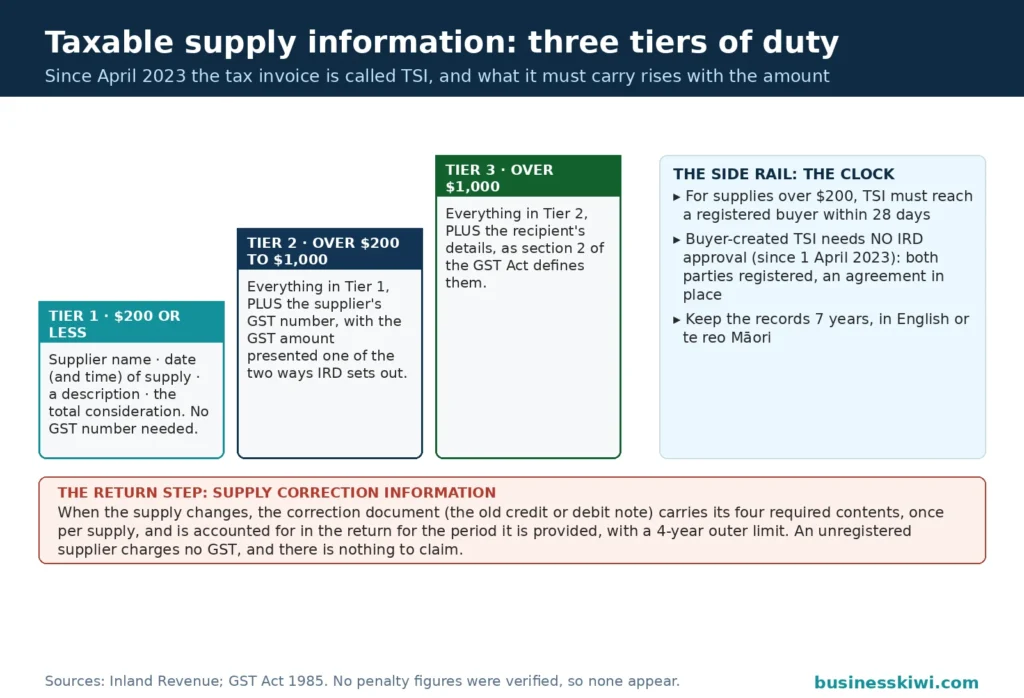
For most supplies, what you must record depends on the value of the supply, measured by the consideration in money or money’s worth. There are three bands. Supplies of $200 or less need only basic details and no GST number. Supplies over $200 and up to $1,000 need the supplier’s name and GST number, the date, a description, and the GST amounts presented in one of two approved ways. Supplies over $1,000 need all of that plus the buyer’s details. A GST-registered buyer who asks for the information for a supply over $200 must receive it within 28 days. Corrections are made with supply correction information, the modern name for credit and debit notes, and everything has to be kept for at least seven years.
What changed on 1 April 2023
New GST invoicing rules took effect on 1 April 2023. They replaced the old requirement to issue a document called a tax invoice with a broader requirement to provide and keep taxable supply information. Three terms changed at once:
Two things did not change: the definition of a taxable supply, and the way GST is calculated. The reform was about invoicing and record keeping only, and Inland Revenue is clear that invoicing practices which complied with the old rules still comply with the new ones. You do not have to change the wording on your documents. A business can keep issuing a single document headed “tax invoice” and be fully compliant, provided the information on it meets the current requirements.
The practical shift is flexibility about where the information lives. Under the old rules, buyers and sellers leaned on one physical document as the evidence of a transaction. Now, records such as invoices, bank statements, supplier agreements and contracts can be used on their own, or in combination, to support the figures in a GST return, and the information can also travel directly between software systems through eInvoicing. What matters is that the required particulars exist and can be produced.

The three value bands
The required particulars for an ordinary supply are set by the consideration for that supply. Each supply is looked at on its own value, not on the total of an account or a month’s trading.
For the two higher bands, the GST on the document has to be presented in one of two ways. The first applies where the tax charged is worked out as the tax fraction of the consideration: you show the consideration and state that the amount includes a charge for tax, in plain terms a GST-inclusive total with a clear statement that GST is included. The second way, used where that does not apply, is to show three figures: the total tax charged, the consideration excluding tax, and the consideration including tax. Most accounting software defaults to one of these presentations, but a missing statement or a missing GST line is the most common defect in this area, so templates produced any other way are worth checking.
One caution on the inclusive statement. It works cleanly where everything on the document is charged at the standard rate of 15%. If a single document mixes standard-rated items with zero-rated items, such as an export component, the tax charged on each part needs to be identifiable, which in practice means showing the GST-exclusive amount, the GST amount and the GST-inclusive amount rather than relying on a blanket statement.
Supplies over $1,000: the buyer’s details in full
The top band adds one requirement the others do not have: recipient details. This is a defined term, and it means more than scribbling the customer’s name at the top. Recipient details are the buyer’s name plus one or more identifier details relevant to that buyer, chosen from:
- an address for a physical location, such as a postal or billing address
- a telephone number
- an email address
- a trading name, where it differs from the buyer’s name
- a New Zealand Business Number
- a website address
So a document for a $4,500 supply that names the buyer and shows their billing address meets the test. One that shows only an account code does not. The obligation sits on the supplier, who is entitled to ask buyers for the details. Inland Revenue has pointed out one practical limit in its own guidance: a supplier cannot compel a buyer who is not GST-registered to hand over these details, short of declining the supply. In practice the requirement bites on business-to-business supplies, where GST credits are claimed and the detail matters.
Providing the information, and asking for it
The record-keeping duty runs in both directions. A GST-registered person who makes or receives a supply for a taxable activity must hold a record of the taxable supply information and any supply correction information for that supply. On top of that, there is a positive duty to provide: if a GST-registered buyer requests the information for a supply over $200, the supplier must provide it within 28 days of the request, or by a different date the two parties have agreed.
For supplies of $200 or less, the position is lighter: the supplier is not required to provide taxable supply information for those supplies at all. Buyers still need their basic record of the purchase, and a receipt or till docket normally carries the four particulars the low band requires. But there is no 28-day duty and no GST number requirement at this level, which removed the old frustration of chasing formal invoices for small purchases.
Claiming GST as a buyer: what happens without the information
Inland Revenue’s position is straightforward: GST-registered customers keep taxable supply information for the supplies they make and to support their expense claims. Under the GST Act, a deduction in a return calculation requires the buyer to meet the record requirements for the supply, so the claim follows the evidence. If you do not hold the information, the claim has nothing behind it. The fix is procedural rather than dramatic: ask the supplier for the information. For a supply over $200 they must provide it within 28 days of your request, and most will simply reissue the invoice with the missing fields added.
There are two situations where a missing GST number is not a defect at all: the $200 or less band, where the law does not require the supplier’s registration number to be recorded, and secondhand goods bought from a seller who is not GST-registered, which has its own record, covered below. Outside those cases, a document with no GST number for a supply over $200 is incomplete, and a document from a supplier who was never registered is not evidence of GST at all, because no GST was charged.
Buyer-created taxable supply information
In some industries the buyer is better placed than the seller to document the supply. Inland Revenue gives two everyday examples: an abattoir that weighs and grades stock before the price payable to the farmer can be known, and a potato chip producer buying from many farmers who wants one standard process. In these cases the buyer can create the taxable supply information instead of the seller, and since 1 April 2023 this no longer needs Inland Revenue’s approval.
The conditions are specific. Both the buyer and the seller must be GST-registered. The two parties must agree that only the buyer will provide the information for the supplies the arrangement covers. If the arrangement is not part of their normal terms of business, they must record their reasons for entering into it. The buyer must keep a copy of the information provided. The document must show everything a standard document for that band shows, plus both the buyer’s and the seller’s GST numbers, and the GST added to the gross amount of the supply. The buyer must also provide the information within 28 days of a request, or by an agreed alternative date.
There is a backstop: Inland Revenue can invalidate a buyer-created arrangement before a supply is made if the parties have not complied with the agreement, or have not recorded the reasons where that was required. Arrangements approved under the old buyer-created tax invoice rules before 1 April 2023 can continue, so there is no need to re-paper an existing setup.

Credit notes and debit notes: supply correction information
When the original information turns out to be wrong, the correction has its own document. Supply correction information is what credit notes and debit notes are now called, and the seller must provide it to correct an error in the original taxable supply information or in a filed return, whether or not the buyer has paid. Inland Revenue’s list of triggers covers the situations businesses meet every week: an order added to or cancelled, goods returned, goods not delivered, a wrong description, wrong seller or buyer details, a wrong date, GST charged at the wrong rate, or a wrong GST amount.
A correction document must show:
- the seller’s name or trade name and GST number
- the date the correction is provided
- details that identify the original information, such as the original invoice number
- the correction itself, including a correction to the amount of tax charged where that is relevant
Only one set of supply correction information should be provided for a particular supply. If the buyer loses their copy, the seller can provide another copy, and copies do not need to be marked “copy only”. The correction goes into the GST return for the period in which it is provided, so when you issue it affects which return picks up the adjustment. There is also an outer time limit under the GST Act: as a general rule, supply correction information cannot be issued more than four years after the end of the taxable period in which the return covering the supply was filed, with narrower exceptions for particular kinds of overpayment and misapplied zero-rating.
One exception removes paperwork altogether: no correction document is needed where the difference results from a discount or rebate whose terms were agreed in writing, or were set out in the original taxable supply information. A prompt payment discount stated on the original invoice is the classic case. A single document can also do double duty, carrying supply correction information for one supply and taxable supply information for a different supply, which suits businesses that fold a credit into the next invoice.
Suppliers who are not GST-registered
A supplier who is not registered for GST cannot charge GST, has no GST number to put on a document, and does not issue taxable supply information. Their invoices and receipts are ordinary commercial documents. For a GST-registered buyer, the consequence is simple: there is no GST in the price, so there is nothing to claim. If a document from an unregistered supplier shows a GST amount or a GST number, query it before paying, because the number may be invented or borrowed and the “GST” is not tax you can recover. GST registration is what gives a supplier a GST number in the first place, so its absence on a small supply from a sole trader is normal, while its absence on a $5,000 document is a question worth asking.
Secondhand goods bought from private sellers
Secondhand goods are the standing exception to the rule that no registration means no credit. A GST-registered buyer who purchases secondhand goods that are not a taxable supply, for more than $200, and claims an input tax deduction on them must keep a specific record instead of taxable supply information. Inland Revenue describes secondhand goods as goods previously used by someone else, including land. The definition excludes new goods, primary produce that has not been used, goods supplied under a lease or rental, livestock, and goods made of fine metal.
The record must show:
- the name and address of the supplier
- the date the goods were supplied
- a description of the goods
- the quantity or volume of the goods
- the consideration paid
Two practical points sit alongside the record. The buyer must actually have made a payment before claiming the credit, whatever accounting basis they use. And the credit itself is worked out using the tax fraction, which at the 15% rate means multiplying the amount paid by 3 and dividing by 23.
A brief note on imported supplies
Businesses that buy from overseas suppliers face their own record rule: it must show the supplier’s name and address, the date of the invoice or the time of supply, a description, the consideration, and any amounts the GST Act treats as not affecting the value of the supply.
Record keeping: seven years, in English or Māori, and retrievable
Inland Revenue’s record-keeping rules apply to taxable supply information in the same way they apply to the rest of your business records. Keep records of cash and non-cash sales and expenses throughout the year, and keep all records, including electronic ones, for at least seven tax years. Records must be in English or Māori unless Inland Revenue has approved another language. If records are stored offshore, including with a cloud provider, either you or the provider needs Inland Revenue’s approval for that storage.
Under the GST Act itself, the record you must hold for each supply is the taxable supply information and any supply correction information for it, which is why the bands matter long after the invoice is paid: the record is the return’s evidence. Failing to keep documents the law requires is an offence under the Tax Administration Act 1994, quite apart from what it does to a GST claim. A filing system that keeps the document, the payment record and any correction together will satisfy the requirement with the least effort.
eInvoicing and Peppol
eInvoicing is the direction the system is moving, and the 2023 changes were designed partly to enable it. In Inland Revenue’s description, eInvoicing digitally swaps invoice information between the buyer’s and the supplier’s financial systems, even where the two businesses use different software. It removes paper and PDF invoices, reduces manual entry, improves accuracy and speeds up payment. Information is exchanged through the Peppol network using the New Zealand Peppol specifications, and Inland Revenue does not receive the information: it moves between the businesses, not to the tax department.
The New Zealand programme is run by the Ministry of Business, Innovation and Employment, which manages the Peppol framework New Zealand adopted in 2019. Businesses connect through accredited access point providers, which act as secure gateways to the network, and the New Zealand Business Number is used to direct each eInvoice to the right buyer. Because an eInvoice carries structured data rather than a picture of a document, the taxable supply information travels with the transaction itself, and Inland Revenue accepts that records built from eInvoicing, bank statements, purchase orders, ledgers and supplier agreements can support GST return figures on their own or combined.
Government is also using procurement to push adoption. Under rules MBIE announced as taking effect in January 2026, mandated agencies must send and receive eInvoices and are expected to pay 95% of eInvoices within five business days, with other domestic trade invoices paid within ten days. For a business that supplies government, that payment speed is a practical reason to get set up early.
Common mistakes
Most problems in this area are small and repetitive. The recurring ones are: working to the old $50 threshold from memory, when the modern bands start at $200; leaving the statement that an amount includes GST off a GST-inclusive document in the middle band; forgetting the buyer’s details on supplies over $1,000; claiming GST from a document issued by a supplier who was never registered; issuing two correction documents for the same supply; putting a correction in the wrong return period; and keeping invoices for a year or two rather than seven. A further quiet trap is assuming the words “tax invoice” are legally required. They are not: the information is the point.
Frequently asked questions
Do my invoices still need to say “tax invoice”?
No. Since 1 April 2023 the legal concept is taxable supply information, and Inland Revenue confirms you do not need to change the wording of your documents. You may keep issuing a single document marked as a tax invoice, and documents that complied with the old rules comply with the new ones, provided the information on them meets the current requirements for the value band.
What has to be on a document for a supply of $200 or less?
Four things: the seller’s name or trade name, the date of the invoice or the time of supply if no invoice is issued, a description of the goods or services, and the total amount payable. The seller’s GST number is not required at this level, and the supplier is not obliged to provide taxable supply information for these supplies at all, although a receipt normally covers what a buyer needs.
A supplier’s invoice has no GST number on it. Can I still claim the GST?
It depends on the value. For a supply of $200 or less, yes, because the GST number is not a required particular at that level. For a supply over $200, no: the supplier’s name and GST number are required particulars, and a claim needs the required information behind it. Ask the supplier to complete the information, which they must do within 28 days of your request for supplies over $200.
How quickly must a supplier send me the information I ask for?
Within 28 days of the request, or by an alternative date you have both agreed. That duty applies to supplies over $200 where the buyer is GST-registered.
When do I need supply correction information instead of just adjusting my next return?
Whenever the original information or a filed return contains an error: goods returned or not delivered, an order changed or cancelled, a wrong description, wrong party details, a wrong date, GST at the wrong rate, or a wrong GST amount. The correction must identify the original document, should be issued only once for that supply, and is accounted for in the return for the period it is provided in. A discount or rebate on terms agreed in writing, or stated in the original information, is the exception: no correction document is needed for those.
Can I claim GST on secondhand equipment bought from a private seller?
Potentially, yes. Secondhand goods are the exception to the rule that an unregistered seller means no credit. You must have paid for the goods before claiming, and for purchases over $200 you need a record showing the supplier’s name and address, the date, a description, the quantity or volume, and the price paid. The credit is the tax fraction of the amount paid, 3 divided by 23 at the 15% rate.
How long do I have to keep tax invoices and related records?
At least seven tax years, including records held electronically. They must be in English or Māori unless Inland Revenue has approved another language, and if they are stored offshore, including in the cloud, approval for that storage is needed for you or your provider. If Inland Revenue audits you, these are the records they will check.
Is eInvoicing the same as emailing a PDF invoice?
No. A PDF is still a document that someone has to read and key in. eInvoicing sends the invoice information directly between the buyer’s and supplier’s financial systems through the Peppol network, using the buyer’s New Zealand Business Number as the address, so it arrives ready to reconcile and pay.
This article is general information about GST invoicing and record-keeping requirements in New Zealand. It is not tax advice for your specific circumstances. If a requirement in this article affects a significant transaction or a disputed claim, confirm the position with Inland Revenue or a qualified tax adviser.
Sources
- Inland Revenue, Taxable supply information for GST, ird.govt.nz
- Inland Revenue, How taxable supply information for GST works, ird.govt.nz
- Inland Revenue, Buyer-created taxable supply information, ird.govt.nz
- Inland Revenue, Supply correction information, ird.govt.nz
- Inland Revenue, Record keeping, ird.govt.nz
- Inland Revenue, Electronic invoicing (eInvoicing), ird.govt.nz
- Inland Revenue, Special supplies, ird.govt.nz
- Parliamentary Counsel Office, Goods and Services Tax Act 1985, legislation.govt.nz
- Ministry of Business, Innovation and Employment, What is eInvoicing?, einvoicing.govt.nz
- Ministry of Business, Innovation and Employment, Government eInvoicing and prompt payment rules take effect this month, mbie.govt.nz