Investing in Shares in NZ: How Buying Stocks, Dividends and Tax Work

Buying shares is the most direct way to own a slice of a company. Apps and online brokers have removed the old barriers of large minimum orders and phone calls to a broker, but you still need to understand what you are buying, what it costs, and how the tax rules work, because New Zealand taxes shares in ways that often surprise people used to overseas guides.
This article covers shares specifically: what a share is, how the NZX and ASX markets work, how to buy shares step by step, what brokerage and other costs look like, how dividends and imputation credits work, and the tax rules that apply when you sell, including the foreign investment fund (FIF) rules for overseas shares. It assumes you have already decided that investing in NZ is something you want to explore, and focuses on the share investing piece of that picture.
The short answer
A share is a unit of ownership in a company. You make money in two ways: dividends, which are payments of company profit to shareholders, and price growth, which you only turn into cash when you sell. In New Zealand you buy shares through a licensed broker or an NZX-accredited online platform, not directly from the exchange. Dividends are taxable income, and New Zealand company dividends usually come with imputation credits for tax the company has already paid. There is no general capital gains tax, but a gain on sale is taxable if you bought the shares mainly to sell them, run a share dealing business, or are part of a profit-making scheme. Overseas shares have an extra layer: once the total cost of your foreign shares passes NZ$50,000, the FIF rules generally apply instead of the ordinary rules.
What a share is, and how it makes you money
When a company needs money to grow, it can divide its ownership into shares and sell them to investors. Each share is an equal unit of ownership: own more shares and you own a bigger portion of the company, with a bigger claim on its profits and a bigger say when shareholders vote.
Shares in larger companies are listed on an exchange, which means they can be bought and sold by the public. The price is set by supply and demand throughout the trading day. If more investors want to buy than sell, the price tends to rise; if sentiment turns, it falls. Prices move on company profits, dividend announcements, the wider economy and investor mood.
Returns come from two places:
- Dividends. When a company makes a profit, its board may pay part of that profit out to shareholders as a dividend, usually once or twice a year. Not every company pays one. Younger growth companies often reinvest everything instead.
- Price growth. If the company becomes more valuable, its share price generally rises, and you can sell for more than you paid. Until you sell, that gain exists only on paper. If the price falls below what you paid, the same applies in reverse.
Some platforms also let you buy fractional shares, which are slices of a single share. That makes it possible to invest a set amount in a company whose shares cost hundreds of dollars each. The tax and ownership principles are the same; you simply own a fraction rather than a whole share.
The NZX and ASX: where shares trade
The NZX is New Zealand’s licensed share market operator. Its main market, the NZX Main Board, is where most New Zealand listed companies trade, from the big banks, power companies and retailers down to much smaller firms. NZX also runs debt markets, and exchange-traded funds (ETFs) listed on the NZX give you a basket of shares in a single trade.
You cannot deal with the NZX directly. Trades go through NZX participants, which are the broking firms and accredited platforms that connect investors to the market. When you place an order, your provider sends it into the market, where it is matched against someone on the other side of the trade.
The NZX trading day is built around auctions and continuous trading: a pre-open session, an opening auction that sets the first prices, continuous trading through the day, and a closing phase late in the afternoon. NZX publishes the exact session times on its website. Listed companies must also release material information to the market as soon as they become aware of it, under continuous disclosure rules, and those announcements are published on the NZX announcements platform. Results, dividend declarations and profit warnings all appear there first, which makes it the most reliable source of company news an investor can read.
The ASX is Australia’s exchange, and it is much bigger than the NZX, with thousands of listed companies. Many New Zealand brokers and platforms offer ASX access alongside the NZX, and some New Zealand companies are dual listed on both. Two practical differences matter. First, ASX trades are in Australian dollars, so currency conversion fees and exchange rate movements come into play. Second, Australian shares have their own exemption from the FIF rules, covered later in this article.

How to buy shares in NZ, step by step
Step 1: Choose a licensed provider. You have two broad routes. A traditional sharebroker offers NZX access, research and, in many cases, an adviser who can place trades for you. An online platform or app is self-directed: you make your own decisions and place your own orders, usually at lower cost. Either way, the Financial Markets Authority (FMA) advises checking that you are dealing with a licensed provider. The FMA licenses and supervises financial service providers and publishes warnings about unregistered businesses and known scams. If a provider is not licensed in New Zealand, you have far less protection if something goes wrong.
Step 2: Open an account and prove your identity. Providers must verify who you are under anti-money laundering law. Expect to supply photo identification, your address, your IRD number and your bank account details. Your IRD number matters for tax: dividend payers use it to report your investment income to Inland Revenue and deduct withholding tax correctly.
Step 3: Fund the account. Most people transfer money from their bank account into a cash or wallet balance with the provider. For overseas markets, your money is converted into the market’s currency, usually with an exchange fee built in.
Step 4: Place an order. The two order types you will use most are:
- A market order buys or sells at the best available price right now. It is simple, but the price you get is the price when the order reaches the market, which may differ slightly from your screen.
- A limit order sets the highest price you will pay (or the lowest you will accept), and only executes if the market reaches that price. It gives you control over price, but no guarantee the trade will happen.
Step 5: Settlement and how your shares are held. After a trade executes, money and shares change hands on the settlement date set by the market, a short period after the trade date. How the shares are recorded depends on your provider. With a traditional broker, shares are generally registered in your name on the company’s share register, maintained by a share registry such as Computershare or MUFG Pension & Market Services, and you receive a holder number for the holding. With many app-based platforms, a nominee company holds the shares on trust and you are the beneficial owner: dividends and other economic rights flow to you, but your name is not the one on the register. Neither model is automatically better, but they differ if you want to vote at meetings, transfer shares, or hold them outside a platform, so understand which one you are signing up for. Many listed companies also offer dividend reinvestment plans, where dividends automatically buy more shares, elected through the registry or your platform.
What share investing costs
Costs are the part of returns you can actually predict, so they deserve attention. The main ones are:
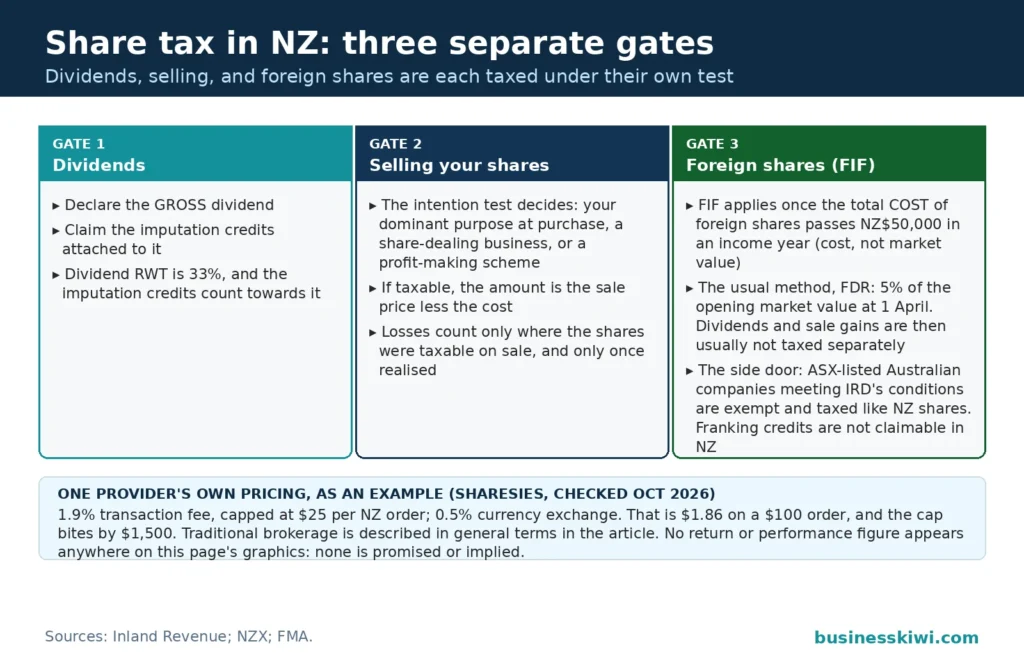
- Brokerage (transaction fees). Charged each time you buy or sell. Traditional brokers typically charge a percentage of the trade value with a minimum fee per trade, so small trades cost proportionally more. App-based platforms often charge a percentage with a cap. As one current example, Sharesies’ own pricing page (checked October 2026) shows pay-as-you-go transaction fees of 1.9 percent of the order amount, capped at $25 per order for NZ shares, with optional monthly plans that cover a set amount of transaction fees. On a $100 NZ share order that works out to a $1.86 fee; on a $1,500 order the 1.9 percent would be more than the cap, so the fee stops at $25. Fees change, so always check your provider’s current pricing page rather than relying on figures quoted anywhere else, including here.
- Currency exchange fees. Buying ASX or US shares means converting currency each way. Sharesies, for example, charges 0.5 percent when you exchange money. A margin on conversion is standard across providers and easy to overlook.
- Fund fees inside ETFs. If you buy an ETF, the fund manager’s fee is charged by the fund provider and built into the unit price. It never appears as a separate bill, but it reduces returns every year you hold the fund.
- Account and service fees. Some brokers charge custody, account or inactivity fees, and optional extras such as live market data. Read the fee schedule before you open the account, and if you cannot work out how fees are charged, ask. The FMA makes the same point in its investing basics: do not hand over money until you understand the fees.
Frequent trading multiplies brokerage and currency costs, which is one reason both cost and tax favour a deliberate, longer-term approach for most people.

Dividends and imputation credits
Dividends are taxable income in New Zealand, whether they come from a New Zealand company or a foreign one. What makes New Zealand different is the imputation system, which is designed to stop company profits being taxed twice.
It works like this. A New Zealand company pays tax on its profits. When it pays a dividend, it can attach imputation credits to that dividend, representing tax the company has already paid. As a shareholder, you declare the gross amount (the cash dividend plus the imputation credits) as income in your tax return or automatic assessment, and you claim the credits against the tax you owe. In effect, company tax becomes a prepayment of your own tax on that dividend.
Resident withholding tax (RWT) sits alongside this. The RWT rate for dividend payments is 33 percent, and the company deducts it before paying you. Imputation credits attached to a dividend count towards that 33 percent, so a fully imputed dividend has less cash RWT deducted because the credits make up the difference. Inland Revenue reports dividend income and tax credits into your income tax assessment automatically for New Zealand dividends, and you should check the amounts are correct.
Where this lands depends on your marginal tax rate. If your rate is below 33 percent, the combined credits may exceed the tax you owe on the dividend, and the difference is sorted out in your end-of-year assessment. If your rate is 39 percent, you may have a little more to pay. Foreign dividends are different: no imputation credits attach, tax may have been withheld overseas, and you generally need to report the income yourself in an IR3 return and claim any foreign tax credits using the IR1261 overseas income summary.
Tax when you sell: purpose is everything
New Zealand has no general capital gains tax. A rise in the price of shares you bought as a long-term investment, to earn dividends and benefit from the company’s growth over time, is generally not taxed when you sell. But there are three important situations where Inland Revenue says amounts from selling shares are taxable income:
- You bought the shares for the dominant or main purpose of selling them. This is the intention test, and it is about your purpose at the time you bought, not what happened later. Buying shares mainly to resell at a profit makes the eventual gain income, even for a one-off purchase, and even if you are not in business.
- You are in the business of share dealing. Inland Revenue looks at the whole picture: a high scale of regular buying and selling, an intention to profit from sales, continuous monitoring of the portfolio, a system for trading, large amounts invested and significant time spent. No single factor decides it, but together they can show a business.
- The shares are part of a profit-making scheme. A coordinated plan or enterprise directed at making a profit from share dealing can make the proceeds income from the time the scheme starts.
Because purpose is judged on evidence, Inland Revenue suggests keeping records from when you buy: your notes on why you bought, the research you relied on, any investment plan or advice, and lending records if you borrowed to invest. Your stated purpose also has to line up with reality. The nature of the share, how long you hold it, the circumstances of purchase and sale, and the number of similar transactions all get weighed up.
Two related points matter. First, if your share sales are taxable, the taxable amount is the sale price less the cost of the shares, transaction fees and related costs can generally be claimed, and a realised loss on taxable shares can also be claimed. Second, the mirror image applies if your shares are not taxable on sale: a loss on shares bought for dividends or long-term investment cannot be claimed, and a fall in value while you still hold the shares is never deductible. There is no bright line test like the one for residential property, so if your trading is frequent or your purpose is mixed, get tax advice before you sell, not after.
Overseas shares and the FIF rules
Foreign shares follow a different regime once your holdings grow. If you are a New Zealand tax resident and the total cost of your foreign shares (technically, your attributing interests in foreign investment funds) comes to more than NZ$50,000 at any point in the income year, the foreign investment fund (FIF) rules generally apply to those shares. Cost means what you paid, converted into New Zealand dollars and including transaction fees, not the market value on any particular day.
Under the FIF rules you do not simply report dividends and sale gains. You calculate FIF income each year using one of several methods and return it in your IR3. The method most individuals use is the fair dividend rate (FDR) method, which taxes 5 percent of the opening market value of your foreign shares at the start of the income year (1 April for individuals). Under FDR, dividends and gains on sale are usually not taxed separately, although an adjustment applies if you buy and sell within the same year. Other methods exist, including the comparative value method, which looks at the change in value across the year plus returns received. You choose a method each year, but must use the same one across all your FIF interests that year. Inland Revenue’s Guide to FIFs (IR461) works through the calculations.
Australian shares have an important carve-out. Shares in ASX-listed companies that are Australian resident, maintain a franking account and meet the other conditions are exempt from the FIF rules entirely, and are taxed much like New Zealand shares. One catch: Australian franking credits attached to those dividends cannot be claimed as tax credits in New Zealand. Inland Revenue has an online tool to check whether a particular Australian share qualifies for the exemption.
Below the threshold, life is simpler. If your foreign shares cost NZ$50,000 or less in total, the FIF rules do not apply and the general rules do: dividends are taxable income, and a sale is taxable only if one of the purpose, business or scheme tests above applies. You can also choose to apply the FIF rules voluntarily below the threshold, which some investors do when their holdings have fallen in value.
The risks that come with shares
Shares sit at the higher-risk end of mainstream investments, and the FMA and Sorted both stress that values will fall as well as rise. The main risks to understand are:
- Volatility. Share prices move daily, sometimes sharply. Whole markets can fall a long way in a crash and take years to recover. The FMA’s advice is to expect this, plan for it, and avoid being forced to sell at the bottom because you need the money.
- Concentration. One company can fail, be taken over on poor terms, or simply disappoint for a decade. Holding one or two shares puts your whole outcome on those companies. Spreading money across different companies, industries and countries softens that blow, and ETFs exist largely to make that spreading cheap and easy.
- Currency risk. Overseas shares are priced in foreign currencies. Even if the share price rises, a stronger New Zealand dollar can eat the gain when the value is converted back, and the reverse can flatter a poor result.
- Liquidity and behaviour. Listed shares are usually easy to sell, which is a double-edged sword: it is also easy to panic-sell in a downturn or chase whatever is rising. Chasing high returns and buying on tips or hype are behaviours the FMA specifically warns against.
- Scams. Fake trading platforms and cold-call investment offers are common, and Sorted warns that anything can be faked, including a slick investing app. Cold calling to sell financial products is illegal in New Zealand. Check the provider is licensed, check the FMA’s warnings list, and treat guaranteed high returns as a red flag.
Common mistakes to avoid
- Buying without knowing the tax position. Selling shares you bought with resale in mind can create a tax bill you did not budget for, and crossing the FIF cost threshold changes your obligations completely.
- Ignoring imputation and RWT details. Failing to give your provider your IRD number, or never checking your automatic assessment against your dividend statements, leads to wrong withholding and messy corrections.
- Letting fees and currency costs creep. Small percentages on every trade and every conversion compound against you, especially if you trade often or hold everything in foreign markets.
- Putting everything in one or two companies. It feels like conviction and behaves like a coin toss.
- Using an unlicensed offshore platform. If it is not licensed in New Zealand, dispute resolution and investor protections may not apply to you at all.
- Selling in a panic. A fall in price is only a realised loss when you sell, and decisions made in the worst week of a downturn tend to be the ones investors regret.
Frequently asked questions
Do I pay tax when I sell shares in New Zealand?
Usually not, if you bought them as a long-term investment for dividends and growth. Gains are taxable if you bought mainly to sell, if you are in the business of share dealing, or if the shares are part of a profit-making scheme. Dividends are always taxable income.
What is an imputation credit?
It is a credit attached to a dividend from a New Zealand company, representing tax the company has already paid on its profits. You declare the dividend plus the credits as income and claim the credits against your own tax, so the same profit is not taxed twice in full.
How much money do I need to start buying shares?
There is no legal minimum, and it depends on the provider. Traditional brokers with minimum brokerage fees make small trades expensive, while app-based platforms with percentage fees and fractional shares let you start with a few dollars. Start with an amount you can afford to leave invested through a downturn.
What happens to my shares if my broker or platform fails?
It depends on how your shares are held. Shares registered in your name on a company’s share register are your property regardless of your broker. Shares held by a nominee company are held on trust for you as beneficial owner, separate from the platform’s own business. Another reason to use a licensed provider and understand your holding structure first.
Are Australian shares taxed the same way as New Zealand shares?
Often, yes. ASX-listed Australian companies that meet Inland Revenue’s conditions are exempt from the FIF rules and are taxed under the general rules, like NZ shares. But Australian franking credits cannot be claimed in New Zealand, and ASX shares that do not qualify, like other foreign shares, fall under the FIF rules once your total foreign share cost passes NZ$50,000.
When do the FIF rules start applying to my overseas shares?
When the total cost of your foreign shares passes NZ$50,000 at any point in an income year. Cost is what you paid in New Zealand dollars, including transaction fees, not current market value. Below that, dividends are taxable and sales follow the general purpose-based rules.
Can I claim a loss if my shares go down?
Only if the shares were taxable on sale in the first place, for example because you bought them to sell or as part of a dealing business, and only once you have actually sold them. Losses on shares held for dividends or long-term investment cannot be claimed, and a fall in value while you still hold the shares is never deductible.
What is the difference between a market order and a limit order?
A market order trades immediately at the best available price. A limit order sets the most you will pay, or the least you will accept, and only trades if the market reaches your price. Market orders prioritise speed; limit orders prioritise price control but may never execute.
This article is general information about how share investing works in New Zealand. It is not financial advice and does not take your personal circumstances into account. Investing involves risk, including the possible loss of the money you invest. If you want recommendations for your situation, talk to a licensed financial adviser. Tax rules change, so confirm the current position with Inland Revenue or a tax professional before acting.
Sources
- Inland Revenue, Share investments, ird.govt.nz
- Inland Revenue, Using the right resident withholding tax (RWT) rate, ird.govt.nz
- Inland Revenue, Foreign investment fund rules exemptions, ird.govt.nz
- Financial Markets Authority, Investing basics, fma.govt.nz
- Sorted, How investing in shares works, sorted.org.nz
- NZX, Market information: trading hours and market holidays, nzx.com
- Sharesies, Pricing and plans, sharesies.nz