IRD Mileage Rates NZ: Kilometre Rates for 2025–26, Logbooks and How to Claim
Ask around for the “mileage rate” and most people mean the per-kilometre rate Inland Revenue publishes each year for claiming the cost of using a vehicle for business. Inland Revenue calls them kilometre rates, and they are the standard shortcut for working out vehicle costs without saving every fuel receipt: record how far the vehicle travelled for business, and multiply those kilometres by a rate Inland Revenue has already calculated from industry cost data.
The catch is that the system has more moving parts than a single cents-per-kilometre figure. There are four vehicle types, two tiers of rates, different rules for employees and the self-employed, and record-keeping requirements that decide whether you can use the higher rate at all. This guide sets out the current rates exactly as Inland Revenue publishes them, and explains the tiers, logbooks, employer reimbursements and GST.
The short answer
Inland Revenue sets kilometre rates under section DE 12 of the Income Tax Act 2007. The most recent rates are for the 2025–26 income year, published in June 2026 after that income year ended on 31 March 2026. They are the rates to use when you work out vehicle expense claims for the 2025–26 year, and employers generally use the latest published rates when reimbursing staff in the meantime.
Kilometre rates for the 2025–26 income year
For comparison, the rates for the previous income year, 2024–25, were:
Kilometre rates for the 2024–25 income year
Use the rates for the income year you are claiming for. Inland Revenue publishes the rates after each tax year ends on 31 March, usually by May, although the 2025–26 rates were released in early June 2026. If you are reimbursing someone before new rates appear, the current published rate applies until Inland Revenue provides the new one.
How the two tiers work
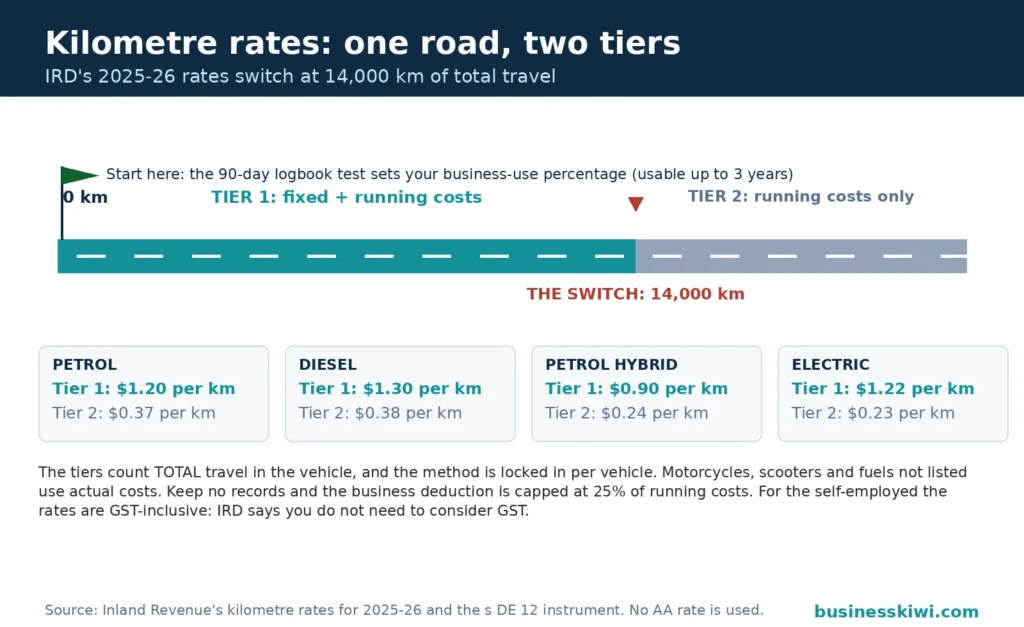
Every vehicle type has two rates because the cost of driving a kilometre is not the same for the first kilometres of the year as it is for the rest.
The Tier 1 rate is a combination of the vehicle’s fixed costs and its running costs. Fixed costs are the costs of owning the vehicle whether it moves or not, such as registration, insurance, interest on the money tied up in it and depreciation. Running costs are the costs of actually driving, such as fuel, road user charges where they apply, tyres and maintenance.
The Tier 2 rate covers running costs only. The logic is that once a vehicle has travelled 14,000 kilometres in a year, its fixed costs have been fully counted already, so additional kilometres only add running costs.
The 14,000 kilometre threshold is based on the vehicle’s total travel for the income year, business and private kilometres combined. You apply the Tier 1 rate to the business portion of the first 14,000 kilometres the vehicle travels in the year, and the Tier 2 rate to the business portion of any travel beyond 14,000 kilometres. It is not 14,000 business kilometres: a vehicle that travels 20,000 kilometres in total, half of them for business, gives you 7,000 business kilometres at Tier 1 and 3,000 business kilometres at Tier 2.
The rates do not vary by engine size or region. Inland Revenue sets them from industry figures for the average cost of operating a motor vehicle, with no allowance for regional fuel price differences.
Who uses the kilometre rate method
Self-employed people. If you are a sole trader or in a partnership and you use your own vehicle in the business, you can claim a deduction for the business use either by using the kilometre rates or by claiming your actual costs. The kilometre rates cover vehicles powered by petrol, diesel, petrol hybrid or electric. If your vehicle runs on something else, such as LPG, you must use the actual costs method. The rates also do not apply to motorcycles or scooters, which must use actual costs as well.
Once you choose a method for a vehicle, you need to keep using that same method for as long as you own the vehicle. You cannot switch between kilometre rates and actual costs from year to year to pick whichever gives the bigger deduction.
Employees. Employees cannot claim deductions for work-related vehicle expenses in their own tax returns. Instead, the cost is handled through the employer: if you use your private vehicle for your employer’s business, your employer can reimburse you, and the reimbursement is exempt from tax to the extent it covers expenditure you incurred for work. Employers work out the exempt amount using actual expenditure, their own reasonable estimate, or Inland Revenue’s kilometre rates, as explained in the reimbursement section below.
Shareholder-employees. Inland Revenue confirms that a shareholder-employee of a close company counts as an “employee” for these reimbursement rules, including a shareholder-employee who does not receive regular PAYE salary or wages. That means your company can reimburse you tax-free for business use of your private vehicle using the kilometre rates, on the same basis as any other employee, provided the amount is a reasonable estimate of your costs.
Businesses claiming for their own vehicles. A business working out what it can deduct for a vehicle used partly for business and partly privately has the same choice: deduct the business portion of actual costs (the cost method), or use the kilometre rate method. Either way, the starting point is establishing what proportion of travel is for business.
Kilometre rates or actual costs: how to choose
Under the actual costs method, you keep records of everything the vehicle costs to run: fuel, warrant of fitness, repairs and maintenance, insurance, registration and parking, then claim the business proportion of the total. You can also claim a deduction for depreciation loss on the business use of the vehicle. Parking costs are treated the same as other vehicle expenses, deductible to the extent they are incurred in earning income.
Under the kilometre rate method, you do not need receipts for individual costs, and you do not claim depreciation separately, because depreciation is built into the Tier 1 rate. If you use kilometre rates, you also give up any separate claim for depreciation recovery when the vehicle is sold.
Which method wins depends on your vehicle and your travel pattern:
- Kilometre rates usually suit people with modest, fairly ordinary running costs, low record-keeping patience, or a vehicle whose actual costs are close to the average Inland Revenue assumes.
- Actual costs can produce a larger deduction if your vehicle is expensive to run, you have had a year with major repairs, or your business use percentage is high and well documented.
- Actual costs demand paperwork. You need accurate records of private and work-related expenses, the reasons for all business travel, and the distances of all journeys. Without those records, neither method works well, and a claim with no logbook and no kilometre records can be limited to 25 percent of the vehicle’s running costs.
The practical approach many businesses take is to run the numbers both ways for one year, using a proper logbook period, and then commit. Because you must stick with the method you choose for that vehicle, it is worth getting the comparison right before the first return is filed.
Worked examples
These examples use only the published 2025–26 rates and simple arithmetic.
Example 1: Self-employed, under 14,000 km in total. A consultant uses her petrol car for client work. Total travel for the year is 11,500 kilometres, and her trip records show 6,200 of those kilometres were for business. Because total travel is under 14,000 kilometres, every business kilometre is claimed at the Tier 1 petrol rate: 6,200 × $1.20 = $7,440. Her deduction for vehicle costs is $7,440, and she does not claim fuel receipts or depreciation on top of that.
Example 2: Self-employed, over 14,000 km, with a logbook. A builder uses his diesel ute for business and private travel. His logbook test period established that 70 percent of travel is for business. Total travel in the 2025–26 year is 20,000 kilometres. Following Inland Revenue’s approach, the business percentage is applied to each tier band: Tier 1, 14,000 × $1.30 × 70% = $12,740. Tier 2, 6,000 × $0.38 × 70% = $1,596. Total deduction = $14,336.
Example 3: Employee reimbursement, no logbook. An employee uses her electric car for work trips and claims reimbursement for 4,200 business kilometres in the year. She kept no logbook, so the Tier 1 rate can only be applied to the first 3,500 business kilometres: 3,500 × $1.22 = $4,270. The remaining 700 kilometres are reimbursed at the Tier 2 rate: 700 × $0.23 = $161. Total tax-free reimbursement = $4,431.
Example 4: Employee reimbursement, with a logbook. If the same employee had kept a logbook showing her work travel, and her total travel for the year was 12,000 kilometres, all 4,200 business kilometres fall within the first 14,000 total kilometres, so the whole claim uses Tier 1: 4,200 × $1.22 = $5,124 tax-free. Keeping records was worth $693 to her in this case.
Logbooks and record keeping
The kilometre rate method is not a record-free method. You still need evidence of how far the vehicle travelled and how much of that travel was for business. The formal way to establish the business proportion is a logbook, and the rules sit in sections DE 6 to DE 11 of the Income Tax Act 2007.
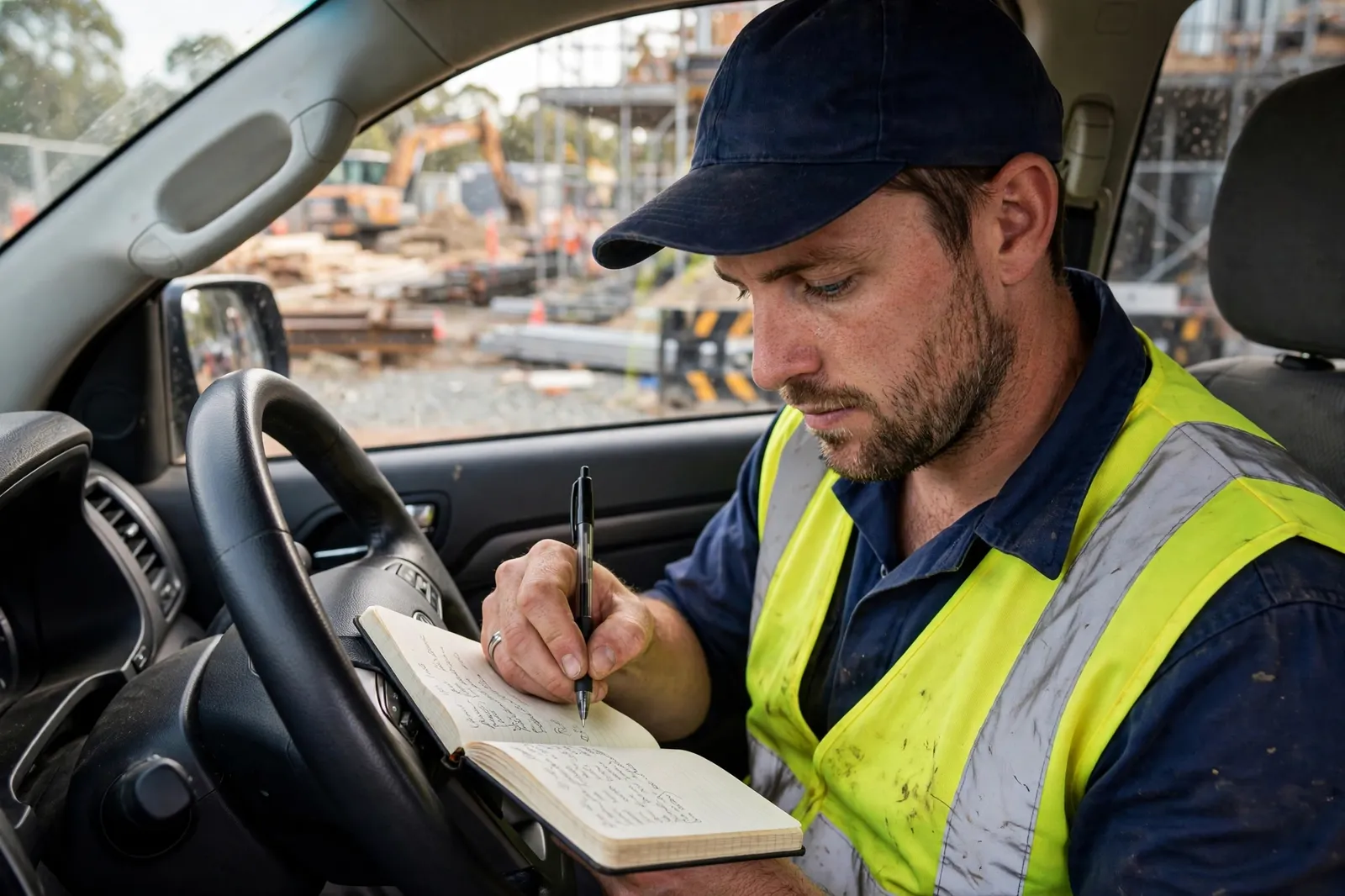
The 90-day test period. You keep a logbook for a test period of at least 90 consecutive days. In practical terms, the first three months of careful records establish the pattern that Inland Revenue will accept for the rest of the logbook term. The period should be typical of your normal travel: there is little point choosing the quietest quarter of the year if your travel is usually much heavier.
What the logbook must record. For the test period, the logbook needs the start and end dates of the period, the vehicle’s odometer readings at the start and end, and for each business journey the date, the distance, and the reason for the trip. Inland Revenue provides a downloadable logbook template, and apps or a notebook are fine as long as the required information is there.
How long the result lasts. The business use percentage from the test period can be applied for the logbook term, which runs for up to three years. If the business use of the vehicle changes by 20 percent or more, Inland Revenue expects a new logbook, because the old percentage no longer represents your travel. A change of vehicle, a move from site work to office work, or a big shift in client locations are all reasons to start a fresh 90 days.
Odometer records still matter. Even with a valid logbook, you must keep recording the vehicle’s total kilometres each year, including an odometer reading at each balance date. This is because the two-tier system depends on knowing when the vehicle’s total travel passes 14,000 kilometres in the year. A logbook percentage alone, with no record of annual distance, cannot support a kilometre rate claim.
If you keep no records. For a business deduction, a claim without a logbook or kilometre records can be limited to 25 percent of running costs, and Inland Revenue can ask you to substantiate even that percentage. For employee reimbursement, without a logbook or other evidence of work use, the Tier 1 rate applies only to the first 3,500 business kilometres (25 percent of 14,000), with Tier 2 rates above that, as Example 3 shows. Keep records for seven years, in line with standard tax record-keeping requirements.
One more boundary worth knowing: travelling from home to your usual workplace is private travel, not business travel, and no method turns commuting into a claim.

Reimbursing employees
Employees cannot deduct their own work vehicle costs, so reimbursement is how the system makes them whole. Under section CW 17 of the Income Tax Act 2007, a reimbursement is exempt income for the employee to the extent it reimburses expenditure the employee incurred in using their vehicle for the employer’s business. No tax is withheld from a genuine reimbursement, and the employer claims a deduction for it as a business expense.
An employer has three broad ways to set the amount:
- Actual expenditure. Reimburse what the employee actually spent, supported by records from both sides.
- The employer’s own reasonable estimate. Section CW 17(3) allows an employer to make a reasonable estimate of the expenditure an employee, or a group of employees, is likely to incur. Inland Revenue accepts that this estimate may be based on rates published by a reputable independent New Zealand source, such as the New Zealand Automobile Association, provided the rate used genuinely represents the employee’s likely costs. Inland Revenue does not publish or endorse any particular AA figure in its guidance, and no AA rate is quoted here: the point is that IRD accepts the approach.
- Inland Revenue’s kilometre rates. Using the Commissioner’s rates is an accepted way to calculate the exempt portion of a reimbursement. With a logbook or other evidence of work use, Tier 1 applies to the business portion of the first 14,000 total kilometres and Tier 2 after that. Without records, Tier 1 is limited to the first 3,500 business kilometres.
Two practical points catch employers out. First, the kilometre rates are set for a past income year, while reimbursement happens in the current year, so Inland Revenue expects employers to satisfy themselves that the rate still represents likely costs, especially when running costs such as fuel have moved noticeably. Inland Revenue is considering further reimbursement guidance for the 2027 income year because of fuel price increases; in the meantime the 2025–26 rates can still be used, or any other reasonable-estimate method. Second, where tracking each employee’s vehicle type is impractical, Inland Revenue accepts a blended average of the published Tier 1 rates as a reasonable estimate.
How much to pay is ultimately a matter for the employer and employee to agree, in the employment agreement or in writing. Inland Revenue’s rates decide the tax treatment of the payment, not the amount an employer must pay.
GST on mileage claims
GST interacts with kilometre rates in a way that surprises many people, because the rates are calculated on a GST-inclusive basis.
Self-employed claimants. When self-employed people use the kilometre rates, Inland Revenue’s position is that they do not need to consider GST in the claim. The deduction is simply the kilometres multiplied by the rate. There is no separate GST input claim attached to a kilometre rate calculation, and no GST adjustment to make on the amount claimed.
Employers reimbursing staff. Input tax cannot be claimed on estimated allowances paid to reimburse an employee, including allowances worked out using the kilometre rates. GST input tax can only be claimed on an actual basis, where the cost was actually incurred and the business holds the required tax invoice at the time of claiming. If your business wants to claim GST on vehicle costs, it needs actual expenditure and tax invoices, not a per-kilometre estimate.
Actual costs method. If you claim actual costs instead, the normal GST rules apply: a GST-registered business claims input tax on the business portion of vehicle expenses it actually incurs, supported by tax invoices, as with other business expenses. This is one of the trade-offs between the methods: the kilometre rate is simpler, but it bundles everything, including any GST, into one income tax figure.
How Inland Revenue sets the rates
The Commissioner of Inland Revenue is required to set and publish kilometre rates, and does so every year under section DE 12(4) of the Income Tax Act 2007. The rates are calculated from third-party data on vehicle ownership costs, such as depreciation, purchase price, insurance and registration, and running costs, such as fuel, maintenance and road user charges.
Because the rates reflect real costs for a completed year, they are set retrospectively. Inland Revenue publishes them as soon as possible after the income year ends on 31 March, usually in time for end-of-year return filing. That timing is why employers reimbursing staff during the year generally work from the most recent published set.
The structure has also evolved. Up to the 2023–24 income year there was a single Tier 1 rate for all vehicle types. From 2024–25, after a review found that running costs now differ significantly between vehicle types, the Commissioner set a separate Tier 1 rate for each category, which is why the tables above show four different Tier 1 figures. Inland Revenue has also signalled that its operational statements on kilometre rates, OS 19/04A and OS 19/04B, issued in August 2019, are being reviewed and updated.
Common errors
- Using the wrong year’s rates. Each income year has its own table. A 2025–26 claim worked out at 2024–25 rates is wrong even if the arithmetic is perfect.
- Applying Tier 1 to every business kilometre. The tier switch is driven by the vehicle’s total travel, not business travel. Once total travel passes 14,000 kilometres, business kilometres are claimed at Tier 2.
- Claiming the drive to work. Home to your usual workplace is private travel. It counts toward the 14,000 kilometre total but never toward business kilometres.
- Keeping no records at all. Without a logbook or kilometre records, business claims can be capped at 25 percent of running costs, and employee reimbursements lose Tier 1 treatment after 3,500 business kilometres.
- Claiming GST on a kilometre rate amount. The rates are GST-inclusive estimates. There is no input tax claim on a kilometre rate deduction or on an estimated reimbursement allowance.
- Adding depreciation on top. Depreciation is inside the Tier 1 rate. Claiming it again separately double-counts it, and there is no depreciation recovery adjustment later either.
- Switching methods year to year. Once you choose kilometre rates or actual costs for a vehicle, you stay with that method while you own it.
- Using the rates for the wrong vehicle. The rates do not cover motorcycles or scooters, and vehicles that are not petrol, diesel, petrol hybrid or electric must use actual costs.
Frequently asked questions
What is the current IRD mileage rate?
Inland Revenue calls them kilometre rates. The latest published rates, for the 2025–26 income year, are $1.20 per kilometre for petrol, $1.30 for diesel, $0.90 for petrol hybrid and $1.22 for electric at Tier 1, covering the business portion of the first 14,000 kilometres of total travel. Beyond 14,000 total kilometres, Tier 2 rates of $0.37, $0.38, $0.24 and $0.23 per kilometre apply respectively.
Can I claim mileage in my own tax return as an employee?
No. Employees cannot deduct employment-related vehicle expenses themselves. The cost is dealt with by your employer reimbursing you, and that reimbursement is tax-free to the extent it covers your work-related expenditure, worked out using actual costs, a reasonable estimate, or Inland Revenue’s kilometre rates.
Do I need a logbook to use the kilometre rate?
You need records that establish your business kilometres and the vehicle’s total kilometres. A logbook kept for at least 90 consecutive days is the standard way to establish your business use percentage, and that percentage lasts up to three years. Without records, claims are limited: 25 percent of running costs for a business deduction, or Tier 1 rates for only the first 3,500 business kilometres for an employee reimbursement.
Can I claim GST on my mileage claim?
Not on the kilometre rate amount. The rates are calculated on a GST-inclusive basis. Self-employed people using kilometre rates do not need to consider GST in the claim at all, and employers cannot claim input tax on estimated reimbursement allowances. GST input tax is only available on actual costs supported by tax invoices.
Which method is better, kilometre rates or actual costs?
It depends on the vehicle and your records. Kilometre rates are simpler and need no cost receipts, but the figure is an average. Actual costs can give a bigger deduction for an expensive-to-run vehicle, and allow GST input claims, but require full records of costs, distances and the reasons for business travel. You must choose one method per vehicle and keep using it while you own the vehicle.
When do new kilometre rates come out?
Inland Revenue sets the rates for each income year after it ends on 31 March and usually publishes them by around May, in time for return filing. The 2025–26 rates were published in June 2026. Until new rates appear, use the most recent published rates for the year you are claiming, and for reimbursements use the current published rate until Inland Revenue provides the next one.
Can my company reimburse me if I am a shareholder-employee?
Yes. Inland Revenue treats a shareholder-employee of a close company as an employee for the reimbursement rules, even if you do not take a regular PAYE salary. Your company can reimburse you tax-free for business use of your private vehicle using the kilometre rates, actual costs, or another reasonable estimate, with the same record-keeping expectations as for any employee.
This article is general information about New Zealand tax rules for vehicle expenses, based on Inland Revenue guidance published for the 2025–26 income year. It is not personal tax advice. Rates and rules change each year, so check the current rates on Inland Revenue’s website or talk to a tax adviser about your own situation before filing or setting a reimbursement policy.
Sources
- Inland Revenue, Kilometre rates 2025-2026, ird.govt.nz
- Inland Revenue, Kilometre rates 2024-2025, ird.govt.nz
- Inland Revenue, Vehicle expenses, ird.govt.nz
- Inland Revenue, The Income Tax (Kilometre Rates for the Business Use of Vehicles for the 2025-26 income year) Instrument 2026, taxtechnical.ird.govt.nz
- Inland Revenue, Kilometre rates for the business use of vehicles for the 2025 income year (OS 19/04 KM 2025), taxtechnical.ird.govt.nz
- Inland Revenue, OS 19/04B: Commissioner’s statement on using a kilometre rate for employee reimbursement of a motor vehicle, taxtechnical.ird.govt.nz
- Inland Revenue, QB 10/01: Reimbursing shareholder-employees for motor vehicle expenses and the use of the Commissioner’s mileage rate, taxtechnical.ird.govt.nz