Envelope Sizes NZ: Standard Sizes, NZ Post Limits and Addressing Rules
Post a letter in the wrong envelope and one of two things tends to happen. Either it travels at a higher rate than you expected, or it comes back to you. The fix is simple once you know how NZ Post measures mail, because the system runs on three numbers: height, length and thickness, plus the weight of the finished item, envelope included.
This guide sets out the standard envelope sizes used in New Zealand, the exact size and weight limits NZ Post applies to letters sent by Standard Mail, how to measure an envelope properly, and the addressing rules that help a letter move through the sorting machines without delay. Everything here comes from NZ Post’s own published guidelines, checked in October 2026. Postage prices sit in our postage costs guide instead, because this page is about sizes and limits rather than what each band costs.
The standard envelope sizes used in NZ
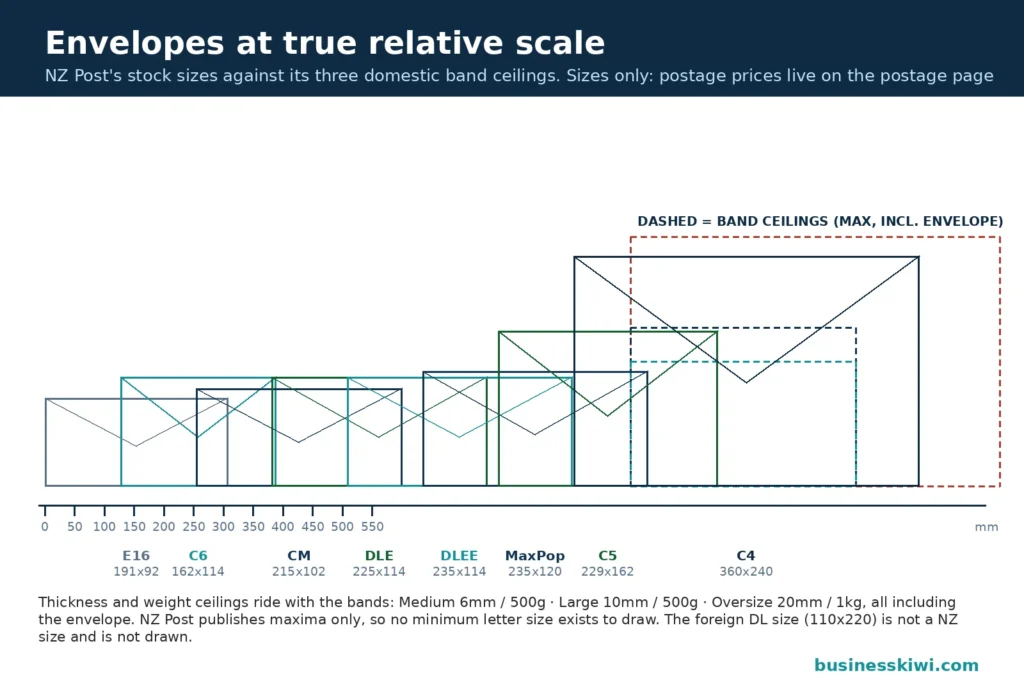
Envelope names like DLE and C5 are industry standard sizes, not marketing labels, and NZ Post publishes the dimensions it works to in its Envelope Layout Standards. These are the sizes you will meet most often when buying envelopes in New Zealand.
A few of these deserve a closer look.
DLE is the workhorse. At 114mm x 225mm it takes an A4 page folded into thirds, which is why most bills, statements and business letters arrive in one. NZ Post sells DLE PrePaid envelopes with postage already included, in window and non-window versions, rated for items up to 6mm thick and 500g in total. If you have seen the term DL used overseas, treat it with care: DL is a slightly smaller international size, while the envelope NZ Post specifies and sells here is the DLE. When buying for NZ Post size bands, the measurements on the packet matter more than the letters on the front.
C5 is the next step up. At 162mm x 229mm it holds an A4 sheet folded in half, or an A5 sheet flat, and it is NZ Post’s example of a Large letter. C4 is where letters stop being small: NZ Post’s layout standards list C4 stock at 240mm x 360mm and class it as Oversize. It holds A4 flat, which is why certificates, contracts and application packs travel in one. C6 is the card envelope, at 114mm x 162mm, suited to greeting cards, invitations and A6 postcards, and still inside the Medium band.
You may also see the codes E9 and E35 on NZ Post pages. E9 is one of the envelope types NZ Post names as fitting its Medium band, and E35 is its example of an Oversize envelope. NZ Post does not publish standalone dimensions for those two codes on the pages covered here, so if you buy either, check the millimetre measurements on the packet against the band limits before you post.
NZ Post letter size bands for Standard Mail
For letters sent within New Zealand by Standard Mail, NZ Post sorts everything into three bands: Medium, Large and Oversize. The band is set by the largest of your measurements, not by the envelope’s name. An envelope only stays in its band while every measurement, and the weight, stays within the limit.
Three points in that table catch people out.
First, the weight always includes the envelope itself. NZ Post states this in its Postal Users’ Guide: dimensions and weight restrictions include the envelope. A document that weighs 480g on its own can tip over the 500g Medium and Large limit once a sturdy envelope is added.
Second, thickness is a hard limit, not a guideline. A Medium letter can be at most 6mm thick. Pages that push a DLE envelope out to 8mm no longer qualify as Medium, however light they are. The item moves up to Large if it fits the 10mm Large limit, and beyond that it is Oversize territory.
Third, the bands step up on any single measurement. Your letter takes the band of its biggest dimension. A slim envelope that is 250mm long is Oversize even if it weighs almost nothing, because it exceeds the 235mm length cap shared by Medium and Large.
One shortcut worth knowing: a single KiwiStamp always covers a Medium letter sent by Standard Mail within New Zealand, because KiwiStamps are non-denominated and hold their value even when prices change. Large and Oversize letters need more than one KiwiStamp’s worth of postage, made up with additional denominated stamps.
How size decides how your letter travels
Size does more than set the band. It also decides how your letter is handled.
Standard Mail letters are targeted for delivery within three working days nationwide, with longer times possible to and from rural and remote areas. That target applies across all three bands, so a bigger envelope does not mean a slower letter, provided it is a letter at all.
Machine sorting is where size starts to bite. NZ Post’s layout standards for bulk mail set the maximum dimensions for machine sorted items at 165mm high by 240mm long. Medium and Large letters fall inside that range, while an Oversize item such as a C4 envelope is too big to be machine sorted and is handled differently. For a one-off personal letter this changes nothing about whether it arrives, but it explains why businesses posting in volume are steered towards DLE and C5 formats.
Prepaid envelopes remove the guesswork at the smaller end. Because a PrePaid envelope is itself a standard size with postage included, using one guarantees the item starts life inside the right band. You still need to watch what goes inside: a DLE PrePaid envelope stuffed past 6mm thick or loaded past 500g no longer meets the Medium specification it was sold for.
Sending a letter overseas: the limits change
If your letter is leaving New Zealand, do not rely on the domestic bands. NZ Post’s Economy Letters service for international mail uses the same band names but tighter limits, especially on weight and thickness.
The differences matter. A domestic Medium letter can weigh up to 500g, but an international Medium letter is capped at 100g. A domestic Oversize letter can be 20mm thick and weigh a full kilogram, while the international Oversize band stops at 10mm and 200g. A fat document pack that posts happily inside New Zealand will not travel as an international letter at all: NZ Post directs senders of documents over 200g, or larger than 260mm high x 385mm long x 10mm thick, to its Economy Tracked, Courier or Express services instead.
International letters must also contain paper based written or printed documents only, with the address information in English, a valid NZ Post return address, and an Economy or Par Avion indicator on the front, top left hand corner.

How to measure a letter correctly
NZ Post measures mail in a fixed order: height first, then length, then thickness. Height is the shorter side of the envelope, length is the longer side, and thickness is how deep the finished item is once sealed.
- Seal the envelope with everything inside, exactly as it will be posted. Contents shift and bunch, so measure the finished item, not the empty envelope.
- Lay it flat and measure the short side (height) and the long side (length) in millimetres with a ruler or tape.
- Measure the thickness at its thickest point. Bulges count. If a folded document, a clasp or a bulky enclosure pushes one spot out to 12mm, the item is 12mm thick for band purposes, not the 4mm it measures elsewhere.
- Weigh the whole thing, envelope included, on kitchen scales. If you are close to a limit, remember that the limits are maximums: 500g means 500g or less.
- Compare all four numbers against the band table. The item must fit every limit in its band, not just most of them.
If your item lands close to a boundary, or you have no scales at home, an NZ Post store can measure and weigh it for you. That is the safest option for anything thick, heavy or unusually shaped.
A short word on odd shapes. Cardboard backing, metal clasps and lumpy enclosures can make an envelope rigid or uneven, and NZ Post’s guidance expects mail to flex enough to pass through sorting equipment. Items that cannot bend, or that have raised or irregular contents, may be handled as parcels or need different packaging. When in doubt, ask at the counter before you post rather than after the item comes back.
When a letter becomes a parcel
There is a clean line between letters and parcels, and NZ Post states it directly in its Postal Users’ Guide: if an item is larger than 260mm x 385mm, thicker than 20mm, or heavier than 1kg, it is classified as a parcel.
Parcels play by different rules:
- Small, size-based parcel items sent by Economy or Courier are capped at 3kg, with the price band set by which NZ Post bag size the item fits.
- Larger items move to weight-based pricing. The ceiling is a maximum weight of 25kg, a maximum length of 1.5m on any side, and a maximum volume of 0.125 cubic metres.
- For weight-based parcels you are charged on the greater of the actual weight or the volumetric weight. NZ Post calculates volumetric weight by multiplying height, length and thickness in metres together, then multiplying by 200, so a big, light box can cost more than its scales weight suggests.
- NZ Post can reweigh and remeasure. If it finds the correct payment has not been made, it may charge the correct price, and an administration fee may be added on top of the shortfall.
The jump from letter to parcel is not a small step. An item just over the letter limits leaves the simple three-band world behind and enters one where volume matters as much as weight. If your document pack is heading that way, splitting it into two letters can work out cheaper than sending one parcel, and it is always worth checking before you seal the box.
What happens if a letter is oversize, overweight or short-paid
NZ Post calls an item with too little postage a short paid item, and its Postal Users’ Guide is blunt about the position: if an item does not have enough postage for delivery, NZ Post is not obliged to deliver it.
What happens next is at NZ Post’s discretion. It may return the item to the sender, delay it, or deliver it anyway. If it delivers, it may charge a handling fee on top of the postage owing. If it returns the item, the postage you already paid is not refunded, and full postage may need to be applied again to resend it. A returned short-paid letter effectively costs you the first lot of stamps as well as the second.
The return address decides how the story ends. With a valid one, an undeliverable item can find its way back to you. Without one, the item may be treated as undeliverable and sent to NZ Post’s Returned Letter Office, where it can be opened to try to identify the sender and otherwise dealt with under the Postal Services Act 1998. The small line of writing on the back of the envelope is doing real work.
The same logic applies at the size boundary. Post a parcel-sized item with letter postage and you should expect the short-paid process, not a free upgrade. Getting the band right before you post is always cheaper than fixing it afterwards.
How to address an envelope in NZ
NZ Post’s sorting technology reads addresses electronically, so a correctly laid out address is not just tidy, it is faster.
Where everything goes:
- The delivery address sits on the front of the envelope, lined up on the left hand side.
- The stamp goes in the top right hand corner. For Standard Mail items, postage must be attached to the front, top right hand corner of the envelope.
- The return address goes in small letters, on one line, in the top left hand corner, or on the back of the envelope.
- Print clearly, use a light-coloured envelope made of firm paper or card, and spell words like Street and Road in full where you can. NZ Post publishes a list of acceptable abbreviations for when space runs out.
The order of the address lines:
- Receiver: the person or business name, on the top line.
- Delivery address: unit or flat number with a slash, then the street number and street name.
- Suburb.
- Town or city, followed by the postcode on the same line.
Always include a postcode. It is the element the sorting system leans on most, and NZ Post’s address and postcode finder will confirm the right one if you are unsure.
Details that trip people up:
- Use the street number in preference to a building name. If you only have a building name, put it on its own line immediately above the street name, with any unit or floor above that.
- Do not use corner addresses, such as corner Main and High Streets, and do not use street number ranges, such as 4-12 Main Street.
- If a street number carries a letter, run them together: 21A Main Street, not 21 A Main Street.
- Leave the province or region out. The town or city name does that job, and adding a region can confuse the sort.
- For rural addresses, use RD plus the delivery number where a suburb would normally go, written with no extra spaces or punctuation: RD 1, not R D 1. Use the mail town for that delivery route, which is not always the nearest town, and skip floor levels.
- For PO Box and Private Bag addresses, do not add a street address as well. The box number runs together with no spaces, as in PO Box 23226, and PO has no spaces or punctuation either.
- Never combine address types. A street address and a PO Box address on the same envelope gives the sorting system two destinations and your letter a slower trip. And every item must show a full return postal address: NZ Post treats it as part of correct addressing, not an optional extra.
Window envelopes: what to watch
Window envelopes are standard for bills and statements because the address printed on the letter itself shows through. The catch is movement: the insert shifts as it travels, and NZ Post’s layout standards require all of the address characters to clearly appear in the window across the full range of that movement.
To stay on the right side of that rule:
- Print the address so the whole block sits comfortably inside the window, with room to spare on every side. If an insert can slide far enough to hide part of the postcode, it will, eventually.
- Make sure the edge of the insert is never visible through the window in a way that cuts across the address. A paper edge crossing the address block can break up the lines the machines read.
- Use envelopes with a proper transparent window covering. NZ Post’s standards require it to be transparent, tight and free of wrinkles, streaks, fogging or colour. Open windows, with no covering at all, are not permitted for mail prepared to those standards.
- For printed mail, NZ Post works to an 8mm clear zone around the delivery address and around the outside of the window, with a 15mm clear zone along the bottom edge of the envelope for the sort code. Home users posting one envelope do not need to measure clear zones, but anyone printing a run of letters for a club, school or business should design to them.
- Keep other text and graphics away from the window. Anything inside it that looks like a block of address lines can be misread as a second address.
If you are posting a single bill in a window envelope, the simple version is this: fold the letter carefully, check the full address is visible before you seal it, and give the envelope a gentle shake to confirm nothing disappears.
Posting your letter: boxes, PostShops and drop points
Once the envelope is the right size and correctly addressed, you have several ways to hand it over. Standard Mail letters can be lodged in NZ Post street posting boxes, through the letter slot at an NZ Post store, at selected stores over the counter, and at NZ Post Business Mail Centres. Business customers with a mail pick up service can also hand mail to their courier.
For most people the choice is between a posting box and a store. If your letter fits a posting box slot comfortably, it is fine to post it there. Oversize letters, and anything close to the 260mm x 385mm ceiling, are better taken to a store, where staff can measure, weigh and confirm the band before you pay. NZ Post has over 560 stores across the country, and the Find NZ Post tool on its website locates your nearest posting box: filter the results by Post a letter to see only the boxes and stores that accept letters. Bear in mind that the day an item is accepted counts as day zero for delivery targets, and mail handed over after the final clearance, or on a weekend or public holiday, starts its journey on the next working day.
Frequently asked questions
What is the standard envelope size in NZ?
The most common is the DLE, at 114mm x 225mm, which takes an A4 page folded into thirds. It is the envelope NZ Post sells as a PrePaid envelope and the size most business letters arrive in. The other regulars are C6 (114mm x 162mm) for cards, C5 (162mm x 229mm) for A4 folded in half, and C4 (240mm x 360mm) for A4 sent flat.
What is the maximum size for a letter with NZ Post?
For Standard Mail within New Zealand, the largest letter band is Oversize: up to 260mm high x 385mm long, up to 20mm thick, and up to 1kg including the envelope. Anything larger, thicker or heavier than that is classified as a parcel and travels under parcel rules instead.
Is a C4 envelope a letter or a parcel?
A C4 envelope is a letter, in the Oversize band, as long as the finished item stays within 260mm x 385mm, is no more than 20mm thick and weighs no more than 1kg including the envelope. NZ Post itself names C4 as an Oversize envelope example. Stuff it thicker than 20mm or heavier than 1kg and the same envelope becomes a parcel.
How thick can a letter be in NZ?
It depends on the band. Medium letters can be up to 6mm thick, Large letters up to 10mm, and Oversize letters up to 20mm. Thickness is measured on the sealed item at its thickest point, so a bulge counts. Past 20mm the item is no longer a letter.
Does the weight limit include the envelope?
Yes. NZ Post states that its dimensions and weight restrictions include the envelope. Weigh the sealed, finished item rather than the contents alone, especially near the 500g cap on Medium and Large letters and the 1kg cap on Oversize.
What happens if I put too few stamps on a letter?
The item is short paid. NZ Post is not obliged to deliver short paid mail, and it may return the item to you, delay it, or deliver it and charge a handling fee on top of the postage owing. If it is returned, the postage already paid is not refunded and full postage may need to be applied again to resend it. A correct return address is what allows it to come back to you at all.
Can I post a letter in any NZ Post box?
Standard Mail letters can go in NZ Post street posting boxes or the letter slot at an NZ Post store, and can also be handed over at selected stores. Use the Find NZ Post tool on NZ Post’s website, filtered by Post a letter, to find your nearest option. Very large Oversize letters are better taken into a store so the size and weight can be checked first.
Do NZ envelope sizes match overseas sizes?
Not always. The envelope NZ Post specifies for everyday letters is the DLE at 114mm x 225mm, slightly larger than the DL size used in some other countries, and NZ Post’s own standards list C4 stock at 240mm x 360mm rather than the smaller figure in some overseas charts. Work from the millimetre measurements and NZ Post’s band limits, not from size names alone. The limits also change at the border: an international Medium letter is capped at 100g, compared with 500g within New Zealand.
This article is general information about NZ Post’s published envelope sizes, size limits and addressing guidelines as at October 2026. Postal specifications change over time, so check the current requirements on NZ Post’s website or at an NZ Post store before sending anything valuable, urgent or unusual.
Sources
- NZ Post, KiwiStamp postage stamp, nzpost.co.nz
- NZ Post, Sending letters overseas, nzpost.co.nz
- NZ Post, How to address mail, nzpost.co.nz
- NZ Post, Sending in NZ, nzpost.co.nz
- NZ Post, Postal Users’ Guide (July 2026), nzpost.co.nz
- NZ Post, Envelope Layout Standards for NZ Post Bulk Mail (version 1.1, effective 1 July 2025), nzpost.co.nz
- NZ Post Support, How much is the required postage to send a letter within New Zealand?, support.nzpost.co.nz
- NZ Post Shop, DLE PrePaid Envelope (Window), shop.nzpost.co.nz