NZ Post Boxes: How PO Boxes and Private Bags Work, What They Cost and How to Get One
The short answer
An NZ Post box is a locked box at an NZ Post box lobby that you rent by the year. Mail addressed to your box number is sorted into the box instead of being delivered to a street address, and you collect it yourself with a key. NZ Post publishes annual rental from $185 to $380 at standard lobbies and $200 to $395 at priority lobbies, depending on the lobby, the box size and how many days a week your mail is sorted. A Private Bag, for more than 50 items a day, costs $480 a year. You apply in person at an NZ Post store with photo ID and the annual fee.
What a PO Box is, and who uses one
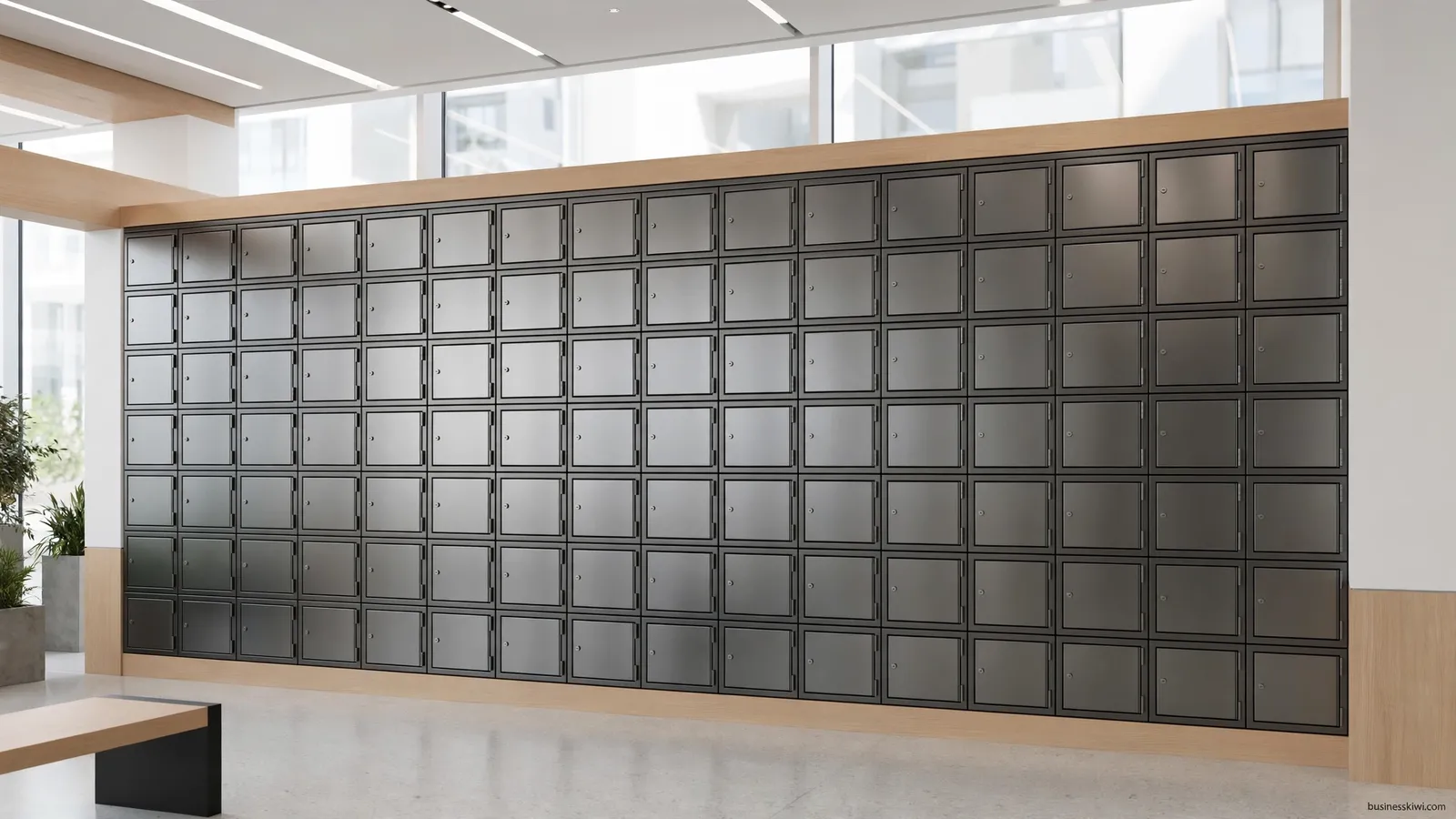
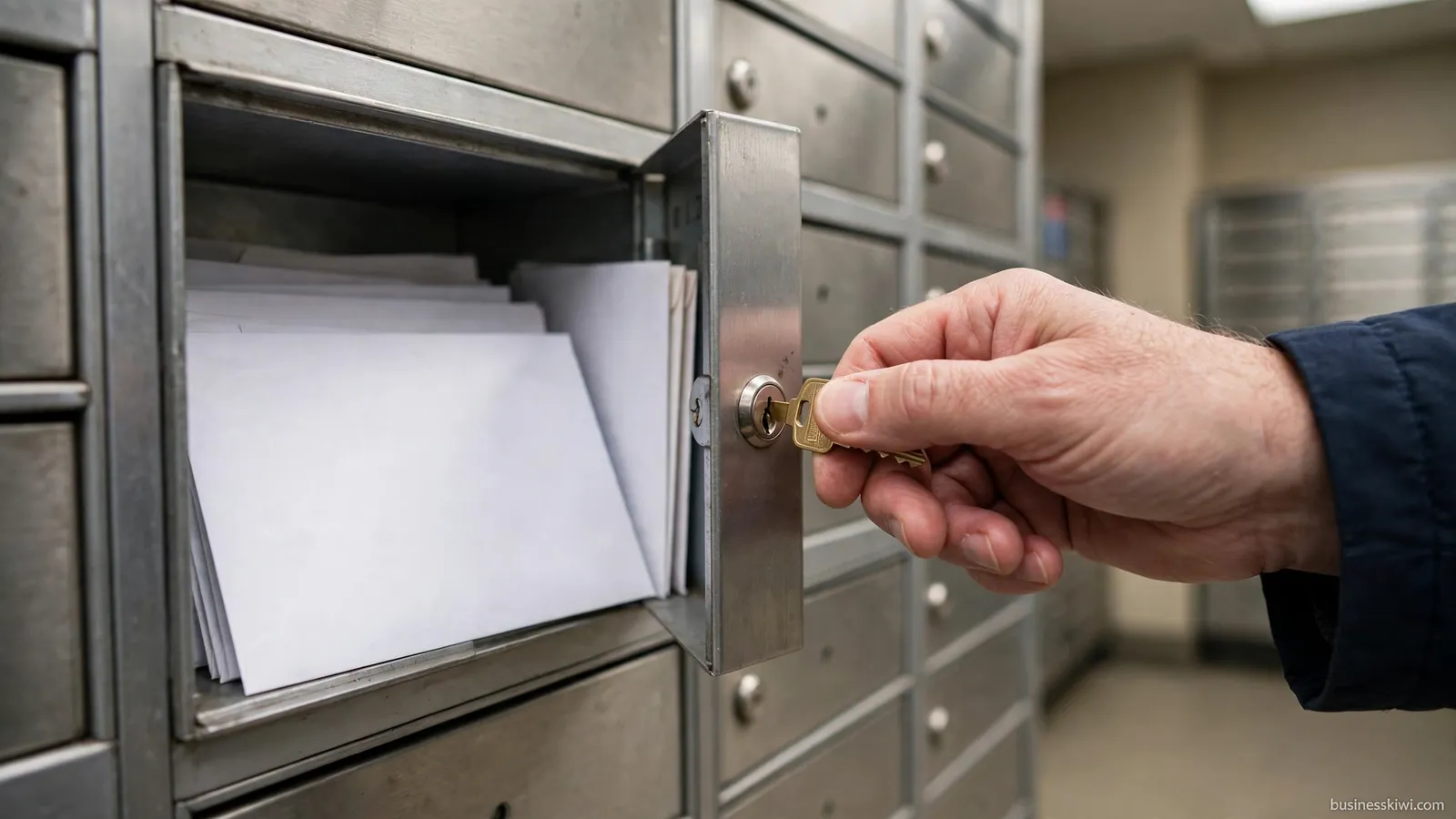
A PO Box is exactly what the name suggests: a numbered, lockable box in a wall of similar boxes at an NZ Post location, known as a box lobby. NZ Post delivers mail to the box as the item is addressed, and the holder is the only person with keys. Nothing is left on a doorstep and nothing sits in an open letterbox at the roadside.
People rent boxes for practical reasons. A box keeps one stable mailing address when you move house within the same area, and it keeps a home address private, which suits home-based businesses, tradespeople and anyone who publishes an address on invoices, vehicles or a website. It also suits rural customers who would rather collect from town, and frequent travellers who do not want mail piling up in a visible letterbox. Businesses use boxes to keep mail separate from a shop counter or home office, and to have it ready early in the day.
The service is open to domestic customers, farmers and business customers alike. What a box is not is a street address. It does not replace your actual address for legal or banking purposes. It is a mailing address, run by NZ Post, under an annual rental contract.
PO Box, Private Bag or street delivery: the differences
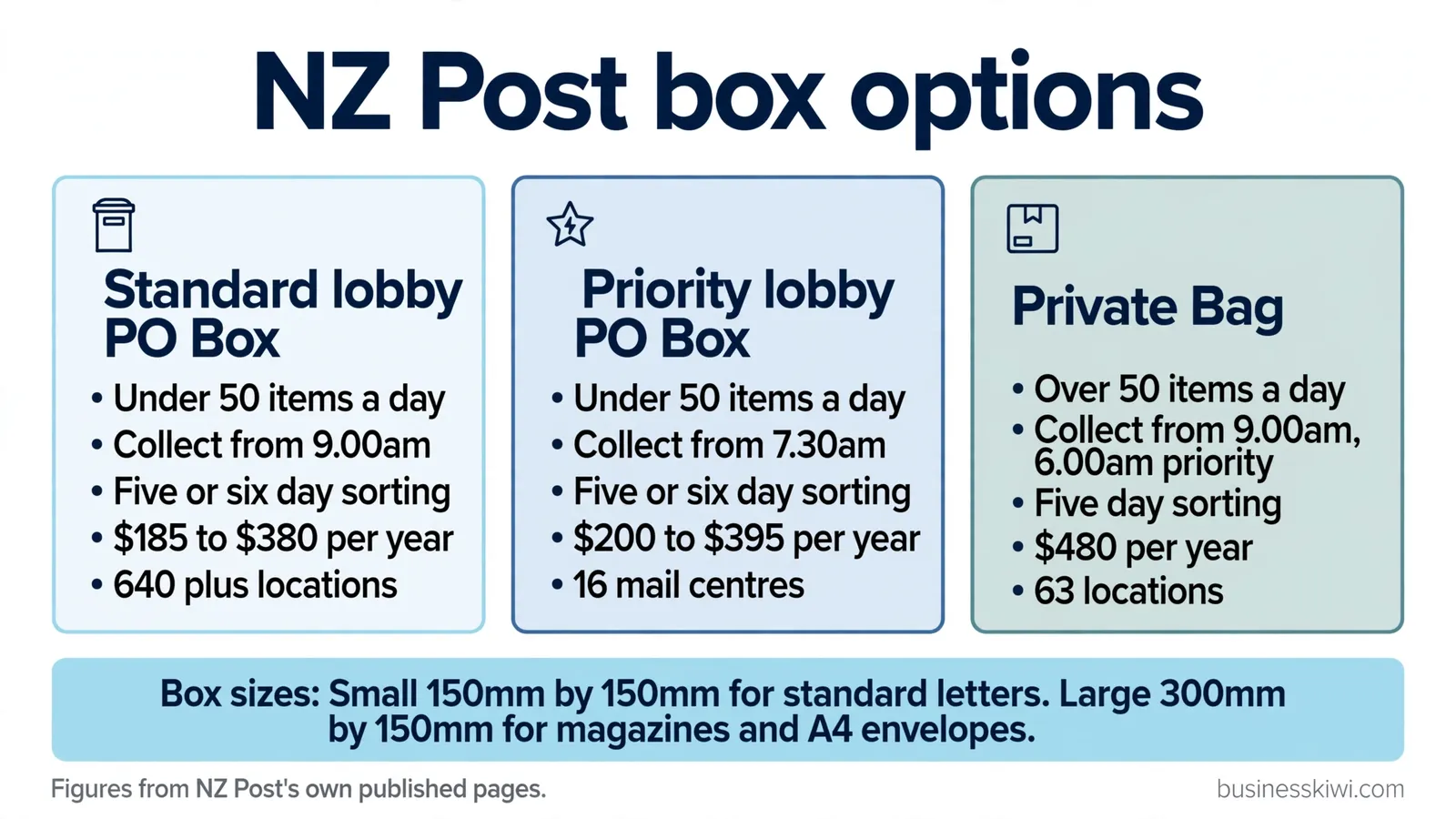
A PO Box suits anyone receiving fewer than 50 addressed items a day, not counting parcels. Your mail is sorted into your locked box, five or six days a week depending on the lobby, and you collect it yourself, from 9.00am at a standard lobby or 7.30am at a priority lobby.
A Private Bag is the step up for volume, designed for organisations receiving more than 50 addressed items a day. Instead of a small locked box, your mail is sorted into a bag held for you at the lobby, five days a week. Collection starts at 9.00am, or 6.00am at a priority lobby, and Private Bags are available at selected locations only, 63 of them according to NZ Post. If your mail regularly overflows a PO Box, NZ Post can require you to move up to a larger box or a Private Bag.
Street delivery is the default. Mail comes to your letterbox on delivery days at no cost, but it arrives when the round arrives and sits there until you clear it. A box trades a yearly fee and a trip to the lobby for security, privacy and predictable early availability.
Box sizes, lobbies and sorting days
NZ Post offers two box sizes. The small box measures 150mm wide by 150mm high and suits standard letters. The large box measures 300mm wide by 150mm high and takes bigger items such as magazines and A4 envelopes. Not every lobby has large boxes, so check availability at the lobby you want; NZ Post suggests emailing its PO Box team to confirm a large box at a particular lobby.
Lobbies come in two types. Standard lobbies are found at more than 640 locations nationwide, with mail ready to collect from 9.00am. Priority lobbies operate at 16 mail centres and have mail ready from 7.30am, the drawcard for businesses that want mail in hand before the working day starts. Email notifications when mail arrives are available at selected lobbies only.
Sorting frequency is the other variable. A five-day sort means mail is sorted into your box each weekday. A six-day sort adds Saturdays, public holidays excluded. Both depend on the location, so the combination of lobby, size and sorting days sets your price.
How to apply, and how renewal works
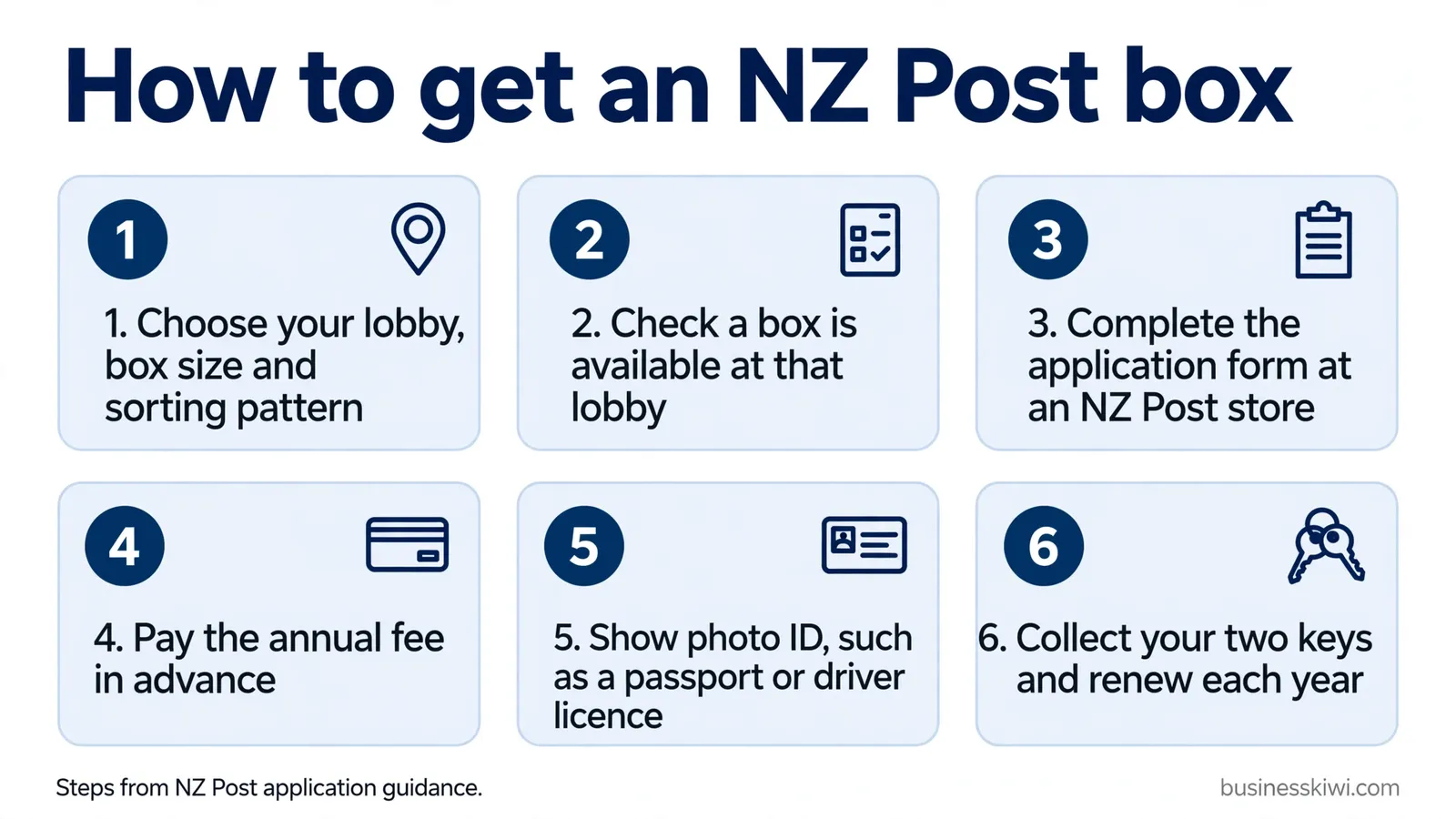
Applying is an in-person job. First choose the lobby, box size and sorting pattern you want, and confirm a box is available, because every application depends on availability at the chosen location. Then complete the application form at your local NZ Post store, or at the box lobby where you want the box.
Take the annual fee (rental is paid yearly in advance) and photo ID. NZ Post’s guide lists a passport, a firearms licence, a Kiwi Access Card or a Certificate of Identity; its support pages also give a driver licence or passport as examples. Businesses also bring authorisation on business letterhead.
You receive two keys. They stay NZ Post’s property, must be returned when the contract ends, and if you lose one you pay for replacing the lock and keys. Only the person who signs the contract is recognised as the box holder, or the organisation where a business holds the box.
Renewal is simple. The rental runs in annual periods paid in advance, so keeping the box means paying the next year’s fee when it falls due. NZ Post’s online renewal service lets you renew up to ten boxes or bags at once by credit card, using the box number and the customer number printed on your invoice. Moving your box to a different lobby is arranged with staff at your current lobby and also depends on availability. Transferring a box to someone else means a new rental agreement and a fresh application form.
What an NZ Post box costs
NZ Post publishes guide prices on its PO Boxes and Private Bags page; the exact figure depends on the lobby type, the box size and whether you take a five-day or six-day sort. Annual rental at a standard lobby runs from $185 to $380, and at a priority lobby from $200 to $395. A Private Bag is $480 a year. The priority premium buys earlier collection; box size and the sixth sorting day push a standard box toward the top of its range.
The rental fee is the main cost, payable in advance and not refundable, though NZ Post may agree in writing to transfer a fee to another box holder. Smaller costs exist. Losing a key means paying for a replacement lock and keys. The optional pick up and delivery service, where NZ Post clears your box and brings the mail to you, costs extra, charged by the number of mail bags for a regular service, with oversized items sent by courier at your courier rate. Fees can change; NZ Post’s terms say changes are notified in writing 30 days ahead.
There is no monthly rental option. Quarterly direct debit survives only for customers already paying that way back in November 2011, so for anyone opening a box now, the pattern is one annual payment.
Collecting your mail
Your part of the deal is simple: collect regularly. Sorted mail waits in the box from the lobby’s availability time, 9.00am at a standard lobby or 7.30am at a priority lobby for boxes, and 9.00am or 6.00am for Private Bags. Many lobbies have access beyond shop hours, and NZ Post’s support pages note that many offer 24 hour access, though it varies by site.
Not everything fits in the box. Oversized items, items with postage owing and items that need a signature are held for collection during box lobby opening hours. A signature-required item left uncollected for 30 days is returned to the sender.
The contract sets a floor on collection: at least once a month. Miss that and NZ Post may return uncollected mail to the sender; mail that cannot be returned may be destroyed. Leave mail uncollected for three consecutive months and NZ Post may cancel the contract without notice. A box is a working mailbox, not long-term storage.
If collecting is the hard part, NZ Post’s pick up and delivery service clears your box for an extra fee and delivers the mail to you in a mail bag; anything too large for the bag travels by courier at your applicable rate.
How to address mail to a box
Getting the address format right decides whether mail lands in the box first time. NZ Post’s format for a PO Box has four parts, one per line: the recipient’s name and, where relevant, the organisation; PO Box followed by the box number; the box lobby name; then the town or city and the postcode. For a Private Bag it is the recipient or organisation, then Private Bag and the bag number, then the town or city and postcode.
Two rules matter. First, use the box address itself for everything sent to the box. NZ Post’s advice to holders who have both a box and a physical address is to always use the box address. Second, never add a street address to a box address; NZ Post is explicit that a physical address should not be included. The lobby name is generally needed too, except where it is identical to the town name.
This matters more than it used to. NZ Post has phased out the old practice of forwarding items on to a holder’s box when they were addressed to a street address that gets no standard mail delivery. Such items are now returned to the sender, or held for a period and then disposed of. Tracked courier items are the exception: they continue to be delivered as the label shows.
Redirection and hold services
Redirect my mail forwards mail from an old address to a new one, in New Zealand or overseas, temporarily or permanently. A permanent redirection runs for 2, 4, 6 or 12 months and can be extended past 12 months; a temporary one runs while you are away, up to 12 months. You can redirect mail to a PO Box or Private Bag, online or in store, but each destination needs its own application, and all mail addressed to a box must be redirected; NZ Post cannot redirect only part of it. The service covers letters, standard NZ Post mail and tracked mail addressed to the names on your application. It does not cover courier items, newspapers, circulars or other operators’ mail.
Apply online at least four working days before you want a redirection to start, or at least six working days ahead in store. Applying online saves 30 percent on the fee, and seniors get a 50 percent discount on household prices for domestic redirections and holds. List every version of your name, because mail in a name you left off will not be caught. Changes need at least three working days. Cancel before the start date and the fee is refunded in full; cancel with more than a month left and a partial refund applies.
Hold my mail is the holiday option. NZ Post holds all mail addressed to your address for between 7 days and 12 weeks, then delivers it on the first day of normal service after the hold ends. Everything addressed to the address is held, regardless of the name on it; you cannot hold mail for one person only. Courier items and other operators’ mail are not held, held mail cannot be accessed during the hold, and on the business service parcels over 3kg cannot be held either. Business fees for redirection and hold are published on NZ Post’s business pages; household fees are shown when you apply.
Limits and watch-outs
The box is yours alone. Unless NZ Post agrees in writing, you must not let anyone else use it, and you must never put items into the box yourself; it is only for mail NZ Post delivers to you. Mail not addressed to you must be handed back promptly.
Treat the box as an NZ Post address, not a universal one. NZ Post delivers to the box as the mail is addressed, and its redirection service does not move courier items at all. A sender whose courier delivers through NZ Post can reach your box, but a courier delivering its own parcels has no way into a locked lobby wall, so check how a sender ships before giving them the box address for a parcel.
Renewal discipline matters. The fee is not refundable, either side can end the contract with 30 days’ written notice, and NZ Post can end it straight away for non-payment, a breach of the terms, or use of the box for illegal activity. When a contract ends, later mail is returned to the sender, with a 30-day holding window in some cases. Restart later and you sign a new contract, and may not get the same box number back.
Finally, a box does not change the rules of the mail itself. NZ Post’s prohibited items, which include currency, credit and gift cards, perishables, perfume, aerosols and aftershave, must not be sent at all. Restricted items such as jewellery, watches, some electronics and original identity or legal documents can only travel under NZ Post’s stated conditions, and prohibited items found in the network are not delivered. If something valuable is being sent to your box, check it is allowed in the post first.
Alternatives to a PO Box
If your problem is parcels rather than letters, a box may be more than you need. Collect my parcel lets you send NZ Post parcels to a collection location instead of your home, at more than 360 participating locations including NZ Post stores and Woolworths supermarkets. Parcels must be no larger than 50cm by 40cm by 30cm and no heavier than 15kg. You get an email when the parcel is ready, have 10 days to collect it, and need photo ID at pick up. It covers parcels only, not letters, and only parcels NZ Post itself delivers.
One service to cross off the list: ParcelPod, NZ Post’s old parcel locker service, closed on 31 March 2024, and NZ Post points parcel customers to Collect my parcel instead. And a home that simply needs a bigger, secure receptacle can use a parcel letterbox on its own fence, a different product bought outright rather than rented.
Related guides: our postage costs guide covers what it costs to send letters and parcels in NZ, and our parcel letterbox guide covers buying a secure parcel box for your own property. For more business guides, browse the Business & Industry section.
Frequently asked questions
How much does an NZ Post PO Box cost per year?
NZ Post publishes annual rental from $185 to $380 at a standard lobby and from $200 to $395 at a priority lobby, depending on the lobby, box size and sorting pattern. A Private Bag is $480 a year. The exact price for your combination is confirmed when you apply.
What ID do I need to open a PO Box?
Photo ID. NZ Post’s Postal Users’ Guide lists a passport, firearms licence, Kiwi Access Card or Certificate of Identity, and its support pages give a driver licence or passport as examples. Businesses also need authorisation on business letterhead.
What is the difference between a PO Box and a Private Bag?
Volume. A PO Box suits fewer than 50 addressed items a day, is a locked box you clear yourself, and is sorted five or six days a week. A Private Bag suits more than 50 items a day, is sorted five days a week, and is available at selected locations only.
Can couriers deliver to my PO Box?
NZ Post delivers mail and its own items to the box as addressed, and oversized or signature items are held at the lobby for collection. Its redirection service does not cover courier items, and other couriers cannot access the locked lobby boxes, so check how a sender ships before giving them your box address for a parcel.
How often do I have to clear my PO Box?
At least once a month under the contract. Mail left uncollected can be returned to the sender, and three consecutive months without a collection can see the contract cancelled without notice.
Can I redirect my mail to a PO Box?
Yes. Mail can be redirected to a PO Box or Private Bag, online or in store, with a separate application for each destination. All mail addressed to the box must be redirected; part-redirection of a box is not available.
What happens if I stop paying for my box?
The rental is paid in advance and is not refundable. NZ Post can terminate the contract for non-payment, after which mail is returned to the sender, subject to a 30-day holding period in some cases. Restarting means a new contract, and you may not get the same box number.
The bottom line
An NZ Post box is a simple, well-priced service when you need your mail somewhere other than your home letterbox: secure, private and ready early in the day, for between $185 and $480 a year depending on the option you choose. Pick the lobby for convenience, the size for your mail, and the sorting pattern for how often you collect. Keep the box cleared, give senders the exact box address, and the service does the rest.
Sources
- NZ Post, PO Boxes & Private Bags: https://www.nzpost.co.nz/personal/receiving-mail/po-box-private-bags
- NZ Post, Postal Users’ Guide, July 2026: https://www.nzpost.co.nz/sites/nz/files/2026-07/nz-post-postal-users-guide-update-July2026.pdf
- NZ Post Support, PO Box: https://support.nzpost.co.nz/s/article/PO-Box
- NZ Post Support, How do I address PO Box and Private Bag mail correctly?: https://support.nzpost.co.nz/s/article/How-do-I-address-PO-Box-and-Private-Bag-mail-correctly?language=en_US
- NZ Post, Redirect my mail: https://www.nzpost.co.nz/personal/receiving/manage-my-mail-parcels/redirect-my-mail
- NZ Post Support, Mail Redirection: https://support.nzpost.co.nz/s/article/Mail-Redirection
- NZ Post, Hold my mail: https://nzpost.co.nz/personal/receiving/manage-my-mail/hold-my-mail
- NZ Post, Manage your business mail: https://www.nzpost.co.nz/business/receiving-mail/redirect-mail
- NZ Post, Changes to PO Box and Private Bag services: https://www.nzpost.co.nz/about-us/changes-to-po-box-private-bag-services
- NZ Post, Changes to our Inbound parcel and Inbound mail rates and services from 1 July 2023: https://www.nzpost.co.nz/about-us/international-july2023
- NZ Post, Collect my parcel: https://www.nzpost.co.nz/personal/receiving/delivery-options/collect-my-parcel
- NZ Post Support, NZ Post parcel pick-up points: https://support.nzpost.co.nz/s/article/NZ-Post-parcel-pick-up-points?language=en_US
- NZ Post Support, ParcelPod Service: https://support.nzpost.co.nz/s/article/ParcelPod-Service?language=en_US
- NZ Post, Service terms: Postal Sending Services: https://www.nzpost.co.nz/about-us/who-we-are/terms-of-business/service-terms-postal-sending-services
- NZ Post, Box Bag Renewal: https://www.nzpost.co.nz/BoxBag/BoxBag/Renewal
This article is general information about NZ Post boxes in New Zealand. It is not advice about your own mail arrangements. NZ Post’s prices, lobby locations and service terms change over time, so check the current details with NZ Post before you apply, and read the contract terms that apply to your box before you sign.