Buy Silver NZ: Coins, Bars, Prices and What to Check
Silver is the accessible end of the precious metals market. A one ounce coin costs roughly the price of a tank of petrol, where the same weight in gold runs to thousands of dollars, so most first time buyers start here. New Zealand buyers also get a genuine break that shoppers in many other countries do not: investment grade silver carries no GST here, provided it meets a strict purity test set out in tax law.
You can buy from a local refiner, from established bullion dealers, from the New Zealand Mint’s retail bullion desk, or from overseas. Each route has its own pricing, paperwork and traps. This guide works through the forms silver is sold in, how prices are built, the GST rules, importing, storage, selling back, and the checks that keep you clear of fakes. Example prices come from New Zealand dealers’ own published ranges, checked in October 2026, and they move with the market every day.
The forms silver is sold in
Physical silver reaches retail buyers in four main forms. They all contain the same metal, but they are made differently and priced differently.
Bullion coins are struck by government mints and issued as legal tender in their home country, with a face value far below the worth of the metal. The coins stocked by New Zealand dealers include the Perth Mint Kangaroo, the Royal Mint Britannia, the Canadian Maple Leaf and the South African Krugerrand, all in one troy ounce sizes, with fractional sizes such as a quarter ounce also available. Designs are standardised and any dealer in the world recognises them.
Minted bars are struck from prepared blanks on presses, much like coins, so they carry sharp designs and clean edges. They often come sealed in assay packaging with weight, purity and a serial number printed on the card. Sizes run from a single gram up to a kilogram, with 1oz, 10oz, 100g and 500g common.
Cast bars are made the old way: molten silver is poured into a mould, cooled and stamped with the maker’s mark, weight and purity. The finish is rougher and each bar looks slightly different. Local refiners produce them in New Zealand, including New Zealand Gold Merchants’ NZ Pure range and MyGold’s Stag bars, and the larger sizes are usually the cheapest way to own the metal.
Rounds look like coins but are struck by private mints rather than governments. They carry no face value and are not legal tender. Designs vary widely, from national emblems to novelty themes, and prices usually sit between cast bars and government coins.
Cutting across all four forms is the split between bullion and collectible product. Bullion is priced off the metal content, with a modest margin for making and handling. Collectible and numismatic pieces, such as proof coins in limited mintages with licensed artwork, are priced off design, scarcity and demand from collectors. New Zealand Mint’s Agoro range of licensed silver coins sits firmly in that second camp. A collectible coin can hold one ounce of .999 fine silver and still sell for several times the metal value, and its resale price depends on collector demand, not just the silver price.
Purity, markings and the troy ounce
Silver purity is quoted as a fineness figure. A stamp of .999 means the piece is 99.9 percent pure silver, with the remaining fraction of a percent made up of trace metals left from refining. A stamp of .9999, sometimes called four nines fine, means 99.99 percent purity. Some refiners stamp .9995, which also clears the 99.9 percent line. Anything described as sterling is a different alloy altogether: sterling silver is 92.5 percent silver, hardened with copper, and it is used for jewellery and tableware, not investment.
Every genuine bullion piece is stamped with its weight, purity and the name or mark of the mint or refiner that made it. Bars above a certain size usually carry an individual serial number as well. Those stamps matter twice over: they are your first check that a piece is what it claims to be, and they are what a dealer looks for when you sell.
Weights need care because precious metals are traded in troy ounces, not the ounces used for groceries. One troy ounce is 31.1035 grams. An ordinary avoirdupois ounce is about 28.35 grams, so a troy ounce is roughly ten percent heavier. When a coin is described as 1oz, it holds one troy ounce of silver. One kilogram equals about 32.15 troy ounces, a conversion worth remembering when you compare a bar price against the per ounce prices of coins. Silver follows the same troy ounce conventions as buying gold.
How the price is worked out
Every dealer price starts with the spot price: the wholesale market price for one troy ounce of refined silver, quoted internationally in US dollars and converted into New Zealand dollars. Spot moves constantly while markets are open, and it is the same starting point for every seller.
On top of spot sits the premium. Silver has to be mined, refined to .999 purity, manufactured into a coin or bar, shipped, insured and retailed, and each step adds cost. MyGold describes its own pricing in those terms: the metal must be mined, refined, made into bars and coins and distributed before it reaches a buyer, and the selling price reflects those costs rather than a fixed percentage over spot. Design and reputation add more. A coin from a famous government mint, or a product that is rare or sought after, trades at a higher premium than an unbranded bar of the same weight.
Manufacturing explains the biggest gap. Striking a coin takes far more machinery, skill and time than pouring a cast bar, which is why coins carry higher premiums than bars, and why a small coin costs so much more per ounce than a big bar. The per ounce ladder from New Zealand Gold Merchants’ published silver range, checked in October 2026, shows the pattern clearly:
- 1kg cast bar, mixed mints: $3,707.70, which works out at about $115 per troy ounce
- 1kg NZ Pure cast bar: $3,878.40, about $121 per troy ounce
- 1kg ABC Bullion cast bar: $3,949.00, about $123 per troy ounce
- 10oz NZ Pure cast bar: $1,228.20, about $123 per troy ounce
- 5oz NZ Pure cast bar: $627.60, about $126 per troy ounce
- 1oz bullion coins: $125.40 to $128.44 each
- 1/4oz Britannia coin: $41.00, about $164 per troy ounce
A second dealer’s range tells the same story. MyGold’s own 1kg Silver Stag cast bar was priced at $3,628.50 in October 2026, about $113 per troy ounce, undercutting the one ounce coins on its shelves by a wide per ounce margin. Minted bars sit between the two: at New Zealand Gold Merchants a 5oz ABC Eureka minted bar was $638.60 against $627.60 for a cast bar of the same weight.
Two practical consequences follow. First, buy the largest bar you are comfortable holding if cost per ounce is your priority, and buy coins if you value being able to sell in small units later. Second, prices are live. Dealers set them off a moving spot price, and MyGold asks buyers to pay within 15 to 20 minutes of ordering so the locked price holds.
GST on silver: the fine metal rules
Here is the part of New Zealand law that saves silver buyers real money, and the part that catches some of them out.
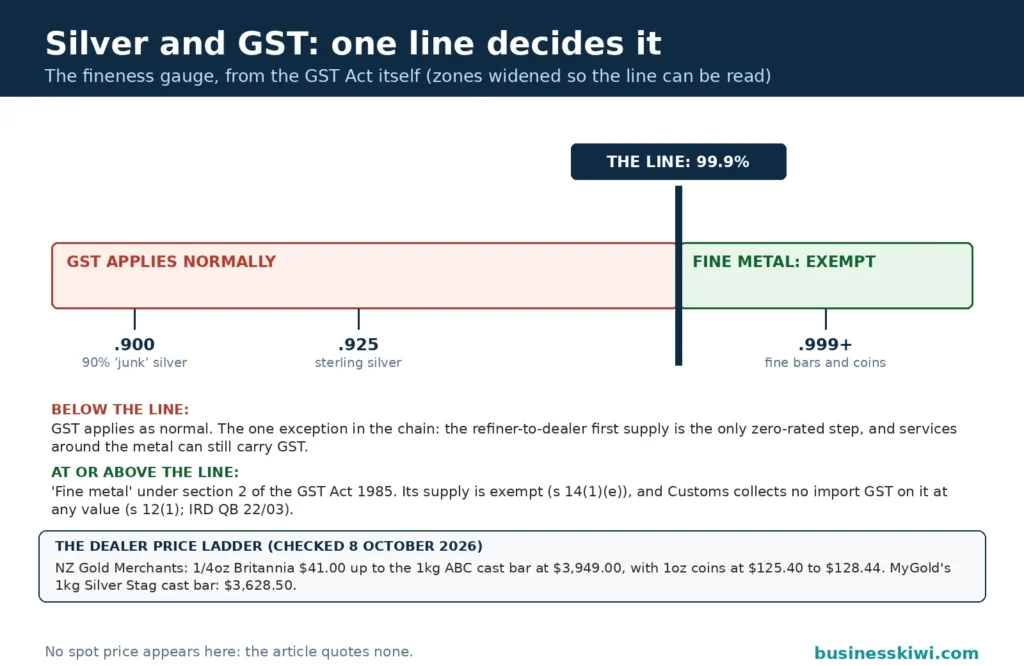
The Goods and Services Tax Act 1985 defines “fine metal” in section 2. For silver, fine metal means silver in any form with a fineness of not less than 99.9 percent. Section 14(1)(e) of the same Act then makes the supply of any fine metal an exempt supply, which means no GST is charged on it. Inland Revenue’s own guidance says the same thing in plain language: the sale of fine metal by a dealer, or by anyone importing fine metal, is an exempt supply. The one exception in the chain is invisible to retail buyers. When a refiner first supplies newly refined fine metal to a dealer as an investment item, that wholesale step is zero rated rather than exempt. Everything a member of the public buys sits under the exemption.
Dealer practice matches the statute. MyGold states in its published questions that there is no GST on the sale of pure silver bars and coins in New Zealand, and that products which are not fine metal do incur GST.
The trap is that the test is purely about fineness, and plenty of silver fails it:
- Sterling silver jewellery, cutlery and tableware at 92.5 percent purity is not fine metal, so GST at 15 percent applies in the normal way.
- Older circulating coins and so called junk silver, struck at 90 percent purity or lower, are not fine metal either.
- Any coin or bar stamped below .999, whatever its shape or story, falls outside the exemption.
Form does not matter; fineness does. A .999 fine silver coin shaped like a cartoon character is fine metal. A .925 bar shaped exactly like an investment bar is not. Anyone who has read a GST guide will know GST attaches to almost every sale in New Zealand, which is why the purity stamp on silver deserves a second look before you pay. If a seller tries to add GST to a .999 product, query it. If a seller offers sub .999 silver with no GST mentioned, the tax may simply be missing from the comparison you are making. One more wrinkle: the exemption covers the metal itself. Services wrapped around it, such as vault storage or a courier charge, are separate supplies and can carry GST in the usual way.
Where to buy silver in New Zealand
Most buyers use one of the established local dealers or the Mint, and each of the main names offers something slightly different.
New Zealand Mint has traded since 1967 and runs a retail bullion desk from Auckland. It sells its own one ounce silver coins, including the Turtle design, alongside other bullion, prices its products off the live global spot price plus a product premium, offers insured vault storage, and runs a buy back service with settlement typically within one business day. Its licensed collectible coins are sold separately under the Agoro brand.
New Zealand Gold Merchants is a refiner as well as a dealer, based in Onehunga, Auckland. It refines and sells the NZ Pure range of cast bars in .9995 fine silver, stocks coins from mints such as the Royal Mint, the Royal Canadian Mint and ABC Bullion, and publishes its full silver range with live prices.
MyGold is a family owned Auckland dealer and an authorised New Zealand distributor for the Perth Mint, the Royal Mint, the Royal Canadian Mint, the Austrian Mint and PAMP. It casts its own Stag branded bars, delivers fully insured to NZ Post shops and depots rather than residential addresses, and requires photo ID when an order is collected.
Commonwealth Vault sells bullion online as an authorised distributor for mints including the Perth Mint and PAMP, and pairs that with safe deposit box storage at sites in central Auckland and in Christchurch, where anyone researching bullion in Christchurch will come across its Oxford Terrace vault.
Favour a business with real premises, a trading history and published prices that move with the market. Confirm the buy back policy before you buy, not after. Expect to show photo ID, and expect bank transfer to be the standard payment method for larger orders. Dealers work under anti money laundering obligations, and a seller who skips identification entirely is telling you something about how they run the rest of the business.
Importing silver from overseas
Overseas dealers and auction sites can look cheaper at first glance, so it pays to know how the border treats silver before you order.
The GST Act charges GST on the importation of goods, and section 12(1) does so in express terms: tax is levied at 15 percent on the importation of goods “not being fine metal”. Inland Revenue confirms the outcome in its Tax Technical guidance, noting that Customs collects GST on the importation of goods other than fine metal. Put together with the exempt supply rule, the position is simple. A .999 fine silver coin or bar imported from overseas crosses the border with no GST to pay, at any value, because the metal is fine metal from end to end.
Silver below .999 purity gets no such pass. Import sterling silver jewellery or low purity coins worth more than NZ$1,000 and Customs will charge GST of 15 percent, calculated on the customs value of the goods plus any duty, plus freight and insurance. You will also need a Customs Number before goods over that threshold can be cleared, and goods levies can apply on top. Duty itself depends on what the item is and where it comes from, as Customs advises. For items at NZ$1,000 or less, Customs generally collects nothing at the border, because GST on ordinary consumer goods is handled at the point of purchase by the overseas seller. Fine metal sits outside that low value goods regime altogether, which follows from its exempt status.
Two cautions from Customs are worth repeating. Declarations must be accurate: a sender who undervalues a parcel to dodge charges exposes you to delays, seizure and extra costs. And an overseas headline price that excludes freight, insurance and border charges is not comparable with a local price until you add everything the parcel will actually cost.
Storing silver and insuring it
Silver is bulky for its value and easy to carry away, so storage deserves thought before the parcel arrives.
At home, dealer advice is a proper bullion safe: fireproof, waterproof and theft resistant, and of the grade your insurer requires. Specialist cover exists for metal kept at home. MyGold offers a dedicated bullion insurance policy for precious metals stored at home, underwritten at Lloyd’s of London. Standard house and contents policies often limit cover for bullion or exclude it, so read the policy wording rather than assuming.
The alternative is to pay someone else to hold it. New Zealand Mint offers insured storage in its vault facilities, and Commonwealth Vault rents safe deposit boxes in five sizes, from extra mini to large, at its Auckland and Christchurch sites, with access controls that include biometric fingerprint scanning. Box rental can run from as little as a month.
Whatever you choose, keep the paperwork. Receipts, photographs and a note of serial numbers support any insurance claim and make resale simpler. Dealers also advise discretion: metal that nobody knows about is metal nobody comes looking for. If you move a holding, use an insured, tracked method rather than the glovebox.
Selling your silver back
Liquidity is one of silver’s strengths. The main dealers all buy metal back, including metal they did not sell you.
MyGold states it will always buy back silver and gold, and will buy any precious metal regardless of where it was purchased. Its process is typical: you describe what you have, it gives a price indication, and once it has physically checked the pieces for purity it confirms a firm price based on the spot price at that moment. Payment goes to your bank account within 2 to 24 hours. New Zealand Mint offers a similar buy back service priced off live global rates, with settlement typically within one business day. New Zealand Gold Merchants tests metal at its Auckland refinery using X ray fluorescence equipment, weighs it while you wait if you visit in person, and usually pays the same day, with overnight payment for couriered items. Photo ID and bank account details are required, and cash payments are limited under anti money laundering law.
Expect the buy back price to sit below spot, just as the selling price sat above it. Dealers describe their offers as a percentage below the spot price or as a dollar figure derived from it. That gap, the spread, is the real cost of owning physical metal, and it is why a purchase needs the spot price to climb before you break even. Recognised coins and bars from known mints, kept in their original packaging with receipts, are the easiest pieces to sell and usually attract the strongest offers. Damaged, obscure or sub .999 pieces take longer and price worse.
Fakes, scams and how dealers test metal
Counterfeit coins and bars exist, mostly copying well known one ounce coins, and the defence starts with how dealers themselves verify metal.
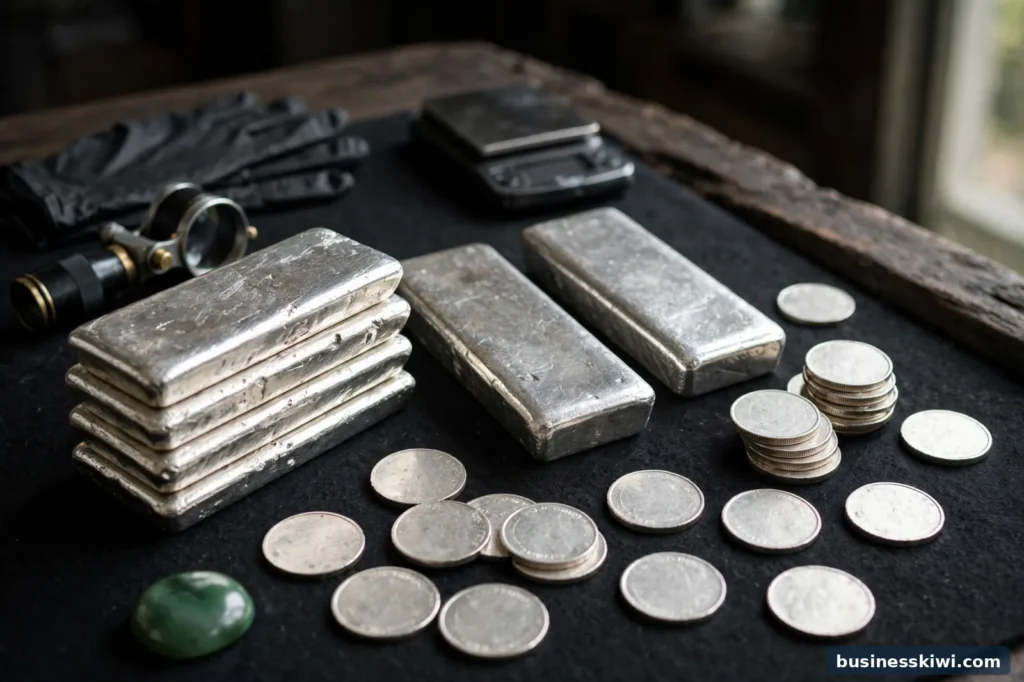
New Zealand Gold Merchants tests everything it buys with X ray fluorescence spectrometry, which reads the composition of a piece without damaging it, alongside checks of weight, markings and hallmarks. A genuine coin also has to weigh and measure right, because fakes often fail on weight or thickness before composition is even tested. Serial numbers on bars can be checked against the refiner’s records, and sealed assay packaging, such as the serialised cards used on minted bars and some cast bars, adds another layer: Commonwealth Vault notes its one kilogram Valcambi bars are individually serialised and ship with an official assay certificate.
Your own checks are simpler. Buy from established dealers rather than unknown sellers on auction or social media sites. Be suspicious of any price below the metal value of the piece, because nobody sells silver for less than it is worth as scrap. Keep new purchases in their capsules or packaging, since breaking seals can trim resale value. And if you are offered a deal that depends on paying quickly, in cash, with no receipt, walk away. The established market will still be there tomorrow.
Frequently asked questions
Do I pay GST on silver in New Zealand?
Not on investment grade metal. Silver of .999 fineness or better is “fine metal” under the GST Act, and supplies of fine metal are exempt, so dealers charge no GST on pure silver coins and bars. Silver below that purity, including sterling silver jewellery at .925, is taxed at 15 percent as normal.
What does .999 fine silver mean?
It means the piece is 99.9 percent pure silver. The rest is a trace of other metals left from refining. The next step up is .9999, or 99.99 percent. Purity is stamped on every bullion coin and bar, and it is the single most important marking on the piece because it decides both the GST treatment and the resale value.
Why does a 1oz coin cost more than the silver price I see quoted?
The quoted price is the spot price, the wholesale value of the raw metal. A coin also carries the costs of refining, minting, shipping and retailing, charged as a premium over spot. Coins cost more to manufacture than cast bars, so a one ounce coin might sell at $125 to $128 when a kilogram cast bar works out near $115 to $123 per ounce. Prices here were checked in October 2026.
Is a 1kg bar better value than 1oz coins?
Per ounce, yes. Bigger bars carry lower premiums, so a kilogram bar is the cheapest way to buy the metal itself. The trade off comes later: a bar is one lump you must sell whole, while coins can be sold a few at a time. Many buyers hold a mix, bars for bulk and coins for flexibility.
Can I import silver from overseas without GST?
Yes, if it is fine metal. GST on imports does not apply to goods that are fine metal, so a .999 silver coin or bar attracts no GST at the border at any value. Silver below .999, such as sterling jewellery, is charged GST at 15 percent on imports over NZ$1,000, worked out on the value plus duty, freight and insurance.
Will a dealer buy my silver back?
In most cases, yes. The major New Zealand dealers buy back bullion whether or not they sold it to you. They test purity, weigh the pieces and price off the spot price at the time, usually a percentage below it. Keep receipts and original packaging, as both make the process faster and can improve the offer.
Are collectible silver coins worth buying?
That depends on whether you are buying as a collector or as an investor. A licensed proof coin from a range such as New Zealand Mint’s Agoro line contains real .999 silver, but most of its price pays for design, licensing and limited mintage. Its resale value follows collector demand, which can rise or fall independently of the silver price. Buy them because you want them, and treat any metal value as a floor rather than the point.
This article is general information only and is not financial, investment or tax advice. Silver prices are volatile and can fall as well as rise, and premiums and buy back spreads mean you can get back less than you paid even when the metal price has moved in your favour. Consider your own circumstances and, for decisions that matter, talk to a qualified adviser.
Sources
- Inland Revenue, Exempt supplies, ird.govt.nz
- Inland Revenue, What low value goods are, ird.govt.nz
- Inland Revenue Tax Technical, QB 22/03: GST, customs brokers and GST levied by Customs, taxtechnical.ird.govt.nz
- Parliamentary Counsel Office, Goods and Services Tax Act 1985, legislation.govt.nz
- New Zealand Customs Service, Receive items from overseas, customs.govt.nz
- MyGold, Frequently asked questions, mygold.co.nz
- MyGold, 1kg Silver Stag Cast Bar, mygold.co.nz
- New Zealand Gold Merchants, Silver bullion range, gogold.co.nz
- New Zealand Gold Merchants, Sell gold and silver, gogold.co.nz
- New Zealand Mint, NZ Mint Retail Bullion, nzmint.com
- Commonwealth Vault, Buy gold and silver bullion and bullion storage, commonwealthvault.co.nz