Diggers for Sale in NZ: Sizes, Prices and the Checks That Matter
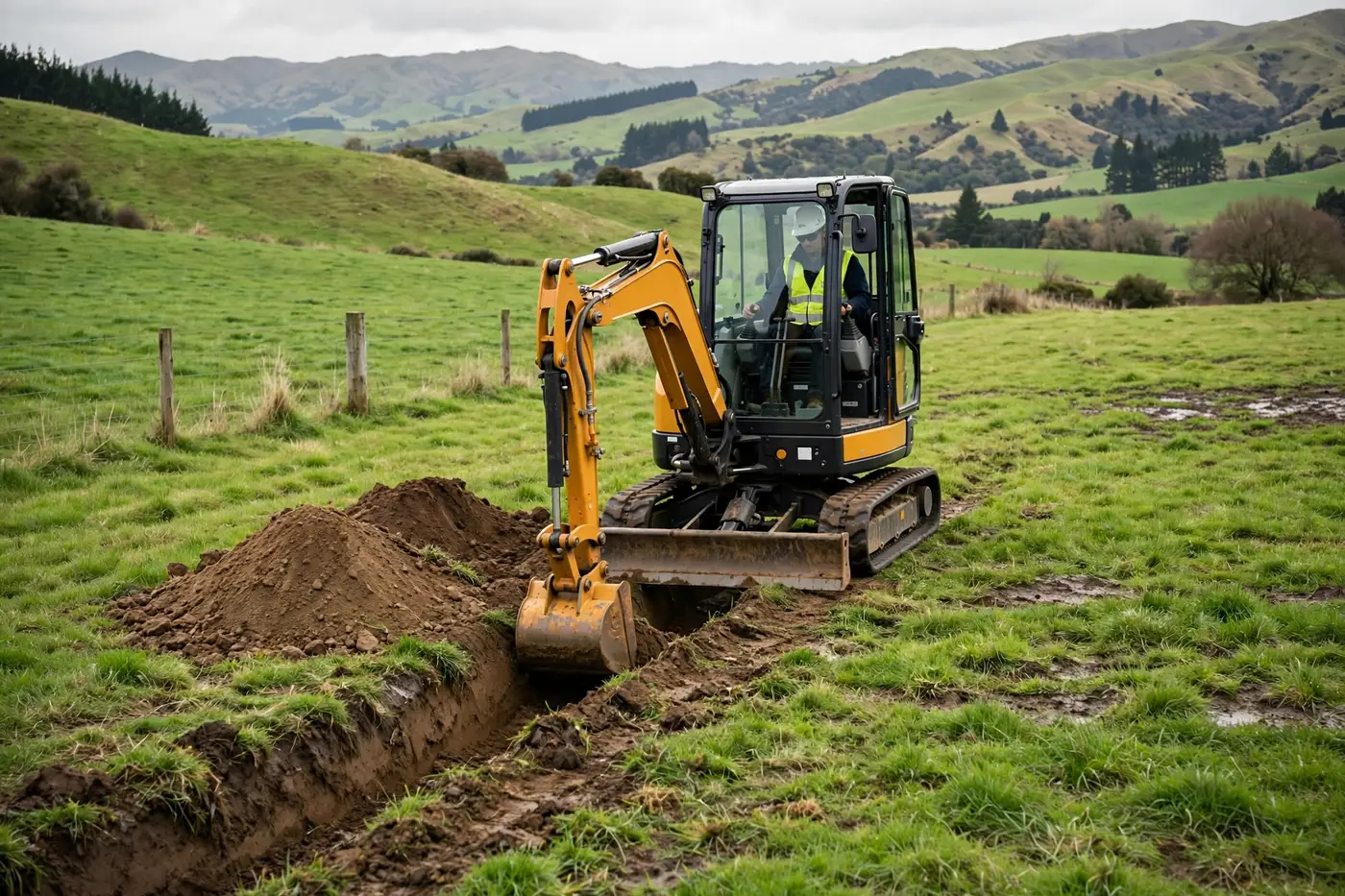
If you are shopping for a digger in New Zealand, you are really shopping for an excavator. That is the machine farmers, drainlayers, landscapers and small civil contractors all mean when they say digger. Diggers are sold by operating weight, from minis of around one tonne up to machines well past 20 tonnes. This guide covers the sizes most private buyers and small businesses actually purchase, from about one tonne through to fourteen tonnes: how the sizes differ, what the specifications mean, why prices are so hard to pin down, what ownership costs, and the checks that protect you, especially when buying second-hand.
The short answer
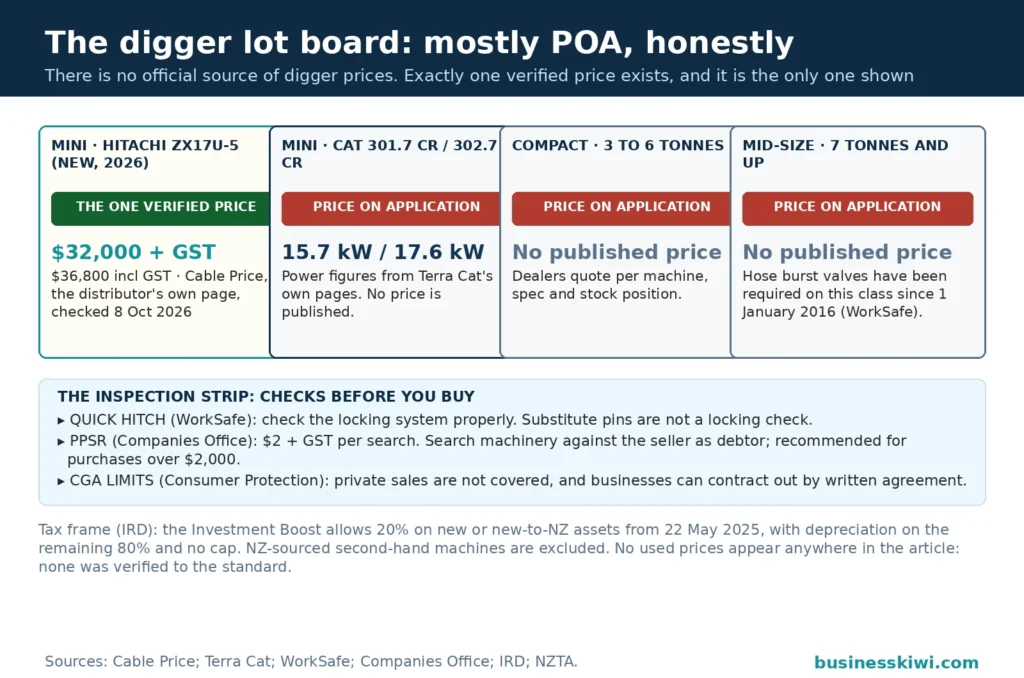
Three things catch first-time buyers out. The first is sizing: diggers are compared on operating weight, dig depth and reach, not engine size, and buying one class too small is the most common and most expensive mistake. The second is price. Most new diggers in New Zealand are sold at a price on application: distributors do not publish list prices, and Caterpillar’s own product pages invite you to request a price rather than showing one. Published prices do exist in places. When we checked on 8 October 2026, Cable Price, the Hitachi distributor, listed a new 2026 Hitachi ZX17U-5 mini on its own website at $32,000 plus GST, $36,800 including GST. Treat that as one data point for one 1.7 tonne machine, not a market rate: there is no official source of digger prices. The third is paperwork: a used digger can carry someone else’s debt, and a two dollar register search stands between you and a repossession.
Digger types and sizes
Almost every digger you will look at is a tracked hydraulic excavator, organised into the classes below.
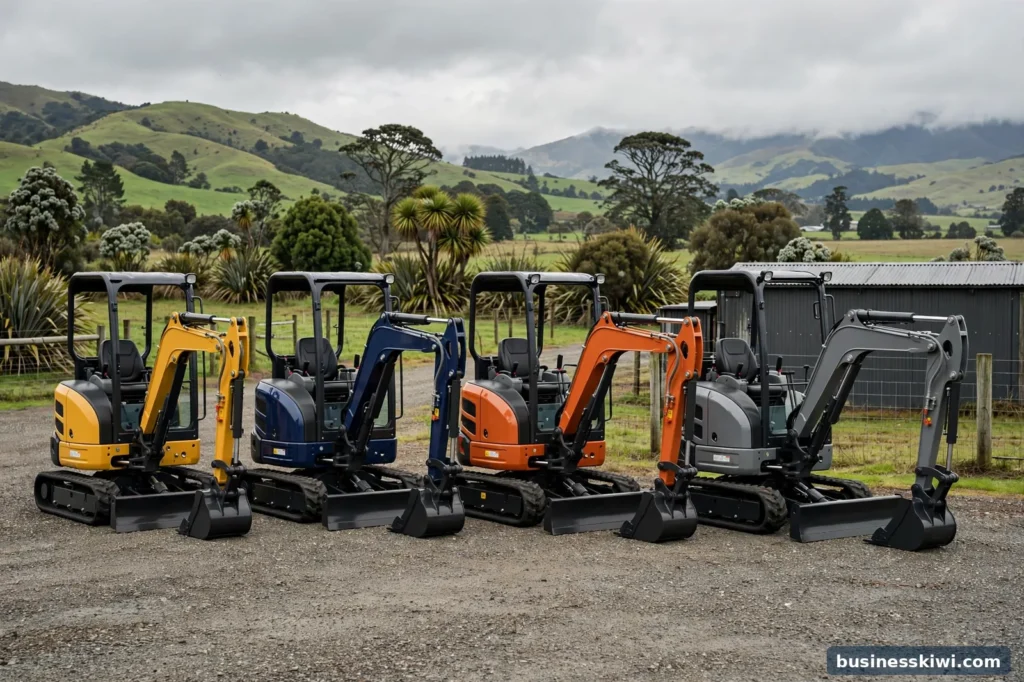
Micro and mini diggers (under 1 tonne to about 2 tonnes). The smallest machines, sometimes called micro diggers, weigh under a tonne and are built to pass through a standard gate. The most popular class here is the 1.5 to 2 tonne mini. The Hitachi ZX17U-5 listed by Cable Price is typical: an operating weight of about 1,760 kg, a Yanmar diesel engine, 230 mm rubber tracks, a 0.034 cubic metre bucket and a dozer blade, with dig depth of about 2.19 metres and reach of about 3.81 metres on Hitachi’s published figures. Caterpillar’s 301.7 CR, sold here by Terra Cat, sits in the same class with net power of 15.7 kW. Minis this size ride on a plant trailer behind a ute, which is a large part of their appeal.
Compact diggers (about 2.5 to 6 tonnes). Step up to machines like Caterpillar’s 302.7 CR, at 2.7 tonnes with net power of 17.6 kW, and you get a stronger, more stable machine that still fits on a trailer, although the trailer and tow vehicle now matter a great deal. The 3.5 to 6 tonne machines in this band are the workhorses of residential drainage, landscaping and farm contracting, but most can no longer be towed behind a standard ute and car licence combination, as the transport section explains.
Mid-size diggers (about 7 to 14 tonnes). Machines in this band, Caterpillar’s 308 CR among them, are civil and roading tools, transported on trucks rather than trailers and usually bought by businesses.
Large diggers (15 tonnes and up). Beyond about 15 tonnes you are in civil, forestry and quarry territory, bought through dealers and finance companies rather than classified listings.
Tail swing. Check how far the back of the machine swings past the tracks when it rotates. Conventional counterweights swing well outside the track line. Reduced or short tail swing designs keep it close: Hitachi’s U-series minis and Caterpillar’s CR (compact radius) models are built this way, and some minis are zero tail swing designs where the counterweight stays within the track width. Beside a fence or a road shoulder, that difference decides whether the machine can work at all.
Tracks and wheels. Tracked machines dominate New Zealand sales because tracks spread weight and grip on soft and steep ground. Wheeled excavators exist but are a specialist purchase here. Choose rubber tracks for finished surfaces and steel tracks for rocky or forestry ground where rubber would be cut up.
What each size suits
Match the machine to the heaviest regular job, not the biggest job you can imagine. A 1.7 tonne mini suits lifestyle blocks and farms well: post holes with an auger, small drainage runs, cleaning out races and drains, modest stumps, trenching for water pipe and power cable, and landscaping around houses. It will frustrate you on deep drainage or big stumps, because dig depth and breakout force run out quickly.
A 3.5 to 5.5 tonne machine is the sweet spot for drainlayers, landscapers and small contractors: drainage depths most jobs need, proper handling of tilt buckets and grabs, confident lifting of pipes, and it still travels on a trailer behind a suitable tow vehicle.
An 8 to 14 tonne machine suits businesses doing subdivision work, roading and contract digging where it works most days. At this size utilisation matters more than purchase price, and dealer backup counts as much as specifications.
Key specifications to compare
Specifications are only comparable if you read them the same way across brands. These are the numbers that matter.
- Operating weight is the machine ready to work, operator and standard bucket included. It drives transport legality, ground pressure and stability.
- Maximum dig depth tells you whether the machine can reach the bottom of your deepest trench with room to work. Deep drainage, effluent ponds and footings all need more than the headline figure once working room is allowed for.
- Maximum reach at ground level governs how far the machine can place material and how wide an area it can work across without moving. Minis around 1.7 tonnes reach roughly 3.8 to 4 metres.
- Bucket capacity and digging force decide how much material moves per pass and whether the machine can tear into compacted ground. Bigger is not automatically better: an oversized bucket slows cycle times and strains pins and bushes.
- Engine power is quoted as net power in kilowatts. It matters less than hydraulic performance, but it is a useful check within a class, where rivals cluster closely (15.7 kW and 17.6 kW for the two minis named above).
- Physical width and height matter more than buyers expect. Retractable undercarriages on some minis narrow to under a metre for access, then widen for stability. Check transport height against your shed door and width against your gates.
- Auxiliary hydraulics. To run a hammer, auger, grab or tilt rotator, the auxiliary circuit’s flow and pressure must match the attachment.
Attachments and quick hitches
Buckets are only the start. A typical working set is a digging bucket, a wide tilting bucket for shaping, and a trenching bucket, then job-specific gear: augers, hydraulic grabs, rippers, compaction wheels and rock breakers. Budget for attachments from the beginning: a machine with the wrong bucket set is only half bought.
Most modern diggers change attachments through a quick hitch on the end of the arm. WorkSafe New Zealand’s guidance is blunt about the stakes: if an attachment is the wrong size for the hitch, or the locking system is not engaged, the hitch can hold for a while, then swing open without warning, and a falling bucket can kill. WorkSafe expects the following.
- Quick hitches use either a manual locking pin or an automatic hydraulic locking system. The operator must check the bucket is securely attached before starting work and every time a different attachment is fitted.
- The hitch should clearly display its model, serial number, manufacturer, weight, maximum rated capacity and each lifting point’s capacity.
- Attachments must have the correct pin centres and diameters. Never accept substitute pins: WorkSafe specifically warns against a structural bolt or piece of reinforcing bar in place of the proper safety pin.
- An exclusion zone must be set up around the working machine so nobody stands under or near the bucket.
- Hose burst protection valves must be fitted to excavators of 7 tonnes or more, new and used (required since 1 January 2016), so check they are there on a mid-size machine.
WorkSafe also requires the business providing the machine to ensure operators are trained, competent with the specific quick hitch fitted, and verified by assessment and monitoring.
New or used: how diggers age
A new machine brings a manufacturer’s warranty, known history, current safety features and tax settings that favour new assets (the Investment Boost below only applies to new or new-to-New Zealand machines), plus the steepest depreciation in the first years.
Used diggers hold their value comparatively well in New Zealand, but condition varies enormously for the same money. Judge a used machine on these points.
- Hours. The hour meter is the digger’s odometer. Minis doing farm and lifestyle work may clock a few hundred hours a year; contractor machines can do far more. Low hours on an old machine are not good news if servicing has been skipped.
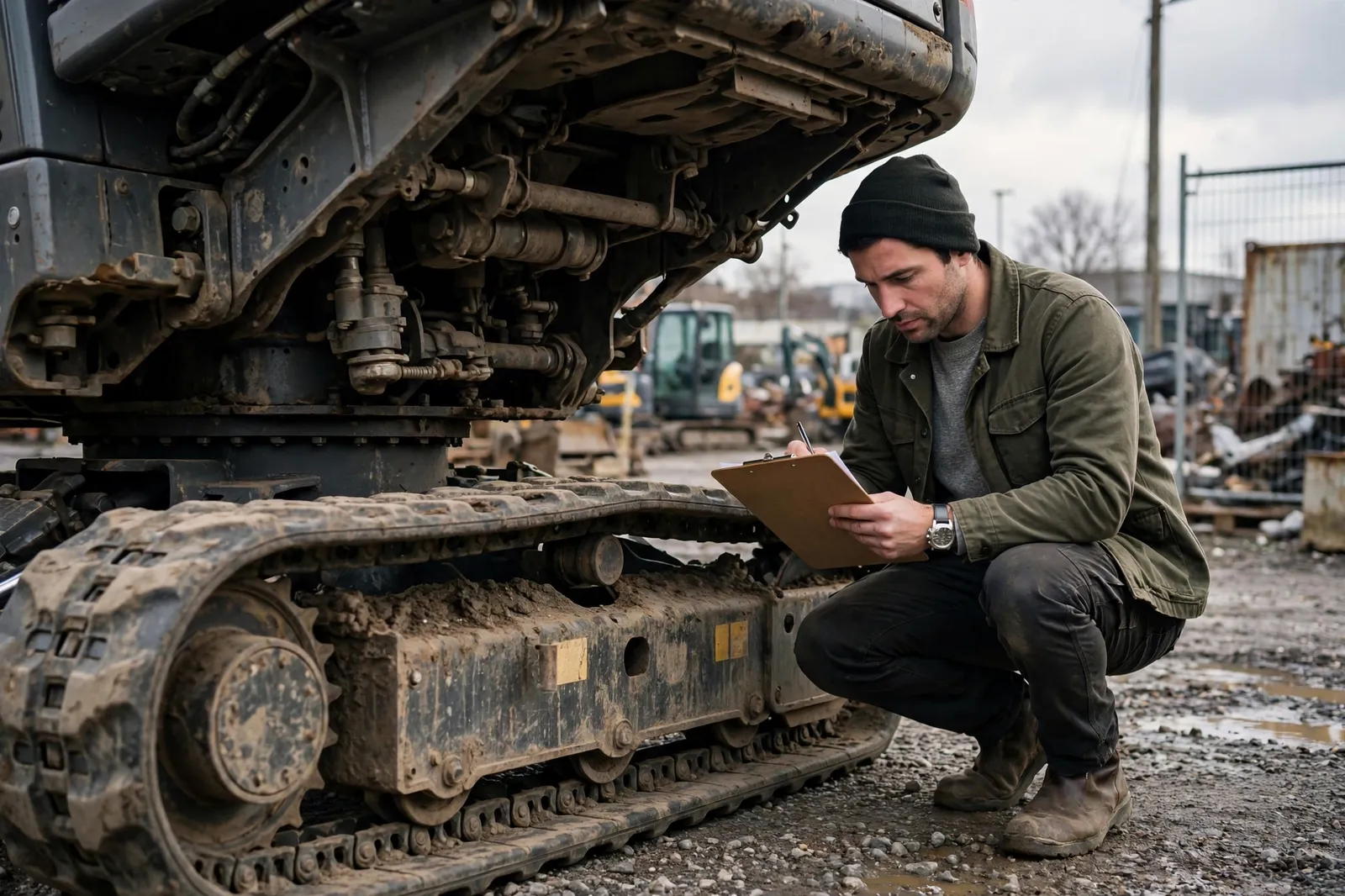
- Undercarriage. This is the expensive wear item: tracks, rollers, idlers, sprockets and track chains. Stretched chains, hooked sprocket teeth and torn rubber tracks all point to a large bill. On any serious purchase, have it assessed as a percentage of life remaining.
- Pins and bushes. Play in the boom, arm and bucket linkages shows as slop when the bucket is rocked. A little wear is normal; obvious movement means replacement.
- Hydraulics. Look for leaks at hoses, rams and the slew ring, listen for pump whine, and check hydraulic oil condition. Slow or jerky functions under load are warning signs.
- Engine and cooling. Cold-start the machine yourself. Smoke, blow-by and overheating under load tell you more than a tidy engine bay.
- Service history. Documented servicing supports the price. Its absence should move the price, or end the deal.
- Imports. A large share of used diggers here are used imports, especially from Japan. That is not a problem in itself, but check that hour readings, model designations and parts support stack up.
Running costs to budget for
The purchase price is the beginning. Build these into your numbers before you commit.
- Fuel. Diesel use scales with size and workload. Minis sip; mid-size machines working hard do not.
- Servicing. Engine oil, filters, hydraulic oil and coolant on the manufacturer’s intervals, plus regular greasing. Dealer servicing costs more and preserves warranty and resale value; independent diesel mechanics are the common choice out of warranty.
- Tracks and undercarriage. Rubber tracks have a finite life. Steel undercarriage components wear as a set and are a major periodic cost on bigger machines.
- Wear steel. Bucket teeth and cutting edges are consumables in abrasive ground.
- Insurance. Plant and machinery cover usually sits inside a business insurance package alongside public liability insurance. Confirm cover in transit, on site and in storage.
- Storage and security. Minis are trailer-mobile, which makes them theft targets. Store them locked away.
Where diggers are sold
New machines come from the authorised distributors and their dealer networks: Cable Price for Hitachi, Terra Cat for Caterpillar, and the equivalent networks for Komatsu, Volvo, Kubota, Yanmar and other brands, each with parts and service backup. Used machines are sold through those same dealers (trade-ins and ex-fleet units, sometimes with workshop checks or warranty), through machinery dealers generally, at auction, and through online marketplaces and private sales. The channel matters because your legal protection changes with it. Prices are generally quoted exclusive of GST. Used prices are asking prices on individual machines, and this guide does not quote them: condition, hours and attachments swing them too widely for a single figure to mean anything.
Checks before you buy
Do these before money moves.
- Inspect in person, working. See the machine cold, start it, run every function, slew it, track it and dig with it if the seller allows. A seller’s video is not an inspection.
- Verify identity. Record the serial number from the machine’s plate and check it matches the paperwork and service records. Walk away from a machine whose plate is missing or defaced.
- Read the service history. Ask for records and receipts. Gaps are not fatal, but they should be priced.
- Search the PPSR for money owing. The Personal Property Securities Register is the official register of security interests over personal property. The Companies Office, which runs it, recommends a PPSR check before buying second-hand items originally worth more than NZ$2,000, which covers any digger. For machinery you search against the seller as debtor (a person or an organisation, including by NZBN), rather than by plate as you would for a car. A search costs $2 plus GST. If a registered security interest shows up, the machine can be repossessed even though you paid for it; if nothing shows, repossession is unlikely. Search close to settlement, in the seller’s correct legal name.
- Weigh the seller. Heed the ordinary signals too: a seller who cannot produce paperwork, resists a PPSR search or wants cash in a hurry is telling you something.
- Get an independent mechanical inspection on anything beyond a small mini. A diesel mechanic who does not know the seller is cheap insurance against undercarriage and hydraulic bills.
- Agree what is included. Buckets, hitch, manuals, trailer if any: list them in writing. Deals fall apart over a supposedly included tilt bucket.
Dealer or private: your legal protection
Your rights differ sharply depending on who sells to you, and for business buyers they are thinner than many people assume.
Buying from a dealer or trader. The Fair Trading Act prohibits misleading and deceptive conduct in trade, so a trader’s descriptions, hours and condition claims must be honest. The Consumer Guarantees Act (CGA) is more limited than most buyers expect: Consumer Protection (part of MBIE) explains that businesses can only rely on the CGA when something goes wrong with a product usually for household or personal use, such as stationery or a domestic oven. A commercial excavator is not that kind of product. Where the CGA might otherwise apply, seller and buyer can also agree in writing that it does not apply, if contracting out is fair and reasonable to both sides. In practice, a business buyer’s rights are typically whatever the warranty, contract or sales agreement says, so read the dealer’s terms before you sign.
Buying privately. The CGA does not cover private sales at all: Consumer Protection states plainly that private sales are not covered, giving the example of buying from a private seller rather than a trader on a site like Trade Me. Buying privately rests on the contract you make, the law of misrepresentation, and your own checks, which is why the PPSR search and inspection matter most here. Put the agreement in writing, even between neighbours: machine, serial number, price, included attachments, and any faults disclosed.
Finance and tax pointers
Finance. Dealers commonly arrange finance through their own partners, banks lend on machinery as a secured asset loan, and leasing suits some businesses. Compare on total cost and end-of-term terms, not the weekly payment. Expect the lender to register its security interest on the PPSR, which is exactly what a future buyer’s search should find.
GST. Prices are generally quoted plus GST. If you are GST-registered and buy the digger for your taxable activity, you claim the GST back through your GST return, and as Inland Revenue sets out, you then depreciate the asset on its GST-exclusive price. If you are not GST-registered, depreciation is worked out on the full GST-inclusive price.
Depreciation. Inland Revenue requires depreciation on business assets kept for longer than a year; a digger is a capital asset, not an expense. There are two methods. Diminishing value claims a percentage of the asset’s reducing tax value each year, so claims are larger early on. Straight line claims the same amount each year based on cost. The total over the asset’s life is the same either way. Inland Revenue sets the rate for each type of asset based on its cost and useful life, and excavators have their own rate in its tables. Because the rate depends on the asset class and your chosen method, this guide does not quote one: use Inland Revenue’s depreciation rate finder and calculator, on its Claiming depreciation page, or check with your accountant. Two smaller points from the same page: assets costing $1,000 or less (the low value threshold in place since 17 March 2021) can be deducted immediately rather than depreciated, which can apply to small attachments, and assets can sometimes be pooled.
Investment Boost. For new machines there is an extra, significant deduction. Inland Revenue’s Investment Boost allows businesses to claim 20 percent of the cost of a new (or new to New Zealand) depreciable asset as an expense in the year it is first available for use, provided that date is on or after 22 May 2025, then claim depreciation as usual on the remaining 80 percent. There is no cap on the value you can claim for. The limits matter for digger buyers: second-hand assets sourced from within New Zealand do not qualify, while a brand new machine, or a new-to-New Zealand import, can. If you claim the Investment Boost on an asset you must depreciate it. Run the numbers before choosing between a new machine and a cheaper used one, because the tax settings narrow the gap.
This is general information only, not personal tax advice. An hour with your accountant before you sign is worth more than any rule of thumb.
Getting it home: transport basics
Moving the machine is part of the purchase, and the legal limits are tighter than many buyers realise. NZ Transport Agency Waka Kotahi’s safe loading and towing guidance states the key numbers: on a full class 1 car licence, the combined weight of tow vehicle, trailer and load must not exceed 6,000 kg; on a learner or restricted licence the limit is 4,500 kg. The maximum legal speed when towing on the open road is 90 km/h. The towball and coupling must match (New Zealand uses both 1 7/8 inch and 50 mm sizes; a mismatch can disconnect the trailer), the safety chain must be secured, and the combination must stop safely, which in practice means a braked trailer for heavier loads. Do the arithmetic before you collect: a 1.7 tonne digger on a 600 to 800 kg trailer behind a 2.2 tonne ute is already around 4.5 to 4.7 tonnes combined. A 3.5 tonne digger combination will exceed 6,000 kg behind most utes and needs a higher licence class or truck transport instead. For larger machines, dealer delivery or a tilt-tray is the normal answer.
Frequently asked questions
How much does a new digger cost in NZ?
Most new diggers are priced on application, so there is no official price list to quote. One published example we verified on the distributor’s own website on 8 October 2026 is a new 2026 Hitachi ZX17U-5 mini excavator listed by Cable Price at $32,000 plus GST ($36,800 including GST). Get written quotes for the exact machine and bucket set you are comparing.
What size digger do I need for a lifestyle block or farm?
For most lifestyle blocks and farms, a 1.7 tonne mini covers post holes, small drains, races, trenches and landscaping. If your regular work includes deeper drainage, culverts, effluent ponds or bigger stumps, look at 3.5 to 5.5 tonnes.
Can I tow a digger on a car licence?
Often, for a mini. NZTA’s limit on a full class 1 licence is a combined 6,000 kg for vehicle, trailer and load, and 4,500 kg on a learner or restricted licence. A 1.7 tonne digger on a trailer behind a ute usually fits on a full licence; a 3.5 tonne combination usually does not.
How do I check a used digger has no money owing on it?
Search the Personal Property Securities Register (PPSR) against the seller as debtor before you pay. It costs $2 plus GST. If a security interest is registered, the machine can be repossessed even after you have paid for it.
Does the Consumer Guarantees Act cover a digger bought for my business?
Usually not. Consumer Protection explains that businesses can only rely on the CGA for products usually for household or personal use, and sellers can contract out of it in writing for business sales. Private sales are not covered at all. Your real protection is the written contract and warranty terms.
Can I claim tax deductions for a digger?
Yes, through depreciation rather than as an upfront expense, using the diminishing value or straight line method at the rate Inland Revenue sets. A new (or new to New Zealand) machine first available for use on or after 22 May 2025 can also attract the 20 percent Investment Boost deduction, with depreciation on the remaining 80 percent. Used machines bought within New Zealand do not qualify for the Investment Boost.
What should I check on a used digger before buying?
Inspect it working from cold, verify the serial number matches the paperwork, read the service history, run a PPSR search on the seller, and check the undercarriage, linkage play, hydraulics and engine behaviour under load. On anything beyond a small mini, pay for an independent mechanical inspection.
Do I need a licence to operate a digger?
There is no excavator operator’s licence for private use on your own land, but WorkSafe expects anyone operating plant for a business to be trained and competent, with competency verified by assessment and monitoring, including competence with the quick hitch fitted.
This article is general information about buying and owning an excavator in New Zealand. It is not financial, tax or legal advice. Prices, rules and specifications change; confirm current pricing with the distributor, tax treatment with your accountant, and your legal position with a lawyer where the purchase is significant.
Sources
- Cable Price (CablePrice New Zealand Ltd), Hitachi ZX17U-5 Excavator, cableprice.co.nz
- Terra Cat, 301.7 CR Mini Excavator, terracat.co.nz
- Terra Cat, 302.7 CR Mini Excavator, terracat.co.nz
- WorkSafe New Zealand, Using quick hitches safely, worksafe.govt.nz
- Inland Revenue, Claiming depreciation, ird.govt.nz
- Inland Revenue, What you can claim with Investment Boost, ird.govt.nz
- Companies Office, How the PPSR can help when you’re buying used goods, ppsr.companiesoffice.govt.nz
- Companies Office, Why you might search the PPSR, ppsr.companiesoffice.govt.nz
- Consumer Protection (MBIE), Faulty goods and services bought by businesses, consumerprotection.govt.nz
- Consumer Protection (MBIE), Faulty and unsafe products, consumerprotection.govt.nz
- NZ Transport Agency Waka Kotahi, Safe loading and towing for light vehicles, nzta.govt.nz