Mystery Shopper NZ: How It Works, What It Pays and How to Avoid the Scams

Mystery shopping sounds simple. You walk into a shop, cafe or bank branch, act like an ordinary customer, then write up what happened and get paid for it. The work is real, and established New Zealand agencies have run mystery shopping programmes for decades. But the same idea is also used by scammers who dangle easy money in front of people and then take theirs instead.
This guide explains how legitimate mystery shopping works in New Zealand, what the established agencies pay, what the tax rules are, and how to tell a genuine assignment from a scam.
The short answer
Mystery shoppers in New Zealand work as independent contractors for specialist agencies. The agency is hired by a business, such as a retail chain, hospitality group, bank or service provider, to check how its staff serve real customers. The shopper visits in secret, follows a brief, and files a detailed report.
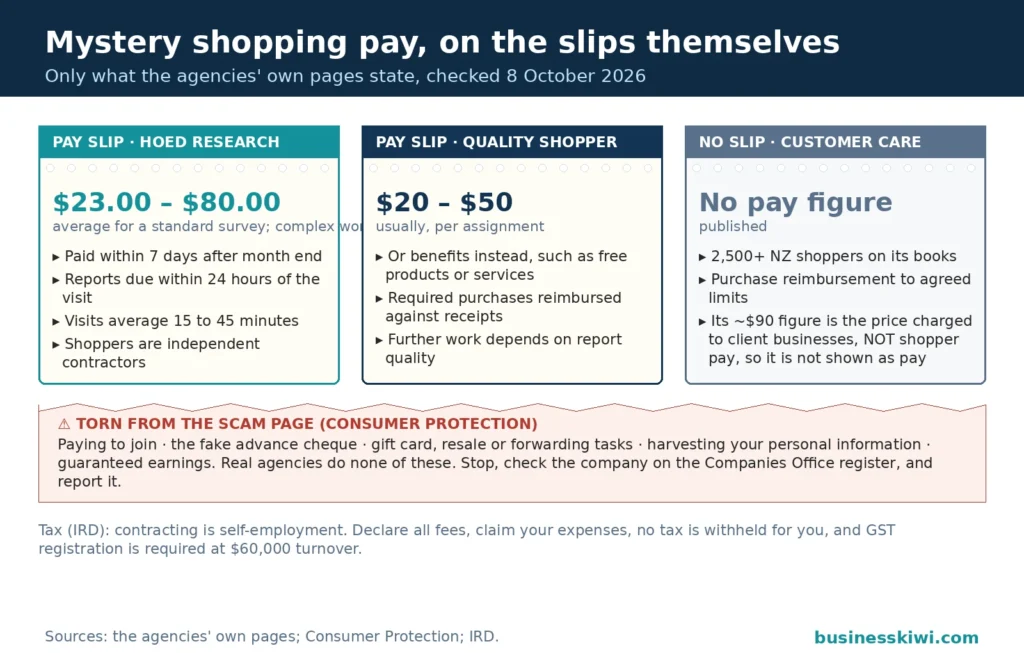
Pay is modest and paid per assignment. HOED Research, one of the largest New Zealand agencies, states that survey fees are specified for each job and on average range from $23 to $80 for a standard survey, with more for longer and more complex work (figures published on its website, checked 8 October 2026). Quality Shopper, another New Zealand provider, states that payment for each assignment is usually between $20 and $50, or benefits such as free products or services, or a combination of both (checked 8 October 2026). Where an assignment requires a purchase, the cost is reimbursed on top, usually against a receipt.
Registering with a legitimate agency costs nothing. If anyone asks you to pay to join, or sends you money in advance and asks you to pass most of it on, you are dealing with a scam.
What mystery shopping is
Mystery shopping is a form of market research. A business wants to know what its customers actually experience: whether they were greeted, how long they waited, whether staff knew the products, whether the premises were clean, and whether sales and compliance steps were followed. Because staff behave differently when they know they are being watched, the assessment is done covertly by someone posing as a normal customer.
The business does not usually deal with shoppers directly. It contracts an agency, and the agency recruits a panel of shoppers, sends them in with a brief, checks their reports and passes the findings to the client. The client’s staff are not told who the shopper was or exactly when they came in.
Assignments are not limited to walking into a store. Customer Care, a Christchurch-based provider with more than 2,500 shoppers throughout New Zealand, describes mystery shopping as covering visits, phone calls, emails, online shopping tests and live chat assessments. A phone assignment might test how long a call took to be answered and how helpful the staff member was. An online assignment might test how quickly a business replies to an enquiry.
What an assignment involves
The typical assignment has four stages.
The brief. Before you go anywhere, the agency gives you instructions and a questionnaire. The brief might tell you to visit a particular store on a particular day, ask about a specific product, try to return an item, or check whether staff ask for ID on an age-restricted purchase. HOED Research is blunt about this stage: you must read the job instructions and the survey thoroughly before the visit, because a visit completed incorrectly may not be paid.
The visit. You carry out the scenario as an ordinary customer and pay close attention without giving yourself away. You note times, names if badges are worn, what was said, and what did and did not happen. You keep any receipt, because purchase assignments require a receipt to be uploaded with the report.
The report. You write up the questionnaire from your notes, answering factually rather than creatively. Agencies check reports for consistency, completeness and basic grammar. Quality Shopper tells its shoppers that all questionnaires are read and analysed, and that further assignments depend on the quality of the data gathered. Customer Care likewise says its shoppers are assessed every time they complete an assignment and only the best rated shoppers are given work.
The deadline. Reports are due fast. HOED requires the survey to be submitted within 24 hours of completing the visit. On most assignments the visit itself is short: HOED says surveys take 15 to 45 minutes on average, with meals and other detailed surveys taking longer.
Which businesses use mystery shoppers
Any business that serves customers through staff can use mystery shopping, and the client lists of New Zealand agencies reflect that spread. Quality Shopper says it works across retail, hotels, restaurants, entertainment, online retailers, financial institutions and travel. Customer Care lists hospitality, retail, technology, the vehicle industry, medical, building, government, financial services, tourism and loyalty programmes among its market research sectors.
In practice the most common assignments involve:
- Retail stores, from supermarkets and liquor outlets to hardware and fashion chains, checking service, store standards and sales steps.
- Hospitality businesses, where the shopper buys a meal or stays overnight and reports on the whole experience.
- Banks and other financial institutions, testing enquiry handling and whether required information was given.
- Petrol stations and convenience stores, often including age-restricted purchase compliance checks.
- Phone, email and online channels, testing response times and the quality of answers.

How legitimate agencies work
The established agencies follow a recognisable pattern, and it is worth knowing what that pattern looks like so you can spot when an offer does not match it.
You apply; you do not get headhunted with a cheque. You register on the agency’s own website and complete a profile covering where you live, the areas you are willing to shop in, and basic details about yourself so assignments can be matched to you. HOED puts available surveys on a job board: you browse jobs in your area, apply for the ones you want, and nominate the date you intend to complete them. The agency reviews applications and accepts or declines them. Quality Shopper keeps registered shoppers on a nationwide database and offers assignments based on profile and location.
You are an independent contractor. This is stated plainly by the agencies themselves. HOED tells its evaluators that as an independent contractor they must declare income earned, and that they are responsible for their own tax obligations. Quality Shopper describes its mystery shoppers as independent. There is no employment relationship, no guaranteed hours and no obligation on either side: you can decline any assignment, and the agency does not have to offer you any.
You will need to give tax and payment details. Because you are a contractor being paid for work, an agency will need your IRD number and a bank account to pay you once you are registered. That is normal. What is not normal is being asked for those details through an unsolicited email, text message or social media approach from someone you have never verified.
Payment follows the work. HOED processes payment of completed surveys within seven days after the month is completed, so assignments done in one month are paid in a monthly cycle shortly after it ends. The order never reverses: with a real agency, money flows to you only after you have done an assignment and the report has been accepted.
How pay works
Mystery shopping pay has two parts: a fee for the assignment, and reimbursement of any purchase the assignment required.
The fee is set per assignment and shown before you accept the job. HOED states that survey fees are specified in each survey on its job board and on average range from $23.00 to $80.00 for a standard survey, with more for a longer and more complex survey. Quality Shopper states that payment for each assignment is usually between $20 and $50, or benefits depending on the nature of the assignment, such as free products or services, or a combination of both. These are the figures the companies publish on their own websites, checked on 8 October 2026; other agencies may pay differently and many do not publish rates at all.
Reimbursement is separate. If the brief requires you to buy something, the purchase is reimbursed, normally up to an agreed limit and always against a receipt attached to your report. Customer Care explains that where a client requires a purchase, a spending limit is agreed and reimbursed to the shopper, with all receipts attached to the surveys. Most of its surveys do not require a purchase at all, although hospitality assignments generally do, since you cannot assess a restaurant without ordering. In some assignments the main value is the reimbursed experience itself, such as a meal, rather than the fee.
Some assignments also carry travel reimbursement, but only where the agency says so in advance. HOED notes that some jobs attract travel cost reimbursement and that these are clearly identified when the job is offered. Do not assume travel is covered when it has not been mentioned.
Realistic expectations
Mystery shopping is a top-up income, not a job in the conventional sense, and the agencies are open about the limits.
Work is irregular. HOED says the amount of work varies from month to month and depends on where you live and shop, because clients typically have their stores surveyed monthly, quarterly, twice a year or as needed. A shopper in a main centre with many client stores will usually see more offers than someone in a small town. Many shoppers register with more than one agency to widen the flow of assignments.
It will not replace a salary. At fees of roughly $20 to $80 per assignment, plus the time taken to travel, complete the visit and write the report, mystery shopping suits people who want flexible extra income around other work, study or family commitments. Treat any claim of large or guaranteed earnings as a warning sign, because no legitimate agency talks that way.
Report quality decides whether you keep getting work. Agencies grade shoppers. Weak, late or sloppy reports mean fewer offers. Good shoppers are observant, write clearly, follow the brief exactly and meet the deadline every time. HOED also sets practical rules, such as not completing surveys with children under 16 in tow, and expects shoppers to be available in the areas listed on their profile.
You stay anonymous. If staff work out that you are the mystery shopper, the assignment can be compromised. Shoppers are expected to behave like ordinary customers and keep the work confidential.
How to apply, and what agencies look for
Applying is straightforward and always free. Go to the agency’s official website yourself, rather than following a link in a message, and complete the registration form. Expect questions about your location, availability, shopping habits and demographics, because clients often need shoppers who match their customer profile.
Quality Shopper sets out what it looks for: people who are detail oriented, trustworthy, eager to learn, observant, objective and fair, responsible about deadlines, and with good literacy. That list is a fair summary for the industry. In practical terms you need:
- A good memory for detail, since you often cannot take notes openly during a visit.
- Clear, accurate written English, because the report is the product the client is paying for.
- Reliability. Accepting an assignment and not completing it, or filing late, quickly ends the offers.
- A smartphone or computer for job boards, questionnaires and receipt uploads.
- Your own transport for assignments beyond walking distance.
Some agencies include a short comprehension or practice task in the sign-up process so they can see you can follow instructions and write a usable report. Passing it is part of the normal process and costs nothing.
The tax position
Mystery shopping fees are income, and Inland Revenue’s rules for the self-employed apply to them. IRD states that self-employment includes contracting and working as a sole trader, and that is what a mystery shopper is in tax terms: in effect, you run a very small business every time you accept an assignment.
The main obligations, as IRD sets them out, are:
- You use your individual IRD number to pay tax, and you pay tax on your net profit by filing an individual tax return.
- All fees and taxable reimbursements count as income and must be declared, even though no employer has deducted tax along the way. HOED tells its evaluators the same thing: declare any extra income earned at the end of each financial year, and the tax obligations are yours.
- You can claim back expenses for the business activity you carry out. Keep records of what you earn and what you spend, including receipts and mileage or travel records for assignments, so you can support the expenses you claim.
- Because no tax is withheld from your fees, it is sensible to set money aside from each payment so the end-of-year bill is not a shock. If your total income crosses the relevant thresholds you may also need to pay provisional tax in the following year.
- You only need to register for GST if your turnover reaches $60,000 a year or more. Mystery shopping alone will not get most people anywhere near that threshold, but if you have other self-employed income it all counts together, and IRD’s threshold applies to your total turnover.
None of this is complicated at mystery shopping scale, but it is your responsibility, not the agency’s. If your situation is more complex, IRD recommends getting advice from an accountant or tax agent.

Mystery shopping scams: the section to read twice
For every genuine agency there are scam operations trading on the mystery shopping name, and the money at risk is much larger than a $30 assignment fee. Scammers copy real company names and branding, build fake websites, and contact people through email, text messages, social media and job ads. Consumer Protection, the MBIE service that runs Scamwatch, warns that scammers can convincingly imitate the logos and communication style of trusted companies, and are known to make fake websites, ID badges and letterheads to fool people into giving money or information. It also warns that an opportunity is not necessarily safe just because someone uses a local phone number, a contact address or a .nz domain name.
These are the main variations.
Paying to join. The offer asks for an upfront fee for registration, training materials, a starter kit or access to a list of assignments. Legitimate agencies do not charge shoppers to register or to see work. Payment for access is the business model of the scam itself, and the assignment list, if it arrives at all, is worthless.
The fake cheque. This is the most damaging version. You are sent a cheque, supposedly as advance payment for your first assignments. You are told to deposit it, spend part of it on gift cards, electronics or money transfers as your “assignment”, and keep the rest as your fee. Days later the cheque bounces, because it was never real, and your bank recovers the full amount from your account. The gift cards and transfers, paid for with your money, are gone. Consumer Protection’s core advice applies directly: be suspicious of any contact you were not expecting, and never rush. No genuine agency pays in advance, and none will ever ask you to move money on its behalf.
Gift card, resale and forwarding tasks. You are asked to buy gift cards and send the card numbers or codes, buy phones or other goods and post them to an address, buy cryptocurrency, or receive parcels and forward them on. These are not mystery shopping tasks; they are ways of converting stolen money or stolen goods, and taking part can leave you out of pocket and potentially involved in laundering. A real assignment involves an ordinary purchase at the business being assessed, reimbursed afterwards against a receipt. It never involves sending codes, goods or money to a third party.
Harvesting your personal information. A fake sign-up process collects your IRD number, bank account details, date of birth and copies of ID, supposedly for payroll. In the wrong hands that is enough to attempt identity fraud. Scammers can also learn private details from other sources and use them to sound convincing, Consumer Protection notes, so the fact that an approach mentions correct details about you does not make it genuine.
Guaranteed high earnings. Promises of hundreds of dollars per assignment, a set weekly income, or payment far above the $20 to $80 range that real agencies publish are bait. So is pressure to act immediately. Consumer Protection advises taking a moment before acting on unexpected messages, and being wary of urgent requests, because urgency is a deliberate tactic.
If you think you have been caught, act quickly. Stop all contact. If you have sent money, contact your bank or payment provider straight away, as Consumer Protection advises, and report the scam even if you are unsure, because reporting helps protect others. If you have shared personal details, change the passwords on accounts that use them and be alert for further approaches. Reports can also be made to the Police and to Netsafe, and Consumer Protection publishes current scam alerts through its Scamwatch pages.
How to check an agency is legitimate
Before you register anywhere, spend ten minutes on checks. Consumer Protection’s guidance is to stop, check and report: check the source of any approach to make sure it is real, look up official websites through a search engine rather than trusting links in messages, and try searching the company’s name together with the words “scam warning”.
Applied to a mystery shopping agency, that means:
- Find the website yourself. Type the agency’s name into a search engine and go to its official site. Do not use links or phone numbers from an unsolicited message.
- Check the company exists. A genuine New Zealand agency is a registered company. You can search the Companies Office register, and many businesses also carry an NZBN (New Zealand Business Number). HOED, for example, trades as HOED Research NZ Ltd. A supposed agency that does not appear as a real company is a hard stop.
- Check the model matches. Real agencies register shoppers free, offer assignments through a job board or by email from their own domain, specify the fee before you accept, require a written report, and pay after the assignment in a regular payment cycle. Any deviation, especially advance payments, cheques, or requests to buy gift cards or forward goods, means walk away.
- Check what they ask of you. Needing your IRD number and bank details to pay you is normal once you have registered through the official site. Being asked for them by a stranger over social media or text, before any verification, is not.
- Search for warnings. Look for the company name plus “scam” or “scam warning”, and check Consumer Protection’s Scamwatch material for current alerts. Scammers often impersonate real agencies, so also confirm that the web address you are on is the agency’s real one, character for character.
Frequently asked questions
How much do mystery shoppers get paid in NZ?
Fees are set per assignment and shown before you accept. HOED Research publishes an average range of $23 to $80 for a standard survey, with more for longer and more complex work. Quality Shopper publishes payment of usually $20 to $50 per assignment, or benefits such as free products or services. Purchases required by an assignment are reimbursed on top, against a receipt. (Figures from the companies’ own websites, checked 8 October 2026.)
Is mystery shopping a real job?
The work is real, but it is not a job in the employment sense. Shoppers are independent contractors, not employees, so there is no guaranteed income, no set hours and no obligation for an agency to offer you work. It is best treated as flexible extra income.
Do I have to pay to become a mystery shopper?
No. Legitimate New Zealand agencies register shoppers for free through their websites. Any outfit asking for an upfront joining fee, training fee or starter kit payment is not operating the way real agencies do, and should be avoided.
Do I have to pay tax on mystery shopping income?
Yes. IRD treats contracting as self-employment. You declare the income in an individual tax return using your own IRD number, pay tax on your net profit, and can claim expenses for the business activity. No tax is deducted from your fees by the agency, so put money aside as you go.
Can mystery shopping be a full-time income?
Realistically, no. Assignments are irregular, vary by location, and pay modest fees. The agencies themselves describe work varying month to month. Most shoppers use it as a top-up around other income, and registering with more than one agency is common.
I have been sent a cheque for my first assignment. What should I do?
Do not deposit it and do not spend any of it. No legitimate agency pays in advance by cheque, and the advance cheque is the centrepiece of the most common mystery shopping scam: the cheque bounces after you have sent gift cards or transfers bought with your own money. Stop contact, and report the approach. If you have already sent money, contact your bank immediately.
How can I tell if a mystery shopping offer is a scam?
The strongest signs are being asked to pay to join, being paid in advance, being asked to buy gift cards or forward goods or money, pressure to act quickly, and earnings promises well above the modest fees real agencies publish. Check the company through its official website, search its name with “scam warning”, and confirm it is a registered New Zealand company before handing over any details.
What do agencies look for in a good mystery shopper?
Quality Shopper lists being detail oriented, trustworthy, observant, objective and fair, responsible about deadlines, and having good literacy. In practice, shoppers who write clear, accurate reports and always meet deadlines get more work, because agencies grade report quality.
This article is general information only, based on the sources below as at October 2026. It is not financial, tax or legal advice. Agency fees and processes can change, so check the agency’s own website for current details, and consider professional advice for your own tax situation.
Sources
- HOED Research, Become a HOED Evaluator, Mystery Shopper, Price Checker, Auditor or Merchandiser, hoed.co.nz
- Quality Shopper, Become a mystery shopper, qualityshopper.co.nz
- Customer Care, FAQ, customercare.co.nz
- Consumer Protection, Be alert. Stay scam safe, consumerprotection.govt.nz
- Consumer Protection, Identify a scam, consumerprotection.govt.nz
- Consumer Protection, Types of scams, consumerprotection.govt.nz
- Inland Revenue, Self-employed, ird.govt.nz