Fairfield College Hamilton: Roll, Zones, Subjects and Enrolment
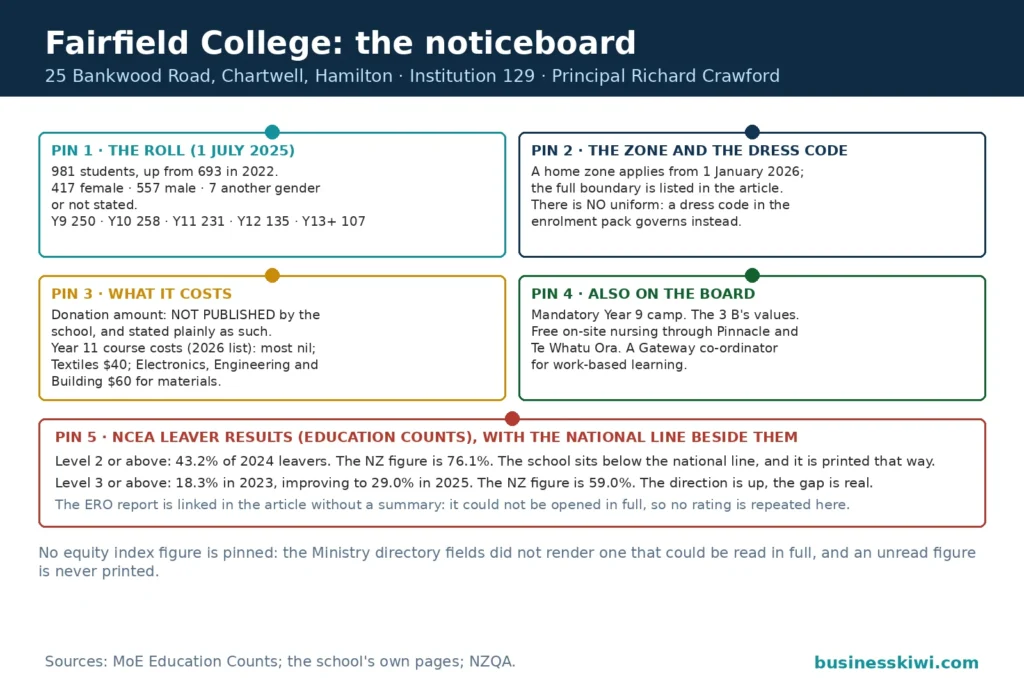
Fairfield College is the state secondary school for a big slice of north-east Hamilton, and it is growing. The Ministry of Education roll count put 981 students at the school on 1 July 2025, up from 693 three years earlier, and enrolments for 2027 are already open. For parents weighing up secondary options in Hamilton, or families moving into suburbs like Fairfield, Claudelands and Enderley, this profile pulls together what the official record actually says about the school: its roll and who attends, how its enrolment zone works, the subjects and programmes on offer, what families pay, and how the enrolment process runs from first form to first day.
Fairfield College at a glance
Fairfield College is a co-educational state secondary school covering Years 9 to 13. It appears in the Ministry of Education’s Education Counts directory as institution number 129. The school’s own published address is 25 Bankwood Road, Chartwell, Hamilton, with a postal address of PO Box 12-228, Hamilton 3248, and its office phone number is 07 853 5660.
The roll has climbed steadily in recent years. Education Counts records 721 students at 1 July 2021, a dip to 693 in 2022, then 745 in 2023, 896 in 2024 and 981 at 1 July 2025. That is growth of more than 40 percent across three roll returns, which is worth knowing if you are planning ahead: this is a school adding students, not losing them.
The 2025 roll breaks down by year level as follows:
- Year 9: 250 students
- Year 10: 258 students
- Year 11: 231 students
- Year 12: 135 students
- Year 13 and above: 107 students
The junior school is noticeably larger than the senior school, a pattern common across New Zealand secondary schools as some students leave for work or training after Year 11. By gender, the July 2025 count recorded 417 female students, 557 male students and 7 students recorded as another gender or not stated.
Fairfield College serves a genuinely diverse community. Because students can identify with more than one ethnic group, the Ministry’s ethnic counts add to more than the total roll. At 1 July 2025 they were: Māori 518, European/Pākehā 437, Pacific 130, Asian 123, MELAA (Middle Eastern, Latin American and African) 41, and Other 13. Māori students make up the largest single group in the school, and te reo Māori and Māori performing arts both feature in the senior subject list, which fits the community the school serves.
One thing this profile does not publish is a decile or Equity Index figure. The Ministry now funds schools using the Equity Index rather than the old decile system, and parents sometimes go looking for the number as a shorthand for school quality. It is not a measure of how good a school is, and because we could not confirm the school’s current index from a Ministry page for this profile, we have left it out rather than print a figure we cannot stand behind. The school office can confirm it if it matters to you.
Leadership, values and expectations
The school’s principal is Richard Crawford, named as principal on the school’s own staff pages, with a dedicated principal’s contact address published on the school website. He leads a staff that includes a pathways team with a Gateway co-ordinator, a role that organises workplace-based learning for senior students.
The expectations the school asks families to sign up to at enrolment are summed up in what it calls the 3 B’s: Be Responsible, Be Respectful, Be the Best You Can Be. They appear in the student code of conduct inside the enrolment pack, alongside practical expectations such as attending every day, arriving on time and prepared, and completing set work.
Attendance gets particular emphasis. The enrolment declaration states plainly that the college places significant importance on regular attendance, that it monitors attendance daily, and that parents are expected to notify the school of absences by text, email or phone, and to work with the school if attendance becomes an issue. Families considering Fairfield should expect attendance to be followed up, not left alone.
Two rites of passage are built into Year 9. Attendance at the annual Year 9 camp is a requirement, not an optional extra, and every Year 9 student also serves as a student runner for at least one day of the year. Both need parent consent on the enrolment form.
The enrolment zone
Fairfield College has an enrolment scheme, and the home zone in the Ministry’s published scheme description took effect on 1 January 2026. Students who live in the zone have an absolute right to enrol. Everyone else is an out-of-zone applicant, and the enrolment form asks families to declare which category they fall into.
In broad terms, the zone covers the suburbs of Fairfield, Claudelands, Enderley, Fairview Downs and Hamilton East, along with Parkwood and the edges of Chartwell and Ruakura. The formal boundary in the Ministry’s scheme description starts at Pukete Bridge and follows Wairere Drive to the roundabout where Crosby Road, Gordonton Road and Pardoa Boulevard meet. It then runs along Pukeroa Road to the Waikato Expressway, south along the expressway to Percival Road (odd-numbered addresses only), and on to Ryburn Road. From there it follows the East Coast Main Trunk railway east and then south to Ruakura Road at Knighton Road, continues along Knighton Road to Cameron Road and Clyde Street, takes in Clyde Street including Page Place down to the Waikato River, and follows the river back to Pukete Bridge. Unless the description says otherwise, addresses on both sides of a boundary road are in zone.
The school publishes a full street-by-street list on its website, and that list is the practical tool for checking a specific address. Proof of residence inside the zone is required, and the enrolment form asks for evidence of your current address, such as a utility bill, tenancy agreement or sale and purchase agreement.
Out-of-zone places, where the board determines there is room, are allocated in the priority order set by the Ministry. Fairfield College has no Secretary-approved special programme, so the first priority category does not apply. The order after that is: siblings of current students; siblings of former students; children of former students; children of board employees or board members; and then all other applicants. If more applications land in a category than there are places, a ballot decides within that category.
Subjects and programmes
Years 9 and 10 follow the New Zealand Curriculum with option choices layered in. The school publishes separate option forms for Year 9 and Year 10, so students begin making real choices from their first year rather than following a single fixed timetable.
The best window into senior breadth is the school’s own published Year 11 subject list for 2026, which runs to more than two dozen courses:
- English, mathematics and science, the core academic subjects
- Business and Enterprise Studies, Geography, History Studies and Media Studies
- Design and Visual Communication, Digital Technology Studies and Visual Arts
- Drama and Music
- Food Technology, Textiles Technology, and Health and Food Studies
- Physical Education and Outdoor Education
- Electronics and Computer Systems, Engineering and Product Design, and Technology and Building
- ESOL, for students learning English as an additional language
Languages and te ao Māori provision are a visible strength. Year 11 students can take Mandarin, te reo Māori, Māori Performing Arts and Toi Whakairo (Māori carving), a spread that reflects the school’s roll and its place in the Waikato.
For students who need a different kind of senior programme, the Senior Foundation Programme is a 15-credit Level 1 course built from unit standards rather than achievement standards. Across the year it covers using community facilities and services, describing your own culture and the rights and responsibilities of living in Aotearoa New Zealand, maintaining hauora (health and wellbeing), managing money, first aid and civil emergencies. It is offered to selected students only, and the school is upfront that the course does not count towards course endorsement or University Entrance. It is a practical, supported pathway, and it is labelled as exactly that.
Course guides carry the detail for the upper years. The school publishes a Senior Course Guide, with the 2027 edition on its website, setting out courses at Levels 2 and 3 and their entry expectations. Parents comparing senior subjects should work from that guide rather than from summary lists like this one, because courses and standards change from year to year.
Beyond the classroom, the school’s size supports the usual range of sport and cultural activity for a Hamilton secondary school, and its staff structure includes dedicated student support and pathways roles. The enrolment pack also confirms horticulture and adventure-based learning among on-site activities used in education outside the classroom, and senior students take part in sporting events beyond the school during the year.
NCEA at Fairfield College
NCEA is the main school qualification in New Zealand, and NZQA sets its rules. There are three certificates. Level 1 needs 60 credits at any level, Level 2 needs 60 credits at Level 2 or above, and Level 3 needs 60 credits at Level 3 or above. Every level also requires 10 literacy (or te reo matatini) credits and 10 numeracy (or te pāngarau) credits, a requirement students only have to meet once. University Entrance sits on top of Level 3: it requires NCEA Level 3 itself, 14 credits in each of three approved subjects, and the literacy and numeracy requirements.
At Fairfield, the senior years run through Years 11, 12 and 13, with internal assessments during the year and external standards assessed in the NZQA exams each November. Students enrolling into Years 11 to 13 from another school are asked to supply their NZQA results as part of the enrolment application, which tells you the school tracks credit positions from day one.
The honest part of any school profile is the achievement data, and the Ministry publishes it as school leaver statistics: the share of students who left school holding at least a given qualification. These are leaver measures, not pass rates for students who sat the exams, and they reflect every student who left in that year, including those who left early for work or training.
For NCEA Level 2 or above, 43.2 percent of Fairfield College leavers in 2024 held the qualification, against a national figure of 76.1 percent. The school’s figures across 2022 to 2024 were 44.8, 43.8 and 43.2 percent, broadly flat.
Level 3 tells a more recent story. The share of leavers with NCEA Level 3 or above rose from 18.3 percent in 2023 to 20.4 percent in 2024 and 29.0 percent in 2025. The national figure in 2025 was 59.0 percent, so Fairfield remains well below the national leaver rate while clearly moving up. Parents reading these numbers should hold both facts at once: outcomes at this school are lower than national averages, and the most recent trend is improvement. The school publishes an Annual Implementation Plan (the 2026 plan is linked from its homepage), which is where it sets out its own targets and priorities for the year.
What it costs
Fairfield College does not publish a school donation amount on its website, and the enrolment material does not ask for one. If a donation is requested at any point, it will be exactly that, a request, and the school office is the place to confirm the current position.
The costs the school does publish are course costs, and they are modest. In the 2026 Year 11 subject list, the large majority of courses carry a course cost of nil. The exceptions are materials-based subjects: Textiles Technology charges $40 for materials, while Electronics and Computer Systems, Engineering and Product Design, and Technology and Building each charge $60 for materials or projects, with a note that extra materials for individual projects may cost more. On the enrolment form, parents agree to pay all course costs in full before the end of the school year.
Families buy their own school stationery before the year begins, working from the list the school publishes for each year level. The lists are specific, down to exercise book sizes for each subject, and mathematics students need a scientific calculator, bought outside school. The school recommends students have their own headphones to use with its IT resources.
School accounts can be paid at the Student Service Centre by cash or Eftpos (not PayWave), by automatic payment, or by online payment. The centre is open for payments and forms from 8.15am to 3.30pm on school days, closing earlier, at 1.30pm, on Fridays.
Uniform, dress code and daily life
Fairfield College does not have a uniform. Instead it runs a dress code, and the enrolment pack spells it out. Tidy casual wear is the standard. Hats and hoodies are not to be worn indoors, hair including facial hair must be clean and tidy, and clothing must not carry alcohol, drug or offensive imagery. Extreme or extravagant fashions are to be avoided, expensive clothing and personal items are best left at home, and the principal makes the final call on whether dress is suitable, with students able to be sent home to change. Students arriving from a uniformed school may need to buy suitable everyday clothes, and the school asks parents to help choose appropriate, low-cost options.
There are two situation-specific rules. Senior students need dress clothes, such as dark pants or a skirt with a shirt and tie or blouse and a tidy jacket, for occasions when they represent the school in public and for prizegiving. A change of clothing is required for physical education, and closed-in footwear must be worn in workshops.
Phones follow the national rule. Under the government requirement for state schools, students may not use or access mobile phones while at school, including breaks and lunchtime, and exemptions are handled through school management.
Health support on site is stronger than many families expect. Under an agreement with Pinnacle Midlands Health Network and Te Whatu Ora Waikato, school nurses provide free nursing services at the college, and every Year 9 student is offered a comprehensive wellbeing assessment, with the aim of completing assessments for consenting students by the end of Year 10. Day-to-day communication runs through the Skool Loop app and the parent and student portal, and parents can update their own contact details through the portal or the Student Services Centre.
ERO reviews
The Education Review Office reviews every state school and publishes its reports on its own website. We were unable to read Fairfield College’s current ERO report in full while preparing this profile, so we do not summarise its findings or repeat any judgement from it. If you are comparing schools, read the actual report on the ERO website rather than anyone’s summary of it, ours included.
How to enrol
Enrolments for 2027 are open now, and the application is an online form linked from the school’s Enrolment and Options page. The process, as the school’s own enrolment pack sets it out, runs like this:
- Complete the online enrolment form for the right year (separate forms run for 2026 and 2027 entry).
- Gather the supporting documents. The school asks for the completed application form, the student’s birth certificate or passport, visa documentation and a citizenship certificate where applicable, an immunisation record or certificate, proof of the current address, a report from the previous school, and NZQA results for students entering Years 11, 12 or 13.
- Year 9 applicants also complete an “All About Me” form online. The school uses it as the basis for an enrolment interview, so it is worth doing properly rather than treating it as paperwork.
- Read and sign the consent and declaration form, which covers attendance expectations, course costs, education outside the classroom consent, photo and video consent, CCTV, and the internet use agreement. Health information and learning support information forms sit inside the same pack, including space to flag diagnoses, reports and agency involvement the school should know about.
- Declare your zone status on the form. In-zone families need their proof of address; out-of-zone families are considered under the priority order described above if places are available.
Timing matters mainly for course choice, because option forms for Years 9 and 10 and the Senior Course Guide drive subject selection. For a sense of the school year, in 2026 the Year 11 cohort started on Monday 2 February. Families can contact the office on 07 853 5660 or through the school website with questions, and applying early is safer than leaving it to the last minute.
Frequently asked questions
Where is Fairfield College and what year levels does it teach?
Fairfield College is at 25 Bankwood Road, Chartwell, Hamilton. It is a co-educational state secondary school teaching Years 9 to 13, and its Ministry of Education institution number is 129.
How many students go to Fairfield College?
The Ministry of Education roll return counted 981 students at 1 July 2025: 250 in Year 9, 258 in Year 10, 231 in Year 11, 135 in Year 12 and 107 in Year 13 and above. The roll has grown from 693 in 2022.
Does Fairfield College have an enrolment zone?
Yes. The school has an enrolment scheme with a home zone that took effect on 1 January 2026, covering Fairfield, Claudelands, Enderley, Fairview Downs, Hamilton East and Parkwood, plus the edges of Chartwell and Ruakura. Students living in zone have a right to enrol. Out-of-zone applications are taken in a set priority order, starting with siblings of current students, if the board has places available.
Does Fairfield College have a school uniform?
No. Fairfield has a dress code instead of a uniform, based on tidy casual wear. Hats and hoodies stay off indoors, clothing cannot display alcohol, drug or offensive imagery, and senior students need dress clothes for prizegiving and public occasions. A change of clothes is needed for PE, and workshops require closed-in footwear.
What does it cost to send a child to Fairfield College?
The school does not publish a donation amount. Most Year 11 courses in 2026 carried no course cost at all. Materials-based subjects charged $40 (Textiles Technology) or $60 (Electronics and Computer Systems, Engineering and Product Design, and Technology and Building). Parents agree at enrolment to pay course costs in full before the end of the school year, and families also buy stationery from the school’s published lists.
What subjects can students take at Fairfield College?
The published Year 11 list for 2026 covers more than two dozen courses, including English, mathematics, science, business and enterprise studies, geography, history, media studies, design and visual communication, digital technology, drama, music, visual arts, food and textiles technology, outdoor education, electronics, engineering and product design, and building technology. Languages include Mandarin and te reo Māori, alongside Māori Performing Arts and Toi Whakairo (Māori carving). The school’s Senior Course Guide sets out Level 2 and Level 3 courses in full.
How do we enrol at Fairfield College?
Apply through the online enrolment form on the school’s Enrolment and Options page. You will need identity documents, proof of address, an immunisation record, the previous school’s report and, for senior students, NZQA results. Year 9 students also complete an “All About Me” form, which the school uses as the basis for an enrolment interview. If you are applying during the school holidays or outside term time, the online form still runs, and the office can be reached on 07 853 5660 once school resumes.
This profile is general information about one school, prepared from official sources. Enrolment schemes, course offerings and costs change, so confirm the details that matter to your family with the school or the Ministry of Education before making decisions.
Sources
- Ministry of Education, Education Counts: Fairfield College school profile and enrolment scheme description, educationcounts.govt.nz
- Ministry of Education, Education Counts: Fairfield College student population pages (roll trends and roll by year level, as at 1 July 2025), educationcounts.govt.nz
- Ministry of Education, Education Counts: Fairfield College school qualifications pages (NCEA Level 2 and Level 3 school leaver data), educationcounts.govt.nz
- Fairfield College: school website homepage and Enrolment and Options page, faircol.school.nz
- Fairfield College: Our People staff pages (principal; Gateway co-ordinator), faircol.school.nz
- Fairfield College: FFC Zone street list, faircol.school.nz
- Fairfield College: Year 11 stationery and subject requirements 2026, faircol.school.nz
- Fairfield College: Senior Foundation Programme course outline 2026, faircol.school.nz
- Fairfield College: Enrolment application 2027 (including consent and declaration form, code of conduct and dress code), faircol.school.nz
- New Zealand Qualifications Authority: NCEA levels and certificates, nzqa.govt.nz