Bradford School: Roll, Enrolment and What Parents Need to Know

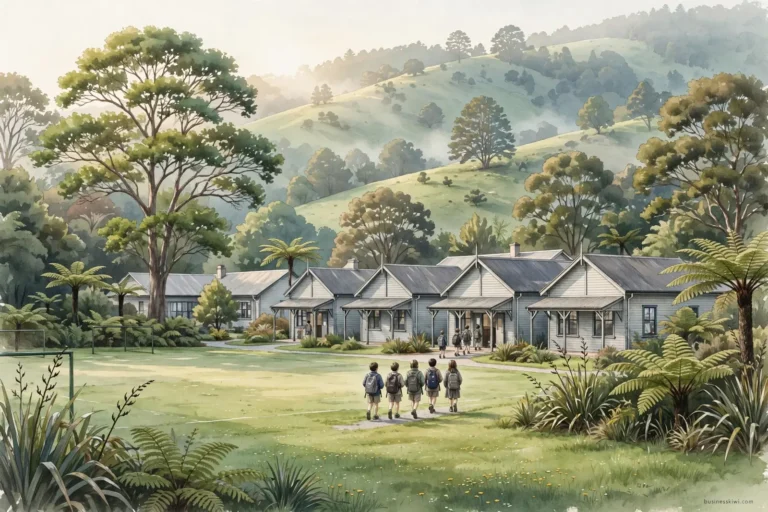
Bradford School is a small state primary school tucked into a quiet cul-de-sac in Dunedin’s Kaikorai Valley, where the streetscape gives way to green hills and the school grounds have more in common with a rural school than an inner-city one. It teaches children from Year 1 to Year 6, and with a roll under 100 it is the sort of school where the office manager is likely to know your child’s name, their siblings, and probably their dog as well.
For parents considering Bradford, the official record tells a fairly clear story: a contributing school with a settled principal, a strong values programme, published strengths in learning support, and a roll drawn mostly from the surrounding valley suburbs. This profile brings together what the Ministry of Education’s Education Counts directory and the school’s own published material actually say, and it is upfront about the things those sources do not publish at all.
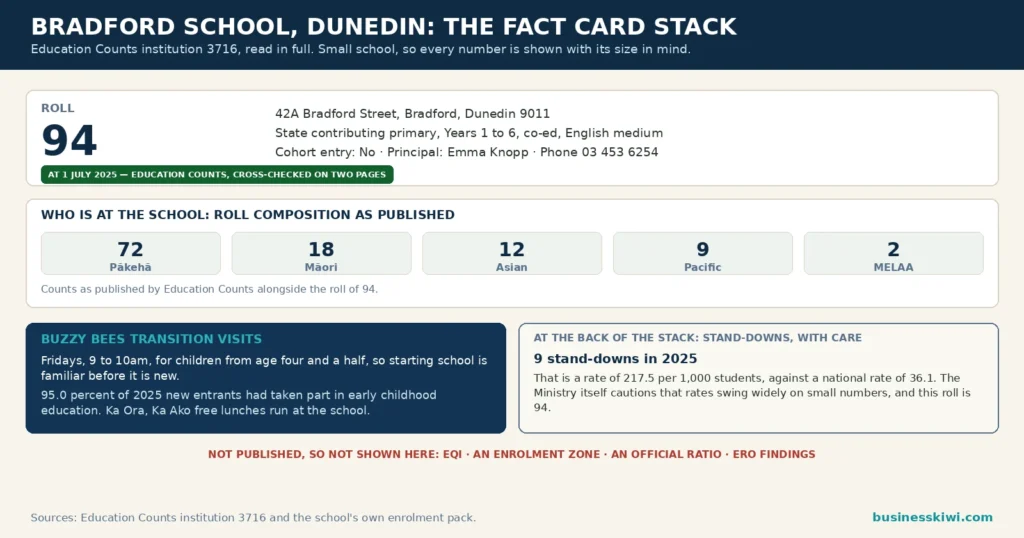
Bradford School at a glance
One figure is missing from that table because no source read for this profile publishes it: the school’s Equity Index (EQI) rating. The Education Counts profile read in full does not state an EQI for Bradford School, and neither does the school’s own material, so it is not guessed at here. The older decile figures that still circulate on some websites date from a funding system the Ministry has replaced, and they are not used in this profile either.
A semi-rural pocket inside the city
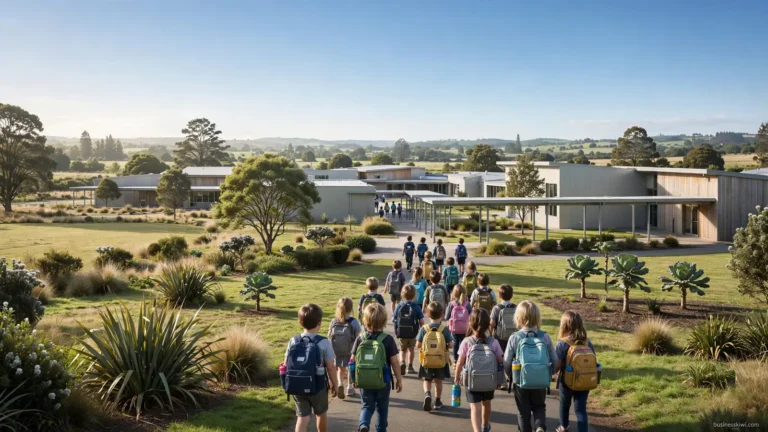
Location shapes Bradford more than most city schools. The school sits at the end of Bradford Street in the Kaikorai Valley, on what its enrolment pack describes as large, peaceful, semi-rural grounds in a quiet cul-de-sac. Children learn within sight of vegetable gardens and an orchard, and the site has the roomy feel of a country school while sitting only a few minutes’ drive from central Dunedin.
That setting is not just scenery. The school leans on its environment hard in its teaching, with enviro groups, gardens and outdoor learning woven into the programme, and space to play is one of the features its own students mention. Children quoted in the enrolment pack describe the school as fun, friendly, spacious and green, with caring kids and people who respect each other. Student voice in a school’s own brochure should always be read as the school’s best foot forward, but it does tell you what Bradford thinks it is selling: room, calm, and a community small enough for everyone to be known.
The suburb itself is one of Dunedin’s older valley communities, and Bradford is its local primary school. Kaikorai Valley College, the local secondary school, is just up the road, and Bradford children are within the same valley community as several kindergartens and early childhood services whose graduates feed into the school.
The values that run the school
Bradford’s culture is organised around three stated values: We Care, We Grow, and He Waka Eke Noa, which the school translates in context as “we are in this together”. The first two are unpacked in the enrolment pack as caring for ourselves, others and our environment, and growing ourselves, others and our environment. The third frames the whole enterprise as a shared waka: staff, children and whānau travelling in the same boat.
These are not left on a poster in the foyer. The school holds a Values Assembly every week, where one aspect of the values is taken up and encouraged across classroom learning, playground behaviour and day-to-day interactions. The pack describes a warm, whānau-based culture, and its parent community survey comments point the same way: families praised children being encouraged to organise and run things themselves, smaller class numbers allowing more specialised teaching, and what one parent called a great whānau atmosphere with genuine parental and community inclusion.
Bradford also publishes a statement on giving effect to Te Tiriti o Waitangi, setting out how the board works to ensure Māori students achieve success as Māori, with tikanga Māori and te reo Māori reflected in school planning and programmes. Kapa haka and tikanga Māori feature in the school’s listed programme offerings, alongside guitar, sport and interest programmes.

Learning at Bradford
The school’s curriculum is built on the New Zealand Curriculum’s key competencies (managing self, relating to others, thinking, participating and contributing, and using language, symbols and text), delivered through what the school calls a rich, authentic curriculum shaped around students’ needs and interests, making use of its environment and staff expertise.
Two named programmes anchor the basics. Bradford uses Structured Literacy for reading and writing, and Pr1me Mathematics for maths. Around those sit a long list of extras that is striking for a school of this size: mentoring, a programme the school calls Resilience Wrestling, the Primary Enterprise Programme, digital technology, a school council, gifted and talented groups, education outside the classroom, and the arts. A specialist librarian runs the library, which is more developed than the school’s size might suggest: classes have library skills sessions on Thursdays and Fridays, a team of student librarians opens the library every lunchtime, and parents and caregivers can join as community library members once their child starts transition visits.
Learning support is a stated strength. The enrolment pack says the school provides extensive learning support and extension for children who need it, with a named SENCO (special education needs coordinator) on staff, and describes teaching staff with expertise in designing programmes around individual strengths and needs. The school also talks openly about building a growth mindset, teaching children that learning is challenging and usually takes practice and errors before goals are mastered. Whether that matches your child’s experience is something only a visit will tell you, but the emphasis on knowing each child in depth is consistent across everything the school publishes, and a roll of 94 makes it plausible in a way it might not be at a school five times the size.
Learning regularly leaves the school grounds. The blanket day trip permission in the enrolment pack lists the kinds of outings classes take: science sessions at the museum, social sciences visits, cultural events, sports trips, swimming, and walks in the local neighbourhood. That matters at Bradford because the valley setting is part of the pitch, and the pack’s own summary of the school stresses an individualised learning philosophy based on close, in-depth knowledge of students, a well-balanced curriculum with an inclusive approach, and learning environments with spaces for children to learn in a wide variety of ways. The pack also describes children being encouraged to organise and run things themselves, with leadership programmes and a school council giving older children real responsibilities rather than token ones.
Who goes to Bradford: the roll in detail
Education Counts publishes Bradford’s roll from the 1 July 2025 roll return, and it totals 94 students. By year level, the roll is spread fairly evenly: 14 children in Year 1, 18 in Year 2, 12 in Year 3, 19 in Year 4, 12 in Year 5 and 18 in Year 6. The same return records a single Year 7 student, which is unusual for a contributing school and most likely reflects an individual circumstance rather than a policy of taking older children; the school is constituted for Years 1 to 6 and parents should not read that one figure as an offering.
The ethnic composition, which Education Counts records on a multiple-response basis so the groups add to more than the roll, is: European and Pākehā 72 students, Māori 18, Asian 12, Pacific 9, and MELAA (Middle Eastern, Latin American and African) 2. In plain terms, roughly three quarters of the roll identifies as European or Pākehā, about one in five as Māori, and the remainder is a mix of Asian, Pacific and other backgrounds. It is a less diverse roll than many urban New Zealand primaries, and a more diverse one than the valley’s demographics might lead you to expect.
What Education Counts does not publish for Bradford, at least in the pages read for this profile, is a student-to-teacher ratio. The school’s own enrolment pack claims a low student-teacher ratio and smaller class numbers as features of the school, and whānau comments in the same document echo that, but no official figure is published, so no ratio is stated here. If class size matters to your decision, ask the school directly for current class numbers by year level.
Starting school: Buzzy Bees and the move from early childhood education
Bradford runs a structured transition programme called Buzzy Bees. It runs every Friday from 9am to 10am, and children aged four and a half or older are invited to join the new entrant class and its teacher for class activities, so the faces and places are familiar before the first official day arrives. Families register through the school office, and the school also suggests bringing children up to play in the playground at weekends as a low-key way to build confidence in the new environment.
The official data suggests most Bradford starters arrive with early childhood education behind them. Education Counts records that 95 percent of the school’s 2025 new entrants had attended ECE before starting, 19 of the 20 children in that year’s starting cohort. That was a little below the Otago regional rate of 98.2 percent, and the school’s rate had been 100 percent in both 2023 and 2024. With a starting cohort this small, one or two children swing the percentage a long way, so the three-year pattern matters more than any single year: nearly every child who starts at Bradford has been to kindergarten, preschool or another ECE service first.
Education Counts also records that Bradford does not operate cohort entry, so children start individually around their fifth birthday rather than in grouped intakes at set points in the term.
Enrolment: zone, documents and what it costs
Here is the honest position on zoning: no enrolment scheme or home zone for Bradford School is published in the sources read for this profile. The Education Counts profile lists the school’s details without a zone description, and the school’s own enrolment pack simply invites families to enrol without describing in-zone and out-of-zone categories or a ballot. Small schools with rolls under 100 often have no enrolment scheme because they are not under capacity pressure, but that is an inference, not a published fact. If you live outside the valley, check with the school office before assuming either way, and get the answer in writing if it matters to a house purchase.
The enrolment pack sets out what the school needs when you do enrol. Families complete an enrolment form, a community expectations agreement, digital citizen and cybersafety agreements, a car seat policy form, a blanket day trip permission form, a lunch selection form and dental school information. The school also needs to sight your child’s birth certificate or passport, and their immunisation certificate, usually found in the back of the Plunket or Well Child book.
On cost, Education Counts records Bradford under the line “Donations should not be requested, unless for a school camp”, which is the wording the Ministry uses for schools in its donations scheme. In practical terms that means the school does not ask parents for a general school donation, though camps can still be charged for. Bradford is also part of Ka Ora, Ka Ako, the free lunches in schools programme: the enrolment pack’s lunch form explains that children are provided with lunch each day, with a Subway roll or wrap and fruit on Mondays and Fridays, and a provider called Time for Lunch on the other three days, with halal, vegetarian, gluten free and dairy free options recorded in advance. For families doing the maths on school costs, free lunches plus no donation is a meaningful combination.
Before and after school care is available on site through a service the school calls the Bradford Burrow, with staff listed in the enrolment pack covering before school care and after school care roles.
What the official record shows
A note on ERO, because parents rightly look for it. The school’s Education Counts profile links through to its Education Review Office report, and Bradford’s own enrolment pack says that previous ERO reports highlight the wonderful culture visitors feel at the school from the moment they enter. That quote is the school’s own summary of its reports rather than an ERO finding, and the current ERO report itself could not be read in full during the preparation of this profile, so no ERO grades, judgements or findings are asserted here. If ERO’s view matters to your decision, and it should, read the report directly through the link on the school’s Education Counts profile before you enrol.
Education Counts does publish engagement data for the school, and one figure deserves careful handling. In 2025 the school recorded nine stand-downs, all involving male students, against a roll of around 94. The Ministry’s age-standardised rate for Bradford that year, 217.5 stand-downs per 1,000 students, sits well above the national rate of 36.1, but the Ministry itself warns that care should be taken with age-standardised rates where small numbers are involved, and at a school this size nine incidents, which may involve fewer than nine children, produce a very large rate. Suspensions are a separate and more serious measure; the figure published in searches of the data is not relied on here because the underlying page could not be read in full. The fair reading is that stand-downs at Bradford in 2025 were higher than the school would want, that the raw count behind the headline rate is small, and that it is a reasonable topic to raise with the principal if you visit.
Taken together with a 95 percent ECE participation rate, a settled leadership team and a full set of published policies, the official record is that of a small school with a strong stated culture and a couple of data points worth a conversation, rather than a school with anything hidden in its numbers.
Practical details parents ask about
Term dates for 2026 are published on the school’s website. Term 1 runs from Wednesday 28 January to Thursday 2 April, Term 2 from Monday 20 April to Friday 3 July, Term 3 from Monday 20 July to Friday 25 September, and Term 4 from Monday 12 October to Friday 11 December.
The leadership team named in the school’s enrolment pack is Emma Knopp as principal, Liz Tobin as deputy principal, and Sonja Reid as office manager. The teaching staff list includes a SENCO, learning assistants, and the new entrant teacher who runs the Buzzy Bees sessions. Education Counts independently lists Emma Knopp as principal, so the leadership name is consistent across the official directory and the school’s own documents.
Day trips are covered by a blanket permission signed at enrolment, with caregivers told about trips by email or newsletter, and separate permission sought for anything overnight. Families also sign a community code of conduct at enrolment, committing to speak respectfully, raise concerns directly with the class teacher, and help out with trips, events, working bees or fundraisers where they can. It is a small but telling detail: Bradford expects parents to be participants, not just customers.
Two practical systems are worth knowing about before your child starts. The library is a genuine community asset rather than a classroom bookshelf: parents can join as community library members from the time their child begins Buzzy Bees visits, student librarians keep it open every lunchtime, and classes borrow on Thursdays and Fridays. And the free lunch programme needs a small amount of paperwork upfront, because the school records each child’s dietary requirements (halal, vegetarian, gluten free, dairy free, or allergies) and even their Subway preferences, so the food provided on each day of the week actually gets eaten.
Enrolling at Bradford School: your next steps
If Bradford sounds like a fit, the practical sequence is simple. Start with a look at the school’s website and a call to the office on 03 453 6254, or email office@bradford.school.nz, to arrange a visit. If your child is four and a half or older, ask about registering for the Friday Buzzy Bees transition sessions at the same time. Collect the documents the school needs to sight, a birth certificate or passport and the immunisation record, and work through the enrolment pack forms. If you live outside the Kaikorai Valley, ask the zoning question directly and early, since no enrolment scheme is published in the sources this profile is based on. And before you finally commit, read the school’s current ERO report via its Education Counts profile, and ask about current class sizes at your child’s year level, since no official ratio is published.
Frequently asked questions
Where is Bradford School?
Bradford School is at 42A Bradford Street in the suburb of Bradford, in Dunedin’s Kaikorai Valley. Its Ministry of Education institution number is 3716, and the school office can be reached on 03 453 6254.
What year levels does Bradford School teach?
It is a state contributing primary school for Years 1 to 6, co-educational, with English as the language of instruction. Children move on to intermediate or secondary schooling after Year 6, with Kaikorai Valley College the local option further up the valley.
How many students go to Bradford School?
The roll was 94 students at the 1 July 2025 roll return published by Education Counts, spread fairly evenly across the six year levels. Rolls at small schools move around from year to year, so treat that as a snapshot rather than a fixed size.
Who is the principal of Bradford School?
Emma Knopp. She is named as principal in the Ministry of Education’s Education Counts directory and in the school’s own enrolment pack, and the deputy principal named in the pack is Liz Tobin.
Does Bradford School have an enrolment zone?
No enrolment scheme or home zone is published in the Education Counts profile or the school’s enrolment pack read for this profile. That often means a small school is not under enrolment pressure, but it is not stated outright, so confirm the position with the school office if you live outside the local area.
Does Bradford School ask for a donation?
Education Counts records the school with the line “Donations should not be requested, unless for a school camp”, the wording used for schools in the Ministry’s donations scheme. Bradford also provides free lunches through the Ka Ora, Ka Ako programme, so day-to-day schooling costs are low by design.
What is Bradford School’s EQI?
No Equity Index rating for Bradford School is published in the Education Counts profile or school material read for this profile, so this article does not state one. Older websites still show a decile figure, but decile was a different measure that the Ministry has replaced, and the figures in circulation for this school conflict with each other.
How do I enrol my child at Bradford School?
Contact the school office on 03 453 6254 or at office@bradford.school.nz and ask for the enrolment pack. You will need to complete the enrolment forms and let the school sight your child’s birth certificate or passport and immunisation certificate. For children aged four and a half and up, you can also register for Buzzy Bees, the Friday morning transition programme, before they start.
Sources
- Ministry of Education, Education Counts, Bradford School: Profile and Contact Details: https://www.educationcounts.govt.nz/find-school/school/profile?district®ion&school=3716
- Ministry of Education, Education Counts, Bradford School: Student Population (Age): https://www.educationcounts.govt.nz/find-school/school/population/age?district=71®ion=14&school=3716
- Ministry of Education, Education Counts, Bradford School: Student Population (Year Level): https://www.educationcounts.govt.nz/find-school/school/population/year?district®ion&school=3716
- Ministry of Education, Education Counts, Bradford School: Early Childhood Education: https://www.educationcounts.govt.nz/find-school/school/early-childhood-education?district=®ion=&school=3716
- Ministry of Education, Education Counts, Bradford School: Student Engagement (Stand-downs): https://www.educationcounts.govt.nz/find-school/school/student-engagement/stand-downs?district®ion&school=3716
- Bradford School, Home page: https://bradford.school.nz/
- Bradford School, Library page: https://bradford.school.nz/library/
- Bradford School, Bradford Enrolment Pack 2024 (PDF, school’s own website): https://bradford.school.nz/wp-content/uploads/sites/147/2024/06/Bradford-Enrolment-pack-2024_compressed.pdf
- Bradford School, Statement on Giving Effect to Te Tiriti o Waitangi (PDF, school’s own website): https://bradford.school.nz/wp-content/uploads/sites/147/2024/10/Statement-on-giving-effect-to-Te-Tiriti-o-Waitangi.pdf
This article is general information about Bradford School, drawn from the official sources listed above at the time of writing. School rolls, staffing, programmes and policies change over time, and details such as enrolment arrangements and term dates should be confirmed directly with the school before you make decisions for your child.