Driller’s Offsider Jobs in NZ: The Work, How to Get In and What It Pays
The short answer
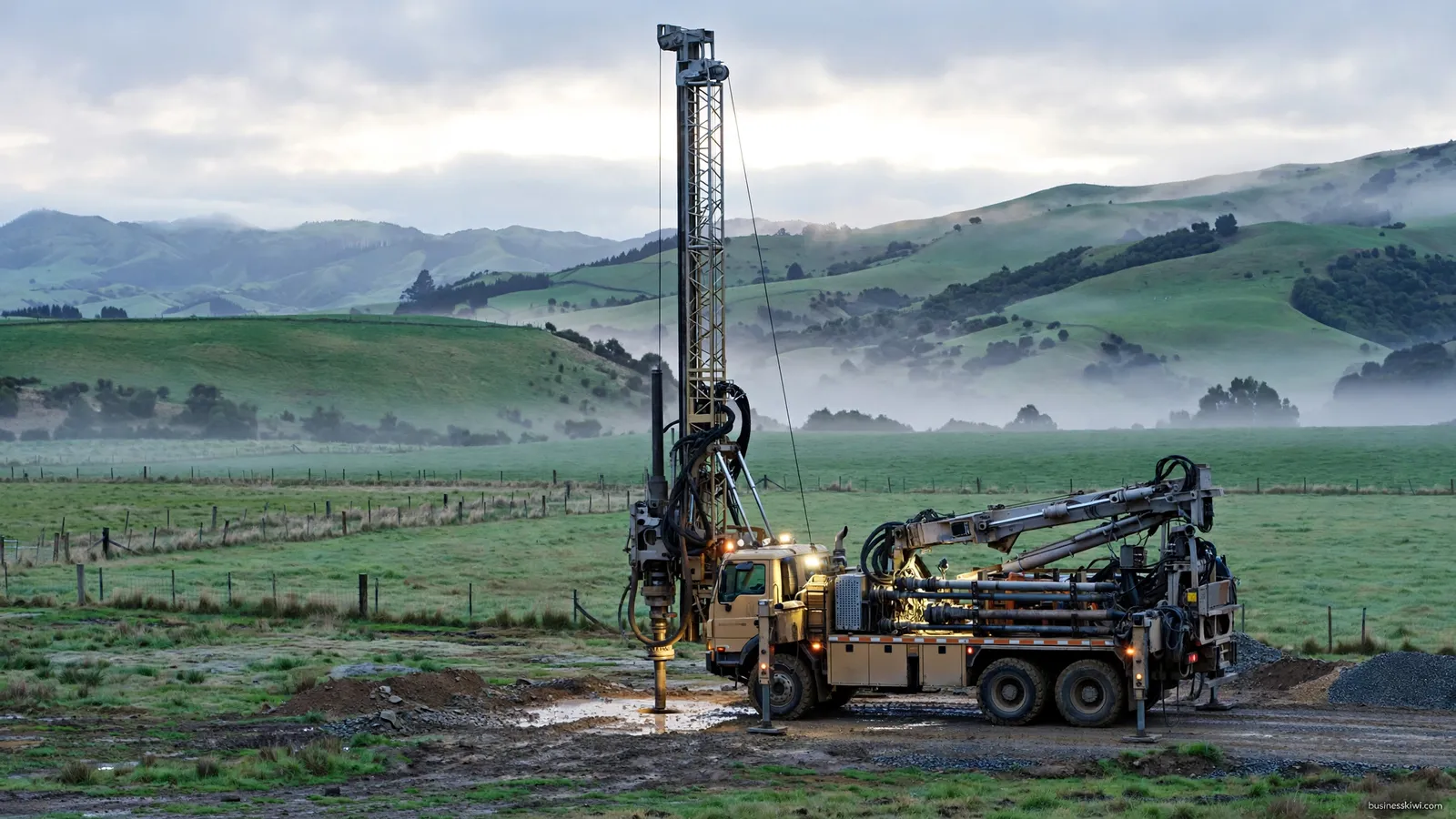
A driller’s offsider is the entry-level crew member on a drilling rig. Tahatū, the official careers site run by the Tertiary Education Commission, lists “offsider” as another name for an assistant driller, alongside labourer, rig assistant, derrick hand, roughneck and roustabout. You do not need a qualification to start. Tahatū says assistant drillers usually learn on the job, but you must hold a driver licence and be able to pass a drug test. Pay for the occupation is most commonly $60,000 to $97,000 a year before tax. The recognised training step once you are employed is the New Zealand Certificate in Drilling (Level 3), completed at work through MITO.
| Fact | Detail |
|---|---|
| Role names | Assistant driller, offsider, rig assistant, derrick hand, roughneck, roustabout |
| Most common pay | $60,000–$97,000 a year (before tax) |
| Median pay | $76,000 a year (before tax) |
| Training time | 0 to 1 year, learned on the job |
| People in the role | About 170 (Tahatū), with numbers increasing |
| First qualification | New Zealand Certificate in Drilling (Level 3), 70 credits |
| Must have | A driver licence, and be able to pass a drug test |
What a driller’s offsider does
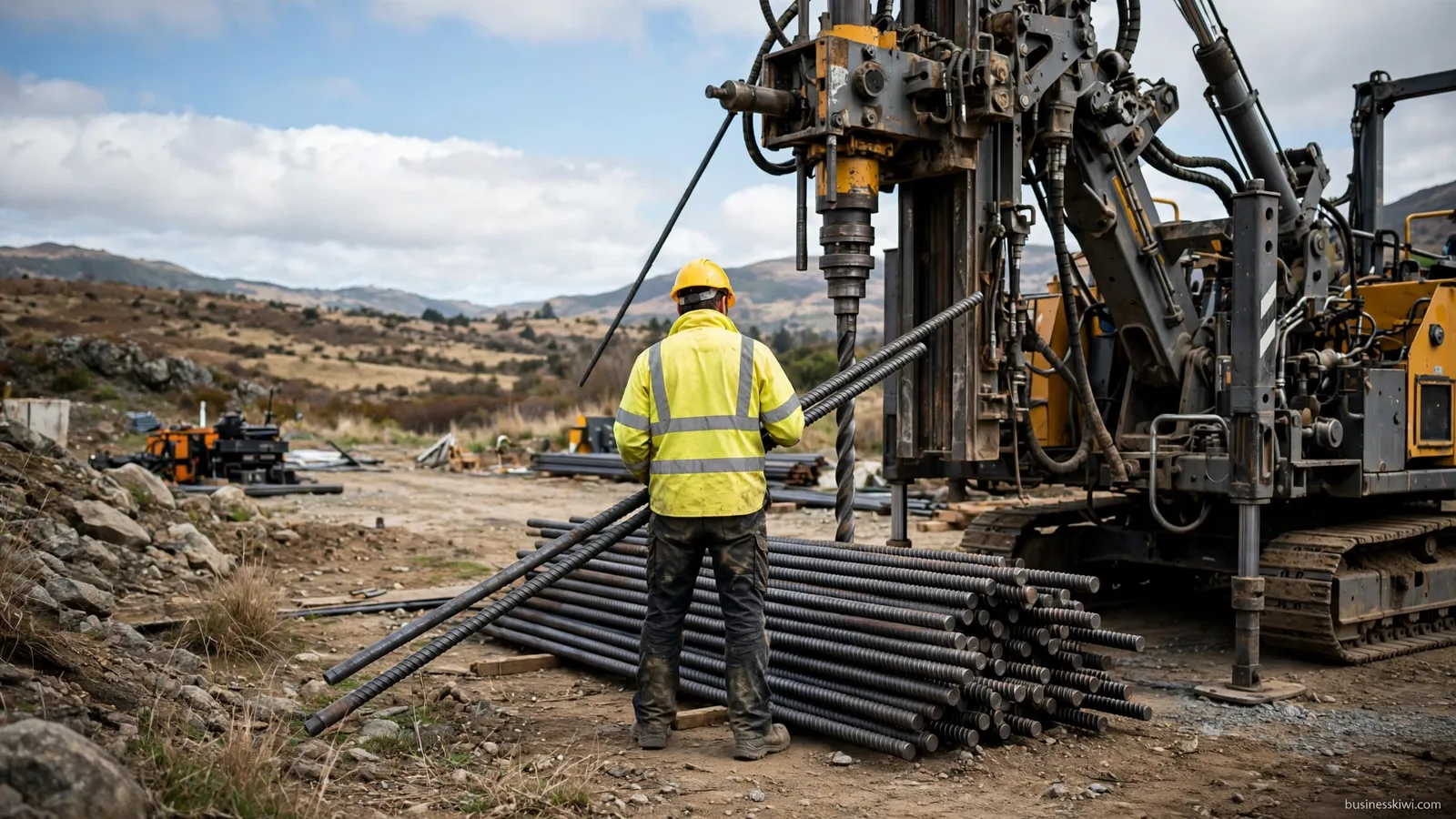
The offsider supports the driller. The driller runs the rig; the offsider keeps the gear, materials and site work flowing so drilling does not stop. Tahatū describes assistant drillers as helping mining or drilling workers with basic tasks: unloading and loading materials, supplying equipment or machine parts, and removing debris after extraction.
The handling work is a big part of the day. Offsiders load and unload drilling materials, choose the materials needed for drilling jobs, and guide machinery into the correct position on site. They help move equipment safely around the drilling site, and they drive trucks and drilling vehicles as part of the crew’s work.
Offsiders also work directly alongside the drilling. They use basic drilling and mining equipment, help the driller with the tasks that keep the hole progressing, and collect rock and soil samples for the crew and the client. Watching the work for safety is part of the role, not an extra: Tahatū lists monitoring drilling work for safety as one of the occupation’s core activities.
Housekeeping matters more than newcomers expect. Offsiders maintain drilling equipment and tools, and they clean drilling sites and equipment. On a rig, a clean and orderly site is a safety control in its own right, and the offsider is usually the person who keeps it that way.
All of this happens under supervision. NZQA’s description of the Level 3 drilling certificate, the qualification written for this role, says graduates work as an assistant driller under direct supervision, familiar with drilling equipment and tools on a drilling site. As your skills grow, the supervision loosens, but an offsider is never the person in charge of the rig.
Where the work is
Drilling happens in several industries, and the offsider role exists in all of them. Tahatū’s profile for drillers lists the job titles used across the industry: non-hydrocarbon driller, hydrocarbon driller, bore driller, raise drill operator, exploration driller and geotech driller. Each title points at a different setting for the same basic work.
Non-hydrocarbon drilling is the largest part of the local industry. It covers water well and bore drilling for farms, towns and industry, geotechnical drilling that tests ground conditions for construction, environmental drilling, and exploration drilling that samples for minerals. MITO runs a dedicated training programme for this sector, the New Zealand Certificate in Non-Hydrocarbon Drilling.
Hydrocarbon drilling is the oil and gas side of the industry. The work uses the same crew structure, with an offsider supporting the driller, but the sites and safety systems reflect the material being drilled for.
Mines and quarries use drill rigs too. WorkSafe notes that drill rigs are commonly used in construction, mining and quarrying applications for drilling blast holes, the holes that are later charged with explosives to break rock. Offsiders on those crews do the same materials, equipment and site work as on any other rig.
Wherever the rig is, the worksite moves. Tahatū says assistant drillers usually work in different places and may travel nationally to worksites. Crews follow the work around the country, so the job suits people who are comfortable being away from home base rather than reporting to the same yard every day.
It is a small occupation. Tahatū counts about 170 assistant drillers employed in New Zealand, and records employment in the role as increasing. Small numbers mean openings come up in ones and twos with individual drilling companies rather than through large intakes.
How to get in
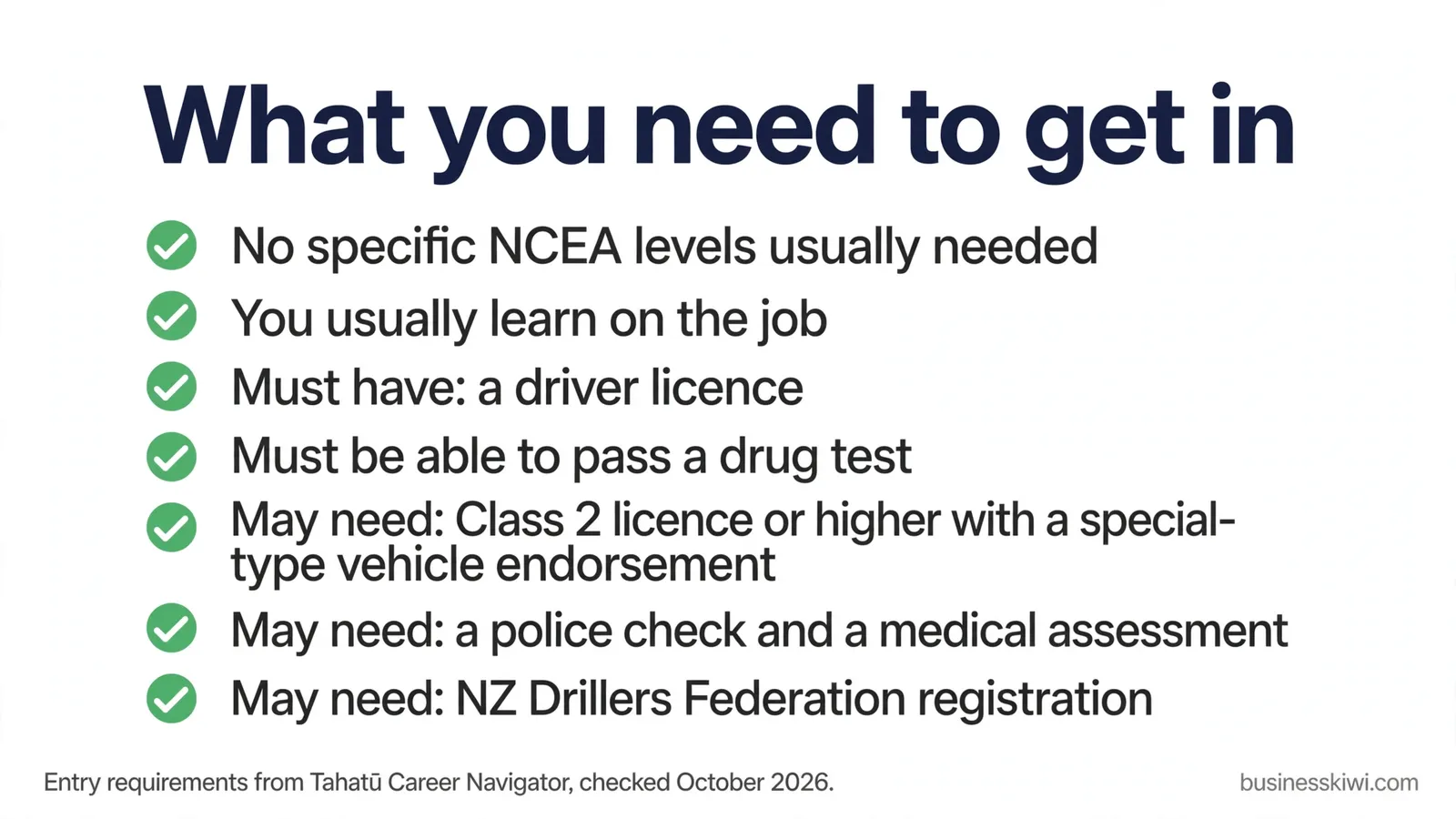
The normal way in is to be hired first and trained second. Tahatū says you usually learn on the job to become an assistant driller, and you usually do not need specific NCEA levels for the job. School results are not the gate for this work.
Two requirements are firm. Tahatū lists a driver licence as a must-have, and you must be able to pass a drug test. Drilling sites are safety-critical workplaces, and drug testing is a standard part of hiring and ongoing site access.
Beyond that, Tahatū lists things you may need, depending on the employer and the site. Experience in similar work helps. Some roles need a Class 2 driver licence or higher with a special-type vehicle endorsement, because the crew’s trucks and rig carriers are heavier than a car licence covers. You may need to pass a police check and a medical assessment. Tahatū also lists registration with the New Zealand Drillers Federation as something some offsiders need.
Employers also screen for the person, not just the paperwork. Tahatū’s description of life in the job says the work is physically demanding, and that assistant drillers need to be safety conscious, able to identify and solve problems, and able to work well in a team. A background of physical work, and a record of turning up reliably, speaks directly to those points.
Once you are employed in the industry, formal training becomes available to you. MITO’s drilling programmes require you to be employed in the extractives industry, with an employer who can support your training, and to have the legal right to live and work in New Zealand. That is why the sequence is job first, certificate second.
Training and qualifications
The qualification written for this role is the New Zealand Certificate in Drilling (Level 3). NZQA’s register lists it at Level 3 with 70 credits, reference 2621, current, with MITO Limited as the education organisation. Its stated purpose is to provide all sectors of the drilling industry with people who can work safely within a drilling environment as an assistant driller.
The graduate profile shows what the certificate covers. Graduates can comply with health, safety and environmental requirements and take part in risk assessment to work safely in a drilling workplace. They can apply knowledge of drilling systems and processes to assist with drilling activities, communicate effectively in a drilling environment, and assist in safely moving equipment about the drilling site.
Training is work-based. MITO’s non-hydrocarbon drilling programme, which offers the Level 3 and Level 4 certificates for that sector, combines workplace practical learning with eLearning, so theory can be completed in your own time and at your own pace, with progress visible to you and your supervisor through MITO’s online portal. MITO’s published annual training fee for that programme is $489, excluding GST, and the fee is non-refundable.
Tahatū puts the training time for an assistant driller at 0 to 1 year. In practice, most of that learning is simply doing the job with an experienced crew, with the certificate giving structure and recognition to what you have learned.
The Level 3 certificate is described by NZQA as the first step in the New Zealand drilling qualification pathway. It leads to the Level 4 certificate covered in the progression section below, so the offsider who wants a career in drilling has a recognised ladder to climb rather than a dead end.
Pay
Tahatū publishes pay for the assistant driller occupation, and its figures are for the occupation itself, not borrowed from another role. The most common pay range is $60,000 to $97,000 a year, before tax. The lower figure Tahatū records is $50,000 a year, the upper figure is $164,000 a year, and the median is $76,000 a year.
The wide spread is worth understanding. New offsiders start at the lower end while they learn the work. Pay rises with experience, with the licences and endorsements you hold, and with the roster you work, because Tahatū notes that assistant drillers usually work long hours in shifts and may be on call. The upper figure sits far above the most common range, so treat it as the top of what the occupation can reach rather than a typical outcome.
Demand context is modest but positive. Tahatū records about 170 people employed as assistant drillers and employment change in the role as increasing. There is no official vacancy count for offsiders, and this guide does not invent one. The honest summary is a small occupation with steady openings as crews replace and grow staff.
For comparison within this guide, the driller role above the offsider pays more, and those figures are set out in the progression section below. No job advertisements have been used for any pay figure in this article.
Working conditions and safety
Tahatū’s summary of life in the job is blunt. Assistant drillers usually work long hours in shifts and may be on call. They work in different places and may travel nationally to worksites. They may work in all weather, in hazardous, noisy and dirty conditions, and the work may be physically demanding.
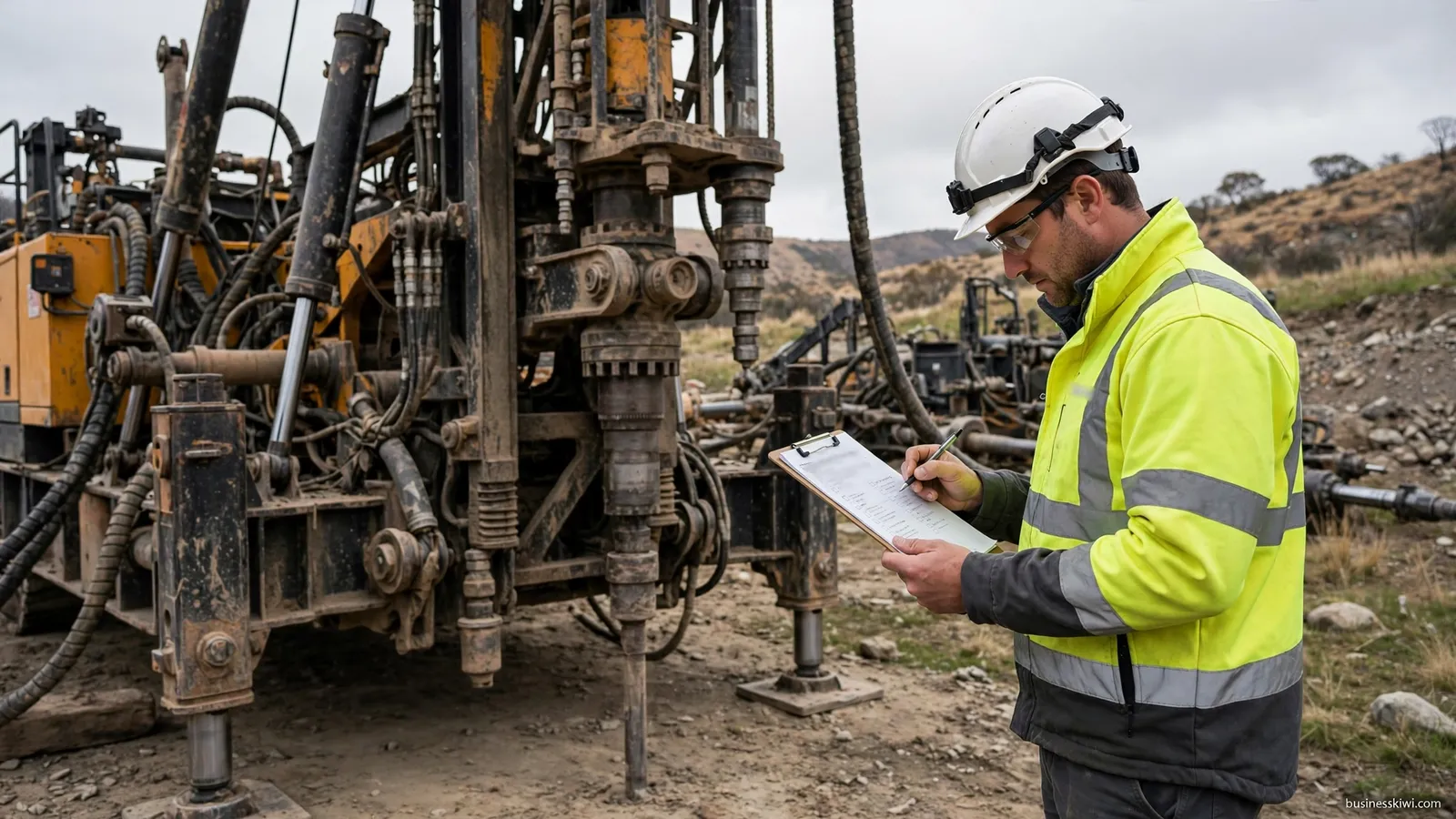
Drilling rigs demand respect. WorkSafe’s technical bulletin on drill rigs describes them as large, heavy and generally slow-moving units that are complex machines, whose operation requires a high level of knowledge and skill. WorkSafe says the safe use of a rig depends heavily on competent operators and a high standard of maintenance. Only authorised and competent operators should operate and move drill rigs, which is why an offsider works under the driller’s direction rather than running the rig.
The risks WorkSafe lists explain the safety culture you will meet on site. They include permanent hearing loss from poor noise management, dust and other airborne contaminants that can cause long-term health effects, loose clothing or uncovered long hair catching in rotating or moving machinery, musculoskeletal injuries from manual handling of heavy equipment, rigs tipping on uneven or unstable ground, contact with overhead powerlines, and moving a rig with its mast raised, which can cause crushing injuries or death if fatigued mast components fail.
The controls are part of everyday crew work, and offsiders help carry them out. WorkSafe’s controls include thorough pre-start checks before a rig is used, risk assessment of the operating area before drilling starts, demarcation barriers that keep other traffic and pedestrians out of the rig’s operating zone, guarding on rotating and moving parts, fit-for-purpose tools and a safe procedure for removing and fitting drill strings, and lowering the mast to a horizontal position before the rig is moved.
For an offsider, the practical meaning is simple. You will do pre-start checks, keep the operating zone tidy and clear, wear the hearing protection and other protective equipment provided, keep clothing and hair away from rotating parts, and speak up when something looks wrong. Monitoring the work for safety is one of the occupation’s listed tasks, and crews expect it from day one.
Where it leads
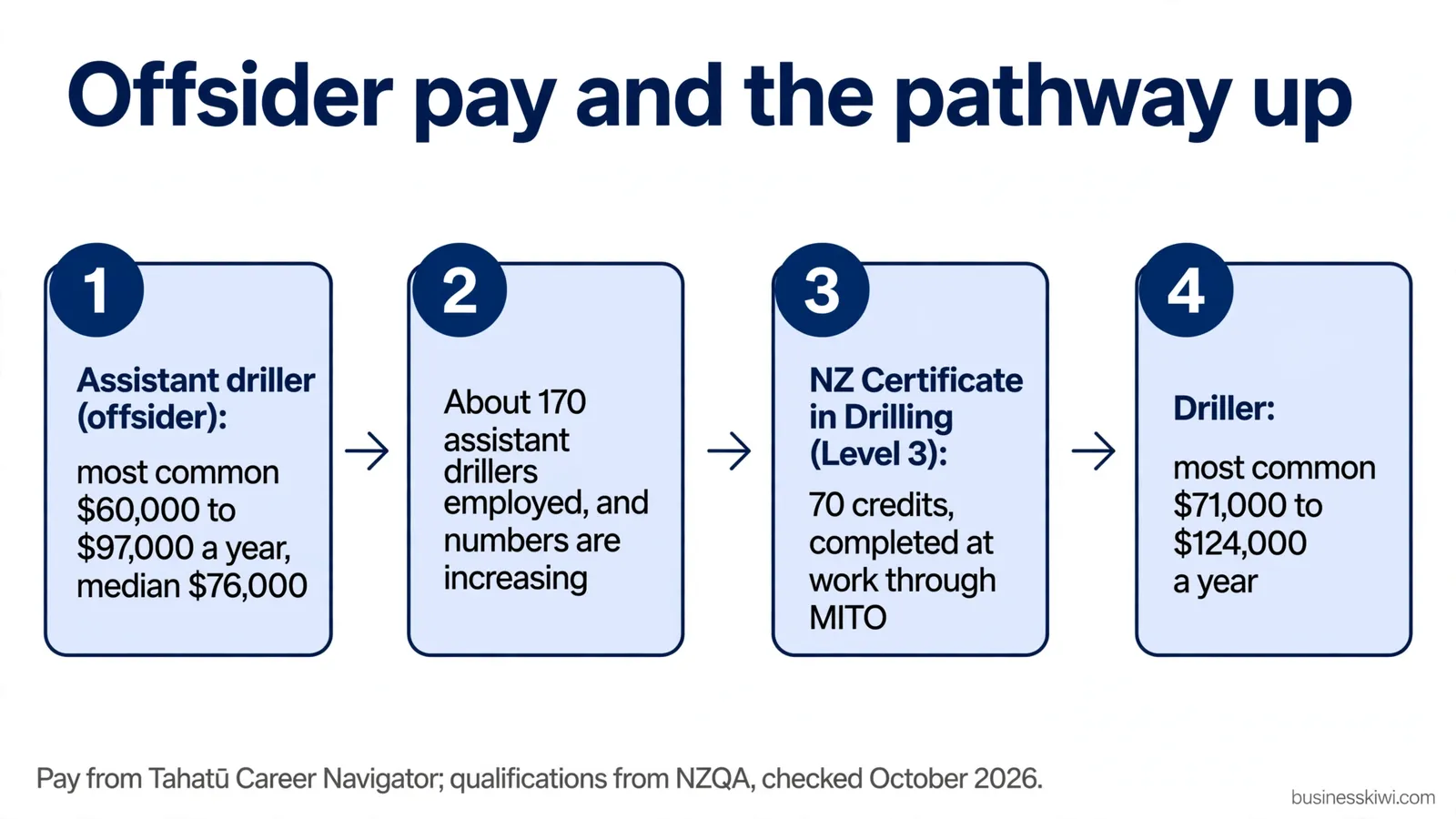
The clear next step is driller. Drillers assemble and operate drilling rigs and related equipment to test for and extract minerals, liquids and gases in the earth. Their work includes operating pumps and air compressors, measuring drilling areas and worksites, moving heavy equipment using cranes, repairing drilling equipment parts, recording drilling activity and following health and safety rules.
Tahatū puts drillers’ most common pay at $71,000 to $124,000 a year before tax, with a lower figure of $57,000 and an upper figure of $177,000. It counts about 430 drillers in New Zealand. Entry is through experience and training: Tahatū says you usually need experience and training to become a driller, a qualification may be useful, and a driver licence is a must. Its list of things drillers may need includes a First Aid Certificate, alongside the same Class 2 licence, police check and medical items that appear at offsider level.
The qualification ladder matches the job ladder. The New Zealand Certificate in Drilling (Level 4), 135 credits on NZQA’s register, builds on the Level 3 certificate and prepares people to work as a driller under broad guidance. Its graduate profile adds the responsibilities that separate a driller from an offsider: coordinating and applying emergency response, selecting drilling methods for the environment, operating and monitoring drilling systems and responding to down-hole problems, interpreting client and contract specifications, mentoring and providing on-job training to the drill crew, and leading reporting on drilling operations. NZQA records that the Level 4 certificate may lead on to a Level 5 certificate in drilling for those who progress further.
In other words, the offsider role is the recognised ground floor of a trade with a defined pathway: offsider, then driller, then the senior and supervisory levels above that. The experience you log in the junior role is exactly what the senior roles ask for.
Related guides: our clinical coder jobs guide covers another entry-level occupation in demand, our guide to how to put references on a resume helps with a first application, and our bookkeeping course guide shows another job-first, train-at-work pathway. For more careers and training guides, browse the Jobs & Education section.
Frequently asked questions
What does a driller’s offsider actually do all day?
You support the driller and keep the rig working. The core tasks listed by Tahatū are helping drillers with their tasks, loading and unloading drilling materials, choosing materials for drilling jobs, guiding machinery into position, driving trucks and drilling vehicles, using basic drilling and mining equipment, collecting rock and soil samples, monitoring the work for safety, and maintaining and cleaning equipment and the site.
Do I need a qualification to become a driller’s offsider?
No. Tahatū says assistant drillers usually learn on the job and usually need no specific NCEA levels. The New Zealand Certificate in Drilling (Level 3) is the qualification written for the role, but it is completed once you are employed in the industry, through work-based training with MITO, rather than before you start.
What licences and checks do I need?
A driver licence is a must, and you must be able to pass a drug test. Depending on the employer, you may also need a Class 2 driver licence or higher with a special-type vehicle endorsement, a police check, a medical assessment, experience in similar work, or registration with the New Zealand Drillers Federation. Employers confirm their own requirements when you apply.
How much does a driller’s offsider earn in NZ?
Tahatū puts the most common pay for assistant drillers at $60,000 to $97,000 a year before tax, with a median of $76,000. Its recorded range runs from $50,000 at the lower end to $164,000 at the upper end. New starters sit at the lower end, and pay builds with experience, endorsements and rosters.
Is offsider work dangerous?
It is physical work around heavy machinery, and it has to be treated seriously. WorkSafe lists risks such as hearing damage from noise, dust, rotating machinery, heavy manual handling and rigs tipping or striking powerlines. Sites manage these with pre-start checks, risk assessments, barriers, guarding and protective equipment, and only authorised, competent operators run the rig. Your part is to follow the procedures, use the protective equipment and raise anything that looks unsafe.
How do I get my first offsider job?
Get hired by a drilling crew, then train on the job. That order matters, because MITO’s drilling programmes require you to already be employed in the extractives industry. Employers look for a driver licence, the ability to pass a drug test, physical fitness for demanding work, and a safety-conscious team attitude. Experience in similar physical work helps, even without drilling experience.
Can an offsider become a driller?
Yes, and the pathway is formal. The Level 3 certificate is the first step in NZQA’s drilling qualification pathway, and it leads to the New Zealand Certificate in Drilling (Level 4), which prepares you to work as a driller under broad guidance. Tahatū puts drillers’ most common pay at $71,000 to $124,000 a year, and says drillers get there through experience and training.
The bottom line
A driller’s offsider job is a genuine entry point into a skilled trade: no qualification needed to start, a driver licence and a clean drug test essential, and real training available once you are on a crew. The pay, most commonly $60,000 to $97,000 a year on Tahatū’s figures, reflects work that is physical, mobile and safety-critical. If you are comfortable outdoors, in a team, and away from home when the work requires it, the offsider role leads somewhere: the Level 3 certificate, then Level 4, then the driller’s seat itself.
Sources
-
Tahatū Career Navigator (Tertiary Education Commission), Assistant driller occupation profile (pay, tasks, entry requirements, employment numbers). https://tahatu.govt.nz/work/explore-career-ideas/occupation/T00796-assistant-driller
-
Tahatū Career Navigator (Tertiary Education Commission), Driller occupation profile (pay, tasks, entry requirements). https://tahatu.govt.nz/work/explore-career-ideas/occupation/T00788-driller
-
NZQA, New Zealand Certificate in Drilling (Level 3) [Ref: 2621], qualification overview (level, 70 credits, purpose, graduate profile, pathway). https://www.nzqa.govt.nz/nzqf/search/addToShortList.do?selectedItemKey=2621
-
NZQA, New Zealand Certificate in Drilling (Level 4) [Ref: 2622], qualification overview (level, 135 credits, purpose, graduate profile, pathway to Level 5). https://www.nzqa.govt.nz/nzqf/search/addToShortList.do?selectedItemKey=2622
-
MITO, New Zealand Certificate in Non-Hydrocarbon Drilling (programme outline, eligibility, training fee). https://www.mito.org.nz/get-qualified/our-industries/drilling-mining-and-quarrying/drilling/
-
WorkSafe New Zealand, Drill rigs, technical bulletin (rig types, risks and controls). https://www.worksafe.govt.nz/about-us/news-and-media/drill-rigs/
This article is general information about working as a driller’s offsider in New Zealand. It is not careers or employment advice for your individual situation. Pay ranges, entry requirements, training fees and qualification details change over time, so check the current information on Tahatū, NZQA and MITO, and confirm requirements with the employer, before you rely on them.