Bachelor of Nursing NZ: Entry Requirements, Study Path and Registration

The short answer: a Bachelor of Nursing is a three year degree at Level 7 of the New Zealand qualifications framework, taught only by providers the Nursing Council of New Zealand has accredited. Finishing the degree is not the last step. You also pass a state final examination set by the Council, register as a registered nurse, and hold a current annual practising certificate before you can work as a nurse.
If you are weighing up nursing as a career, the degree is the front door. Almost every registered nurse working in New Zealand hospitals, clinics and communities started with this qualification, or with its close relative, the graduate entry master’s degree. This guide walks through what the degree involves, who can apply, what it costs, and what happens between your first lecture and your first shift as a registered nurse.
Who sets the rules for nursing degrees
Nursing is a regulated profession, and the regulator is the Nursing Council of New Zealand. The Council prescribes the qualifications nurses must hold, sets the education standards programmes must meet, and accredits the institutions allowed to teach them. A degree that is not Council accredited does not lead to registration, no matter how good the teaching is. That is the first check to make with any provider.
The Council works with three scopes of practice. A registered nurse has the broadest general scope. An enrolled nurse works under the direction of a registered nurse or another registered health professional. A nurse practitioner is an expert clinician with an accredited master’s degree and an expanded scope. The Bachelor of Nursing leads to the registered nurse scope.
Registered nurses assess health needs, provide care, and support people to manage their own health. They work independently and alongside doctors, midwives and other health professionals. They can also delegate work to enrolled nurses and healthcare assistants and direct the care those staff give. Settings range from hospital wards and emergency departments to GP clinics, schools, aged care homes and patients’ own homes.
The three pathways into nursing compared
Most school leavers take the bachelor’s degree. It is not the only door. If you already hold a degree in another subject, a two year graduate entry master’s degree leads to the same registered nurse scope. If you want a shorter qualification, the Diploma in Enrolled Nursing takes 18 months and leads to the enrolled nurse scope.
Two rules apply across the degree routes. The bachelor degree must be completed within six years of enrolment, and the graduate entry master’s within four years. Those limits matter if you plan to study part time or take a break partway through.
Some providers also offer Bachelor of Nursing programmes with a Māori or Pacific focus, which weave tikanga, kaupapa and cultural practice through the same Council competencies. Graduates sit the same state examination and register in the same scope.
Entry requirements
Entry requirements are set by each provider, and the detail varies. The common pattern looks like this.
University Entrance is the baseline. Most providers expect University Entrance, gained through NCEA Level 3, Cambridge, the IB or an approved foundation programme. Mature applicants without UE can often apply under special or discretionary admission, and providers assess work and life experience as part of that process.
School subjects matter. Providers generally look for a solid block of credits in English, mathematics and a science. Biology is the most useful science, with chemistry close behind. If you are still at school and nursing is the goal, choose your Level 2 and Level 3 subjects with those three areas in mind.
Places can be limited. Nursing intakes are capped by the number of clinical placements available, not just by classroom seats. Popular providers fill their intakes, and some run waitlists. Applying early in the cycle is a genuine advantage.
Extra checks come with the application. Because students work with patients from early in the degree, providers require health and immunisation declarations and safety checking, which includes police vetting. You will also need to show you can meet the English language standard for nursing study. None of this is unusual for a health degree, but it does mean the paperwork takes longer than a standard arts or business application.
If you do not meet the academic entry level yet, most providers run foundation or bridging certificates in health science. A semester or two of bridging study is a common route in for career changers and for school leavers whose subject mix does not line up.
What you study across the three years
Every accredited programme must cover the Council’s competencies, so the shape of the degree is similar wherever you study it. The exact paper names and order differ by provider.
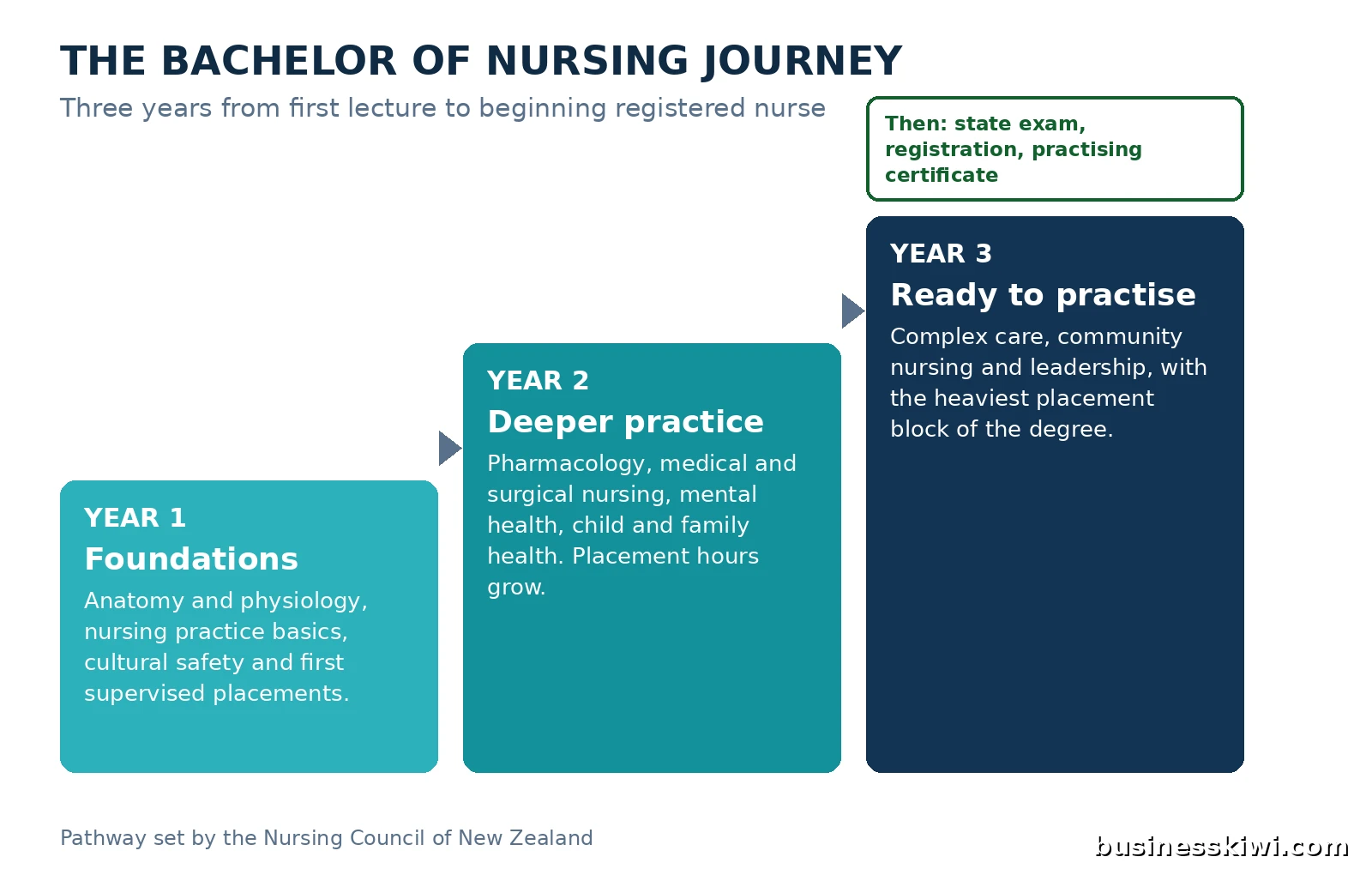
Year one builds the foundations. Expect human anatomy and physiology, an introduction to nursing practice and professional communication, the social and cultural context of health in New Zealand, and your first supervised clinical experiences. Te Tiriti o Waitangi and culturally safe practice are not add-ons. They run through the degree from the start, because the Council’s competence standards require them.
Year two goes deeper into practice. Students study pharmacology, which is the safe use of medicines, along with medical and surgical nursing, mental health and addictions, and child and family health. Placement hours grow, and the settings widen beyond the general hospital ward.
Year three prepares you to practise. The focus shifts to complex care, community and primary health nursing, leadership and managing a caseload. The final semester carries the heaviest placement block of the degree, working close to full shifts under supervision. By graduation you are expected to practise at the level of a beginning registered nurse, and the state examination tests exactly that.
Assessment is a mix of written assignments, examinations, practical skills assessments in simulation labs, and graded performance on placement. Nursing students often notice the degree feels more structured than other degrees. Attendance on placement is compulsory, rosters can include early starts, and professional conduct standards apply while you are a student, not just after you graduate.
Clinical placements: at least 1,000 hours of real practice
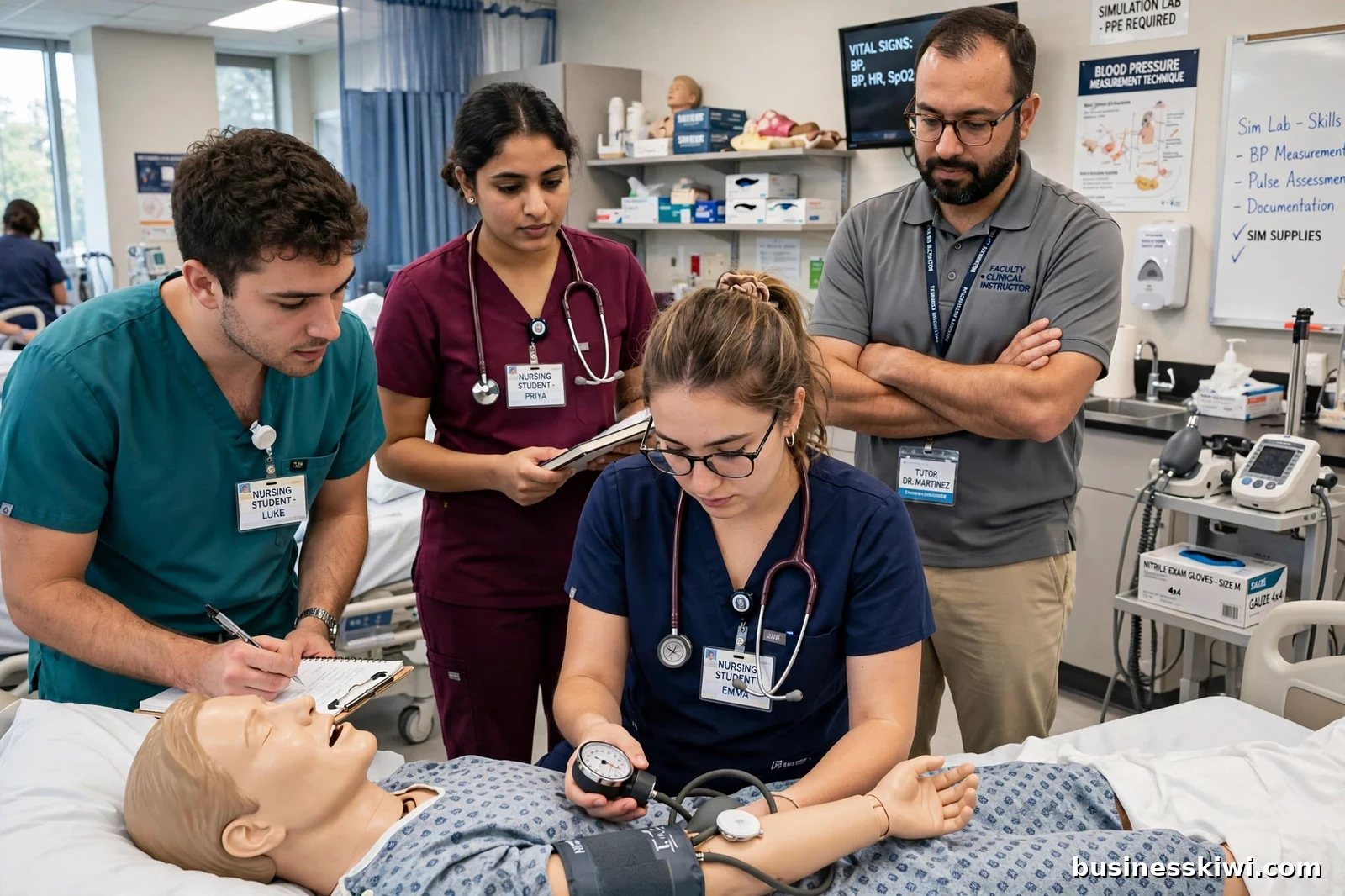
The degree is deliberately hands-on. Under the Nursing Council’s current education standards, a registered nurse programme must include at least 1,000 hours of clinical practice. The long-standing minimum was 1,100 hours, and many programmes still run above the floor. Enrolled nurse programmes have a lower minimum of 700 hours under the same updated standards.
One rule has not changed. Clinical hours must be completed in real health settings. Time in a simulation lab is valuable training, but it does not count toward the clinical hours minimum.
Placements rotate through different services so graduates are genuine generalists. A typical degree includes time in medical and surgical wards, aged residential care, mental health services, community and district nursing, and primary care. Placements are arranged by the provider with hospitals and community services, and students can be rostered anywhere in the provider’s region. Travel time and cost are part of student life in this degree, and they are worth budgeting for alongside fees.
What the degree costs, and how students pay for it
Fees are set by each provider and change by year, so the honest answer is to check the fee schedule on your chosen provider’s page and budget from that figure. Domestic students pay far less than international students, whose fees are set at a different rate. On top of tuition, budget for a uniform, immunisations, transport to placements, textbooks or online resources, and the cost of the required safety checks.
Most domestic students fund the degree through StudyLink. Student loans cover fees and course-related costs, and living costs can be covered by a student allowance if you qualify, or by loan living costs if you do not. Apply early. StudyLink processing in the January and February rush is slow, and nursing intakes usually start early in the year.
Fees Free needs careful reading. The scheme no longer pays first year fees. For first-time tertiary learners it can cover the fees of the final year of a first qualification, up to $12,000, and you claim it after you finish, through myIR. Inland Revenue now runs the scheme. Two limits matter for nursing students. Your final year must have started on or after 1 January 2025, and the qualification must be completed by 31 December 2026 to qualify. The Government has also announced that Fees Free finishes at the end of 2026. If you are starting a three year degree in 2027, plan your budget without it, because under current settings it will not be there when you graduate.
Scholarships exist for nursing students through providers, health employers and iwi and Pacific trusts. They rarely cover the whole degree, but even a small award helps in the heavy placement semesters, when paid part-time work is hardest to fit in.
Registration: the steps after you graduate
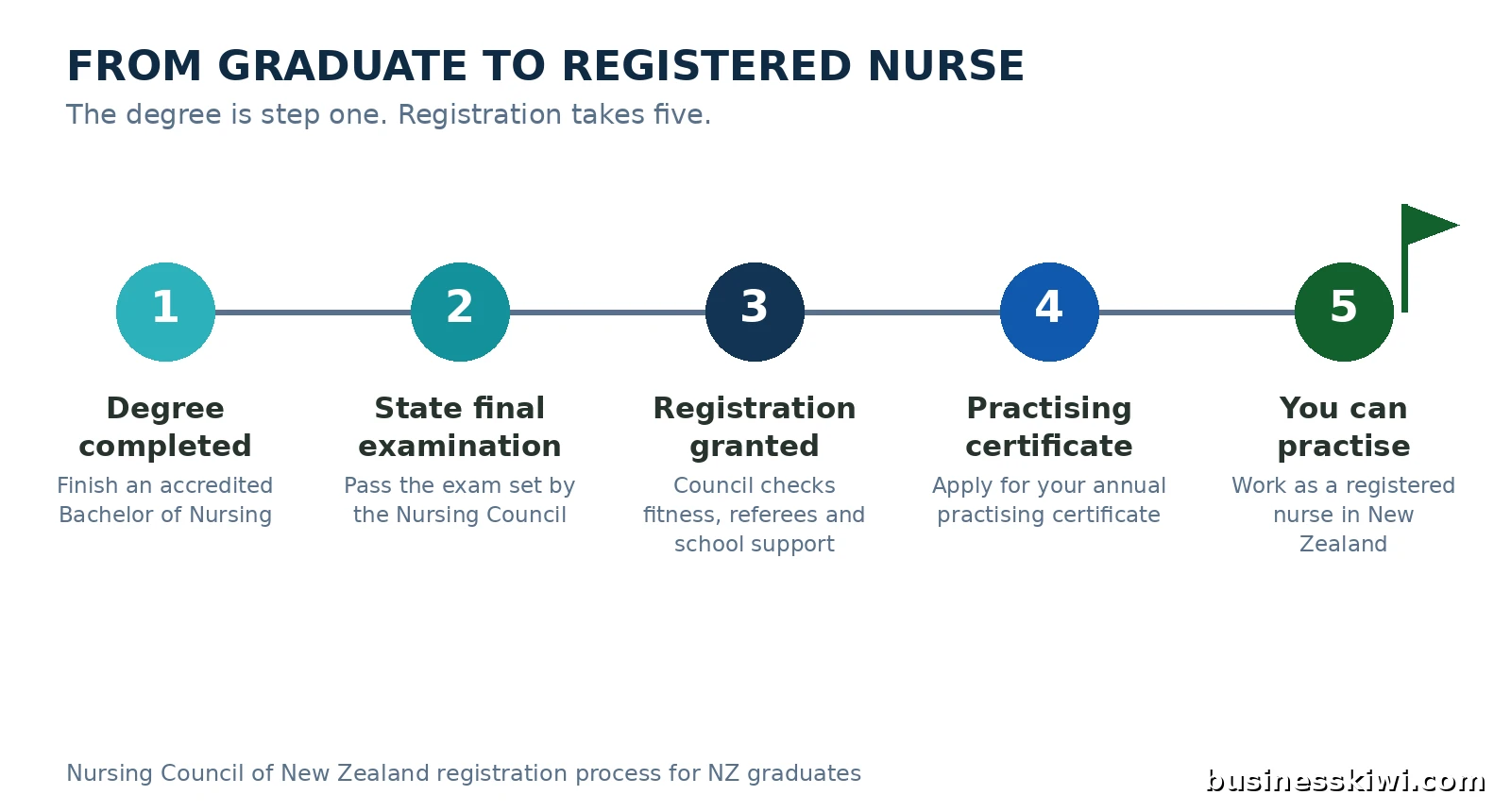
Finishing the degree makes you eligible to register. It does not make you a registered nurse on its own. The Council’s process for New Zealand graduates has several parts.
First, you pass the state final examination for registered nurses, which is set by the Nursing Council. Providers prepare students for it across the final year, and your school of nursing supports your application. You also provide two referees of good standing in your community, who cannot be relatives, flatmates, fellow students or your own nursing educators. Finally, you sign a declaration that you meet the Council’s fitness for registration requirements, covering health, character and competence matters.
The Council considers each application individually. If there are court convictions or other fitness questions, it can ask for more information before deciding. Once the Council registers you, one more step remains. You must apply for an annual practising certificate, and you cannot legally practise as a nurse until you hold a current one.
Registration is not a one-off event at the start of your career. To keep practising, nurses must show continuing competence. Across each three year period that means at least 450 hours of practice and 60 hours of professional development relevant to your scope, alongside meeting the Council’s competence standards. Employers support much of this, but the responsibility sits with the individual nurse.
Your first job, and where registered nurses work
New graduates usually start work through employer-run graduate programmes, often called Nurse Entry to Practice programmes. These give first year nurses structured orientation, preceptored shifts and study days while they settle into the registered nurse role. Positions are competitive in the big cities, and being flexible about location and service area improves your chances.

From there, the scope is wide. Registered nurses work in hospitals across medical, surgical, emergency, intensive care and theatre services. They work in primary care and community teams, in mental health and addiction services, in aged care, in public health, in schools, and in occupational health. Experience opens doors into clinical leadership, nurse education, research and advanced practice, with the nurse practitioner scope at the top of the clinical pathway.
Pay is set largely by collective agreements and experience steps, and it changes as those agreements are renegotiated. For current salary ranges, starting rates and how pay progresses, see our guide to nurse salary in NZ, which tracks the figures separately.
Is the Bachelor of Nursing right for you?
The degree suits people who are comfortable with science, steady under pressure and genuinely interested in people at their most vulnerable. It is a demanding three years. The workload is real, placements are rostered like work because they are work, and the professional standards start on day one.
It may not suit you if shift work is impossible in your life, or if you want a degree you can complete entirely online in your own hours. Nursing cannot be learned that way. The enrolled nurse diploma is worth a look if 18 months of study fits your circumstances better, keeping in mind that enrolled nurses practise under direction and the scope is narrower. If you already hold a degree and want to change careers, price up the two year graduate entry master’s before defaulting to a second bachelor’s degree. It reaches the same registration a year sooner.
How to apply, step by step
Step 1. Choose only Council accredited providers. Start from the Nursing Council’s list of accredited schools of nursing. Any programme not on that list does not lead to registration.
Step 2. Compare two or three programmes. Look at intake dates, placement regions, class sizes and whether a Māori or Pacific pathway is offered. Attend an open day if you can.
Step 3. Check the entry requirements in writing. Confirm the UE standard, the subject credits expected and any foundation option, directly on the provider’s admission page.
Step 4. Prepare the extra paperwork early. Gather identity documents, immunisation records and referees, and allow time for police vetting and safety checks.
Step 5. Apply by the provider’s closing date. Nursing intakes are capped. Early applications stand a better chance when places and placements are allocated.
Step 6. Sort StudyLink at the same time. Lodge your loan or allowance application as soon as your place is confirmed. Do not wait for the semester to start.
Step 7. Plan for the full three years. Map your budget across placements as well as semesters, including travel, and note the six year completion limit that applies from enrolment.
Frequently asked questions
How long is a Bachelor of Nursing in New Zealand?
Three years of full time study. The degree must be completed within six years of enrolment under Nursing Council rules, which gives some room for part time study or a break, depending on the provider’s own limits.
What NCEA subjects do I need for nursing?
Providers set their own requirements. The usual pattern is University Entrance plus credits in English, mathematics and a science, with biology the most useful science subject. Check the exact credit expectations on your chosen provider’s page before you lock in your school subjects.
How many clinical hours are in the degree?
At least 1,000 hours under the Nursing Council’s current education standards, all in real clinical settings. The previous minimum was 1,100 hours, and many programmes still include more than the minimum.
Can I study nursing if I already have a degree?
Yes. A two year graduate entry master’s degree in nursing leads to the same registered nurse scope. It must be completed within four years of enrolment, and entry usually expects a bachelor’s degree at a minimum grade average, set by each provider.
Does finishing the degree make me a registered nurse straight away?
Not quite. You must also pass the state final examination set by the Nursing Council, complete the Council’s registration process, and hold a current annual practising certificate before you can practise as a registered nurse.
Is the Bachelor of Nursing covered by Fees Free?
Only the final year can be covered, up to $12,000, and only for eligible first-time learners who complete their qualification by 31 December 2026. The Government has announced Fees Free finishes at the end of 2026, so students starting in 2027 should budget without it.
What is the difference between a registered nurse and an enrolled nurse?
Registered nurses complete a degree or graduate entry master’s and practise with the broadest general scope, including directing the care given by others. Enrolled nurses complete an 18 month diploma at Level 5 and practise under the direction of a registered nurse or another registered health professional.
The bottom line
The Bachelor of Nursing is a three year, Level 7 degree with a clear shape. University Entrance and the right school subjects get you in. At least 1,000 hours of real clinical practice sit at its centre. A state examination, Nursing Council registration and an annual practising certificate stand between you and your first shift. Choose an accredited provider, read the Fees Free dates honestly, and plan for the placement years as carefully as the classroom ones. Do that, and the degree does what it promises. It turns students into registered nurses the whole health system relies on.
For more guides on degrees, training and careers, browse our jobs and education guides.