How to Put References on a Resume: The NZ Guide to Referees on Your CV

The short answer for New Zealand: for most applications, do not print referees’ names and phone numbers on the CV itself. End the CV with “Referees available on request”, and keep a separate list ready to hand over when an employer asks. If the job ad or the application form asks for referees up front, supply them there instead. Line up two referees before you apply, and never print someone’s contact details without asking them first.
It is the last section of the CV, and it causes a surprising amount of stress. Do you list your referees, or write the line and hope for the best? Do you use your current boss, who does not know you are leaving yet? And what if you have just arrived in New Zealand, with every past manager on the other side of the world?
One naming note first. In New Zealand the document is a CV, short for curriculum vitae, although Tahatū, the Tertiary Education Commission’s careers service, notes it is sometimes called a resume. Same document, same rules either way. This guide covers what to write, who to ask, how to ask, and the awkward cases.
Should referees go on your CV, or not?
The default answer is the line, not the list. Careers NZ, the government careers service within Tahatū, is clear that it is fine to write “Referees available upon request”, and there are good practical reasons to do exactly that.
Referee details take up space on a document that Tahatū advises keeping to two pages if you can. Employment NZ confirms that a job can be offered subject to satisfactory references, which tells you referees matter late in the process, not early. Sending two people’s phone numbers to every employer you apply to, including the ones who will never shortlist you, helps nobody, and it shares your referees’ details far more widely than they agreed to.
There are four situations where you give the details straight away:
- The job ad asks for referees. Some ads require referees with the application. Do what the ad says, in the way it says it.
- The application form has referee fields. Online portals often collect referees inside the form. Fill them in there rather than on the CV.
- The employer asks after your interview. Hand over your prepared referee list promptly, ideally the same day.
- You are handing a CV in person to a small business. A local employer who may decide quickly can reasonably want names on the spot; even then, the line on the CV plus your list in your bag covers you.
Our NZ CV template guide walks through every other section in order. The referees section involves other people, which is why it needs more care than the rest.
What a referee entry actually looks like
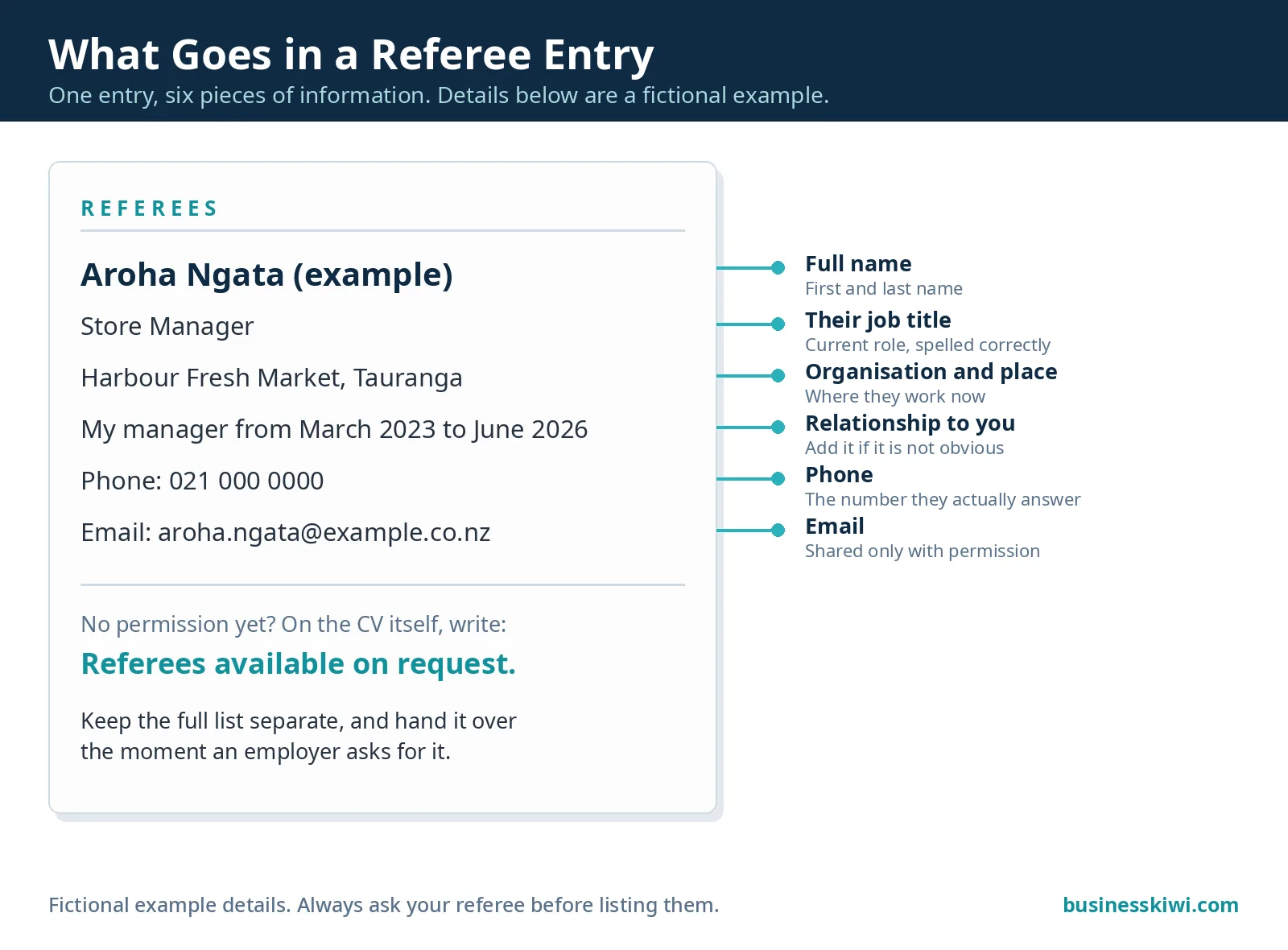
When you do supply referees, on a form, in a separate list, or at an employer’s request, each entry needs the same six pieces of information: full name, job title, organisation, how they know you if that is not obvious, a phone number, and an email address. Nothing else: no home addresses, no history essays.
Here is a complete entry, with fictional details:
REFEREES
Aroha Ngata (example)
Store Manager, Harbour Fresh Market, Tauranga
My manager from March 2023 to June 2026
Phone: 021 000 0000
Email: aroha.ngata@example.co.nz
And here is the version most CVs should carry:
REFEREES
Available on request.
Two formatting points matter. Put the section last, after your work history and education, because referees are checked last. And double-check every digit and letter: the Careers NZ CV checklist includes a reminder to double-check all the contact details on the document, yours and your referees. A transposed digit in a phone number can quietly kill an application at the final step, and you will never know it happened.
The annotated graphic below breaks one entry apart line by line, so you can copy the shape exactly.
Who to ask: strong referees and weak ones
A referee’s job is to answer an employer’s questions about your skills, your attitude, your work experience and your work habits. Careers NZ’s Job Hunters’ Workbook puts the choices in a blunt order, and it is worth following.
| Strong choices | Weak choices |
|---|---|
| Your manager. The best choice is almost always the person you report to now, or reported to most recently. | Friends. Do not use friends as referees if they know nothing about your work. |
| A project manager or senior colleague who directed your work. A good choice when your direct manager is unavailable, or as your second referee. | Family members. Employers discount them, fairly or not. The one exception is a genuine family business, and then you say so openly on the entry. |
| A client who worked closely with you. Useful for contractors, tradespeople and anyone whose work is delivered to customers. | Anyone you have not asked. An ambushed referee gives a hesitant reference, and hesitation reads as a warning. |
| Your course tutor or teacher. A limited but legitimate choice for students and recent graduates, if they know your work well enough to talk about it. | A manager from many years ago who barely remembers you. Choose people who can talk about the worker you are now. |
Careers NZ notes it is usual to have two or three referees, and its job-search guide treats having at least two people who have agreed to act as your referees as a basic readiness item. Line up a third as a backup if you can: people go on leave, change jobs and lose phones at the worst possible moment.
Asking permission: do it in five steps
Asking is not a formality. It is the step that turns a name on a list into someone who will speak well of you, promptly, when a stranger rings. Do it before you send a single application.
- Shortlist people who know your recent work. Work down from your current or latest manager, using the strong choices above.
- Ask before you apply, never after the employer calls. A short phone call or email is enough. If the answer sounds reluctant, thank them and ask someone else. A half-hearted referee helps no one.
- Tell them about the role. Say what you are applying for and why you want it. A referee who knows the job can aim their answers at it.
- Send them your current CV and the job description. Referees speak more confidently when your history is in front of them.
- Agree the contact details. Confirm the phone number they actually answer and the email they actually check, and get their current job title right for the entry.
A short ask, in writing, looks like this (example wording):
Kia ora [Name], I am applying for a [job title] role at [organisation], and I would love to list you as a referee. Would you be happy for the employer to call you about the work I did with you at [workplace]? I can send my CV and the job description so you have them handy. Ngā mihi, [your name]
Keep it that easy to say yes to. Then, when an employer moves you forward, warn your referees the same day: “I have an interview on Thursday, so a call may come early next week.” Careers NZ gives exactly this advice, to tell your referees you have an interview and what the role is. A warned referee answers on the second ring and sounds pleased to help. An unwarned one sounds wary, because reference calls now arrive looking exactly like scams.

What happens when the call comes
Reference checks sit at the sharp end of hiring. Employment NZ says the information asked for must be relevant to the safe and proper performance of the job, so referees get asked about the work itself: what you did, how reliably you did it, how you got on with the team, and whether they would hire you again.

Two habits protect you here. First, reply fast when an employer asks for your list. Every day of delay is a day another finalist’s referees are talking. Second, thank your referees afterwards, whatever the outcome. Referees who feel used once go quiet the next time you need them.
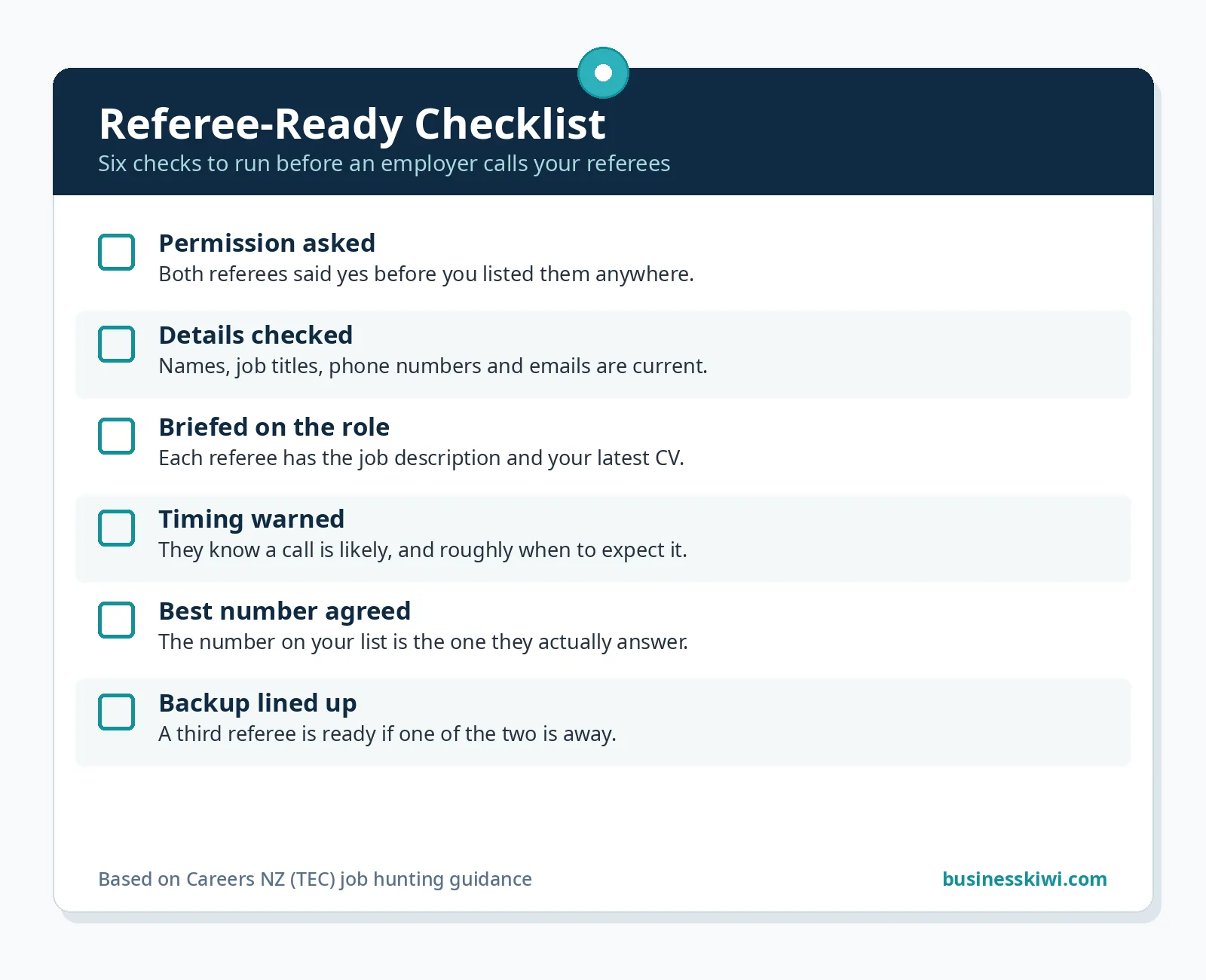
The checklist graphic pulls the whole preparation into six quick checks. Run through it before any application goes out.
The tricky situations
You do not want your current employer contacted yet. This is normal, and the rules back you. Employment NZ states that employers should only contact referees provided by the applicant, and that if an employer wants to speak to your current employer when you have not given them as a referee, the employer must get your permission first. So list previous managers, say plainly that your current employer does not know you are looking, and offer them as a referee at the offer stage. When the move is final, our guide to writing a resignation letter covers the leaving side of the process.
You are new to New Zealand. Careers NZ is practical about this: it is best to use people from New Zealand workplaces as referees if you can, but referees who know your work from outside New Zealand can be used if needed. So use your overseas managers, and make their entries easy to act on: full international phone format, an email address, and a note of the time difference if it is large. A written reference helps where a call is impractical. Then build local referees fast, through part-time work, volunteering or a short contract, because the next search will be far easier.
You are a student or this is your first job. Use the people who have seen you work in any organised setting: a tutor or teacher who knows your work, the supervisor from a part-time or holiday job, a volunteer coordinator, or a coach. Careers NZ’s workbook lists teachers, community leaders and course tutors as limited choices, and limited is fine when they can talk about your reliability and work habits. Work experience counts too: Tahatū advises asking the placement manager to be your referee for future applications, at the time, while they remember you.

You have nobody to ask. Start with a character referee from an organised setting, such as a community group, sports club or faith community, someone who can speak about you showing up and following through. Then create a work referee deliberately: a few weeks of volunteering or casual work, done well, produces one.
Your referee has left, retired or gone quiet. Keep your referees’ details current between job searches, and ask departing managers for a personal email address before they go. If a referee stops responding, replace them and update the list you hand out: a check that hits a dead number can stall an offer.
The privacy side, briefly
Reference checking runs on consent, and it is worth knowing where you stand. Employment NZ states that employers must comply with the Privacy Act 2020 when they collect and handle applicants’ personal information, and must not collect information about an applicant from someone who is not their nominated referee without the applicant’s consent. In plain terms: an employer should be talking to the referees you gave them, about the job you applied for, and nobody else without asking you.
From the other side, you can ask an employer to show you the personal information it holds about you. The Privacy Commissioner notes one limit: reference material may be withheld under section 50 of the Privacy Act 2020 where it is evaluative material, compiled only to assess your suitability for the job, that was supplied under a promise of confidence. Referees can also ask for their identity and the contents of their reference to be kept confidential. If an information request is handled wrongly, the Commissioner’s office can advise or take a complaint.
It cuts both ways, which is the final practical point. Your referees’ phone numbers and email addresses are their personal information. Asking permission before you print them is not just good manners; it is how the system is supposed to work.
Frequently asked questions
Should I put referees on my CV or write “available on request”?
Write “Referees available on request” on the CV, and keep a separate referee list ready. Supply full details when the job ad asks for them up front, when an application form has referee fields, or when an employer asks, which is usually near the end of the process.
How many referees do I need?
Two for most applications. Careers NZ describes two or three as usual. Have a third person agreed as a backup, in case one referee is away or unreachable when the call needs to happen.
Can I use a friend or a family member as a referee?
Only with limits. Careers NZ advises against friends who know nothing about your work, because a referee must answer questions about your skills, attitude and work habits. Family members are discounted by employers unless you genuinely worked in the family business, in which case state the relationship openly on the entry.
What if all my referees are overseas?
Use them. Careers NZ says referees who know your work from outside New Zealand can be used if needed. Give full international phone numbers, email addresses and a note about time zones, and build local referees through part-time work, volunteering or short contracts.
Will an employer ring my current boss without telling me?
They should not. Employment NZ says employers should only contact referees the applicant has provided, and must get your permission before speaking to your current employer if you have not listed them. List previous managers, explain your situation, and offer your current employer as a referee once an offer is on the table.
Can I see what my referee said about me?
You can ask the employer for the personal information it holds about you. The Privacy Commissioner notes, though, that a reference may be withheld under section 50 of the Privacy Act 2020 if it is evaluative material compiled solely to assess your suitability and given in confidence. If you think a request was handled wrongly, the Commissioner’s office can help.
What contact details should a referee entry include?
Six things: full name, job title, organisation, your relationship to them if it is not obvious, a phone number, and an email address. Use the number they actually answer and the email they actually check, and double-check both, as the Careers NZ CV checklist advises.
The bottom line
Treat the referees section as a small project, not a last line. Two agreed referees, asked early and briefed properly, beat a long list of people who are surprised to hear from an employer. Keep the CV line simple, and warn them the moment an interview lands. Do that, and the quietest section of your CV becomes the one that closes the deal. You will find more help in our jobs and education guides, including how to pair this section with a strong cover letter.
Sources: Careers NZ and Tahatū (Tertiary Education Commission) CV guidance, Job Hunters’ Workbook and referee resources; Employment NZ (MBIE), “Tests and checks” and “The hiring process”; Office of the Privacy Commissioner guidance on the Privacy Act 2020. All read October 2026.