Travel Money for Kiwis: How Exchange Rates Work and What Each Option Really Costs
The short answer
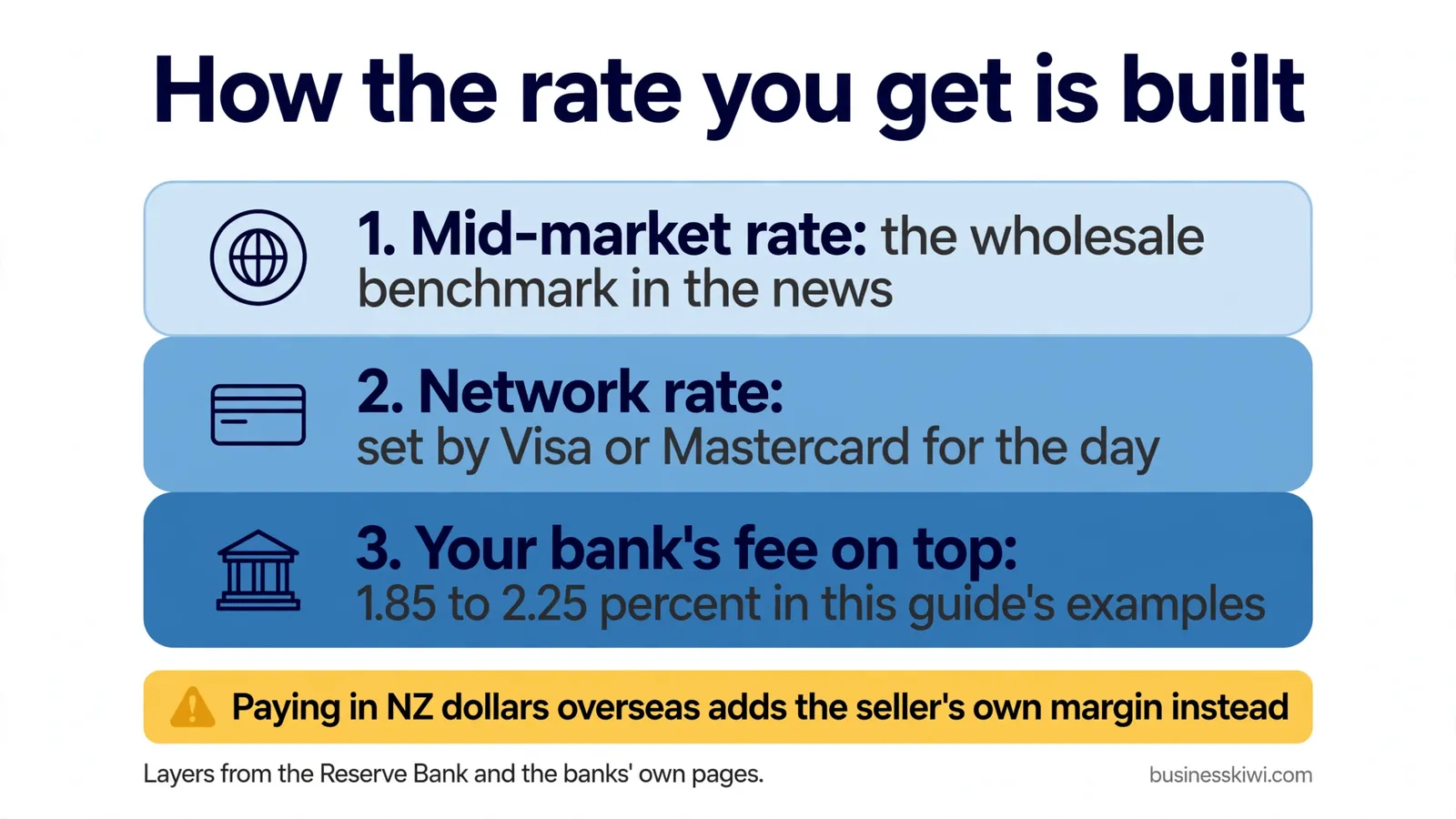
The exchange rate you see in the news is not the rate you will get. That headline rate is a wholesale market rate. Every bank, card and travel money provider adds its own margin or fee on top of it, and that gap is where most of the cost of travel money hides.
For most New Zealand travellers, the cheapest setup is a mix. Carry a small amount of local cash for your first day or two. Spend mainly on a card with a low or zero foreign currency fee. If you use a terminal or ATM that offers to charge you in New Zealand dollars, decline it and pay in the local currency instead. That one habit saves more than most rate shopping does.
How exchange rates actually work
Currencies trade on global markets around the clock. The rate quoted by news sites and search engines is the mid-market rate. It sits halfway between the price buyers and sellers are trading at in the wholesale market. It is a benchmark, not a price any traveller can transact at.
The Reserve Bank of New Zealand publishes reference exchange rates for the New Zealand dollar against the major currencies. Since 2015 these have been the market fix struck at 2pm each day, published the same afternoon. They exist so businesses, accountants and statisticians have a consistent yardstick. The Reserve Bank does not sell currency to the public, and no provider is obliged to offer you its reference rate.
When you buy travel money, you deal at a retail rate instead. The provider takes the market rate and adjusts it in its own favour. The difference is called the margin, spread or mark-up. BNZ, for example, states openly on its exchange rates page that it includes a margin on foreign exchange conversions, and that the margin improves on larger single transactions. On a small holiday spend, you simply pay the standard retail margin.
Card purchases work slightly differently. Visa and Mastercard each set a wholesale exchange rate for the day a transaction is processed. Your bank then converts your purchase at that network rate and adds its own foreign currency fee on top. So with a card, the cost comes in two layers: a network rate that is usually close to the market rate, plus your bank’s percentage fee.
One more wrinkle matters. Some transactions are converted twice. BNZ and ASB both note that a purchase can be converted into US dollars first and then into New Zealand dollars. Each conversion is a chance for value to leak away, although the network rate limits how large the leak can be.

The four main ways to take travel money
1. Foreign cash bought before you go
Cash still has a place. It covers taxis, tips, markets and small vendors that do not take cards. It also gives you a backup if a card fails on day one.
What has changed is where you buy it. The big banks have been stepping away from over-the-counter foreign cash. ANZ says customers can no longer buy or sell foreign cash at its branches. ANZ points customers to overseas ATMs, specialist exchange providers, prepaid travel cards and travel agents instead.
BNZ has made a similar move. Its exchange rates page says you cannot buy foreign cash from BNZ, or sell it back, either in branch or online. Instead, BNZ customers can buy through its partner Travelex, online for collection or in person at a Travelex location. Westpac has a comparable partnership. Westpac customers can buy or sell foreign cash through Travelex, online or in store.
The practical lessons are simple. Bank branches are no longer the default place to buy notes. Specialist providers and airport desks now handle most cash sales, and their rates vary widely. Airport desks are convenient but rarely generous, because a captive audience does not force them to compete. Wherever you buy, compare the total you actually receive for your New Zealand dollars, not the rate on the board. Fees and margins are both inside that final number.
2. Prepaid travel money cards
A travel money card is a prepaid card you load with foreign currencies before you travel. You lock in the exchange rate at the moment you load. That certainty is the main attraction, along with a card that is not linked to your everyday bank account.
Westpac’s Global Currency Card shows how these products work. You can load up to nine currencies. There is no card issue fee, no monthly fee and no fee to load by bank transfer. Loading by debit card costs 1.5 percent of the load amount. International ATM withdrawals carry no Westpac fee, although a withdrawal from a New Zealand ATM costs $4. The maximum balance across all currencies is NZ$75,000, and the minimum load is NZ$10.
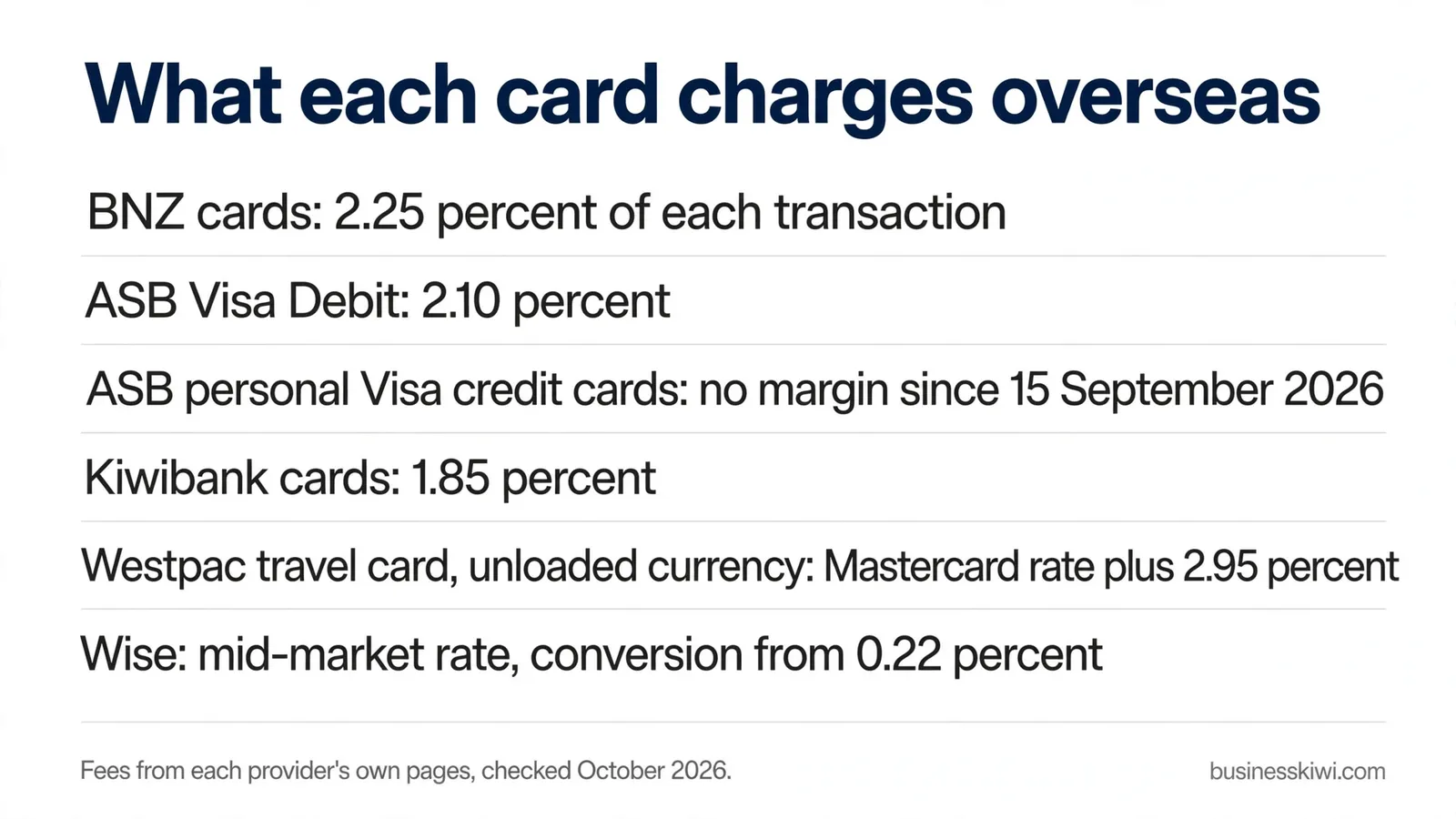
Read the conditions before you rely on one. The rate you lock in is a retail rate. Westpac’s card site explains that its load rate reflects the card manager’s cost price plus a margin, so you are locking in certainty, not the market rate. The bigger trap sits at the edges. If you spend in a currency you have not loaded, or your loaded balance runs short, the card converts for you at the Mastercard rate plus 2.95 percent of the transaction value. A card that looks fee-free can become expensive the moment you stray outside your loaded currencies.
3. Your normal debit and credit cards
For many travellers, this is the simplest option. Your existing cards work in shops and ATMs worldwide. The cost is the foreign currency fee your bank adds to each transaction, and the banks publish these fees, so you can check yours before you fly.
BNZ charges a foreign currency service fee of 2.25 percent of the New Zealand dollar value of every foreign currency transaction, on both credit and debit cards. Transactions are converted at the exchange rate applied by Visa. BNZ folds the fee into the exchange rate shown on your statement, so you see one combined figure rather than a separate fee line.
ASB calls its fee the Offshore Service Margin. On ASB Visa debit cards it is 2.10 percent of the converted New Zealand dollar amount. ASB has removed the margin from all personal ASB Visa credit cards, effective from 15 September 2026, so those cards now convert at the Visa rate with no ASB margin on top. Cash taken from a cheque or savings account overseas still attracts a 1.10 percent margin. ASB also warns that overseas ATM operators may add their own withdrawal fee.
Kiwibank’s published rates and fees page sets its international transaction fee at 1.85 percent of the total amount, for transactions processed overseas on its EFTPOS and Visa Debit cards. Kiwibank also states openly that it makes money on the conversion when it converts foreign currency into New Zealand dollars.
ANZ cards can be used at ATMs displaying the Visa or Plus logo. ANZ warns that the New Zealand dollar amount of an overseas ATM withdrawal can shift slightly between the moment you withdraw and the moment the bank processes it, because the exchange rate moves in between. That timing point applies to every card. The rate that counts is usually the processing day rate, not the rate on the day you tapped.
Credit cards carry one extra warning. Withdrawing cash on a credit card is a cash advance. BNZ states that interest accrues on cash advances straightaway and no rewards are earned on the amount withdrawn. A cash advance can cost far more than the conversion fee alone. Use a debit card for ATM cash, and save the credit card for purchases you will pay off in full.
4. Multi-currency accounts and apps
A newer option is a multi-currency account with a linked debit card. You hold balances in several currencies inside one account, convert between them in the app, and spend from the matching balance when you travel.
Wise is the best known provider serving New Zealanders. From Wise’s own New Zealand pages: you can hold and exchange more than 40 currencies, conversions use the mid-market exchange rate with no mark-up, and the conversion fee starts from 0.22 percent when you spend a currency you do not hold. Spending a currency you already hold costs nothing. The physical card costs a one-off $14, there is no monthly fee, and international ATM withdrawals are free up to $400 a month, with 2.69 percent charged on withdrawals above that.
The trade-offs are practical rather than financial. You must open and verify an account before you travel, and order the card ahead of time, since delivery takes about 7 to 10 working days. You also manage your travel money inside a separate app rather than your usual banking app.
Always pay in the local currency
At some point on almost every trip, a card terminal or ATM will offer you a choice. Pay in the local currency, or pay in New Zealand dollars. The second option is called dynamic currency conversion, and it is almost always the dearer one.
Dynamic currency conversion means the merchant, or the ATM operator, converts the amount for you on the spot. Seeing a New Zealand dollar total feels comfortable and clear. The catch is that the conversion rate is set by the business doing the converting, and it includes their margin. That margin is usually much larger than your bank’s fee. In some cases the terminal applies the conversion without making the choice obvious, so watch the screen before you confirm.
If you pay in the local currency instead, the amount stays in that currency until Visa or Mastercard converts it at their wholesale rate. Your bank then adds its normal foreign currency fee, which you can check before you travel. One firm rule covers nearly every situation: whatever country you are in, choose the local currency on the screen, and decline any offer to convert to New Zealand dollars for you.
How much cash to carry, and keeping it safe
Cash needs are smaller than they used to be, but they have not vanished. A sensible approach is to land with enough local cash for your first day: transport from the airport, food, and small purchases. After that, top up from ATMs as you go rather than carrying the whole trip’s cash at once.
Split what you do carry. Keep a small working amount in your wallet and the rest somewhere separate, such as a money belt or your accommodation safe. If one lot is lost or stolen, the other keeps the trip alive. Carry a backup card stored apart from your main card for the same reason.
Tell your bank where you are going before you leave. Westpac warns that its fraud detection may block a credit or debit card used overseas if the bank does not know you are travelling, and it lets customers record their plans in its app or by phone. A blocked card at an airport is a miserable start to a trip.
If something does go wrong, act quickly. MFAT’s SafeTravel site advises victims of scams overseas to report the crime to local police and get a police report for their travel insurance claim, block their bank cards through their banking app or by contacting their bank, and contact their travel insurer. Registering your trip with SafeTravel before you go also means MFAT can reach you in an emergency.
Watch-outs that catch travellers out
Refunds do not reverse cleanly. BNZ states that it does not credit its foreign currency service fee back on purchase refunds, and exchange rate movements mean a refund can land at a different New Zealand dollar amount than you originally paid.
Leftover cash loses value twice. Notes you bring home are bought back at the provider’s sell rate, not the rate you paid. Spend down small balances on the last day, or keep common currencies like Australian dollars for a future trip.
Free can have edges. A travel card with no load fee may still charge when you spend an unloaded currency, withdraw at home, or leave a balance sitting for a long time. Read the full fee table, not the headline.
ATM fees stack. Your bank may charge an overseas withdrawal fee, and the ATM’s owner may charge another on top. Fewer, larger withdrawals usually cost less than many small ones, balanced against how much cash you are comfortable carrying.
Rates move while you travel. A rate locked in on a travel card protects you from falls and cuts you off from rises. Neither outcome is a reason to delay booking a trip. Convert because you need the money, not to gamble on the rate.
Related guides: our travel loan guide covers borrowing for a trip, and our NZ passport photo guide covers the document side of getting ready to go. For more money guides, browse the Finance section.
Frequently asked questions
What exchange rate will I actually get on my trip?
You will get a retail rate, not the mid-market rate shown in the news. With a bank card, Visa or Mastercard sets the conversion rate and your bank adds its foreign currency fee, such as 2.25 percent at BNZ or 2.10 percent on an ASB Visa debit card. With cash or a travel card, the provider builds its margin into the rate it quotes you.
Is it better to buy foreign cash before I leave New Zealand?
A small amount, yes, so you can pay for transport and food as soon as you land. Large amounts are usually better handled by card, because cash rates at exchange desks carry wide margins, and carrying a lot of cash is a security risk. Note that ANZ and BNZ no longer sell foreign cash themselves, so you will use a specialist provider such as Travelex.
Should I pay in New Zealand dollars when a terminal offers me the choice?
No. That offer is dynamic currency conversion. The merchant or ATM operator sets the rate, and it usually includes a much bigger margin than your bank’s fee. Choose the local currency and let your card network convert it instead.
Which is cheaper, a travel money card or my bank debit card?
It depends on how you use them. A travel card like Westpac’s Global Currency Card charges nothing to load by bank transfer and nothing for overseas ATM withdrawals, but converts at a retail rate with a margin inside it, and charges the Mastercard rate plus 2.95 percent if you spend a currency you have not loaded. A bank debit card charges a flat percentage on everything, such as 2.10 percent at ASB or 1.85 percent at Kiwibank. Compare the total cost on the amount you expect to spend.
Do banks charge for using an ATM overseas?
They can, in two ways. Your own bank may charge a fee for overseas withdrawals, and the ATM operator may add its own fee as part of the transaction. Some products do not charge their own withdrawal fee at all. Westpac’s Global Currency Card has no fee for international ATM withdrawals, although ATM operators can still charge theirs.
Can I use my credit card to withdraw cash overseas?
You can, but it is expensive. A withdrawal on a credit card is a cash advance. Interest starts accruing straightaway, as BNZ’s guidance points out, and the foreign currency service fee still applies. Use a debit card or a travel card for cash instead.
How much cash should I take on holiday?
Enough local currency for your first day or two of small spending, such as airport transport, tips and markets. Keep the rest of your money on cards and top up cash from ATMs as needed. Split the cash you carry into two places so one loss does not empty your pockets.
The bottom line
Travel money costs come down to three things: the rate you are given, the fee added to it, and the choices you make at the terminal. You cannot transact at the mid-market rate, but you can keep the gap small. Check your own bank’s foreign currency fee before you fly. Use local currency at every terminal and ATM. Carry a little cash, a backup card, and a second way to pay. Do those things and the exchange rate stops being a worry and becomes what it should be: a minor cost of a good trip.
Sources
-
Reserve Bank of New Zealand, “Exchange rates and Trade Weighted Index (B1)” (rate methodology): https://www.rbnz.govt.nz/statistics/series/exchange-and-interest-rates/exchange-rates-and-the-trade-weighted-index
-
ANZ, “No longer offering foreign currency”: https://www.anz.co.nz/comms/foreign-cash/
-
ANZ, “Using your ANZ cards overseas”: https://www.anz.co.nz/content/anzconz/nz/en/personal/migrants-travel-foreign-exchange/travel/travel-money/
-
ASB, “What is the Offshore Service Margin on my credit card statement”: https://www.asb.co.nz/help/offshore-service-margin.html
-
ASB, “Rates and fees”: https://www.asb.co.nz/rates-and-fees
-
BNZ, “Using cards overseas”: https://www.bnz.co.nz/support/credit-cards/travel/using-cards-overseas
-
BNZ, “Exchange rates”: https://www.bnz.co.nz/personal-banking/international/exchange-rates
-
Kiwibank, “Rates and fees”: https://www.kiwibank.co.nz/personal-banking/rates-and-fees/fees/
-
MFAT SafeTravel, “Victim of crime”: http://safetravel.govt.nz/victims-crime
-
Westpac, “Managing Your Money While Overseas”: https://www.westpac.co.nz/personal/life-money/travel/managing-your-money-while-overseas/
-
Westpac Global Currency Card, “Limits and Fees”: https://www.westpaccurrencycard.co.nz/limits-and-fees/
-
Wise, “Wise Card New Zealand Review”: https://wise.com/nz/blog/wise-card-review
This article is general information about travel money and exchange rates for New Zealand travellers and how the different ways of paying overseas work. It is not personal financial advice and does not take your own situation into account. Exchange rates move constantly, and banks and providers change their fees, so check the current rate and fee table with your own bank or provider before you travel or convert money.