Renting in Blenheim: What It Costs, How It Works and What to Check Before You Sign
The short answer
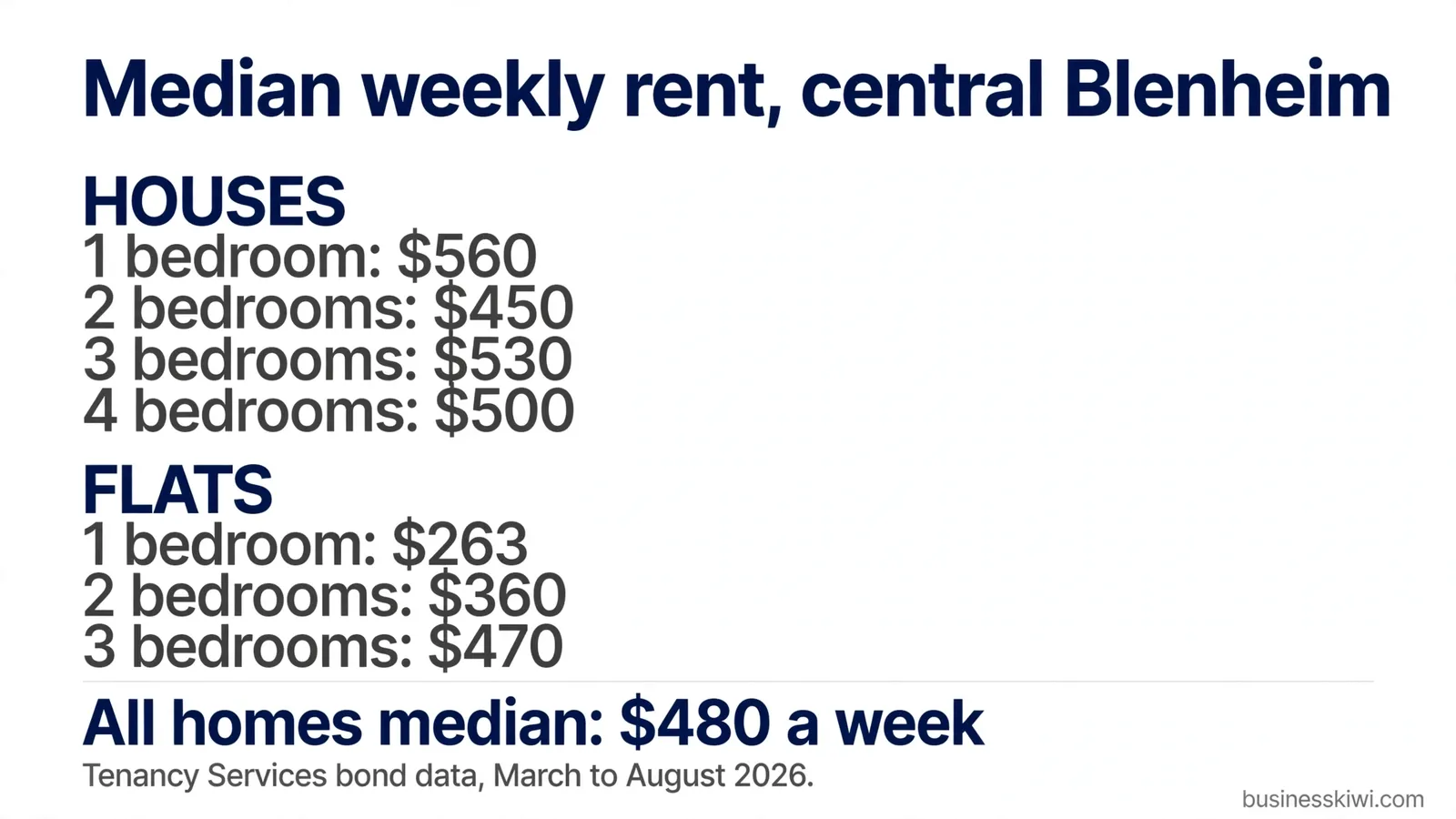
Renting in Blenheim works the same way as renting anywhere in New Zealand. What is local is the price. Tenancy Services collects the bond money for almost every new tenancy, and its market rent tool turns that bond data into the only official rent figures published for Blenheim. For the six months from 1 March 2026 to 31 August 2026, the median weekly rent across central Blenheim was $480, based on 680 active bonds. A three bedroom house in central Blenheim had a median of $530 a week, while a two bedroom flat had a median of $360. Before you move in, the most a landlord can ask for is a bond of up to four weeks of rent, plus up to two weeks of rent in advance. Letting fees are banned.
What renting in Blenheim is like
Blenheim is the main town of Marlborough, at the top of the South Island, and most of the district’s renting happens in or near the town. The Marlborough region had 49,431 people at the 2023 Census, with 24,330 private dwellings. About 26 percent of households in the region do not own the home they live in, so renting is a normal part of the local housing picture.
The town has an older population than most of New Zealand. The median age in Marlborough was 46.1 years at the 2023 Census, and 23.9 percent of people were aged 65 or over. Marlborough District Council reflects that in its own housing role: the council owns units in Blenheim rented to older people who meet its criteria, with enquiries handled through APL Property.
Work shapes demand too. Agriculture, forestry and fishing was the largest industry group in the region at the 2023 Census, employing 13.9 percent of working people, with manufacturing close behind at 13.4 percent. A share of local renting is tied to that work, including people who arrive for a season or a contract. Tenancy Services has a specific warning for this situation. If your landlord is also your employer, the arrangement is called a service tenancy, and special rules apply to rent paid in advance. Blenheim itself is compact, and a bus service runs six days a week on the north and south sides of town, as the council notes. Most renters can consider the whole town, and use the area figures below to judge whether an asking rent is fair.
What rents actually look like
Every rent figure in this section comes from one place: the Tenancy Services market rent tool, checked on 12 October 2026. The tool is built from bonds lodged with Tenancy Services, covers the previous six months of bond data (not including the most recent month), and is updated monthly. The figures below are for 1 March 2026 to 31 August 2026. Tenancy Services is clear that the tool is a guide only, and should not be used on its own to set the rent of any one property.
There is no single median rent for the whole of Blenheim in the tool. The town is reported as 14 separate areas, with more than 1,700 active bonds between them. Central Blenheim is the biggest area, with 680 active bonds and a median weekly rent of $480. The middle half of central Blenheim rents sat between $343 and $580 a week.
The main urban areas compare like this, using the median across all dwelling types:
-
Springlands: $570 a week (178 active bonds)
-
Witherlea: $550 a week (197 active bonds)
-
Redwoodtown: $500 a week (301 active bonds)
-
Central Blenheim: $480 a week (680 active bonds)
-
Mayfield: $460 a week (94 active bonds)
-
Riversdale: $460 a week (76 active bonds)
-
Woodbourne: $380 a week (113 active bonds)
Houses are the most common rental type in Blenheim. In central Blenheim, the median for a one bedroom house was $560 a week (117 bonds), a two bedroom house was $450 (114 bonds), a three bedroom house was $530 (236 bonds), and a four bedroom house was $500 (44 bonds). Treat rows built on small bond counts with care.
Family sized houses cost more in some outer areas than in the centre. A three bedroom house had a median of $590 a week in Springlands (55 bonds), $570 in Witherlea (78 bonds) and $550 in Redwoodtown (105 bonds). A four bedroom house reached a median of $700 in Springlands (23 bonds).
Flats are the cheaper way into the market. In central Blenheim, a one bedroom flat had a median of $263 a week (28 bonds), a two bedroom flat was $360 (90 bonds), and a three bedroom flat was $470 (22 bonds). Redwoodtown two bedroom flats sat at $390 (40 bonds), and Witherlea two bedroom flats at $450 (24 bonds). The tool counts a flat as part of a subdivided building, or a separate smaller building on a property, such as a sleep-out.
Some areas are too small to read much into. Burleigh (16 bonds), Grovetown (21), Islington (19), Rapaura (26), Rarangi (14), Yelverton (10) and Tuamarina (6) each had few bonds in the period, and the tool publishes little or no breakdown for them. In those areas, compare any asking rent with the nearest larger area instead.
You can run the same check yourself in the market rent tool on tenancy.govt.nz. Read the median, the quartiles and the bond count together. If a landlord charges significantly more than the market rent for similar homes nearby, a tenant can apply to the Tenancy Tribunal and ask for the rent to be reduced.
Where the rentals are
The areas named above are the working map of the Blenheim rental market, because they are the areas the official data uses. Central Blenheim holds the largest pool, including most of the town’s flats. Redwoodtown, to the south, is the second biggest pool. Springlands in the west and Witherlea in the south east sit at the higher end for houses. Mayfield and Riversdale sit in the middle. Woodbourne, by the air force base, is the cheapest of the larger areas. Around the town sit smaller settlements the tool groups under Blenheim, including Grovetown, Rapaura and Rarangi. Rapaura is vineyard country, and homes there are often tied to rural work. Wherever you look, judge a property against the closest area with a decent bond count.

How renting works, step by step
Most Blenheim rentals are rented through viewings and applications. Three legal points protect you at this stage. A rental must be advertised with its rental price stated, and a landlord cannot run a bidding process or encourage you to offer more than the advertised rent. Nobody can charge you a letting fee: letting fees have been banned since 12 December 2018, including fees to renew or extend a tenancy. And key money is banned. Key money is any extra payment, on top of rent and bond, asked for to grant or change a tenancy. The one exception is an option fee, which holds a property while you decide. It is capped at one week of rent, and must be refunded or put towards your rent if you take the property.
Once you are accepted, the agreement comes next. A tenancy agreement is a contract between you and the landlord, and it must be in writing. The landlord must give you a copy of the signed agreement before the tenancy starts. The Residential Tenancies Act 1986 applies even if there is nothing in writing, but a written agreement is your protection, so insist on one. Every agreement must state both sides’ names and contact details, the property address, the start date, the bond amount, the rent amount and payment frequency, how rent will be paid, any chattels provided, and the end date if it is a fixed term. It must also include a signed healthy homes compliance statement, covered below. Read it all before you sign, including any extra conditions, which still have to comply with the law.
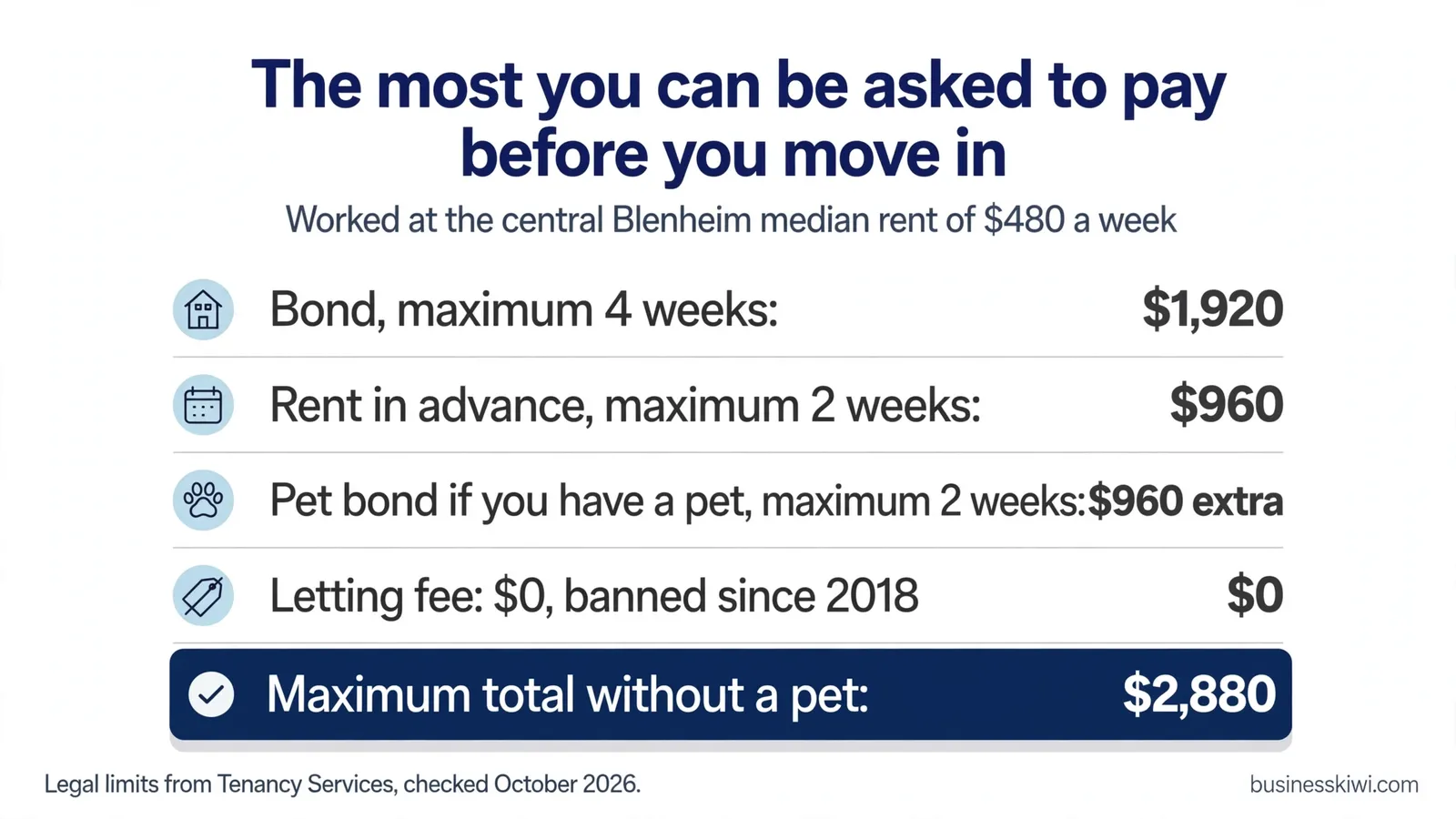
The money at the start is capped by law. A landlord can charge a general bond of up to four weeks of rent. The landlord must give you a receipt and lodge the bond with Tenancy Services within 23 working days, and Tenancy Services holds it until the tenancy ends. If you have not had a notification within six weeks that your bond was lodged, check with your landlord. Alongside the bond, a landlord can ask for one or two weeks of rent in advance, depending on whether you pay weekly or fortnightly. It is unlawful to ask for more than two weeks in advance, and the landlord cannot ask for the next payment until the advance rent has been used up.
Do the start of tenancy inspection with the landlord and complete the property inspection report together. It is the baseline for your bond refund when you leave, so note every mark and fault, and keep your own photos.
Healthy homes and your rights during the tenancy
Every private rental in Blenheim must meet the healthy homes standards. Full compliance has been required for all private rentals since 1 July 2025. The standards cover five things: a fixed heater that can heat the main living room to the required capacity; ceiling and underfloor insulation that meets the standard; a window or door that opens to the outside in every liveable space, plus extractor fans in kitchens and bathrooms; efficient drainage and guttering, with a ground moisture barrier where there is an enclosed subfloor; and blocking of unreasonable gaps that cause draughts.
Your tenancy agreement must include a signed statement of the property’s current level of compliance. A landlord who leaves that statement out, when it is required, can face a penalty of up to $500 for each tenancy. You can also ask for compliance information at any time, and the landlord must provide it within 21 days. Landlords who do not meet the standards are in breach of the Act and can face penalties of up to $7,200. If a rental falls short, raise it in writing and keep copies.
Inspections have limits. A landlord can inspect between 8am and 7pm, no more often than once every four weeks, with at least 48 hours of notice and no more than 14 days. Endings follow set rules too. A fixed term tenancy generally runs to its end date and cannot be ended early by notice, unless certain circumstances apply or both sides agree. A periodic tenancy can be ended with written notice, and as a tenant you give at least 21 days. Landlords have longer notice periods and, for some endings, need a stated reason.
Rent increases are limited too. Rent can only go up once every 12 months, and not within the first 12 months of the tenancy. The landlord must give you at least 60 days of written notice, stating the new rent and the day it starts. The law does not cap how much rent can rise by. If your new rent is far above similar homes nearby, you can negotiate, and in some cases apply to the Tenancy Tribunal for a review. When rent goes up, the landlord can also ask you to top up the bond.
Costs on top of rent
Budget for more than the weekly rent. The upfront costs are the bond and rent in advance described above, capped at six weeks of rent in total if the landlord charges the maximum of both. If you keep a pet with the landlord’s consent, there can also be a pet bond of up to two weeks of rent, lodged with Tenancy Services like the general bond. It is refunded when the tenancy ends or the pet goes, if there is no pet damage to pay for.
During the tenancy, tenants usually pay for power, internet and phone, and for water charges only where the agreement and the law allow them to be passed on. Contents insurance is your own choice, but worth pricing, because the landlord’s insurance does not cover your belongings. Lawns and gardens depend on the agreement, so check who is responsible before you sign.

Watch-outs for Blenheim renters
Rental scams exist in smaller markets too. Never pay a bond or rent in advance for a property you have not seen, to a person who cannot show you a written agreement. A real landlord gives a receipt for the bond and lodges it with Tenancy Services. If no lodgement notification arrives within six weeks, chase it up.
Check that the home is a lawful rental. A sleep-out or converted garage can be a legal flat, and the market rent tool counts genuine flats in its data. But any home rented out still has to meet the healthy homes standards and have a proper written agreement. If a place has no compliance statement and a landlord who resists paperwork, walk away.
Seasonal and work linked housing needs extra care. If accommodation comes with a job, ask whether it is a service tenancy, what happens to the housing if the job ends, and get the terms in writing. Tenancy Services publishes specific guidance on service tenancies because the rent in advance rules differ. Finally, good rentals can move quickly at peak times of year in a town this size. Use the area medians above to judge value calmly.
Related guides: our national renting guide covers the renting process for the whole country, our periodic tenancy guide covers ending a rolling tenancy in depth, and our Auckland rentals guide covers the biggest market the same way. For more property guides, browse the Real Estate section.
Frequently asked questions
How much is rent in Blenheim?
It depends on the area and the type of home. Tenancy Services bond data for 1 March 2026 to 31 August 2026 puts the median weekly rent in central Blenheim at $480, across 680 active bonds. Area medians run from $380 in Woodbourne to $570 in Springlands. A three bedroom house in central Blenheim had a median of $530, and a two bedroom flat had a median of $360.
How much money do I need before I move in?
At most, six weeks of rent. The bond is capped at four weeks of rent, and rent in advance is capped at two weeks. On a $480 a week rent, that is a maximum bond of $1,920 and up to $960 in advance, so $2,880 in total. On a $550 a week rent, the maximums are $2,200 and $1,100, so $3,300. Some landlords charge less, and there is no letting fee on top.
Can a landlord or agent charge me a letting fee?
No. Letting fees have been prohibited since 12 December 2018, including charges to renew or extend a tenancy. Key money is also banned. The only holding payment allowed is an option fee of up to one week of rent, refunded or credited to your rent if you take the property.
How often can my rent go up?
Once every 12 months at most, and not in the first 12 months of the tenancy. Your landlord must give you at least 60 days of written notice, with the new amount and the date it starts. There is no legal cap on the size of an increase. If the new rent is well above the market rent for similar homes nearby, you can raise it with the landlord, and the Tenancy Tribunal can review market rent cases in set circumstances.
What is a pet bond, and do I have to pay one?
A pet bond is a second bond a landlord can charge when they consent to you keeping a pet at the property. It is capped at two weeks of rent and is lodged with Tenancy Services, like the general bond. It covers pet damage beyond fair wear and tear. You get it back when the tenancy ends or when you stop keeping the pet, whichever comes first, if there is no pet damage to pay for.
Does my rental have to meet the healthy homes standards?
Yes. All private rentals in New Zealand have had to comply since 1 July 2025, and Blenheim is no exception. The standards cover heating, insulation, ventilation, moisture and drainage, and draught stopping. Your agreement must include a signed compliance statement, and you can ask the landlord for compliance information at any time. They must provide it within 21 days.
How much notice do I give when I want to move out?
For a periodic tenancy, a tenant gives at least 21 days of written notice. For a fixed term tenancy, the tenancy generally runs to the end date in the agreement, and ending it early needs agreement from both sides or a specific legal ground.
The bottom line
Blenheim is a mid priced rental market by New Zealand standards. The official bond data says a typical central Blenheim home rents for around $480 a week, with houses, flats and suburbs spreading widely either side of that figure. Know the caps before you pay anything: four weeks of bond, two weeks of rent in advance, no letting fee, no key money. Get a written agreement with a healthy homes compliance statement, do the start of tenancy inspection properly, and use the market rent tool whenever a rent looks out of line.
Sources
-
Tenancy Services (MBIE), Market rent tool, Blenheim area pages (central Blenheim, Burleigh, Grovetown, Islington, Mayfield, Rapaura, Rarangi, Redwoodtown, Riversdale, Springlands, Tuamarina, Witherlea, Woodbourne, Yelverton), data period 1 March 2026 to 31 August 2026, https://www.tenancy.govt.nz/rent-bond-and-bills/market-rent/
-
Tenancy Services (MBIE), Market rent explained, https://www.tenancy.govt.nz/rent-bond-and-bills/market-rent/market-rent-explained/
-
Tenancy Services (MBIE), Bonds, https://www.tenancy.govt.nz/rent-bond-and-bills/bond/
-
Tenancy Services (MBIE), Preventing problems with bonds, https://www.tenancy.govt.nz/rent-bond-and-bills/bond/preventing-problems-with-bonds/
-
Tenancy Services (MBIE), Charging rent, https://www.tenancy.govt.nz/rent-bond-and-bills/rent/charging-rent/
-
Tenancy Services (MBIE), Rent increases and reductions, https://www.tenancy.govt.nz/rent-bond-and-bills/rent/increasing-rent/
-
Tenancy Services (MBIE), Letting fees and key money, https://www.tenancy.govt.nz/rent-bond-and-bills/letting-fees-and-key-money/
-
Tenancy Services (MBIE), Tenancy agreements, https://www.tenancy.govt.nz/starting-a-tenancy/tenancy-agreements/
-
Tenancy Services (MBIE), Healthy homes compliance, https://www.tenancy.govt.nz/healthy-homes/healthy-homes-compliance/
-
Tenancy Services (MBIE), Inspections, https://www.tenancy.govt.nz/maintenance-and-inspections/inspections/
-
Tenancy Services (MBIE), Giving notice to end a tenancy, https://www.tenancy.govt.nz/ending-a-tenancy/giving-notice-to-end-tenancy/
-
Stats NZ, Our Marlborough region: 2023 Census, https://www.stats.govt.nz/assets/2023-Census/Detailed-regional-infographics/English-copy-of-Detailed-infographic-about-the-Marlborough-region.pdf
-
Marlborough District Council, Age friendly, https://www.marlborough.govt.nz/our-community/positive-ageing
This article is general information about renting a home in Blenheim and Marlborough. It is not legal advice, and it is not a valuation of any individual property. Rent figures come from Tenancy Services bond data for the period stated and change as new data is published. If you have a dispute or an unusual situation, check tenancy.govt.nz or get advice from Tenancy Services or a lawyer.