Property Sharing Agreements in NZ: What to Include and Why Co-Owners Need One

Buying a property with other people is often the only realistic way onto the ladder, or into a better property than any of you could manage alone. Friends pool deposits. Siblings buy together. Parents help an adult child into a home by taking a share themselves. In almost every case the purchase itself is handled carefully, with lawyers, a sale and purchase agreement and a registered title. The arrangement between the owners themselves, though, is often left to a conversation and a handshake.
That gap is where co-ownership goes wrong. The problems rarely start at the purchase. They start two or three years later, when one owner loses a job, wants to move in with a partner, needs their money out, or stops paying their share of the mortgage. At that point everyone discovers the same uncomfortable fact: the title records who owns the property and in what shares, but it says nothing about who promised to pay for what, who gets to live there, or how anyone gets out.
A property sharing agreement is the document that fills that gap. It is a written contract between the co-owners that records how the property will be paid for, used, maintained and eventually sold or divided. This guide explains what it should cover, how it sits alongside the registered title, and what the law does if you never get around to signing one.
What a property sharing agreement is
A property sharing agreement (you will also see it called a co-ownership agreement) is a private contract between the people who own, or are about to own, a property together. It is separate from the agreement for sale and purchase, which is the contract with the seller, and separate from the mortgage, which is the contract with the lender. It deals only with the owners’ rights and obligations between themselves.
Settled, the consumer website run by the Real Estate Authority, is blunt about group purchases: getting a lawyer to draw up a co-ownership agreement is essential if you are buying a house as a group. The New Zealand Law Society’s Property Law Section Guidelines, which set expected practice for conveyancing lawyers, say the same thing from the other side of the desk. When a client buys as a tenant in common, the lawyer should advise the client of the benefits of a separate agreement setting out the ownership terms between the owners, including what happens if one owner wants to sell their share.
Two points follow from that. First, the agreement is something to sort out at purchase time, when everyone is getting along and a lawyer is already involved in the transaction. Second, it is a contract, and it works like one: if an owner does not do what they agreed to do, the others have a written document to point to, rather than competing memories of a kitchen-table conversation.
The title records the shares. The agreement records everything else
When land is transferred to two or more owners as tenants in common, the record of title held in the register administered by Land Information New Zealand records each owner and the share they hold, in the style of “as to a one-half share” or whatever fractions the owners have chosen. Legal interests in land in New Zealand are created by registration under the Land Transfer Act 2017, so what is on that register is the authoritative record of who owns what.
But a share on the title is all it is. The title does not record:
- who actually contributed what to the deposit, which may be quite different from the title shares
- who is expected to pay the mortgage, the rates, the insurance and the repairs, or in what proportions
- whether one owner is going to live in the property while the others do not
- what happens when one owner wants out, or stops paying, or dies
The property sharing agreement is the document that answers those questions. It can also deliberately depart from the title picture. Owners might register equal shares on the title for simplicity while recording in their agreement that one of them contributed more to the purchase and should be repaid that extra amount before the sale proceeds are split. None of that is visible on the title, which is exactly why it needs to be written down somewhere enforceable.
When you need one
Friends buying together. This is the classic case Settled writes about. Friends are the co-owners least likely to think they need a formal document and the most likely to have different incomes, different timeframes and different plans. If one wants to sell in three years and the other expects to stay for ten, that difference needs to surface before settlement, not after.
Siblings. Inheritances and family purchases often put siblings on a title together. Siblings also tend to assume family understandings will hold. They often do not, especially once partners and children enter the picture and the property has to be dealt with by people who never made the original arrangement.
Parents helping adult children. A parent might take a share so the child can service a bigger loan, or contribute part of the deposit. The agreement should record whether the parent’s contribution is a gift, a loan or the purchase of a genuine share, because those are three very different arrangements with very different outcomes when the property is sold or the parent’s estate is wound up.
Partners who are not married. Couples buying together need to read the separate warning later in this guide. Depending on their situation, a property sharing agreement alone may not do the job they think it does, because the Property (Relationships) Act 1976 applies its own rules to couples. Many couples need both documents, or a relationship property agreement instead.
Investors buying together. Two or more people buying a rental or a do-up together, without forming a company, are co-owners with exactly the same need for written terms. Investment co-ownership adds extra topics, including how rent is shared, who manages the tenancy and how expenses are handled, all of which belong in the agreement.
Co-ownership that arrives by inheritance. When a tenant in common dies, their share becomes part of their estate and passes under their will, or under the intestacy rules if there is no will. The Community Law Manual explains the contrast: a share held as a tenant in common is included in the deceased’s estate, unlike a joint tenancy, where the surviving owner simply becomes the sole owner. People who inherit a share alongside relatives they did not choose as co-owners start with no agreement at all, and putting one in place is a sensible early step.

What the agreement should cover, clause by clause
The following are the topics a well-drawn agreement works through, in roughly the order they arise.
Ownership shares. The starting point: the shares each owner holds, matching what will be recorded on the title, and the basis on which those shares were set.
Deposit and purchase contributions. Who is putting in what at settlement, including legal costs and other purchase expenses, and whether each contribution buys share, is a loan to the group, or is a gift. Contributions frequently come from different sources; Settled notes, for example, that co-buyers may each be able to withdraw their KiwiSaver savings (apart from $1,000, which must stay in the account) towards a first home. Unequal deposits are one of the most common sources of later argument, because memories of who paid what fade faster than people expect.
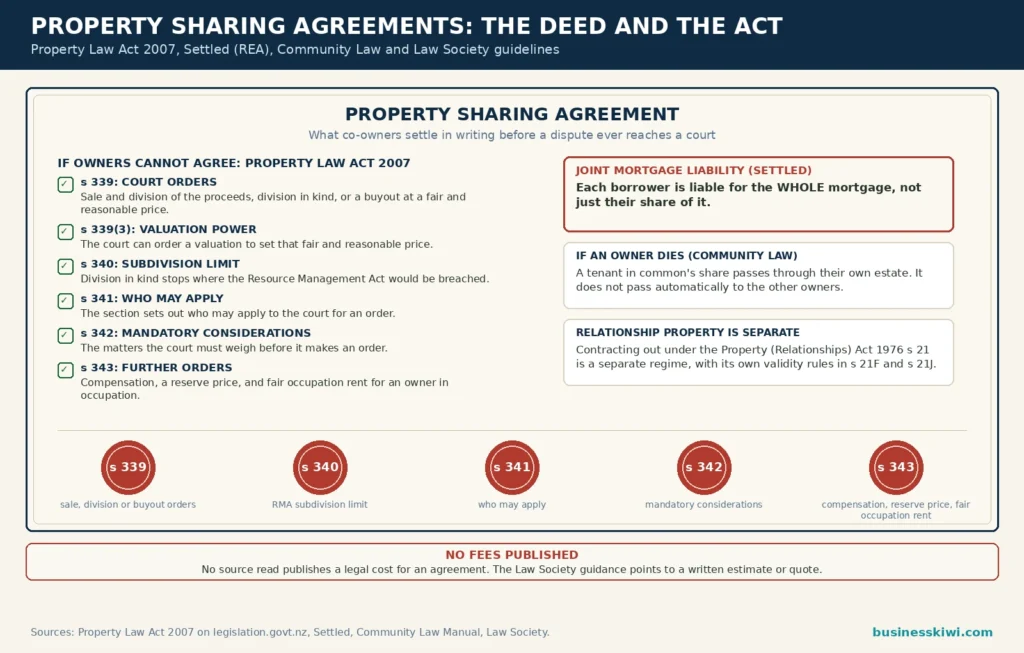
The mortgage, and a plan for missed payments. This is the clause people most often get wrong, because they misunderstand the starting position. As Settled puts it, you may own only part of the house, but you are liable for the whole mortgage. Co-owners are jointly liable to the lender. Settled also explains how the borrowing is usually structured: one mortgage over the property, split into parts, so each owner can structure their part as they prefer, fixed or floating, and pay it down at their own pace. Even so, the joint liability remains: paying your part off faster does not release you while the others still owe money.
The agreement cannot change any of that as between you and the bank. What it can do is set out what happens between the owners if one of them cannot pay: whether the others will cover the shortfall, how covering payments are recorded, whether they are treated as a loan to the defaulting owner or buy the covering owners a larger share, and at what point a default triggers the buyout or sale machinery. Settled urges buying groups to talk these scenarios through in detail before they happen, including loan default, one owner wanting to sell early, and a major unexpected repair. The agreement is where the answers get recorded.
Outgoings: rates, insurance, maintenance and repairs. The agreement should allocate the running costs: council rates, house insurance, routine maintenance and repairs. It should say whether costs are shared in line with ownership shares or some other way (for example, an owner who lives in the property paying more of the day-to-day costs), set a spending threshold above which everyone must agree before money is committed, and deal with how costs are paid and accounted for, such as a joint account each owner contributes to monthly. Routine maintenance and capital improvements should be treated separately, because they have different effects on value.
Insurance. Settled includes insurance in the list of things a written agreement should sort out: how much insurance each person will need to have. In practice the agreement should cover the house insurance itself (which the lender will require in any event), who arranges and pays for it, whether owners will hold life or income protection cover so a death or long illness does not immediately leave the others carrying the whole mortgage, and what happens to any insurance payout after damage to the property.
Who lives there, and what happens if use changes. The agreement should record the starting arrangement. Is everyone living in the property? Is one owner living there while the others hold their shares as an investment? Is it rented to third parties from the start? Then it should deal with change: what happens if the owner in occupation moves out, or if the group decides to rent the property out. Points to settle include whether an occupying owner pays anything for exclusive use, and how rent is shared if the property is let. This matters more than people think, because occupation has real value, and in a court dispute the Property Law Act 2007 expressly allows a court to order a person to pay a fair occupation rent for their use of the property.
Improvements and renovations. Planned work should need the level of agreement the owners choose, usually unanimous consent for anything major or structural. The agreement should say how improvements are funded, and whether an owner who funds or carries out improvements gets that recognised when the property is sold or their share is bought out. Record-keeping matters here too: under the Property Law Act, one of the things a court must weigh in a division dispute is the value of contributions each owner has made to the cost of improvements and maintenance. An owner who paid for a new roof and kept no records is in a far weaker position than one whose agreement required contributions to be logged.
Valuation: agreeing how a share is priced. Most exits involve someone buying someone else’s share, and the fight is almost always about price. The agreement should remove the fight in advance by naming the method: for example, a market valuation by a registered valuer appointed jointly, or two valuations (one chosen by each side) with the price set at the average. It should say who pays for the valuation, and whether the share is priced at its straight proportion of the whole property’s value. It is notable that the Property Law Act gives a court power to order a valuation before it decides a division application. The statute treats independent valuation as the natural starting point; your agreement should too.
First refusal. A tenant in common can in principle sell or leave their share to whoever they choose; Settled lists that freedom among the benefits of the structure. In practice, few groups want a stranger, or a co-owner’s new partner, arriving on the title uninvited. A first refusal (or pre-emptive rights) clause requires an owner who wants to sell to offer their share to the existing owners first, on stated terms and within a stated timeframe, before it can be offered to outsiders. The clause should also deal with gifts and transfers to family members or trusts.
Selling the whole property. Sometimes the right exit is a sale of the entire property. The agreement should say what can trigger one (for example, agreement of all owners, or a default that has not been fixed), how the sale is run, and how the proceeds are divided after the mortgage and sale costs are paid, including adjustments for unequal contributions and covering payments recorded under the earlier clauses. Without this, one owner generally cannot force the others to sell without going to court.
Death of an owner. For tenants in common there is no survivorship shortcut: as the Community Law Manual explains, the deceased owner’s share forms part of their estate and passes to whoever is named in their will, or under the intestacy rules if there is no will. The surviving owners may therefore find themselves co-owning with the deceased’s children, partner or other beneficiaries. The agreement cannot override a will, but it can manage the consequences: it can give the surviving owners an option to buy the share from the estate within a set period at the agreed valuation method, and require each owner to keep a current will consistent with the agreement. Keeping an up to date will is one of the simplest and most neglected parts of co-ownership.
Disputes: a ladder, not a cliff. A good agreement builds in steps: direct discussion first, then mediation, and only then court. The steps should have timeframes so a dispute cannot simply be stalled forever. Most co-ownership disagreements are about money and hurt feelings, and a structured process resolves them at a fraction of the cost of litigation.
Review triggers. Circumstances change, and the agreement should anticipate its own updating. Sensible triggers for a review include a refinancing, an owner moving in or out, a change in shares or contributions, major building work, or simply the passage of a set number of years.
If there is no agreement: the Property Law Act 2007 safety net
None of the above is legally required. There is no statute that says co-owners must have a property sharing agreement. What the law provides instead is a court process for unpicking co-ownership when it breaks down, in Part 6 of the Property Law Act 2007.
Under section 341, an application can be made by a co-owner (and in some situations by a mortgagee who has become entitled to exercise a power of sale, or a person holding a charging order over an owner’s share). Under section 339, the court can then make one of three orders:
- an order that the property be sold and the proceeds divided among the co-owners
- an order dividing the property in kind among the co-owners, although section 340 prevents a division that would subdivide land contrary to the Resource Management Act 1991
- an order requiring one or more co-owners to buy the share of one or more others at a fair and reasonable price
Before deciding, the court may order the property to be valued, under section 339(3). Section 342 requires the court to have regard to the extent of the applicant’s share, the nature and location of the property, the number of co-owners and the size of their shares, the comparative hardship of refusing or granting the order, the value of contributions any co-owner has made to improvements or maintenance, and any other relevant matters. If it makes an order, section 343 lets the court add supporting orders, including compensation between co-owners, a reserve price, directions about sale expenses and how proceeds are divided, permission for a co-owner to bid with a set-off instead of paying cash, and payment of a fair occupation rent. An order binds every co-owner, even one who was not a party to the proceeding, unless the court orders otherwise.
Notice something about that list: almost everything the court is empowered to sort out is something a property sharing agreement sorts out in advance, on terms the owners chose themselves. The Act is a safety net, not a plan. Reaching it means lawyers, court time and a decision imposed by someone who has never met you.
A separate warning for couples
If the co-owners are a couple, there is a second legal regime in play. The Property (Relationships) Act 1976 sets default rules for how a couple’s property is divided when a relationship ends, and those rules can override what the title says and what the partners assumed applied. A property sharing agreement between partners does not, by itself, contract out of that Act.
Couples who want their own arrangement to govern can make a contracting out agreement under section 21 of the Property (Relationships) Act 1976, sometimes called a prenuptial agreement. The Community Law Manual describes it as the only binding way for a couple to divide their property differently from the Act, other than court orders, and sets out the strict validity requirements: the agreement must be in writing and signed by both parties; each party must receive independent legal advice from a separate lawyer before signing; each signature must be witnessed by a lawyer; and the witnessing lawyer must certify that they explained the effect and implications of the agreement before it was signed. Even then, a court can set a contracting out agreement aside if it would cause serious injustice.
The Law Society’s conveyancing guidelines flag exactly this point for lawyers: where a purchasing client says the property is to be their separate property under the Property (Relationships) Act, the lawyer should explain that the client may need to buy in their own name, enter into a section 21 contracting out agreement, or both. The practical message is simple. If you are buying with a partner, tell your lawyer about the relationship and take advice on whether you need a property sharing agreement, a contracting out agreement, or both. Do not assume one document silently does the other’s job.
Getting the agreement made
Timing. The best time is before the purchase settles, and ideally before you sign the sale and purchase agreement, because the agreement should line up with the shares going on the title and the way the mortgage is structured. It can be done later, any time co-owners agree, and doing it late is far better than not doing it at all. But later is harder: the conversations the agreement requires are easiest before anyone has a grievance.
Independent advice. Each owner should have the agreement explained to them by a lawyer acting for them. Where owners’ interests are identical and simple, one lawyer sometimes drafts for the group, but each owner should still take their own advice, because the agreement deals precisely with the situations in which the owners’ interests conflict. For couples’ contracting out agreements under the Property (Relationships) Act, independent advice from separate lawyers is not just sensible, it is a legal requirement for validity. Ask for a written estimate or quote before work starts: the Law Society’s guidelines say property lawyers should provide estimates or quotes in writing before work begins, and that a lawyer cannot charge more than a quote given, subject to limited exceptions.
Form and keeping. The agreement should be in writing and signed by every owner. Keep signed copies somewhere safe and accessible, not buried in a conveyancing file nobody can find in ten years. If shares or contributions later change, do not rely on a handshake amendment: record the change properly, with legal help, and if the title shares themselves change, that change is made by registering the appropriate transfer with Land Information New Zealand.
Common mistakes
Assuming the title tells the whole story. Equal shares on the title plus an unequal deposit plus no agreement is the most common setup for a co-ownership dispute. The title is the starting point for what each owner gets out; if the real deal was different, it needed to be written down.
Skipping the exit clauses. Groups happily agree on shares and costs, then go vague on selling, buyouts and death because those topics feel negative. They are the whole point of the document. An agreement without a workable exit mechanism leaves the hardest problem to the Property Law Act and the court.
No valuation method. “We will get it valued” is not a method. Which valuer, appointed by whom, paid for by whom, and what happens if the two sides’ numbers are far apart all need to be answered in advance.
Forgetting the mortgage reality. Owners who think of the mortgage as “my half and your half” are surprised to learn they are each liable for the whole debt, that their credit records are linked while the joint borrowing lasts, and that a lender will generally count their share of the property as their asset but the whole mortgage as their liability when they apply to borrow again. Settled lists all three as risks of buying with others. An agreement that plans for missed payments is the only control the owners have over that exposure.
Never reviewing it. Shares stay the same while lives change. An agreement written for two friends flatting together may be hopelessly wrong five years later when one has moved out, the property is tenanted, and contributions have drifted. Build in reviews, and actually hold them.
Frequently asked questions
Is a property sharing agreement legally required in New Zealand?
No statute requires co-owners to have one. It is, however, the document both Settled and the New Zealand Law Society’s conveyancing guidelines point to for anyone buying as tenants in common: Settled calls a lawyer-drawn co-ownership agreement essential for a buying group, and the Law Society guidelines direct lawyers to advise clients buying in shares about the benefits of a separate agreement covering their ownership terms, including what happens if one owner wants to sell their share.
Is the agreement registered on the title?
No. The record of title records the owners and the shares they hold, and Land Information New Zealand maintains that register. The agreement is a private contract between the owners. It works alongside the title rather than forming part of it, which is why each owner should keep their own signed copy.
What happens if one co-owner stops paying the mortgage?
As far as the lender is concerned, the owners are jointly liable: Settled’s warning is that you can own half the house and still be liable for the whole mortgage, and if one owner cannot keep up their repayments the others must cover the shortfall to protect the property and their own credit records. A good agreement prepares for this in advance by setting out how covering payments are recorded and adjusted, and what happens next, which can include the defaulting owner’s share being bought out or the property being sold.
Can I sell my share to someone outside the group?
A tenant in common holds a distinct share that they can sell or leave to whoever they choose. In practice, most property sharing agreements restrict this with a first refusal clause, so the share must be offered to the existing owners first. There are practical limits as well: a part share in a property is a hard thing to sell to a stranger, and any incoming owner has to fit with the existing mortgage arrangements.
What happens to a share when a co-owner dies?
If the property is held as tenants in common, the deceased owner’s share becomes part of their estate and passes under their will, or under the intestacy rules if they had no will. That is different from a joint tenancy, where the surviving owner automatically becomes the sole owner. A property sharing agreement usually deals with this by giving the surviving owners an option to buy the share from the estate at a value worked out by the agreed method, and by requiring every owner to keep a current will.
Can a co-owner force a sale if we cannot agree?
Ultimately, yes, through the court. Under sections 339 to 343 of the Property Law Act 2007, a co-owner can apply to the court, which can order the property sold and the proceeds divided, order a division in kind, or require one or more owners to buy another’s share at a fair and reasonable price. The court weighs matters including the size of the shares, comparative hardship and contributions to improvements and maintenance. It is a genuine remedy, but it is litigation, with the cost, delay and loss of control that involves.
We are a couple buying together. Is a property sharing agreement enough?
It may not be. Couples are also subject to the Property (Relationships) Act 1976, which applies its own property division rules when a relationship ends. To set those rules aside, a couple needs a contracting out agreement under section 21 of that Act, which has strict requirements, including independent legal advice from separate lawyers for each partner and lawyer certification. Tell your lawyer you are a couple and ask whether you need one document or both.
How much does it cost to have an agreement drawn up?
There is no standard figure, and this guide will not invent one. The cost depends on the number of owners and how complex the arrangements are. What you can do is ask each lawyer involved for a written estimate or quote before work starts. The New Zealand Law Society’s guidelines say property lawyers should provide these in writing before work commences, so asking is normal practice, not an imposition.
Sources
- Settled (Real Estate Authority), Should I buy a house with a group of friends?: https://www.settled.govt.nz/blog/should-i-buy-a-house-with-a-group-of-friends/
- Parliamentary Counsel Office, Property Law Act 2007, Part 6 subpart 5 (version as at 20 October 2022): https://demo.legislation.govt.nz/act/public/2007/91/en/2022-10-20.pdf
- Community Law, Community Law Manual, Dealing with the deceased’s property: Wills, intestacy, and the courts: https://communitylaw.org.nz/community-law-manual/chapter-16-a-death-in-the-family/dealing-with-the-deceaseds-property-wills-intestacy-and-the-courts/
- Community Law, Community Law Manual, Making your own agreement to divide your property: “Contracting out”: https://communitylaw.org.nz/community-law-manual/chapter-12-relationships-and-break-ups/dividing-your-property-when-you-split-up-relationship-property/making-your-own-agreement-to-divide-your-property-contracting-out/
- New Zealand Law Society, Property Law Section Guidelines (June 2021): https://www.lawsociety.org.nz/assets/Branches-Sections-and-Groups/Property-Law-Section/Guidelines/PLS-Guidelines-June-2021-v3.pdf
- Land Information New Zealand, Land registration glossary: https://www.linz.govt.nz/guidance/land-registration/land-registration-glossary
This article is general information about property sharing agreements in New Zealand. It is not legal advice, and it is not a substitute for advice about your own circumstances. Co-ownership arrangements have long-term legal and financial consequences, and the right documents depend on the owners, their relationships and the property involved. Before buying property with others, or signing any agreement about a property you co-own, get independent legal advice from your own lawyer.