Tenants in Common in NZ: Shares, Rights and What Happens When Things Change

Buying a house with a partner, a sibling, a friend or another investor is now a normal route onto the property ladder in New Zealand. What receives far less attention is the legal shape of that ownership. When two or more people own land together, the register records them in one of two ways: as joint tenants, or as tenants in common. The choice looks like a technicality at settlement. It is not. It decides what happens to your interest if you die, whether you can sell or leave your share to someone else, and how much leverage you have if the arrangement breaks down.
This guide explains tenants in common in plain terms: what the shares mean, how they appear on the record of title, the rights and obligations that come with them, and the points where co-owners most often come unstuck. It is general information about the legal framework, drawn from Land Information New Zealand (LINZ) guidance, the Property Law Act 2007, the Real Estate Authority’s consumer site Settled, and Community Law. It is not legal advice, and co-ownership is an area where an hour with a lawyer before you sign is money well spent.
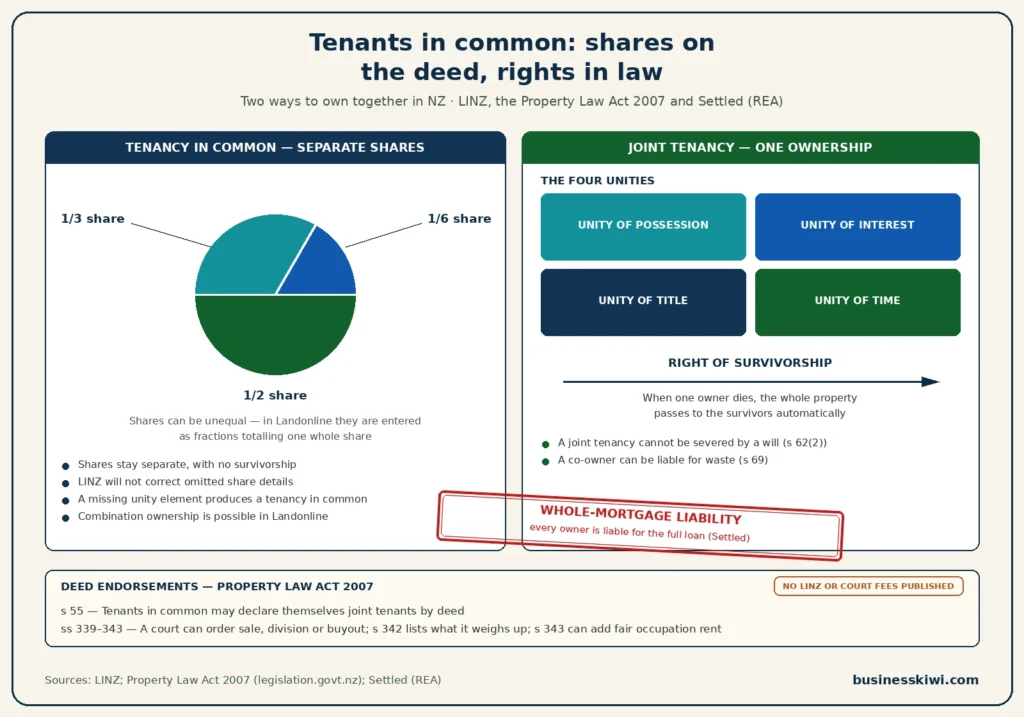
The two ways to own property together
New Zealand law gives co-owners two basic structures. They differ in one fundamental respect: whether each owner has a separate, identifiable share.
Joint tenancy: one ownership, no separate shares
Joint tenants do not hold individual shares at all. Together they own the whole property, and each of them is entitled to possess the whole of it. LINZ guidance explains that a joint tenancy can only be created where four essential elements, known as the four unities, are all present. Each joint tenant must acquire their interest under the same instrument, at the same time, with an equal interest in the property, and with an equal right to possess the entire property. If any one of those elements is missing, a joint tenancy cannot be created and the resulting ownership is a tenancy in common instead.
The defining feature of joint tenancy is survivorship. When one joint tenant dies, the survivor or survivors simply own the property in full. The deceased person’s interest does not form part of their estate and cannot be left to anyone in a will. In fact, the Property Law Act 2007 states the point directly: a joint tenancy is not severable by will (section 62(2)). Joint tenancy is the structure most couples choose, precisely because the property passes automatically to the survivor.
Tenancy in common: distinct shares in one property
Tenants in common each hold a distinct share in the property. The shares can be equal, such as a half each, or uneven, such as one owner holding a quarter and another holding three quarters. Each share is a separate asset belonging to that owner. It can be sold, transferred, given away or left in a will, and it does not disappear into the other owners’ hands when the owner dies.
That separateness is why tenancy in common is the usual choice where the buyers are not a couple, where contributions are unequal, or where an owner wants their share to go to their own children or estate rather than to a co-owner. Settled, the Real Estate Authority’s consumer site, describes tenancy in common as the more popular option for friends buying together, because each owner’s share is distinct and passes to their estate if they die.
What “undivided share” actually means
You will often see tenants in common described as holding “undivided shares”, and the phrase causes confusion. An undivided share is a share of the whole property, not ownership of a particular part of it. A person with a one-third share does not own the back bedroom and the garage. They own one third of everything, and like every other co-owner they are entitled to occupy and use the whole property unless the owners have agreed otherwise between themselves.
This has practical consequences. No co-owner can fence off a section and call it exclusively theirs. No co-owner can point to a room and say their share lives there. The share is a proportion of the value and of the ownership, not a slice of the physical land, until and unless the property is actually divided or sold.
How to tell which form a property is held in
The answer sits on the record of title, the official register record LINZ maintains for the land. Community Law’s manual describes the difference in wording. Where owners hold as joint tenants, the title names them together without shares, in the form “owned by [name] and [name]”. Where they hold as tenants in common, the title records each owner against their share, in the form “owned by [name] as to a ½ share, and [name] as to a ½ share”.
When a transfer is prepared in Landonline, LINZ’s registration system, the person lodging it must select whether the buyers take the property as sole or joint tenants, or as tenants in common or a combination. For tenants in common, each owner’s share is entered as a fraction, and the fractions must total one whole share. So a title might show one owner with a ¼ share and another with a ¾ share, adding to the whole.
Combinations are possible too. LINZ gives the example of one owner holding a ½ share while two others are joint tenants between themselves as to the other ½ share. Within that joint tenancy half, survivorship applies between those two owners. Between them and the first owner, the ownership is a tenancy in common.
If you already own property with others and are unsure of the structure, ask your lawyer to obtain the record of title and explain the ownership line. Do not rely on memory or on what was said at purchase time. The register is what counts, and it is also where any change has to be recorded.
Choosing and recording your shares
Shares do not have to match. The most common pattern is equal shares, but the proportions can reflect whatever the owners decide, and buyers often set them by reference to their contributions to the deposit and purchase price. One sibling putting in twice the deposit of another might take a two-thirds share against the other’s one-third, for example.
Whatever is agreed needs to be carried through into the transfer documents at purchase, because the shares recorded on the register are the shares the law works with. LINZ’s guidance on amalgamating shares is a useful warning about how literally the register is kept. If a transfer leaves one person holding separate shares, those shares stay recorded separately unless the transfer instrument itself includes a recital asking for them to be amalgamated. LINZ will not fix an omitted recital later; the parties have to lodge a further transfer to correct it. The lesson generalises: get the ownership structure right in the documents the first time, because the register records what the instruments say, not what everyone intended.
It is also worth knowing that tenants in common can change their minds about the structure itself. Section 55 of the Property Law Act 2007 allows two or more people who hold property as tenants in common to declare, by deed, that they are joint tenants of it. The reverse journey, from joint tenancy to tenancy in common, is discussed below.

Rights and responsibilities of tenants in common
Ownership of a share carries a bundle of rights and obligations that apply whether or not the owners have written anything down.
Occupation. Every co-owner is entitled to occupy the whole property. One owner cannot lawfully lock another out or treat part of the property as their own private territory, because the shares are undivided. Where one owner lives in the property and the others do not, questions of fairness around money usually have to be sorted out by agreement. If matters ever reach a court under the Property Law Act, one of the further orders available under section 343 is an order requiring the payment of a fair occupation rent for all or part of the property. That power sits within a court-ordered division or sale, but it shows the direction of the law: exclusive occupation by one owner is not necessarily free.
Outgoings and maintenance. Rates, insurance, mortgage payments and upkeep have to be paid by someone, and the default expectation is that owners contribute in line with their shares unless they have agreed something different. Section 342 of the Property Law Act is relevant background here: when a court decides whether to order a division or sale, one of the matters it must consider is the value of any contribution a co-owner has made to the cost of improvements or maintenance. Owners who quietly carry the costs for years should keep records, because contributions can matter if the ownership is ever unwound by a court.
Care of the property. A co-owner who damages the property is not untouchable. Section 69 of the Property Law Act makes a co-owner of land liable in damages to the other co-owners for loss arising from acts or omissions that would amount to the tort of voluntary waste or equitable waste if done by a life tenant or lessee. In ordinary language, deliberately or carelessly running the property down can create a legal liability to your co-owners.
The mortgage reality. Where the property has a joint mortgage, the ownership shares do not limit what the bank can claim. Settled warns buyers about this plainly: you might own half the house, but you are liable for the whole mortgage, and if a co-owner stops paying, the others must cover the shortfall. Your credit record is linked to your co-owners for as long as the loan lasts. Tenancy in common divides the ownership; it does not divide the debt risk.
What happens when a co-owner dies
This is where the two structures diverge most sharply.
If a tenant in common dies, their share does not go to the surviving owners. The share is part of the deceased’s estate. Community Law explains that it passes to whoever is named in the deceased’s will, or, if there is no will, under the laws of intestacy administered through the estate process. The executor or administrator deals with the share along with the rest of the estate, and dealing with an estate that includes land generally involves an application to the High Court for probate or letters of administration.
The contrast with joint tenancy is stark. A joint tenant’s interest simply ends at death and the survivors own the whole property, outside the estate and regardless of what any will says. Couples sometimes discover, too late, that they bought as joint tenants when one of them had children from an earlier relationship who were meant to inherit a share. The title structure overrides the intention. If you hold as tenants in common, a current will matters just as much, because your share will go where your will, or the intestacy rules, send it.
One further overlay deserves a mention. If the deceased was in a marriage, civil union or de facto relationship, relationship property law can interact with the estate. A surviving partner may have a choice between taking under the will or intestacy and applying for a division of relationship property under the Property (Relationships) Act 1976. The form of ownership on the title does not by itself decide that question. This is specialist territory with strict time limits, and the only safe advice is to get a lawyer involved early.
Selling or transferring a share
Because a tenant in common’s share is a separate asset, it can be dealt with separately. An owner can transfer their share to one of the other owners, which LINZ’s guidance shows is a routine registration: one owner transfers their share, and the remaining ownership continues as a tenancy in common across the resulting shares. A share can also be transferred to an outsider, who then steps into co-ownership with the remaining owners.
In practice, a share in a house is a hard thing to sell to a stranger. The buyer would be purchasing a fraction of a property they must share with people they do not know, with no right to any particular rooms, and most buyers will not touch it or will only offer a steep discount. The realistic exits for a tenant in common are usually a buyout by the other owners, or a sale of the whole property with the proceeds divided by shares. That is exactly why the exit arrangements belong in a written agreement made at the start, when everyone is still getting on.
Transferring a share also matters for joint tenants. LINZ’s worked examples show that if one joint tenant transfers their interest to someone else, the joint tenancy cannot survive that dealing: the result is a tenancy in common in shares. Lawyers call this severance. It can happen through dealings with the interest during the owner’s lifetime, but it cannot be done by will, as section 62(2) makes clear. Severance is one of the classic ways a joint tenancy ends without anyone selling the property itself. Anyone relying on severance, or worried it may have happened, needs legal advice on their specific documents rather than assumptions.
A share is also an asset that creditors can look to. If a co-owner gets into serious financial difficulty, their share is part of what they own, and the Property Law Act even allows a person holding a charging order over a co-owner’s property to apply to the court for a division or sale order under section 341. A co-owner’s bankruptcy or debt problems are therefore not only their problem. This, too, belongs in the early conversations before you buy together.
When co-owners disagree
Disagreements usually follow a pattern: one owner wants to sell, another wants to stay; one wants to renovate, another cannot afford it; one has moved out and resents paying for a property they no longer use. The first tools are negotiation and any dispute process the owners agreed in writing at the start. Mediation is often the sensible next step, and it is far cheaper than court.
If agreement cannot be reached, the Property Law Act 2007 provides the backstop. Under section 339, a court may make an order in respect of property owned by co-owners for one of three outcomes: the sale of the property and division of the proceeds among the co-owners; the division of the property in kind among the co-owners; or an order requiring one or more co-owners to purchase the share of another at a fair and reasonable price. Any co-owner can apply under section 341, and the application must be served on the other co-owners and on others with an interest in the property that may be affected.
The decision is discretionary, not automatic. Under section 342, the court must have regard to the extent of the applicant’s share, the nature and location of the property, the number of other co-owners and the extent of their shares, the hardship that refusal would cause the applicant compared with the hardship the order would cause anyone else, the value of contributions any co-owner has made to improvements or maintenance, and any other matters the court considers relevant. The court may order a valuation before deciding. Alongside a main order, section 343 lets the court make further orders, including compensation payments between co-owners, fixing a reserve price on a sale, directing how sale expenses and proceeds are dealt with, allowing a co-owner to bid for the property, and requiring payment of a fair occupation rent. Division of land in kind has a limit under section 340: the court cannot order a division that would subdivide land contrary to the Resource Management Act 1991, and in that situation it may turn to a sale or buyout order instead. Orders under section 339 bind every co-owner, whether or not they were a party to the proceeding, unless the court orders otherwise.
The existence of this jurisdiction is worth understanding before you buy. It means no co-owner can be locked into a property forever against their will, but it also means any co-owner can set a court process in motion that may end in a forced sale. A good written agreement does not remove the court’s powers, but it usually prevents the relationship reaching that point.
Buying with others: the practical steps
Most of the pain in co-ownership is avoidable, and it is avoided at the start. The steps that matter are these.
Get independent legal advice, each of you. Settled puts hiring a lawyer to draw up a co-ownership agreement at the centre of buying as a group, and it advises having the crucial conversations before anyone signs. Where interests may diverge, and they usually do eventually, each party should have their own lawyer rather than sharing one.
Decide the structure and shares deliberately. Talk through joint tenancy versus tenancy in common with your lawyers, decide the proportions, and make sure the transfer documents match the decision. Remember that if any of the four unities is missing, you will be tenants in common whether you meant it or not.
Put a property sharing agreement in writing. Settled identifies the contents a co-ownership agreement needs to cover: the proportions of ownership, liability for costs, what happens on on-selling of shares, what happens if one person wants to sell, what happens if one person does not want to live in the house while the others do, and how much insurance each person needs to have. To that list, experienced buyers add: how outgoings and mortgage payments are shared, how the property is valued on a buyout, a first option for co-owners to buy a departing owner’s share, what happens on a death, how long the arrangement is expected to last, and a dispute process that starts with negotiation and mediation rather than lawyers’ letters.
Sort the wills at the same time. If you hold as tenants in common, your share goes where your will says. Buying together without updating your will leaves the share to chance and to the intestacy rules.
Keep records. Contributions to the deposit, the mortgage, improvements and maintenance should be documented as they happen. If the ownership is ever unwound, by agreement or by a court applying section 342, the paper trail is the evidence.
Talk about the awkward scenarios before they happen. Settled’s suggested questions for house purchase partners include what happens if one person wants to sell earlier than the others, what happens if someone loses their job or cannot work, and what you will do if prices have fallen when you want to sell. None of these conversations is comfortable. All of them are easier before money is committed.
A final boundary note: despite the name, tenants in common are owners, not renters. Community Law makes the point explicitly: in this context “tenants” is about ownership, not about renting or leasing property, and the Residential Tenancies Act has nothing to do with it. Co-owners who let the property to actual tenants step into landlord obligations as a separate matter.
Frequently asked questions
What is the difference between tenants in common and joint tenants?
Joint tenants own the whole property together without separate shares, and when one dies the survivors own the whole property automatically. Tenants in common each hold a distinct share, which can be unequal, and that share is their own asset: it can be sold, transferred or left in a will, and it forms part of their estate when they die.
Can tenants in common own unequal shares?
Yes. The shares can be set in whatever proportions the owners agree, such as a quarter and three quarters, or a third and two thirds. On the register the shares are recorded as fractions and must total one whole share.
What happens to my share if I die?
It passes through your estate. If you have a will, the share goes to whoever you have left it to. If you do not, it is distributed under the laws of intestacy. It does not pass automatically to your co-owners. That is the opposite of joint tenancy, where survivorship gives the whole property to the surviving owners.
Can I sell my share without the other owners agreeing?
A share is a separate asset and can be transferred, including to someone outside the group. In practice, shares in a shared property are difficult to sell to outsiders and the realistic options are usually a buyout by your co-owners or a sale of the whole property. A property sharing agreement may also restrict how shares can be sold, so check it and take advice before acting.
Can one co-owner force a sale of the whole property?
A co-owner can apply to the court under section 339 of the Property Law Act 2007 for an order for sale and division of the proceeds, for division of the property in kind, or for another co-owner to buy their share at a fair and reasonable price. The court decides after weighing the matters in section 342, including the shares, the hardship on each side and contributions to the property, so an order is possible but never guaranteed.
How can I check how a property I own is held?
Look at the record of title. Joint tenants are named together without shares; tenants in common are each recorded against a share, such as “as to a ½ share”. Your lawyer can obtain the title from LINZ and confirm the structure.
Do we need a written agreement if we trust each other?
Yes, in practice. Trust does not cover death, job loss, a new partner, a falling market or a simple change of mind, and those are the events that break co-ownerships. A written property sharing agreement records the shares, the cost sharing, the exit process and the dispute process while everyone still agrees, which is the only time it can easily be written.
Can tenants in common become joint tenants later?
Yes. Section 55 of the Property Law Act 2007 allows people who hold property as tenants in common to declare by deed that they are joint tenants. Take advice before doing it, because it changes what happens on death: survivorship replaces the ability to leave your share in your will.
Sources
- Land Information New Zealand, “Transfer creating a joint tenancy”, Land Registration Guide (linz.govt.nz). The four unities, survivorship, the consequence where an element is missing, and worked examples of resulting ownership.
- Land Information New Zealand, “Transfers with requests to amalgamate shares”, Land Registration Guide (linz.govt.nz). How shares are recorded, amalgamation recitals, and LINZ’s position on correcting omissions.
- Land Information New Zealand, “Prepare a transfer in Simple mode”, Landonline guidance (linz.govt.nz). Selecting sole or joint tenants or tenants in common on a transfer, shares recorded as fractions totalling one whole share, and combination ownership.
- Property Law Act 2007 (legislation.govt.nz), sections 55, 62, 69 and 339 to 343. Declaring joint tenancy by deed, joint tenancy not severable by will, co-owner liability for waste, and the court’s powers to order division or sale and the considerations and further orders that apply.
- Settled (Real Estate Authority), “Should I buy a house with a group of friends?” (settled.govt.nz). Consumer guidance on joint tenancy and tenancy in common, mortgage liability, and the role and contents of a co-ownership agreement.
- Community Law, Community Law Manual, chapter 16, “Dealing with the deceased’s property: Wills, intestacy, and the courts” (communitylaw.org.nz). How title wording shows the ownership form, survivorship, and a deceased tenant in common’s share forming part of the estate.
- Community Law, Community Law Manual, chapter 16, “Relationship property laws if your partner has died” (communitylaw.org.nz). The surviving partner’s choice between the will or intestacy and a relationship property division.
This article is general information about how co-ownership of land works in New Zealand. It is not legal advice, and it does not cover every situation: relationship property, trusts, cross-lease and unit title ownership, and tax can all change the picture. If you own property with others, are thinking of buying with others, or are in a dispute with a co-owner, talk to a lawyer about your own circumstances before you act.