Colony Eggs in New Zealand: What Colony Housing Means and How It Compares
The short answer
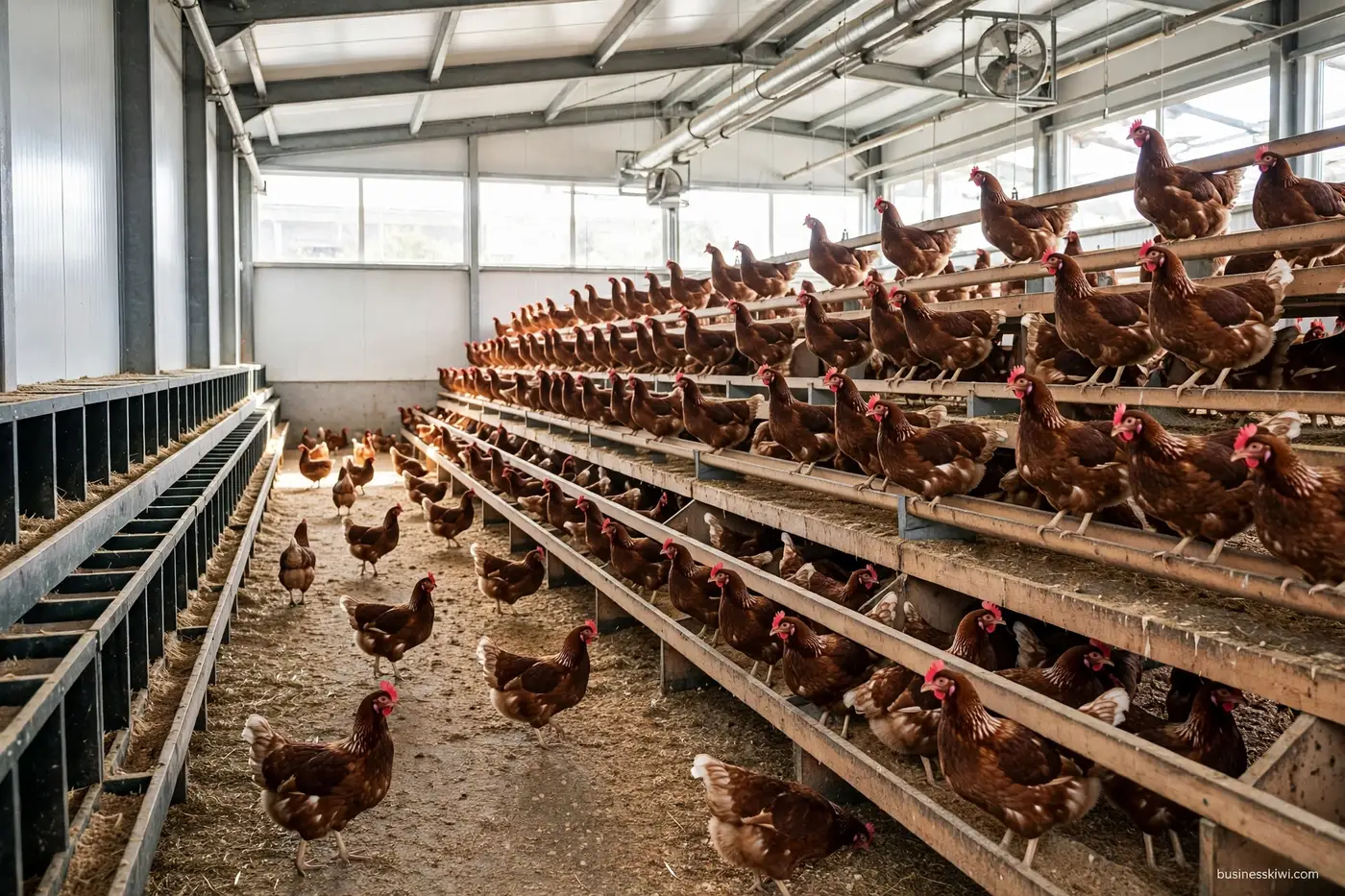
Colony eggs come from hens kept in colony cages. A colony cage is a larger, furnished cage that replaced the old conventional cage, often called the battery cage, in New Zealand. Each hen has at least 750 square centimetres of cage space, a secluded area for laying, perches and a scratching area, all inside a shed. Colony hens do not go outdoors. The system is lawful under the Code of Welfare: Layer Hens. It sits alongside barn eggs, from hens that roam inside a shed, and free range eggs, from hens that can also go out onto a range.
What colony housing is
The Code of Welfare: Layer Hens defines a colony cage as a modified and enlarged enclosure that has more space than cages and has perching, nesting and scratching areas. The same definition notes that colony cages may also be referred to as furnished cages or enriched cages. Those three names describe the same housing system, so a carton marked with any of them is describing caged housing.
The contrast is with the conventional cage. The Code defines a cage as an enclosure of metal or plastic holding three to seven hens, with no perches and no nest areas, sitting inside a building and often stacked in tiers. A colony cage is a much bigger unit shared by a much bigger group. In its report on the 2012 code, the National Animal Welfare Advisory Committee (NAWAC) recorded colony cages housing between 20 and 90 birds, typically 40 to 60. The Petitions Committee of Parliament, reporting in 2024, put the figure at up to 80 hens in each colony cage.
Colony cages were built as the halfway step between the barren cage and the open shed. NAWAC’s assessment, as MPI has summarised it, was that colony cages attempt to combine the hygiene and productivity of the cage system with some of the behavioural freedoms of non-cage systems. The furnishings are the point of difference. A conventional cage offered a hen feed, water and a sloping wire floor, and nothing else. A colony cage adds a separate place to lay, something to sit on above the floor, and an area where hens can scratch, while the birds stay in a controlled indoor environment for their whole laying life.
The New Zealand systems compared
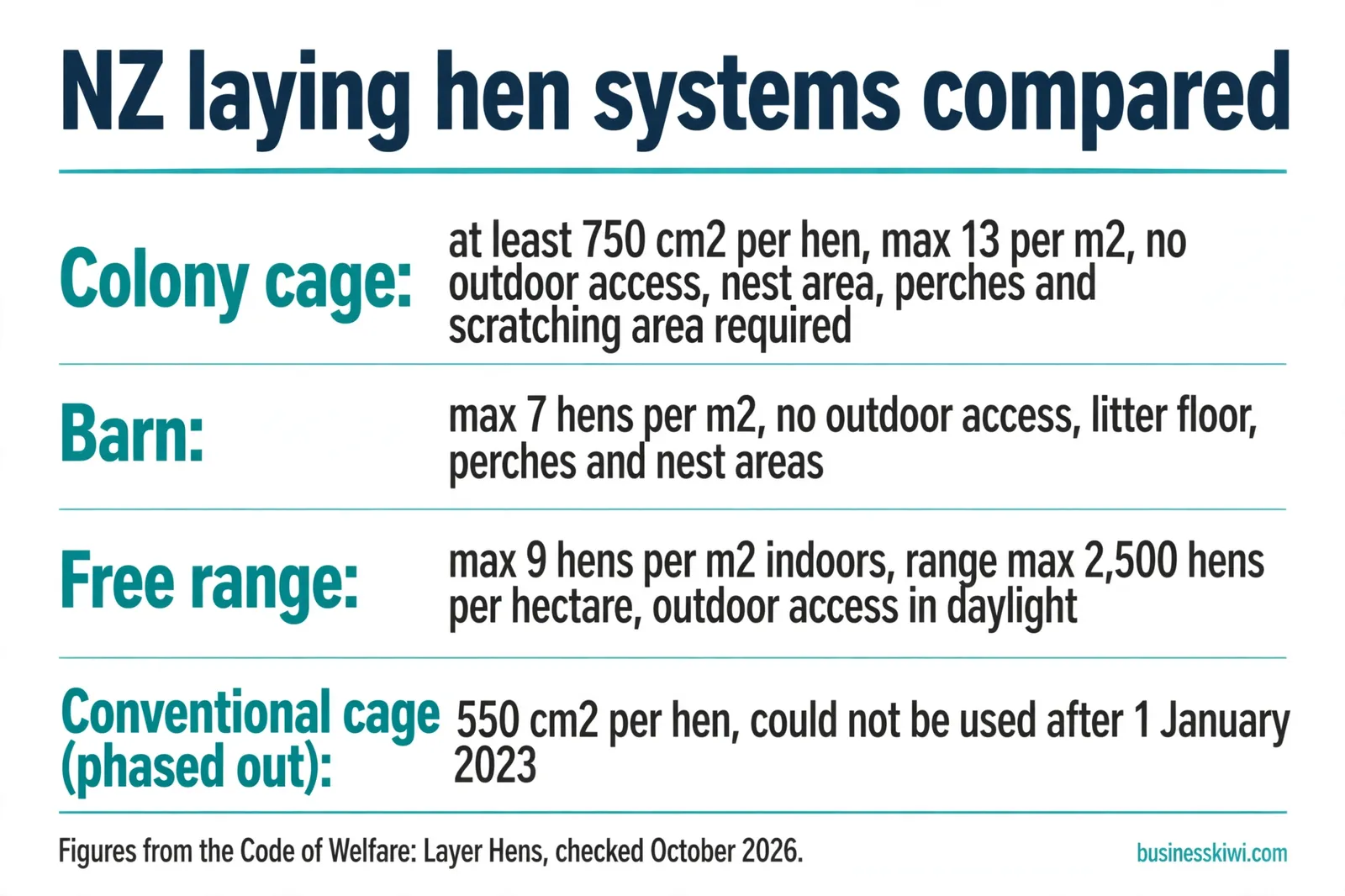
New Zealand now uses three laying hen systems: colony cages, barns without outdoor access, and barns with outdoor access, which are sold as free range. The Egg Producers Federation of New Zealand also lists organic among the production systems its members use. The conventional cage is history, but it belongs in the comparison because it explains where colony housing came from.
| System | How the hens are housed | Space the Code sets | Outdoor access | What the Code requires inside |
|---|---|---|---|---|
| Colony cage | A large furnished cage inside a shed, shared by a group of hens | At least 750 cm² per hen, and no more than 13 hens per m² | None | A secluded nest area with a covered floor, perches of at least 15 cm per hen, a scratching area, and claw-shortening devices |
| Barn | No cages. Hens move around a shed floor covered with litter | No more than 7 hens per m² | None | Perches, secluded nest areas, and good quality friable litter available at all times |
| Free range | No cages. A barn with openings to an outdoor range | No more than 9 hens per m² indoors, and no more than 2,500 hens per hectare on the range | Yes, during daylight hours | The barn fittings, plus a managed range with shelter and shade |
| Conventional cage (phased out) | A small cage holding three to seven hens, with no perches and no nest areas | 550 cm² per hen under the final standard | None | Nothing beyond the cage itself. The system could not be used after 1 January 2023 |
| Organic | Listed by the Egg Producers Federation as a New Zealand production system | Not published | Not published | Not published |
The table sets out the physical differences. It cannot show the management trade-offs, and NAWAC is open about those. MPI’s summary of NAWAC’s work records that hens in cage systems are kept in a finely controlled environment, which helps control many aspects of their health, but their behavioural needs are restricted. Hens in barns, with or without outdoor access, can express a wider range of behaviours, but their environment is harder to manage and carries greater health risks, including higher indoor levels of ammonia and dust, more disease pressure, and a greater risk of smothering and injurious pecking. NAWAC also recorded less injurious pecking and less feather loss in colony cages than in barns. No system was presented as best on every measure.
The rules: the Code of Welfare and the cage phase-out
Layer hen welfare sits under the Animal Welfare Act 1999. The Act places obligations on the people who own or are in charge of animals. Codes of welfare, developed by NAWAC and issued by the Minister of Agriculture, expand on those obligations. A code sets minimum standards, which use the word “must”, and recommended best practice, which goes further. The current Code of Welfare: Layer Hens came into force on 1 October 2018 and was amended in May 2021. Failing to meet a minimum standard in the code is not an offence by itself, but it can be used as evidence in a prosecution under the Act. Meeting the minimum standards is a defence.
One standard matters for every system. Minimum Standard No. 12 states that hens must have the opportunity to express a range of normal behaviours, including nesting, perching, scratching, ground pecking and dustbathing. NAWAC’s judgement in 2012 was that a furnished colony cage could give hens that opportunity, while a conventional cage could not. That judgement drove the phase-out.
The phase-out worked in steps. An amended code issued in December 2012 created a phased transition away from conventional cages, ending on 1 January 2023. The Animal Welfare (Care and Procedures) Regulations 2018 then set the deadlines in law, based on when a cage system had been installed. Cages installed before the end of 1999 had to stop being used, or be upgraded to the furnished standard, from 1 January 2019. Cages installed in 2000 and 2001 followed from 1 January 2021. Every remaining cage system had to meet the furnished specification from 1 January 2023. From that date, the only cages that can lawfully house laying hens in New Zealand are cages that meet the colony requirements: a nest area, perching space, a scratching area, at least 45 centimetres of height, and at least 750 square centimetres per hen.
The debate has not closed. Animal welfare groups petitioned Parliament to ban colony cages as well, and the Petitions Committee reported on that petition in September 2024. A majority of the committee did not support a ban. It considered that NAWAC’s review of the layer hen code, which is under way, is the appropriate avenue for the question. MPI’s position, given to the committee, is that colony cages were deemed to meet the minimum standard under the code, and that any regulatory change will be considered once NAWAC has completed its process.
Colony cage requirements in detail
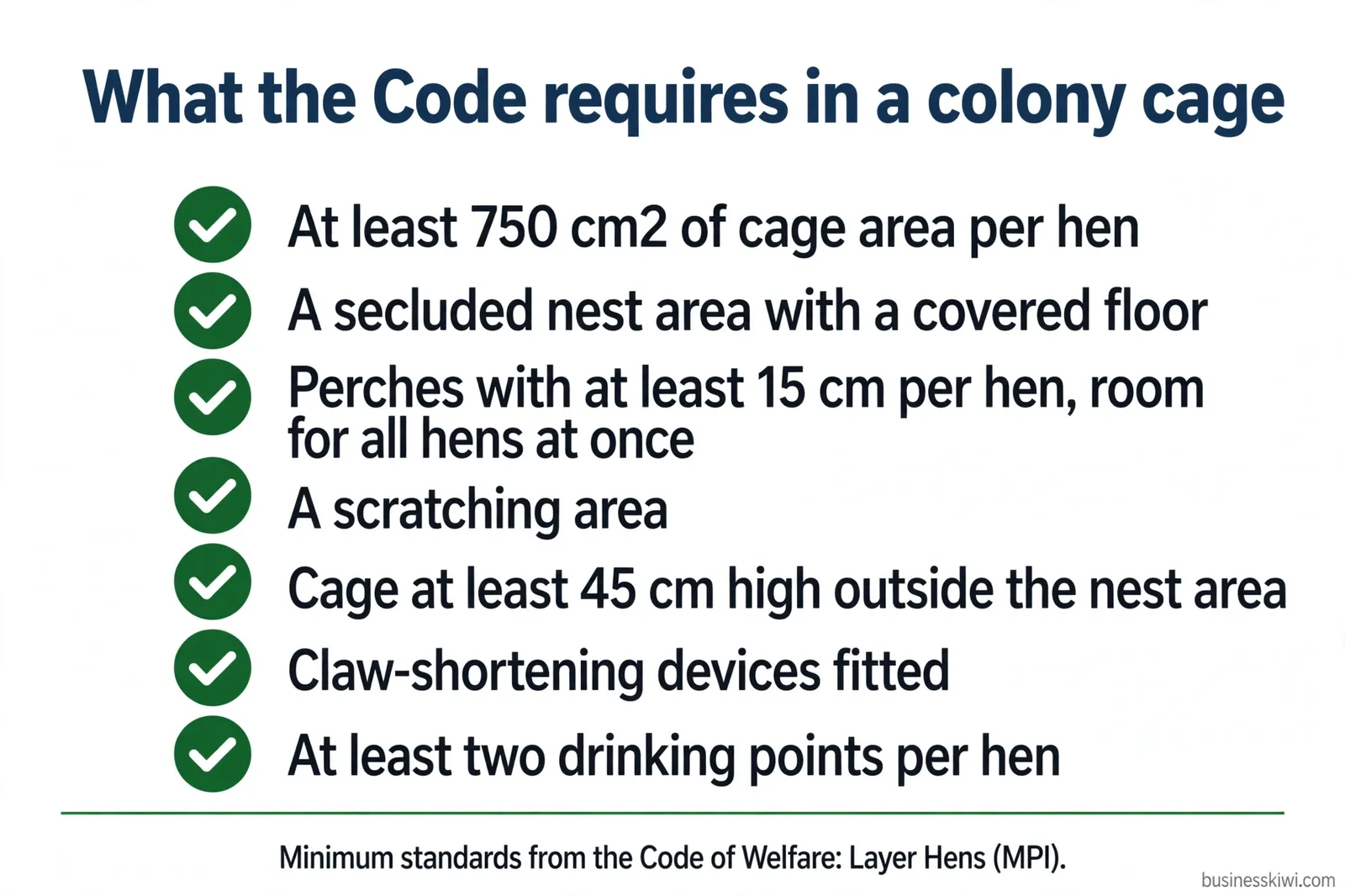
Minimum Standard No. 4 covers housing and equipment design. For housing systems other than cages, it requires facilities for roosting, a surface for pecking and scratching, and a secluded nesting area. It then sets specific design requirements for colony cages. There are six of them.
First, a secluded nest area must be provided, and the floor of the nest area must be covered with a suitable substrate that prevents direct contact with the wire mesh floor. Second, the floor slope must not exceed eight degrees, and the floor must support the hens’ forward facing claws. Third, the cage must be at least 45 centimetres high everywhere other than in the nest area. Fourth, perches must be provided, designed so a hen can grip without risk of trapping its claws, with at least 15 centimetres of perch space per hen so that all birds can perch at the same time. Fifth, a scratching area must be provided. Sixth, suitable claw-shortening devices must be fitted, which keep claws worn down in a system where hens do not scratch on the ground.
Other standards apply across the shed. Minimum Standard No. 6 sets the colony stocking density at a minimum of 750 square centimetres per hen, or 13 hens per square metre. Hens in cages must have access to at least two drinking points each. Minimum Standard No. 7 requires that hens without daylight access receive a light period, at a minimum of 20 lux at hen level, and that all hens get at least eight hours of continuous darkness in every 24 hours. Minimum Standard No. 8 requires action to lower ammonia if levels rise above 20 parts per million at hen level. Daily inspections are part of the system too: hens that cannot reach food and water have to be removed during daily inspections and raised separately or humanely destroyed.
It is worth knowing that the code also describes recommended best practice above the legal floor. For perches, best practice is at least 17 centimetres per hen rather than the 15 centimetre minimum, and perches fitted higher, at 40 to 50 centimetres, to reduce the risk of vent pecking. A farm can meet the code without meeting every best practice recommendation, so the minimum figures are the ones a buyer can rely on for every colony egg on the shelf.
Labelling: what the words on the carton mean
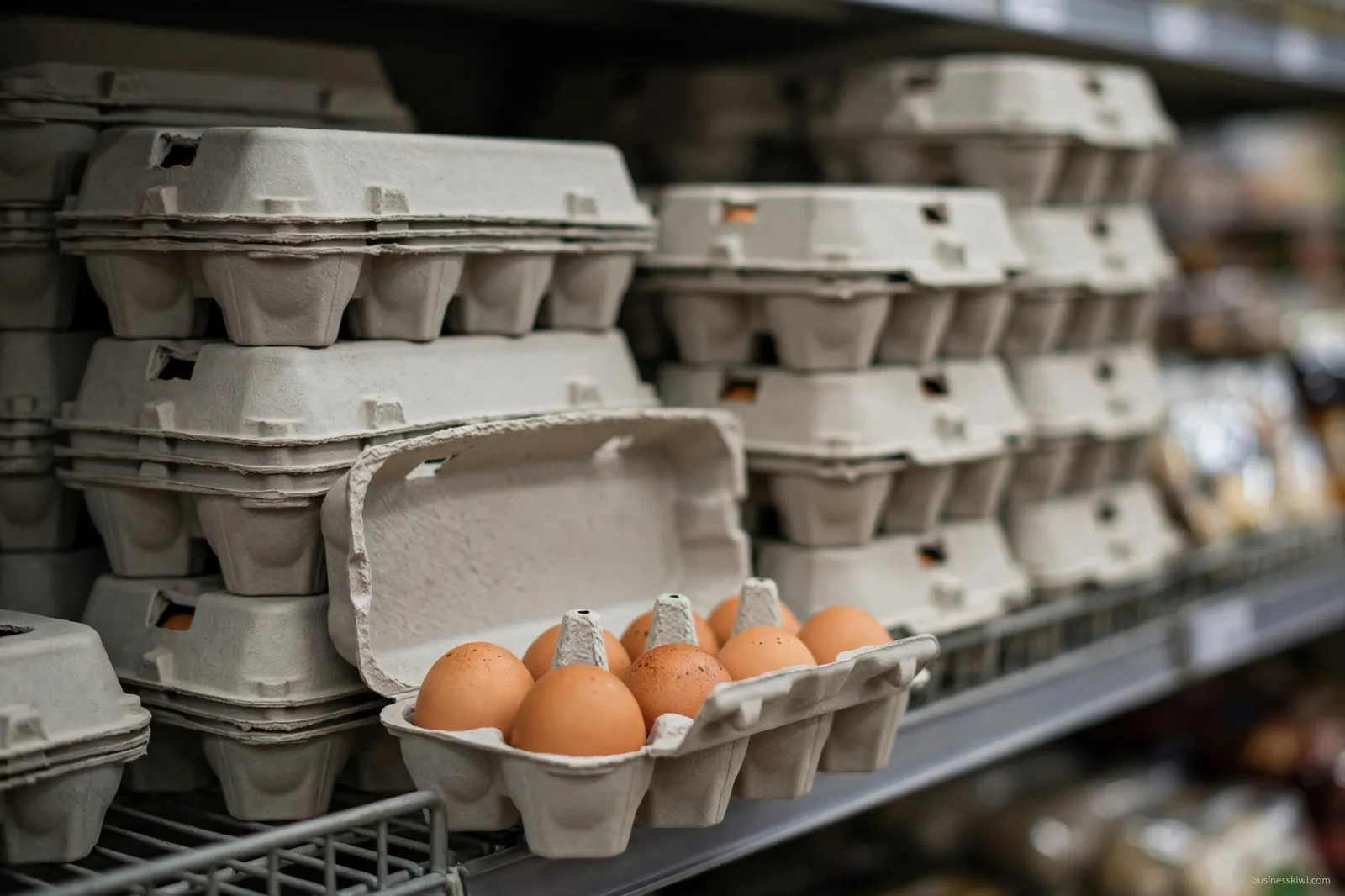
The words on an egg carton describe the housing system, and each word maps to one system in the table above. Colony means the hens lived in colony cages. Barn means the hens lived loose inside a shed, with no outdoor access. Free range means the hens lived in a barn with access to an outdoor range. Organic is listed by the Egg Producers Federation as a further system used in New Zealand.
There is no separate egg labelling statute in the sources behind this guide. The backstop is the Fair Trading Act 1986, which prohibits misleading or deceptive conduct and false or misleading representations. Commerce Commission guidance on free range claims states the principle plainly: the labelling of eggs must be accurate and able to be substantiated, and in normal circumstances it would breach the Act to label eggs as free range if the birds do not have access to outside space. In other words, a claim on a carton has to match the system the hens actually lived in, and the trader has to be able to prove it.
Two practical points follow. Colony is the only current carton term that describes a cage. Barn and free range are both cage free, and the difference between them is outdoor access, not the shed fittings. And where an egg is sold matters. MPI records that up to 85 percent of commercially farmed eggs are sold as table eggs, the cartons a shopper can read, while supermarkets represent around half of the total egg market and the rest goes mainly into baking and catering, where the end buyer never sees a carton.
Shoppers should also know that the two big supermarket groups committed to stop selling caged eggs. MPI records that Woolworths New Zealand and Foodstuffs announced in 2017 that they would go cage free by 2025 and 2027 respectively. Colony eggs remain lawful and remain in production, but the shelf space open to them in major supermarkets is shrinking as those commitments take effect.
The New Zealand flock picture
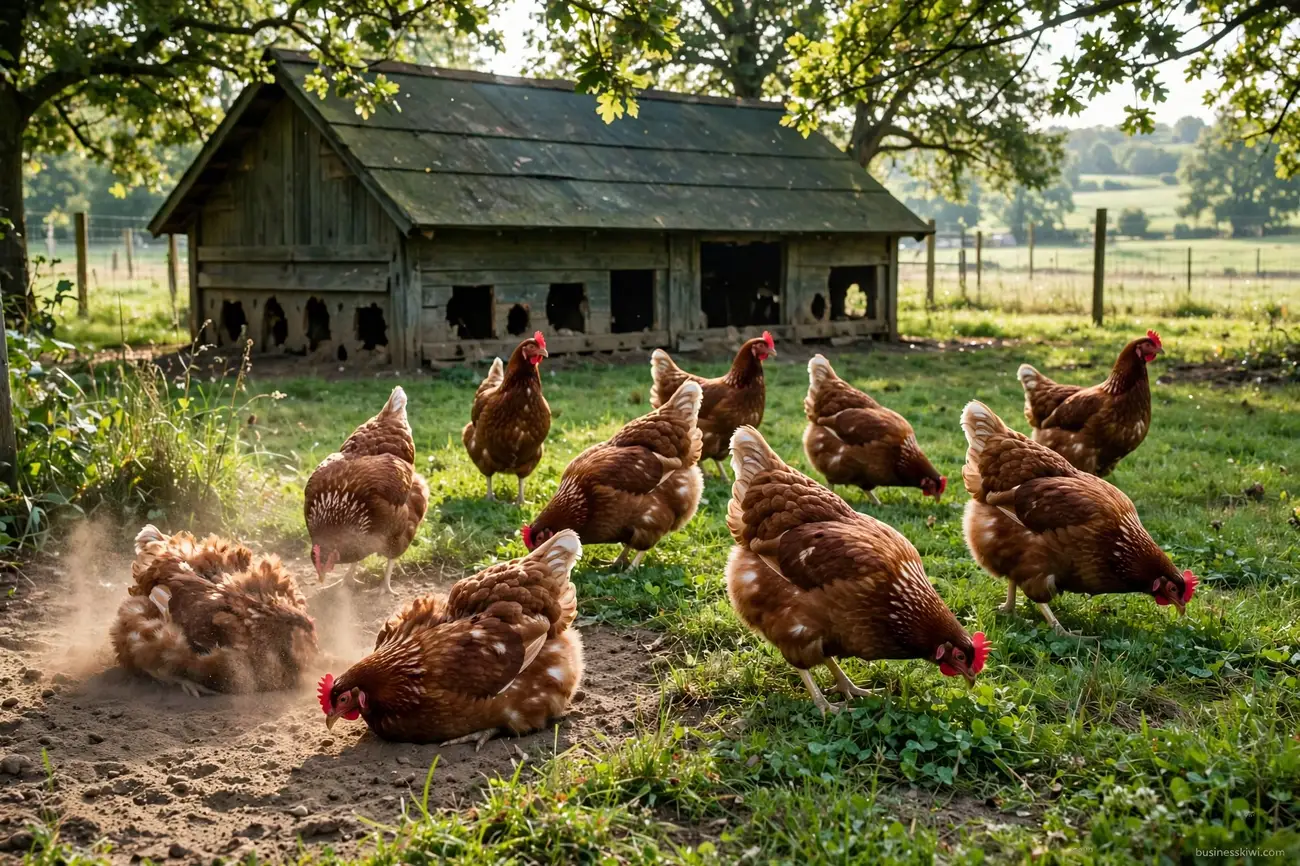
The Egg Producers Federation publishes the industry’s headline figures, and its current fact sheet, using industry production statistics for the year ended 31 December 2025, puts the picture at around 145 egg farms in New Zealand and a layer bird population of around four million birds. The industry produces 103 million dozen eggs a year. The Federation has 169 members. New Zealanders eat an average of 232 eggs each per year, about four and a half eggs a week, and eggs are bought by 70 percent of Kiwi households at least once a fortnight, according to consumer research the Federation cites from February 2025.
For the split between systems, the most recent official figures are MPI’s. In its August 2023 submission to Parliament, MPI estimated the commercial flock at 3.6 million birds, with 33 percent in colony cages and the remaining 67 percent in barn or free range systems. The Federation’s current fact sheet does not publish an updated split by system, so the one third figure is the latest official share available.
The shift behind those numbers is large. MPI published the flock share by system over time, sourced from the Egg Producers Federation’s 2022 report. In 2015, 81.4 percent of the flock was in conventional cages, 9.3 percent in colony cages and 9.3 percent in barn or free range systems. By 2022 the conventional share had fallen to 10.7 percent, colony had reached 33 percent and barn or free range 57 percent. In 2023, with the phase-out complete, conventional cages reached zero. Colony’s share has sat at about one third since 2021, while barn and free range production has done all of the growing.
How to choose as a buyer
Start with the system word on the carton, because that word carries the legal meaning. If you want eggs from hens that were never in a cage, choose barn or free range. If outdoor access matters to you, choose free range, and know what sits behind the term: a barn much like a barn system, plus a range that hens can use during daylight hours, stocked at no more than 2,500 hens per hectare. If you are content with caged housing that meets the current code, colony eggs are the present day version of the cage egg, with more space and furnishings than the battery cage they replaced.
Then weigh the trade-offs the official sources describe, rather than treating any system as perfect. Colony housing gives hens a controlled environment and, on NAWAC’s assessment, lower levels of injurious pecking and feather loss than barns. Barn and free range housing gives hens room to move, litter to scratch in and, for free range, the outdoors, at the cost of higher exposure to dust, ammonia, disease and pecking outbreaks if management slips. Every commercial system in New Zealand must meet the same code minimums for food, water, light, air quality and daily care, whichever carton you pick.
Finally, check the claim, not just the branding. Pictures of paddocks and words like natural or farm fresh are marketing. The system term is the part a trader must be able to substantiate under the Fair Trading Act. If a claim looks vague, the system word is the reliable guide.
For the farm side of animal care and safety duties, our dairy health and safety guide covers how one farming sector runs its safety system. If you are looking at farming as a business, our agriculture finance guide explains how farm funding works. And for the household side of food costs, our guide to dealing with the rising cost of living has practical steps. More guides like this one sit in our Business and Industry section.
Frequently asked questions
Are colony eggs cage eggs?
Yes. Colony eggs are laid by hens living in colony cages. The Code of Welfare: Layer Hens defines a colony cage as a modified and enlarged enclosure with perching, nesting and scratching areas, also called a furnished cage or an enriched cage. All three names describe caged housing.
Are colony cages legal in New Zealand?
Yes. Colony cages that meet the code’s requirements are lawful. What ended on 1 January 2023 was the conventional cage. Under the Animal Welfare (Care and Procedures) Regulations 2018, every cage system still in use from that date had to meet the furnished specification, with a nest area, perches, a scratching area and at least 750 square centimetres per hen.
How much space does a hen in a colony cage get?
The minimum is 750 square centimetres per hen, expressed in the code as no more than 13 hens per square metre. The Petitions Committee noted that each colony cage can house up to 80 hens. Under the final standard for the old conventional cage, a hen had 550 square centimetres.
What is the difference between colony, barn and free range eggs?
Colony eggs come from hens in furnished cages inside a shed. Barn eggs come from hens that live loose on a litter floor inside a shed, at no more than seven hens per square metre, with no outdoor access. Free range eggs come from hens in a barn, at no more than nine hens per square metre, that can also use an outdoor range stocked at no more than 2,500 hens per hectare.
When were battery cages banned in New Zealand?
The decision was made in the amended code of December 2012, with a ten year phase-out. The deadlines in the 2018 regulations stepped through 1 January 2019 for the oldest cages and 1 January 2021 for the next group. From 1 January 2023, conventional or battery cages could no longer be used at all.
Do colony hens ever go outside?
No. Colony cages sit inside a building, and the hens stay in the cage for their laying life. Outdoor access exists only in barn systems with a range, the systems sold as free range, where the code requires access to the range during daylight hours.
How many New Zealand hens live in colony cages?
MPI’s most recent official estimate, given to Parliament in August 2023, put about 33 percent of the commercial flock in colony cages, out of an estimated 3.6 million birds. The Egg Producers Federation’s current fact sheet puts the total layer population at around four million birds for the year ended 31 December 2025, but it does not publish an updated split by housing system.
The bottom line
Colony eggs are cage eggs from a better specified cage. New Zealand law no longer allows the barren battery cage, and every cage still in use must give hens at least 750 square centimetres each, a secluded nest area, perches and somewhere to scratch. Colony housing holds about a third of the national flock on the latest official figures, with barn and free range systems making up the rest and growing. The carton word is the key fact: colony means caged, barn means cage free indoors, and free range adds the outdoors.
Sources
- Code of Welfare: Layer Hens, issued under the Animal Welfare Act 1999, in force 1 October 2018, amended 9 May 2021, Ministry for Primary Industries: https://www.mpi.govt.nz/animals/animal-welfare/codes/all-animal-welfare-codes/code-of-welfare-layer-hens
- Ministry for Primary Industries, written submission to the Petitions Committee on the Petition of SAFE: Free hens from cages, 16 August 2023: https://www3.parliament.nz/resource/en-NZ/54SCPETI_EVI_f3e950cd-d0d4-4cba-4dc5-08db6228cbfc_PETI310/ff47b85880503e20f1eedc0fb27be375c7904166
- Petitions Committee, Petition of SAFE: Free Hens from Cages, report to the House of Representatives, September 2024: https://eggfarmers.org.nz/wp-content/uploads/2024/10/Final-Report-Petition-of-SAFE-1.pdf
- Egg Producers Federation of New Zealand, homepage and industry fact sheet: https://eggfarmers.org.nz/ and https://eggfarmers.org.nz/wp-content/uploads/2026/04/A4-Egg-Fact-Sheet_HR.pdf
- Commerce Commission, Guidance on Free Range Egg and Poultry Meat Claims During an Avian Influenza Outbreak: https://www.mpi.govt.nz/dmsdocument/68493/direct
This article is general information about colony eggs and the housing systems used to produce them in New Zealand. It is not legal advice or animal welfare advice. Standards, supermarket policies and industry figures change over time, so check the current Code of Welfare: Layer Hens and the Egg Producers Federation’s published figures for the latest position before relying on any detail here.