Dairy NZ Health and Safety: Farm Safety Duties, the Main Hazards and the Tools That Help
The short answer
DairyNZ publishes a practical set of health and safety resources for dairy farms: an example health and safety policy, a hazard register template, incident report forms, contractor checklists and a self-assessment table. Its Workplace 360 tool gives a farm a free self-assessment of its people and safety practices in about half an hour. The legal duties sit in the Health and Safety at Work Act 2015 and fall mainly on the farm business itself, while WorkSafe New Zealand, the regulator, publishes agriculture guidance covering the hazards that hurt people on farms, from vehicles and animals to fatigue and children on farm.
Why dairy farm safety is its own topic
A dairy farm is a workplace, a home and a small factory at the same time. People milk cows before dawn, handle large animals and work with chemicals, effluent and hot water, often with family members and children nearby.
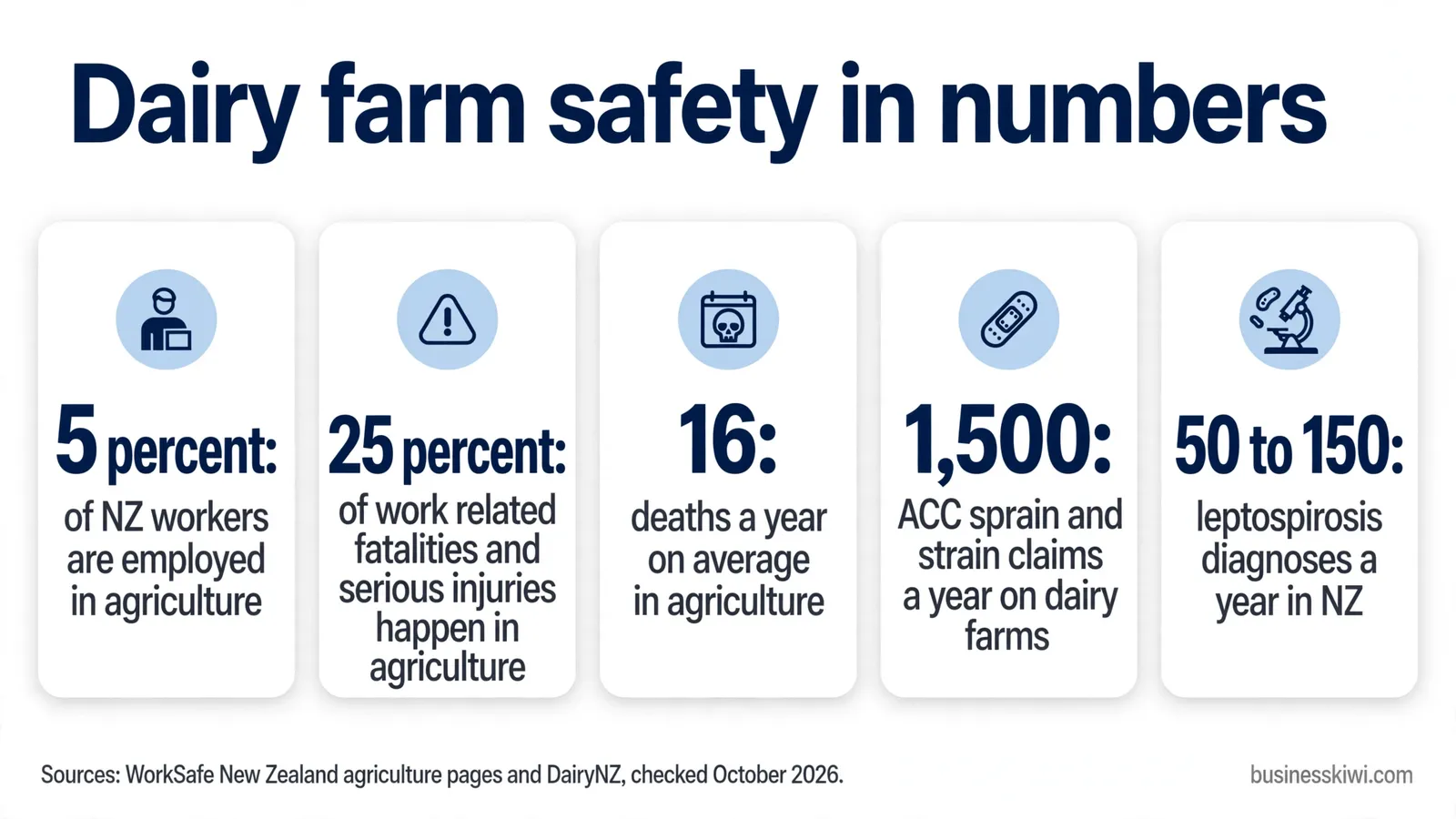
WorkSafe’s agriculture pages put the sector’s risk in plain terms: about 5 percent of New Zealand workers are employed in agriculture, yet the sector accounts for around 25 percent of work-related fatalities and serious injuries, with an average of 16 deaths a year. WorkSafe says harm on farms is persistent, and vehicles and machinery, agrichemicals and farm animals are serious risks, made harder by difficult and remote working environments.
The legal frame in plain English
The Health and Safety at Work Act 2015 places its main duties on a PCBU, short for a person conducting a business or undertaking. On a dairy farm the PCBU is the farm business itself, whether a company, a partnership or a sole trader. A self-employed farmer is a PCBU too, and must look after their own health and safety as well as everyone else’s.
The PCBU’s primary duty of care is to ensure, so far as is reasonably practicable, the health and safety of its workers while they are at work, and to make sure other people are not put at risk by the work. That means a work environment, plant, structures and systems of work without risks to health and safety, substances used, handled and stored safely, adequate facilities for workers, and the information, training, instruction and supervision people need to work safely. It also means monitoring workers’ health and workplace conditions to check the controls are working.
People at the top carry a personal duty as well. Directors, partners and anyone who exercises significant influence over the business are officers of the PCBU, and an officer must exercise due diligence: know about health and safety and keep that knowledge current, understand the hazards of the operation, make sure the business has proper resources and processes for managing risk, and verify those processes are actually in place and being used.
Workers have duties too. Everyone on farm must take reasonable care of their own health and safety, take care not to harm others, follow reasonable instructions and farm rules, and report injuries and incidents, including early symptoms of illness.
Duties often overlap on a farm. A farmer, a sharemilker and a contractor can all hold duties for the same work at the same time. WorkSafe describes these as shared arrangements: the businesses involved need a common understanding of the hazards and how the site will be made safe. One more point matters to many farmers: the law does not require a written health and safety policy document. The duties are about managing risk in practice, every day. A short written policy still helps a farm organise itself, but the paper alone meets no duty.
What DairyNZ provides
DairyNZ’s health and safety resources sit inside its People resources on its website. The set is built around templates a farm can pick up and use:
-
An example health and safety policy, a starting point for a farm writing its own.
-
A hazard management register template, for recording farm risks and their controls.
-
A farm incident and near miss report form.
-
A health and safety acknowledgement, to go through with an employee and confirm they understand the key points.
-
A checklist for contractors, and a letter to contractors, for alerting contractors to on-farm risks before work starts.
-
Health and safety meeting minutes and records templates.
-
A maintenance register and an on-farm emergency plan form.
-
A table of risks, covering common farming activities and the injuries they cause.
-
A self-assessment table, described below.
-
The Workplace Organisation Decision Tree, for building a safe and efficient working environment.
Workplace 360
Workplace 360 is DairyNZ’s featured workplace tool, relaunched in a refreshed form to make it simpler to use. A farmer works through a checklist of critical workplace practices first, then explores selected topics in more depth. It takes around 25 to 30 minutes, and the farm then receives a customised report showing what is working, where the gaps are, and links to practical tools for fixing them. Fonterra suppliers can use completing it toward their Co-operative Difference requirements.
The self-assessment table
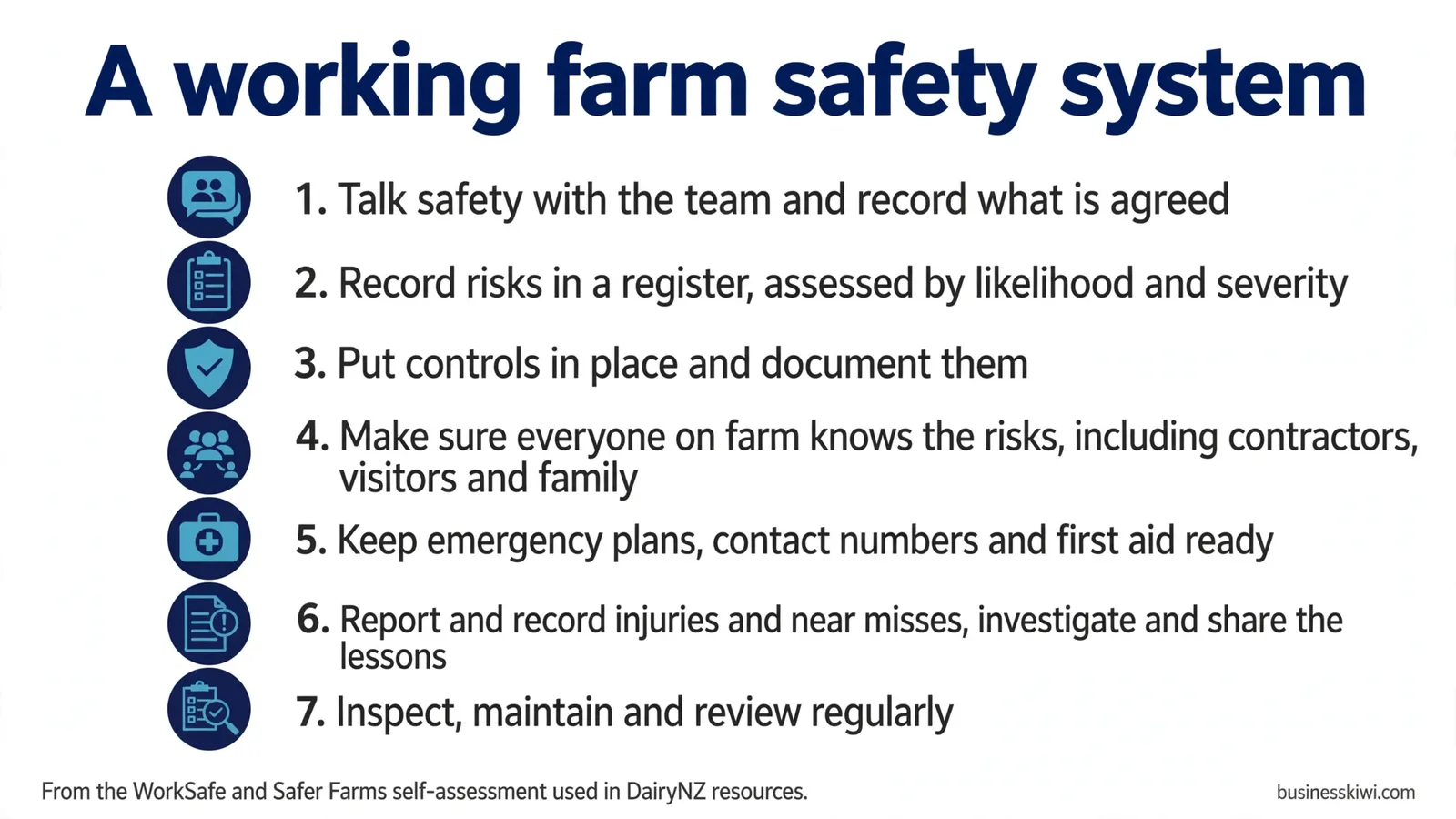
DairyNZ’s resource set includes a farm health and safety self-assessment table, a WorkSafe and Safer Farms document. It works through the whole system: worker involvement in safety discussions, risks recorded in a register and assessed by likelihood and severity, controls documented and monitored, everyone on farm made aware of the risks that affect them, emergency plans and first aid, worker health monitoring, injuries and near misses reported and investigated, notifiable events sent to WorkSafe, regular inspections and planned maintenance with records.
Research that turned into farm gear
DairyNZ also works on the injury problems themselves. Its Reducing Sprains and Strains project ran for three years from 2021 to 2024 in partnership with ACC, with scientists and farmers co-designing equipment to cut these injuries: an Easy-Entry Calf Trailer Gate, an Easy-Access Calf Pen Gate, an Easy-Lift Bucket Trolley for moving heavy milk buckets without lifting them, and a Cups-On Mat that lifts a shorter milker into a better working position at the rotary platform.
The main hazards on a dairy farm
Animals, and the diseases they carry
Cows are large, strong and unpredictable, especially when startled, hurt or protecting a calf, and WorkSafe lists farm animals among the serious risks in agriculture. Children in particular lack the judgement, size and speed to get out of an animal’s way safely.
The less visible animal risk is disease. Leptospirosis is the one DairyNZ singles out: a bacterial disease people catch through contact with urine from infected animals, through the eyes, nose and mouth or through cuts and grazes. DairyNZ says it can cause flu-like symptoms or severe ongoing illness, including kidney or liver damage and chronic fatigue. Around 50 to 150 people are diagnosed in New Zealand each year, and a high proportion are farmers and farm workers. The controls are simple: wash and dry hands before eating, do not eat, drink or smoke in the cow shed, wear gloves, milking sleeves, shed aprons and gumboots, and see a doctor early if flu-like symptoms appear. Vaccinating the herd is the main animal-side control.
Vehicles and machinery
WorkSafe’s agriculture pages are direct: harm involving farm vehicles is persistent, and farm vehicles and attached machinery are a leading cause of serious harm. Tractors, quad bikes, side-by-sides, two-wheelers and utes all feature, along with the machinery they tow or power.
The day-to-day controls are unglamorous. Match the vehicle to the task and the terrain. Keep vehicles and machinery on a planned maintenance programme, use suitably qualified people for repairs, and keep written records. Pre-start checks pick up worn guards, brakes and hitches before they hurt someone.
Sprains, strains and physical work
The most common injuries on dairy farms are not the dramatic ones. DairyNZ, citing ACC data, says sprains and strains brought about 1,500 ACC claims a year in 2022 and 2023, totalling $5 to $6 million and around 40 percent of dairy-related claims. The highest-risk period is August to October, the spring calving season, when hours are longest and fatigue builds.
DairyNZ’s project survey work found most injuries happened in the paddock, from slips, trips and falls and from bending and twisting, with calf-related work such as lifting calves and carrying buckets a major contributor. Milking was a high-risk area too, because of repetitive twisting and reaching and wet, slippery surfaces, and backs took the largest share. On average, injured farmers took 12 days off work but 26 days to feel fully recovered.
Chemicals and farm substances
Dairy farms store and use agrichemicals, detergents, teat sprays and fuels, and the legal duty is to ensure they are used, handled and stored safely. WorkSafe’s farm guidance adds: keep safety data sheets for the chemicals on farm, store dangerous chemicals locked away from children and well away from housing, label containers clearly, and use the protective equipment the label requires.
Effluent, ponds and water
Water is a farm hazard in more places than visitors expect: effluent ponds and holding tanks, races and troughs, dips, dams, creeks and rivers. WorkSafe’s guidance asks farms to map their water hazards, partly because children can drown in very little water. DairyNZ’s leptospirosis guidance adds that effluent ponds and holding tanks should be fenced, and paddocks not grazed soon after effluent spraying.
Fatigue, stress and wellbeing
DairyNZ treats farmer wellbeing as part of the same picture as physical safety, and WorkSafe agrees fatigue is a safety issue, not just a health one. Tired people make poor decisions, and fatigue shows up in the injury pattern every calving season.
DairyNZ’s farmer wellbeing guidance works around five habits: connect with people and give time to others, keep learning, be safe and have a plan, rest and take notice, and be active and eat well. On rest it is specific: breaks through the day are critical because decision-making suffers when people are fatigued, aim for as close to eight hours of sleep a night as possible, and plan a few consecutive days off after the busy periods. Support is available through the Rural Support Trust on 0800 787 254 and through 1737, the free call or text counselling line.
Children on the farm
Farms are where dairy families live as well as work, and WorkSafe is clear that children are not small adults: they have less strength, coordination and understanding of situations, and they explore. Under the health and safety regulations, a PCBU must ensure, so far as is reasonably practicable, that no worker under 15 is present in an area, or does work, likely to harm them. Young people under 15 must not work or help on machinery, and must not lift heavy weights or do work that might affect their health. Workers under 16 should not work between 10pm and 6am. The tractor rule is specific: a worker under 15 must not drive or ride on a tractor, except that a young person aged 12 or over who is fully trained, or being trained, may drive one for agricultural work. WorkSafe strongly recommends young people only operate vehicles designed for their age and capabilities. The practical approach is separation and supervision: identify hazards together on a farm walk, supervise young children closely, fence play areas away from animal pens, work areas and water, and keep keys out of vehicles and chemicals out of reach.
Visitors and contractors
Farms have a constant flow of other people: vets, tanker drivers, relief staff, contractors, advisors and visitors. The person in control of the farm must take all practicable steps to keep everyone on it safe. For authorised visitors, WorkSafe’s guidance is that the farmer must warn them about work-related, out-of-the-ordinary hazards that could seriously harm them, such as tree felling or earthmoving; everyday farming hazards do not need the same warning, and a verbal warning when permission is given is enough. Visitors must also play their part: stay out of unauthorised areas, do not disturb animals or work activities, follow instructions, and do not let children wander unsupervised.
Contractors need more than a warning: they need the hazard conversation before work starts, which is what DairyNZ’s contractor checklist and letter to contractors are for. Contractors carry their own duties to their own workers, and the two sets of duties overlap, so both sides need a shared understanding rather than assumptions.
Building a system that actually runs
A working farm safety system is mostly rhythm, not paperwork. It starts with knowing your risks: walk the farm, list the hazards, and record them in a hazard or risk register, the single most basic document WorkSafe says every farm needs. For each risk, note the controls in place. Eliminate the risk where you can; where you cannot, minimise it with the best control that is reasonably practicable.
Induction is where the system meets each new person. Show new workers around, point out the hazards and the farm’s rules, and make sure only trained or supervised people do each job. DairyNZ’s health and safety acknowledgement form helps confirm a worker has been through the key points, and training records matter, because memory is not a record.
Reporting keeps the system honest. Record every injury and incident, including near misses, in an incident register. Investigate what happened, fix the cause, and share the lesson with the team. Serious injuries, illnesses and incidents are notifiable, which means WorkSafe must be told as soon as possible. Add regular safety inspections, planned maintenance with records, an emergency plan with contact numbers and first aid arrangements, and safety as a standing item in farm meetings.
Training and where to get help
Most farm safety training happens on the job, through induction, supervision and refresher training for young, new or returning workers. Beyond the farm gate, DairyNZ points farmers to training events and courses through industry training providers, and WorkSafe’s website carries the sector guidance.
Watch-outs
A hazard register written once and never reviewed is decoration. Add new risks as they arise, and review it as seasons and staff change. Watch the calving season most of all: the injury data and the fatigue risk peak together, exactly when shortcuts look attractive. Do not assume a contractor has their own system sorted; the checklist conversation is the farm’s protection as much as theirs. And do not let paperwork substitute for verification, because officers must check that processes are actually used, not just that they exist.
Related guides: our health and safety policy template guide covers HSWA duties and policies for any NZ business in depth, and our stock tank guide covers troughs, tanks and stock water on farm. For more business guides, browse the Business & Industry section.
Frequently asked questions
Does a dairy farm legally need a written health and safety policy?
No. The Health and Safety at Work Act 2015 does not require a written policy document; the duties are about managing risk in practice. Many farms keep a short policy anyway because it helps set expectations, and DairyNZ provides an example policy as a starting point.
Who is the PCBU on a dairy farm?
The PCBU is the farm business itself, whether that is a company, a partnership or a sole trader. A self-employed farmer is their own PCBU. Where several businesses work on the same farm, such as a farmer and a sharemilker or contractor, their duties can overlap.
What does DairyNZ provide for farm health and safety?
Templates and tools: an example health and safety policy, a hazard register template, incident and near miss report forms, a contractor checklist and letter, an emergency plan form, a self-assessment table and the Workplace 360 self-assessment tool. Its research programme has also produced farm equipment designed to cut sprain and strain injuries.
How long does Workplace 360 take, and what does it cost?
Workplace 360 is free and takes around 25 to 30 minutes. It has two parts, a checklist of critical workplace practices and a deeper look at topics you choose, and produces a report showing strengths, gaps and links to tools that can help.
What are the biggest injury risks on a dairy farm?
WorkSafe names farm vehicles and attached machinery as a leading cause of serious harm in agriculture, along with animals and agrichemicals. The most common injuries are sprains and strains, at about 1,500 ACC claims a year on dairy farms, concentrated in the August to October calving season.
What should happen after someone is hurt, or nearly hurt, on farm?
Record it in the farm’s incident register, including near misses, then investigate the cause and change whatever allowed it to happen. Share the lesson with the team. If the injury, illness or incident is notifiable, WorkSafe must be notified as soon as possible.
What are the rules for children helping on the farm?
Workers under 15 must not do work, or be in areas, likely to harm them, must not work on machinery and must not lift heavy weights. A young person aged 12 or over who is trained, or being trained, may drive a tractor for agricultural work. WorkSafe recommends young people only use vehicles designed for their age and capability, with close supervision for younger children.
The bottom line
Dairy farm safety is not a folder on a shelf. It is a register that stays current, an induction every new worker actually gets, incidents recorded and learned from, machines maintained, children separated from the dangerous parts of the farm, and a team rested enough to think straight. DairyNZ supplies the templates and tools; WorkSafe sets the expectations and publishes the sector guidance. The farm’s job is to run the system, season after season.
Sources
-
DairyNZ, People resources and tools, Health and safety: https://www.dairynz.co.nz/resources/people/?category=resources&page=1&subtopics=Health+and+safety
-
DairyNZ, DairyNZ refreshes Workplace 360 to help build great workplaces: https://www.dairynz.co.nz/news/dairynz-refreshes-workplace-360-to-help-build-great-workplaces/
-
DairyNZ, Reducing sprains and strains: https://www.dairynz.co.nz/sprains-strains
-
DairyNZ, Leptospirosis: https://www.dairynz.co.nz/animal/cow-health/leptospirosis
-
DairyNZ, Farmer wellbeing: https://dairynz-web.aueast01.umbraco.io/people/building-a-great-team/wellbeing/
-
WorkSafe New Zealand and Safer Farms, Farm Health and Safety Management Self-Assessment Table: https://uat.dairynz.co.nz/media/2i2jfgka/wsnz_2072_self_assesment_fs_v7_fa1.pdf
-
WorkSafe New Zealand, Agriculture: https://worksafe.govt.nz/topic-and-industry/agriculture
-
WorkSafe New Zealand, Managing health and safety: A guide for farmers: https://www.worksafe.govt.nz/topic-and-industry/agriculture/keeping-safe-on-farms/managing-health-and-safety/
-
WorkSafe New Zealand, Children and young people on farms: https://www.worksafe.govt.nz/topic-and-industry/agriculture/keeping-safe-on-farms/children-and-young-people-on-farms
-
WorkSafe New Zealand, Health and safety leadership: A guide for small to medium business owners and company directors: https://www.worksafe.govt.nz/dmsdocument/863-a-guide-for-small-to-medium-business-owners-and-company-directors
This article is general information about DairyNZ health and safety resources in New Zealand and about farm safety duties in general terms. It is not legal advice, and it is not safety advice for a specific farm. Every farm’s hazards are different, so check DairyNZ and WorkSafe New Zealand for current guidance, and consider advice from a qualified health and safety professional for your own operation.