Stock Tank NZ: Troughs, Storage Tanks and Stock Water, Explained
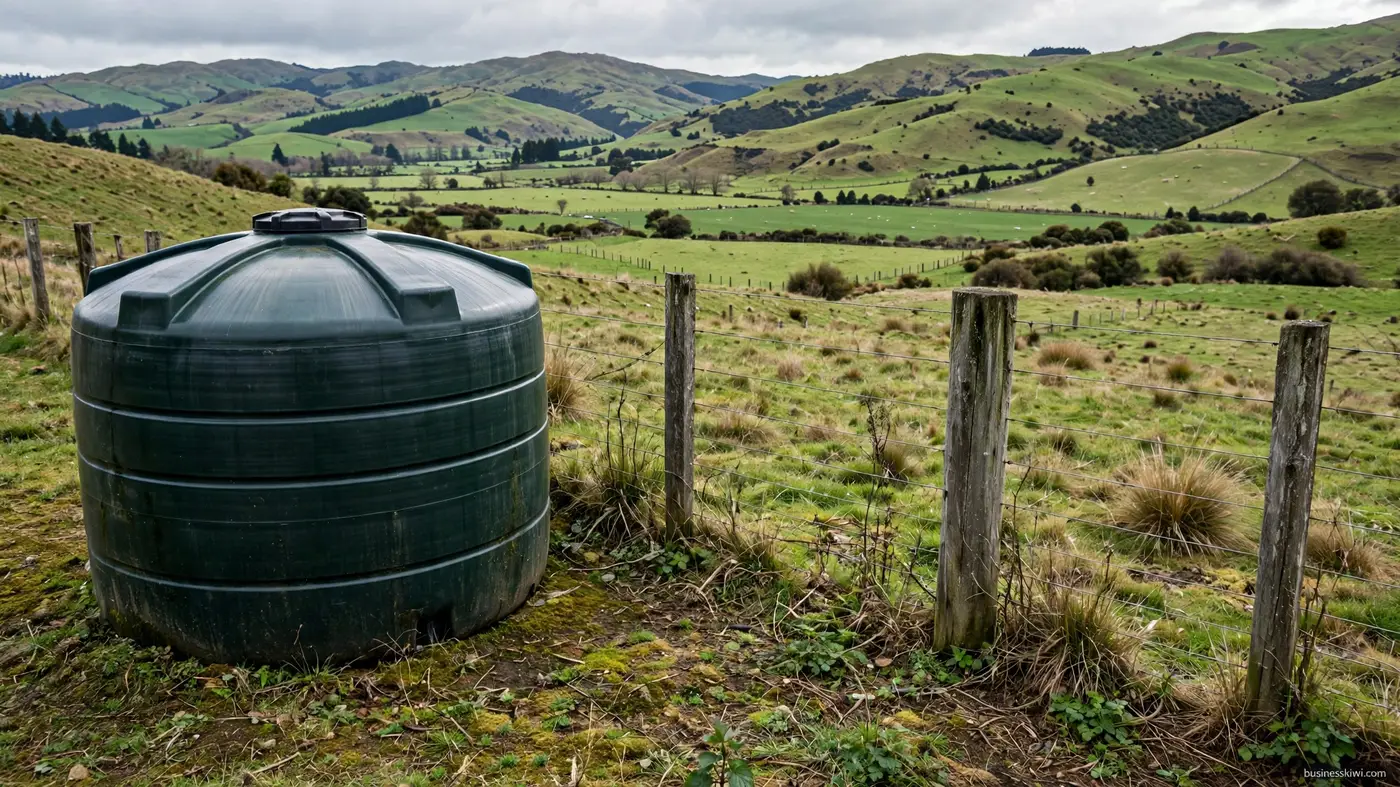
On a New Zealand farm, “stock tank” usually means one of two quite different pieces of gear. It can be the large storage tank that holds the farm’s water reserve, or the drinking trough out in the paddock that stock actually drink from. The two work as a pair. The tank stores, the trough delivers, and pipes and a float valve join them together. This guide explains both jobs, the materials on offer, the sizes that makers actually sell, and what to get right when you site and plumb them.
The short answer
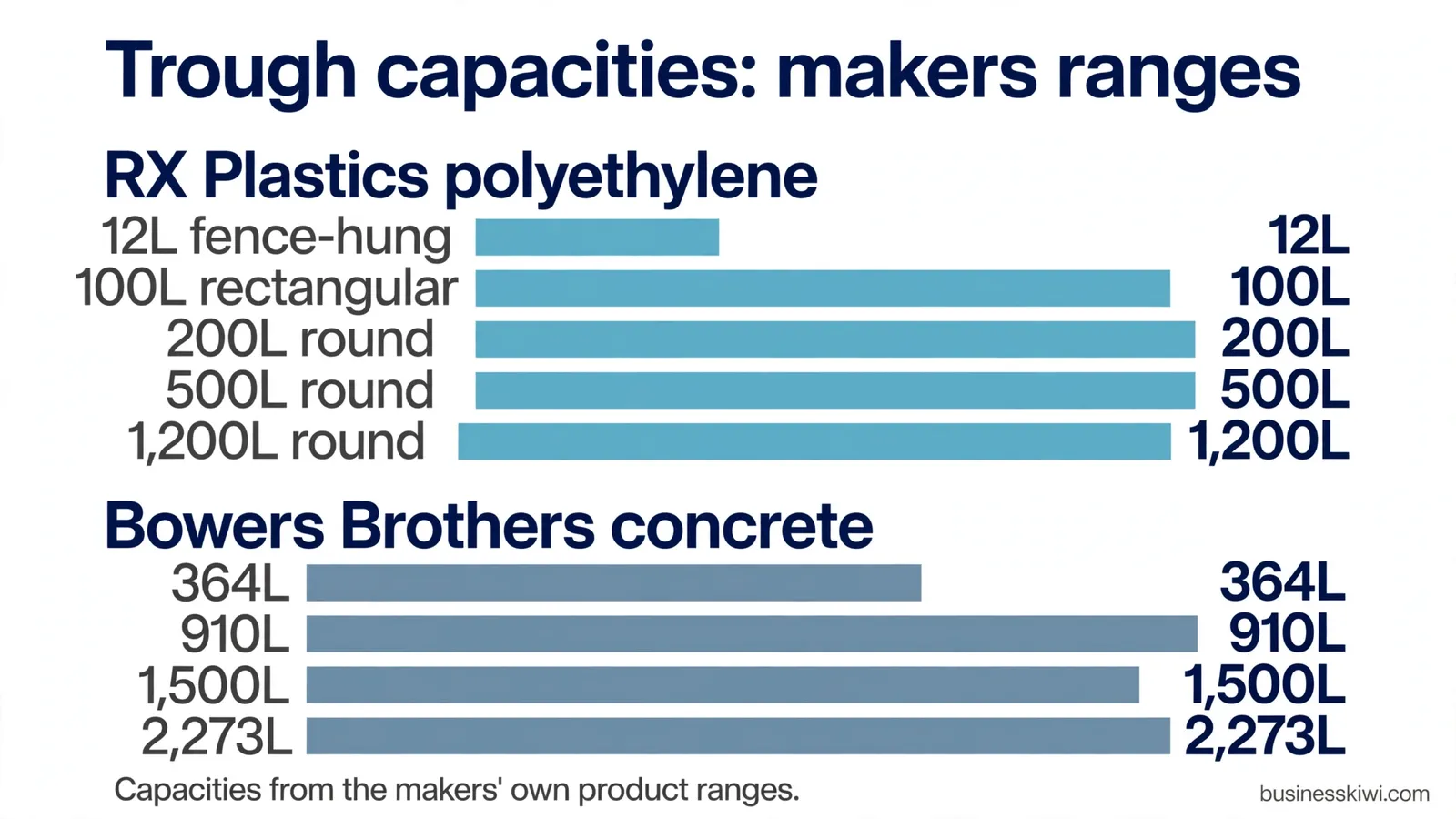
A stock water system has three parts: a source, storage, and troughs. Storage tanks in polyethylene run from a few hundred litres up to 30,000 litres, and they buffer your supply against dry spells, pump breakdowns and peak demand. Troughs are much smaller. Polyethylene troughs from RX Plastics run from 12 litre fence-hung units up to a 1,200 litre round, while precast concrete troughs from Bowers Brothers run from 364 litres up to 2,273 litres for cattle. Most troughs fill automatically through a float valve, also called a ballcock, so the water level looks after itself. Size the storage for your driest month, size the trough for the mob drinking from it, and put both on level ground.
The two jobs: storage tanks and troughs
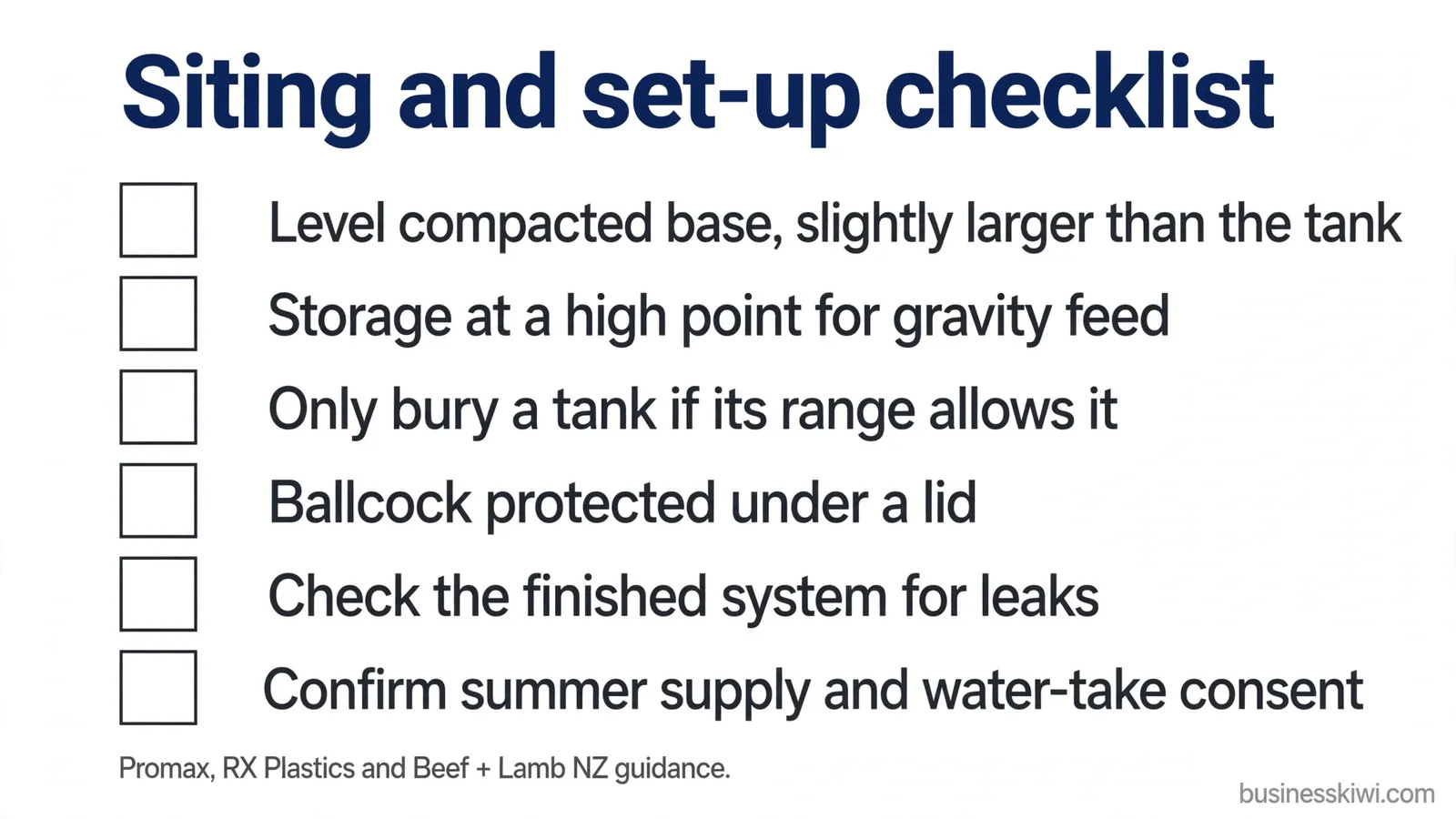
A storage tank is a reservoir. It sits between your water source, which might be a bore, a spring, a creek with a pump, or a roof, and the rest of the farm. Its job is to hold enough water to keep troughs filling when the source cannot keep up, whether that is a dry February, a power cut or a pump away being repaired. Because it only stores, it can sit anywhere sensible, and Beef + Lamb New Zealand’s stock water guidance suggests placing storage at a high point on the farm so water can gravity feed down to the troughs from there.
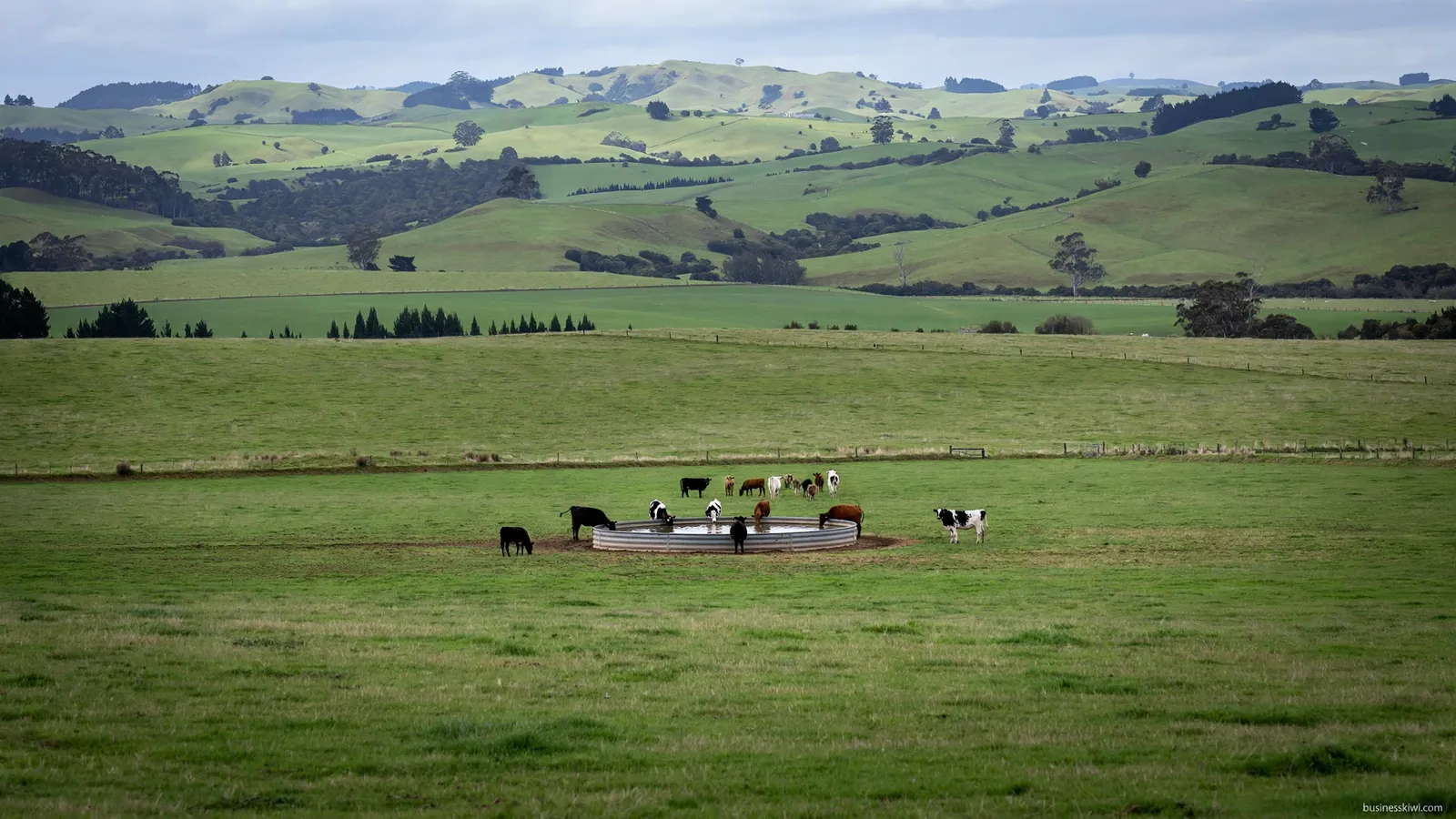
A trough has the harder job. It stands in the paddock or yard where animals push, rub and drink, sometimes hundreds of times a day. It holds a comparatively small volume, often a few hundred litres, and relies on the supply line and float valve to replace what stock drink. Troughs come in shapes matched to the job. Round troughs let more animals drink at once. Long rectangular troughs suit races and yards. Between-fence troughs serve two paddocks through a fenceline, and small fence-hung or drag troughs move with break-fed stock.
Confusing the two leads to bad buying. A big trough is not storage, because a mob can drink it down faster than a weak supply refills it. A storage tank is not a drinker, because stock cannot reach the water inside it. Most farms need both, sized to work together.
Materials compared: polyethylene and concrete
Polyethylene, usually shortened to poly, dominates both halves of the market. RX Plastics moulds its Super Troughs from virgin PE and builds strength in with super-sized ribs in the walls, corrugations in the floor and a rolled rim. Promax blends its own UV-stabilised polyethylene in-house and certifies its tanks to AS/NZS 4766, the polyethylene storage tank standard. Poly is light. Promax’s 30,000 litre XPRESS tank weighs 450 kilograms empty, and RX points out that the light weight of its troughs makes them easy to handle and shift. One-piece moulding means no seams to leak, and Promax notes that its sealed construction keeps light and contaminants out of stored water. Warranties are published: Promax gives 5 years on its small tanks and 20 years on its large tanks.
Concrete is the traditional trough material, and precast makers such as Bowers Brothers in the Waikato have produced concrete troughs for decades. Concrete’s strengths are weight and permanence. A Bowers 500 litre cattle trough weighs 300 kilograms, and the 2,273 litre model weighs 1.65 tonnes, so stock cannot push it around and it stays where it is placed, usually by the maker’s hiab truck. Bowers uses high-strength, agricultural-grade concrete and describes its troughs as resistant to cracking, shifting and wear, and as a low-maintenance option. The trade-off is that concrete troughs are effectively permanent once placed, and they need machinery to move.
Steel troughs exist on older farms, often as cut-down tanks, but the current NZ makers’ ranges read for this article are polyethylene and concrete, so those are the two materials compared here. Whichever material you choose, the drinking end needs a protected float valve, because a ballcock knocked about by cattle is the most common failure point in any trough.
Capacities and sizing
Start with demand. DairyNZ publishes average daily water intake for heifers by bodyweight: a 45 kilogram calf drinks about 3.5 litres a day, a 90 kilogram calf about 11 litres, a 270 kilogram heifer about 26 litres, and a 455 kilogram heifer about 38 litres a day. Intake climbs with liveweight, and DairyNZ warns that limited water depresses growth rates, so these figures are a floor for planning, not a ceiling. Hot weather pushes demand up further, which is why systems are designed for summer, not for the annual average.
Trough sizes then follow the mob. RX Plastics’ round Super Troughs come in 200, 500 and 1,200 litres, its rectangular models in 100 and 300 litres, and its standard range adds a 450 litre round and small 45 and 115 litre rectangular troughs. Bowers’ concrete cattle range runs from 364 litres up to 2,273 litres, its sheep troughs hold 364 and 772 litres with a lower 416mm side height for smaller animals, and its pig troughs hold just 15, 30 and 66 litres. A bigger trough is not only about volume. It is also drinking space, so more animals can drink at once without dominant stock guarding the water.
Storage sizing works the other way, from the supply side. Promax’s own guidance says 450 to 2,000 litres is usually plenty for garden watering and stock top-up, while washing down, troughs and small-scale irrigation point to 3,000 to 5,000 litres. Working farms go larger: Promax’s ranges run through 5,760 litres in the small XPRESS line and up to 30,000 litres in its large tanks. Beef + Lamb New Zealand’s planning guide starts from the same question from the other end: work out how much water the farm requires, then confirm the source can provide a reliable supply right across the summer period before you commit to tank sizes.
Siting and installation basics
Tanks and troughs both want level ground. Promax specifies a flat, level, well-compacted base that fully supports the tank floor and is slightly larger than the tank’s footprint, commonly compacted basecourse topped with sand or crusher dust, kept clear of roots, rocks and sharp objects. A poly tank that is only partly supported flexes at the unsupported edge every time it fills and empties, which is how bases quietly shorten a tank’s life.
Burial rules differ by range. Promax’s corrugated ENDURO tanks can be buried up to a third of their height, which helps where you need fall from a downpipe or a lower profile along a fence. Its smooth-walled XPRESS and Slimline tanks are above-ground only, and the XPRESS range can be inset without backfill but is not designed for in-ground installation. Check your exact model’s instructions before any digging starts.
For troughs, siting is about stock flow. Place troughs where animals already pass, such as races, gateways and yards, and where the supply pipe run is short and protected. RX designs around the weak points: the lead-in pipe to the ballcock is hidden inside the moulding so stock rubbing cannot damage it, and the ballcock sits under a lid in an enclosed cavity, reached by undoing a single stainless steel bolt when it needs maintenance. Concrete troughs need a firm, level pad too, and because Bowers’ range weighs between 300 kilograms and 1.65 tonnes, placement is a machinery job, done once and done right.
Height matters as well. Sheep troughs are lower than cattle troughs, and RX notes its 200 litre round, at 390mm deep, suits sheep and lambs because of its low sides. Young or small stock that cannot comfortably reach over the rim will not drink their fill.
Fittings: ballcocks, valves and outlets
The float valve is the working heart of a trough. RX fits its Super Troughs with a 20mm long-threaded full-flow float valve, a backnut and a 150mm ballfloat as standard, and rates that valve to a maximum of 5 bar and 160 litres per minute, flow chosen so the trough keeps up with thirsty animals on a hot day. Larger RX troughs also carry a 40mm bung, and the standard range has a threaded bung in the base, which is what makes draining and cleaning straightforward. Standard round troughs have a 20mm brass socket moulded in for the supply connection.
Tanks are simpler. They need an inlet, an overflow and an outlet. Promax’s 30,000 litre XPRESS has a threaded 50mm outlet at the base for quick set-up, a 610mm manhole in the lid, and four inlet and outlet panels in the lid design. Smaller tanks in the ranges use smaller outlets, so match your pipework to the fitting supplied rather than forcing an adaptor chain at the tank wall.
Two habits protect the whole system. Bury or otherwise protect supply pipes where stock and vehicles cross them, and fit the valve gear the trough was designed for. Beef + Lamb New Zealand’s implementation guide also advises checking the finished system carefully for leaks, because a small leak at a fitting can drain storage quietly for weeks before anyone notices the tank is low.

Water quality and cleaning
Stock drink more, and perform better, when water is clean, so trough hygiene is production work, not cosmetics. The design features above do part of the job. Promax’s sealed, one-piece tanks keep light and contaminants out of stored water, and keeping light out also starves the algae that turn open water green. Trough lids over the ballcock cavity keep stock from fouling or damaging the valve end of the trough.
The rest is routine. Use the base bung to drain a trough fully, scrub the walls and floor, and refill with clean water rather than topping up indefinitely over a layer of sediment. Check float valves at the same visit, because a valve that dribbles or sticks shows up first as an overflowing or empty trough. Beef + Lamb New Zealand’s case-study work underlines why farmers bother: the farmers in its stock water study repeatedly cited poor dam water quality, dams drying out, and stock getting stuck in dams as the problems that pushed them to reticulated trough systems in the first place.
Frost is a smaller issue than many expect for the tank itself. Promax reports a customer’s 3,000 litre ENDURO in Queenstown that has never frozen, even at minus 9 degrees. Exposed pipes and valves are the vulnerable parts in a hard frost, so lag or bury exposed pipework in cold districts and check float valves after a freeze.
Planning the wider system
A stock tank purchase is usually one line in a bigger water scheme, and the planning sequence in Beef + Lamb New Zealand’s stock water management guide is worth following. Identify how much water is required and where. Confirm the source is reliable across summer. Decide the energy for any pumps, whether that is mains power, diesel or solar. Put storage where it can gravity feed the farm. Check whether you need consent to take the water. Then talk to a stock water engineer or pipe company about specification: pump requirements, storage tank sizes, pipe sizes, and the size and number of troughs. The guide’s blunt advice on specification is to over-spec rather than under-spec.
The economics in that guide, drawn from an AgFirst study of 11 hill country farms, found an average rate of return of 53 percent and an average payback period of 3 years after reticulation, driven by increased stock numbers and better stock performance, with drought management significantly improved. Those are study averages for whole schemes including subdivision fencing, not a promise for any single tank, but they explain why water storage is treated as core farm infrastructure rather than an optional extra.
Prices vary by size and range. On Promax’s own store, listed prices including GST were $1,050 for a 2,500 litre XPRESS, $1,450 for a 3,000 litre ENDURO and $2,050 for a 5,000 litre ENDURO, and its 30,000 litre XPRESS was listed at $4,499. Troughs are commonly sold through rural suppliers rather than direct, so expect to price them through your merchant with delivery to the farm or a local depot on top.
Watch-outs
Undersizing storage is the classic mistake. A tank that copes in May can be empty by February, and Beef + Lamb New Zealand’s guide is built around confirming summer reliability before anything is ordered. The second mistake is the base: an uneven or partly supported base under a poly tank, or a concrete trough dropped onto soft ground where it settles out of level. Third, respect each model’s limits. Burying a smooth-walled tank that was designed for above-ground use, or backfilling against it, invites wall damage. Fourth, protect the small parts. Ballcocks, floats and lead-in pipes fail more often than tanks and trough bodies do, so designs that hide and lid them exist for a reason. Finally, walk the system after installation and again each season, checking for leaks, valve problems and troughs that stock have shifted or fouled.
Related guides: our septic tank guide covers on-farm wastewater, and our culverts guide covers farm drainage and crossings. For more farm and business guides, browse the Business & Industry section.
Frequently asked questions
What is the difference between a stock tank and a trough?
A stock tank stores water in bulk, from hundreds up to 30,000 litres in current polyethylene ranges. A trough is the smaller vessel stock drink from, usually between 12 and about 2,300 litres, kept full by a float valve on the supply line. Most farms need both, working as one system.
How much water do cattle and young stock drink each day?
DairyNZ’s published figures for heifers rise with bodyweight: about 3.5 litres a day at 45 kilograms, 11 litres at 90 kilograms, 26 litres at 270 kilograms and 38 litres at 455 kilograms. Demand rises in hot weather, so size systems for summer rather than for the average day.
Should I choose a polyethylene or a concrete trough?
Polyethylene troughs are light, easy to shift for break feeding, and moulded with protected ballcock cavities, which suits rotational grazing. Concrete troughs are far heavier, from 300 kilograms up, stay put permanently, and are placed by hiab, which suits fixed paddock and yard positions. Both are proven in New Zealand conditions.
What size storage tank does a farm need?
Promax suggests 450 to 2,000 litres covers stock top-up, while trough supply and washdown point to 3,000 to 5,000 litres, and full farm storage runs to 30,000 litres. The right figure comes from your daily demand, how many days of buffer you want, and whether your source stays reliable through summer.
How much does a stock water tank cost?
On Promax’s own store, a 2,500 litre XPRESS was listed at $1,050 including GST, a 3,000 litre ENDURO at $1,450 including GST, and a 5,000 litre ENDURO at $2,050 including GST. Larger tanks and troughs are often priced through rural suppliers, with delivery extra.
What does a trough need to fill itself?
A float valve, also called a ballcock, connected to the supply line. RX Plastics fits a 20mm full-flow valve with a 150mm ballfloat as standard on its Super Troughs, rated to 5 bar and 160 litres per minute. As stock drink and the float drops, the valve opens and refills the trough automatically.
How do I keep trough water clean?
Drain the trough fully through its base bung, scrub out sediment and algae, and refill, rather than topping up over dirty water. Keep lids on ballcock cavities, keep stored water in a sealed tank out of the light, and check valves and water quality as part of your regular farm rounds.
The bottom line
Treat stock water as a system, not a single purchase. The storage tank gives you buffer and gravity, the trough gives stock clean water where they graze, and the float valve joins the two without daily attention. Buy the materials and sizes that match your stock class and grazing style, polyethylene for flexibility or concrete for permanence, set everything on level, well-supported ground, and size the storage for the driest month rather than the average one. Do that, and the system quietly pays its way every day of the year.
Sources
- RX Plastics, Troughs: stock water storage and supply, https://rxp.co.nz/troughs/
- RX Plastics, Water Troughs brochure, https://rxp.co.nz/wp-content/uploads/2022/10/Trough-Brochure_New-Branding-WEB.pdf
- Promax, Small Water Tanks (under 6,000L), https://www.promax.co.nz/collections/small-water-tanks
- Promax, 30,000L Water Tank, XPRESS, https://www.promax.co.nz/products/water-tanks/xpress-water-tank-30000-ltr-north-island
- Bowers Brothers Concrete, Precast Water Troughs, https://www.bowersbrothers.co.nz/product/precast-water-troughs/
- DairyNZ, Heifer feeding and nutrition, https://www.dairynz.co.nz/animal/heifers/feeding-nutrition/
- Beef + Lamb New Zealand, Stock Water Management: The Dollars and Sense, https://beeflambnz.com/sites/default/files/2026-06/Stock-water-managemnt.pdf
This article is general information about stock tanks in New Zealand. It is not engineering, veterinary or farm systems advice for your property. Product specifications, ranges and prices change over time, so check the maker’s current datasheet or store listing before you buy, and confirm the details of any specific model with the manufacturer or your rural supplier. Farm water rules, including whether you need consent to take water and how stock must be kept from waterways, vary by region, so check your regional council’s current rules as well.