Self Inking Stamps in NZ: Sizes, Inks, Prices and How to Order One That Fits
The short answer
A self inking stamp is a stamp with its own ink pad built inside the body. Press it down and the rubber die flips onto the paper, prints, and flips back against the pad to re-ink itself. There is no separate pad to open, no ink on your fingers, and NZ suppliers rate the pads at roughly 10,000 to 20,000 impressions before they need attention. Custom text and logo versions are made to order by NZ stamp makers, usually from a proof you approve first, and a single stamp is a normal order. Prices are set by the stamp model and size rather than by your wording, and at least one NZ maker lists a small custom model, the 12 x 12mm Trodat 4921, at $44.20. Date stamps and numberers are self inking too, but they are their own product type and sit outside this guide.
How a self inking stamp works
Stamps Plus, an Auckland stamp maker, describes a self-inking stamp as a spring-loaded, all-in-one machine with a replaceable internal ink pad. The die sits facing up against the pad inside the body. When you press the stamp down, a twisting mechanism rotates the rubber die away from the pad and down onto the paper. Release the pressure and the die swings back onto the pad, picking up fresh ink for the next impression.
That one movement explains the type’s appeal. Every impression is inked the same way, so a run of envelopes, invoices or loyalty cards comes out even. The stamp also seals itself between uses, which keeps the pad from drying out the way an open pad on a desk does.
The rubber die itself is made for your wording or artwork. Self-Inking Stamps Limited, a Northland maker, creates the die in a laser engraving machine once you have approved the proof. If the wording later changes, the die can be swapped without replacing the whole stamp, which is covered further down this page.
Self inking, pre-inked and traditional stamps compared
Three stamp types share the same job and do it differently.
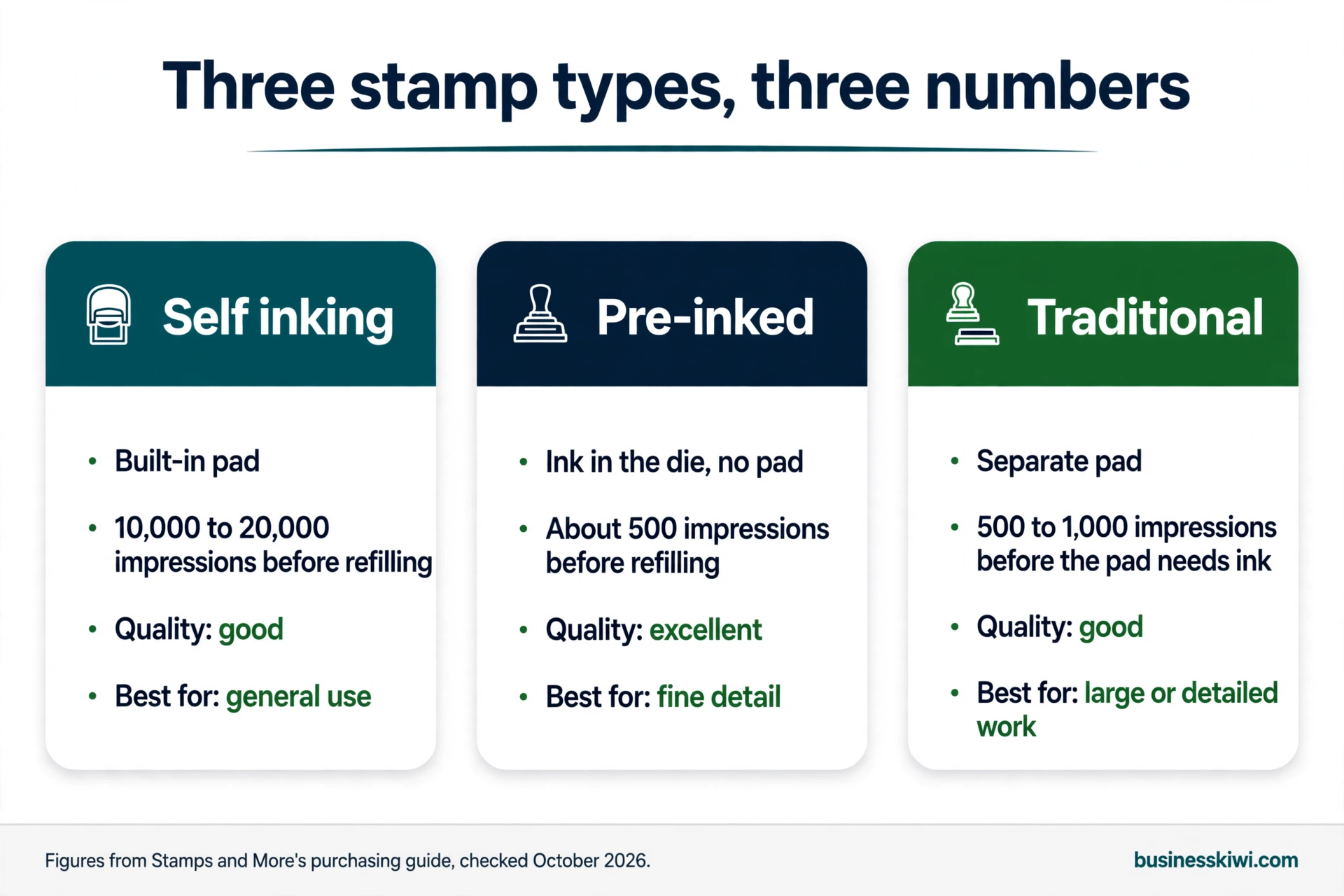
Self inking is the type above: a body, a spring mechanism and a built-in felt ink pad. Stamps and More, an Auckland maker, rates self-inking stamps at 10,000 to 20,000 impressions before refilling, with good impression quality, and lists general use as the recommended role.
Pre-inked stamps, also called flash stamps, have no felt pad at all. Stamps Plus explains that the die is a porous, gel-like rubber and the ink sits in a reservoir in the die itself, flowing through the die just before each impression. Stamps and More rates them at about 500 impressions before the ink needs refilling, with excellent impression quality, the sharpest of the three types. They reward a gentle press rather than a quick stamp, and they suit high-quality work such as fine logos.
Traditional hand stamps are the vintage format: a wooden mount and handle with a text plate, used with a separate ink pad. The pad is re-inked by hand, which is why Stamps and More puts a traditional setup at 500 to 1,000 impressions before the pad needs more ink. There is no size ceiling in the way self inking bodies impose one, so traditional stamps remain the route for very large impressions and detailed work.
For most office and small business jobs, self inking wins on speed and cleanliness. Pre-inked wins on fine detail. Traditional wins on size and flexibility.
Sizes and shapes
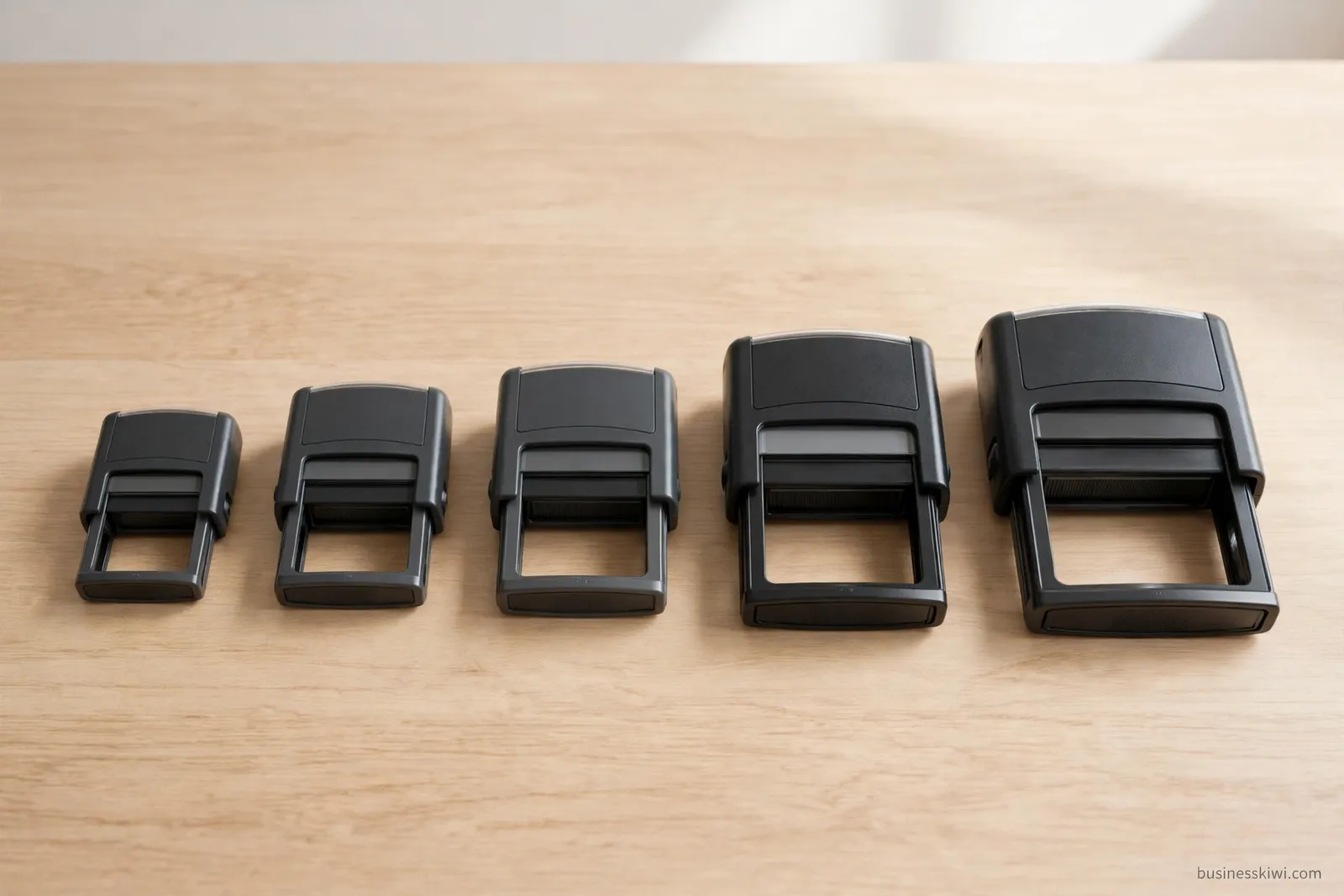
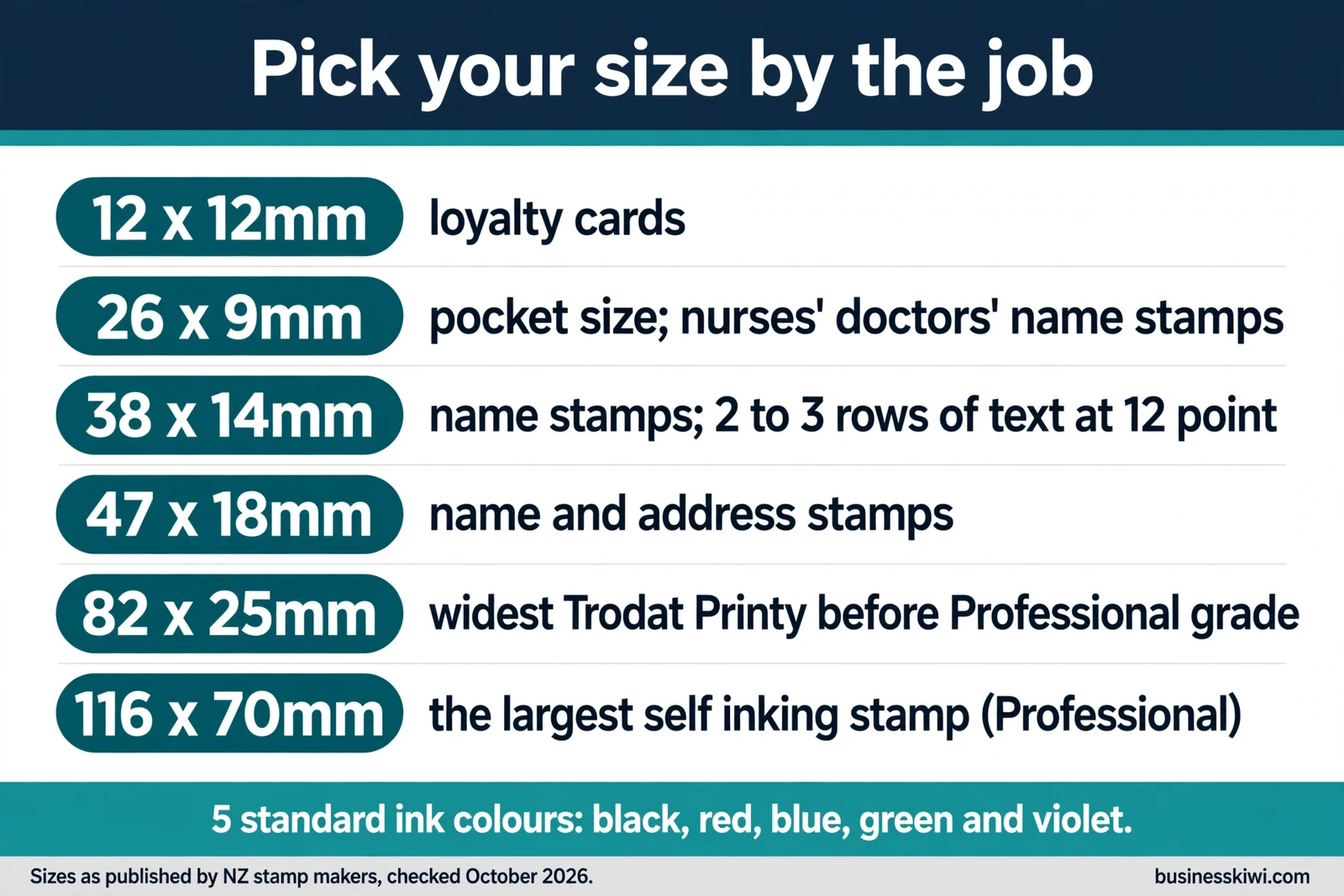
Self inking stamps are sold by impression size, the width and height of the mark in millimetres. The second number is the height, and height decides how many rows of text fit. Self-Inking Stamps Limited gives the working example: a 38 x 14mm stamp takes two to three rows of text comfortably at a 12 point font.
The Trodat Printy range is the most common line NZ makers sell, and Stamps and More publishes an actual-size comparison chart of the range. The Self-Inking Stamps Limited ordering page pairs the popular sizes with the jobs they are regularly used for:
| Impression size | Trodat model where named | What NZ suppliers say it suits |
|---|---|---|
| 12 x 12mm | Printy 4921 | Loyalty cards |
| 26 x 9mm | Printy 4910 | Pocket size; nurses’ and doctors’ name stamps |
| 38 x 14mm | Printy 4911 | Name stamps; two to three rows at 12pt |
| 47 x 18mm | Printy 4912 | Name and address stamps |
| 58 x 22mm | Printy 4913 | Address stamps with more lines |
| 70 x 10mm | Printy 4916 | One to two rows of text |
| 82 x 25mm | Printy 4925 | The widest Printy size before Professional grade |
| 20 x 20mm, 30 x 30mm, 40 x 40mm | Printy 4922, 4923, 4924 | Square or round logos and symbols |
| 85 x 55mm and 116 x 70mm | Professional range | The largest self inking stamps; 116 x 70mm is the biggest |
Round stamps run from a 19mm circle up to 50mm in the same chart. If your stamp has to fit a set space, such as a box on a form or invoice book, Self-Inking Stamps Limited says it can adjust row heights and layout to fit a stated measurement, and suggests scanning the form and sending it as a PDF so the proof matches the space. Bigger is not automatically better: a stamp sized to the job reads cleanly, while an oversized one wastes pad life and desk space.
Ink colours, pads and refills
Self-Inking Stamps Limited lists five standard ink colours for self inking stamps: black, red, blue, green and violet. Another eleven colours are available on multi-colour models, where different parts of the die print in different colours, and some models cannot take every colour. Pads can also be supplied dry, so a special ink can be loaded instead.
The ink type matters as much as the colour. Both Stamps Plus and Stamps and More describe the same four families:
- Endorsing ink is the standard water-based ink for everyday stamping on paper. Stamps Plus notes it has been tested as skin-safe, which is why it is used for hand stamps at events.
- Textile ink is made for clothing. After a few hours of drying it is machine washable, and both makers name the Trodat 4911 as the common clothing stamp.
- Quick-drying ink is solvent-based and is needed for plastic, wax-coated, grease-proof and other non-matte surfaces. Standard water-based ink does not suit glossy surfaces.
- UV ink prints a mark that shows under ultraviolet light, used on skin and for security marking.
When impressions fade, there are two remedies, and both makers describe them. You can fit a replacement pad: pads are stocked by model number, so a Trodat 4912 takes the pad made for a 4912. Or you can re-ink the pad you have. Stamps Plus gives the method: drizzle a few drops evenly over the surface of the pad, wait a minute or so, then add a few more drops until the felt is full but not flooded. Self-Inking Stamps Limited gives the same advice in shorter form: pop the pad out, add a few drops at a time, then test, because too much ink makes the words bleed and blur.
Ordering a custom text or logo stamp
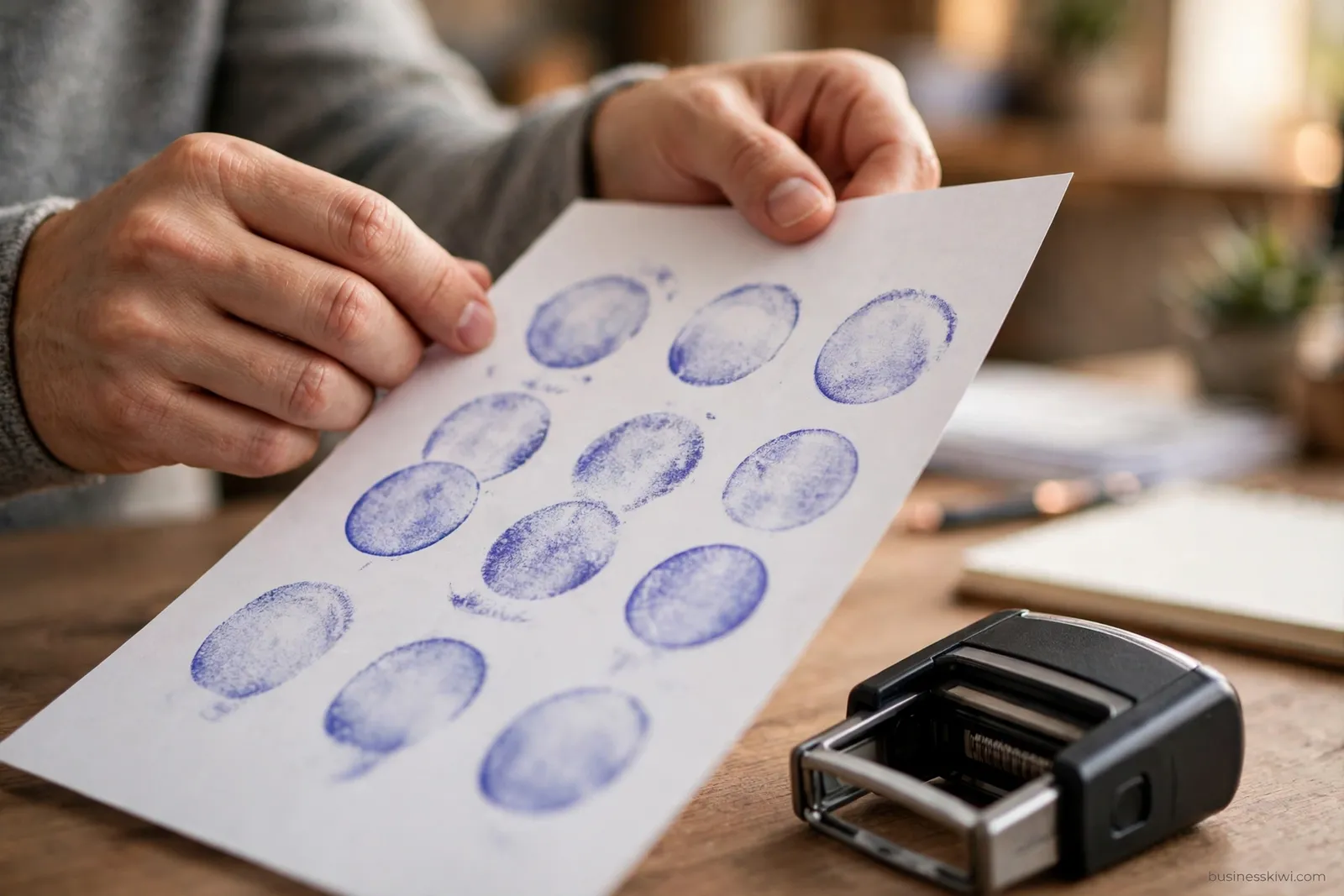
The NZ makers run a proof-first process, and it is worth using properly.
Start with the words. Type your text exactly as it should print, capitals included. Most makers let you enter the text on the product page or send it by email. Stamps Plus says plain text and basic borders can come from any office document. If your layout has to fit a form, give the maker the measurement it must fit within, in millimetres.
Choose the size before the font. Size comes first because it limits everything else. Self-Inking Stamps Limited lists Calibri and Arial as the most common stamp fonts, and warns that Arial is a wide font: a long line may not fit a smaller stamp, in which case Arial Narrow saves a lot of space. Point sizes, bold first lines, centred or left-aligned rows and different fonts per row are all set at proof stage. For event and children’s hand stamps, Stamps Plus recommends keeping the design around 20 to 30mm and using outlines rather than solid blocks of colour, which can smudge.
Send artwork the way makers ask for it. For a logo, both makers want a vector file. Self-Inking Stamps Limited ranks its preferences: a vector image, CorelDraw (.cdr), Adobe Illustrator (.ai) or a PDF of a vector image, all at no charge. A very high resolution PDF, or a JPG or PNG at 300 dpi or more, can be worked with but may attract an extra graphic design fee, and screenshots or images pulled from the internet are unsuitable. Stamps Plus asks for .eps or .ai files, sometimes .pdf, and notes that the files from your business cards or signage are usually fit for purpose. Keep the artwork one colour if you can, because a stamp prints in one colour.
Approve the proof at full size. Self-Inking Stamps Limited makes a proof of every stamp and sends it to you, and the stamp is not made until you approve it. Text proofs are generally back the same day, and its target is no later than the next working day morning. Print the proof at 100 percent size: that is the actual size of the mark, so it is your one chance to check the fit, the spelling and the layout before the die is cut. Its average is three working days from inquiry to stamping, and a proof approved before 10am is targeted at that day’s 3pm courier.
Prices and minimum orders
There is no single NZ price list for custom stamps, because the two models of selling differ. Self-Inking Stamps Limited works on a proof and quote basis and states the principle plainly: the cost is governed by the stamp model, there are no extra fees, and the price alongside the model is the finished price, ready to work straight out of the box. Stamps Plus states the matching rule from the other side: neither the content of the stamp nor a standard ink colour affects the price, and you pay only for the text plate size, with no hidden costs for having an image rather than text.
Where NZ makers do publish a price, it is tied to a model. Stamps and More lists its custom Trodat 4921, the 12 x 12mm loyalty size, at $44.20. Expect the price to climb with body size and to climb again for the steel-frame Professional models, and check delivery: Self-Inking Stamps Limited charges $11.95 including GST for stamps anywhere in NZ, with $2.50 extra for rural postcodes, while Stamps and More ships free on orders over $150 and does not charge extra for rural delivery.
Minimum order is one stamp. Nothing on the NZ makers’ pages requires a set of stamps, and both describe single custom orders as routine. Volume works the other way: Self-Inking Stamps Limited takes 10 percent off when you order two or more self inking stamps, with 25 percent or more off at 50 plus and 30 percent or more off at 100 plus on selected models. Bulk orders may need a 50 percent deposit before stock is ordered in, and multi-colour stamps in bulk can take four to six weeks because the special pads are not held in bulk in NZ.
Care and troubleshooting
Most stamp problems are ink problems, and most have a simple fix.
Faint or patchy impressions. The pad is running dry. Re-ink it a few drops at a time, or fit a replacement pad for your model. Test on scrap paper after each few drops rather than flooding the pad.
Blurred or bleeding words. Too much ink, usually from over-filling the pad. Self-Inking Stamps Limited warns about exactly this: add too little, test, then add more if needed.
The wording has changed. You do not need a new stamp. Both makers sell a replacement rubber die for your existing body. Stamps and More sells it as a “Rubber Die Only” product by size, and Stamps Plus offers a stamp remake service that swaps the die, cleans and services the machine and fits a new ink pad.
Marks smudge or will not dry. The surface is wrong for water-based ink. Glossy paper, plastic and wax-coated stock need a quick-drying solvent ink and a dry pad, so order that combination up front rather than after the first smeared run.
You need the same stamp again. Makers keep your artwork on file. Both say a repeat is simple if you give the name or order number from the first order, and both can copy a stamp bought elsewhere from the model number plus a scanned impression sent as a PDF.
For the giveaway side of desk branding, our personalised pens NZ guide covers printed pens and minimum orders. Our clear labels NZ guide covers the other everyday marking product, and our pull up banners NZ guide covers event signage. For print ordering generally, see our online printing NZ guide. More product guides are in our Business and Industry section.
Frequently asked questions
What is the difference between a self inking stamp and a pre-inked stamp?
A self inking stamp has a felt ink pad inside the body and the die flips against it after every impression. A pre-inked stamp has no pad: the ink sits in the porous die itself and flows through it. NZ makers rate self inking pads at 10,000 to 20,000 impressions before refilling, and pre-inked stamps at about 500, but pre-inked impressions are the sharpest of the three types.
How many lines of text can I fit on a stamp?
It depends on the height of the stamp. Self-Inking Stamps Limited’s working example is the 38 x 14mm size, which takes two to three rows of text comfortably at a 12 point font. A 47 x 18mm stamp is the size it regularly uses for a name with an address. Give the maker your text and the space it must fit, and the proof will show the layout at actual size.
Can I put my logo on a self inking stamp?
Yes. Send the logo as a vector file (.ai, .eps, .cdr or a vector PDF) for the cleanest result. High resolution files at 300 dpi or more can be used but may attract a design fee, and screenshots are not suitable. Stamps Plus confirms the logo does not change the price: you pay for the text plate size only. One-colour artwork works best, because the stamp prints in one colour.
What ink colours can I choose from?
Five standard colours: black, red, blue, green and violet. Multi-colour models add another eleven colours, with different parts of the die printing in different colours. Textile, quick-drying and UV inks are separate choices made for the surface you are stamping, and some are loaded into a dry pad when you receive it.
How long will my custom stamp take to arrive?
Self-Inking Stamps Limited averages three working days from inquiry to stamping, with the proof usually back within one business day. Each re-proof adds about a working day. Once made, its orders go by overnight courier to most urban addresses. Stamps and More usually dispatches on the next courier after order and payment, unless the case has to come into stock.
Can a self inking stamp print on clothing or plastic?
Yes, with the right ink. Textile ink is made for clothes and is machine washable after a few hours of drying. Plastic, wax-coated and other non-matte surfaces need a quick-drying solvent-based ink, usually in a dry pad you load yourself. Standard water-based endorsing ink is for paper and does not suit glossy surfaces.
What happens if my details change after I buy a stamp?
Order a replacement rubber die for the same body. Both NZ makers offer this: you choose the size, supply the new wording, and fit the new die into the stamp you already own. Stamps Plus also offers a full remake service that includes cleaning the mechanism and fitting a new ink pad.
The bottom line
A self inking stamp is the default choice for everyday NZ office and small business marking: fast, clean, self-contained and good for thousands of impressions per pad. Pick the impression size from the job, not from habit, send text or vector artwork, and use the proof at 100 percent size to check spelling and fit before the die is cut. The price follows the model, a single stamp is a normal order, and when your details change you can replace the die instead of the stamp.
Sources
- Self-Inking Stamps Limited, FAQ: https://www.selfinkingstamps.co.nz/faq/
- Self-Inking Stamps Limited, Address Stamps Self Inking product page (sizes, fonts, ink colours, re-inking): https://www.selfinkingstamps.co.nz/product/address-stamps-self-inking/
- Self-Inking Stamps Limited, Bulk Discounts for Rubber Stamp Orders (pricing components, volume discounts, deposits): https://www.selfinkingstamps.co.nz/bulk-orders/
- Stamps Plus, FAQs (stamp type definitions, artwork files, ink types, re-inking method, remake service): https://stampsplus.co.nz/faqs/
- Stamps and More, Purchasing Information (type comparison table, ink types, fonts, proofs): https://www.stampsandmore.co.nz/pages/purchasing-information
- Stamps and More, Trodat 4921 Custom Self-Inking Stamp 12mm product page (listed price $44.20): https://www.stampsandmore.co.nz/products/trodat-4921-custom-self-inking-stamp-12mm
- Stamps and More, Stamp Size Comparison Chart (Trodat Printy impression sizes): https://cdn.shopify.com/s/files/1/0595/9421/1534/files/S_M_Size_Comparison_Charts.pdf?v=1688963113
This article is general information about self inking stamps and how they are sold in New Zealand. Prices, models and delivery terms change, and most makers confirm the final price with the proof, so check the current price and size for the model you choose before you order.