Maths Starters in NZ: Short Warm-Ups That Start the Lesson Thinking

The short answer
A maths starter is a short activity at the start of a maths lesson, usually five to ten minutes long. The whole class works on the same quick task. It might be a set of basic facts, a counting challenge, an estimate or one small problem to talk through. The point is focus. Students switch into maths mode, bring earlier learning back to mind and share the strategies they used. In New Zealand classrooms, starters draw on official resources such as NZMaths and Figure It Out, and the content links back to the mathematics and statistics learning area of the New Zealand Curriculum. Parents can borrow the same idea at home in short bursts, and the Ministry of Education now provides a free practice tool for Years 3 to 8 built around exactly that pattern.
What a maths starter is
A starter is the opening routine of a maths lesson. It is brief, it involves everyone, and it is finished before the main teaching begins. Most starters need no special equipment. A whiteboard, a projected question or a spoken prompt is enough.
A starter is not a test. There are no marks, and speed matters less than thinking. A good starter gives every student a way in. NZMaths, the Ministry of Education’s maths teaching site, designs many of its problem-solving activities with a low entry point and a high ceiling, so the same task can stretch the whole class. One child might solve a problem by counting. Another might use a known fact or spot a pattern. Both are doing real maths.
Starters also differ from the main lesson task. The main task teaches something new. A starter usually revisits something familiar, or warms up the exact skill the new learning is about to need. That link matters. A starter on doubles, for example, sets up a lesson on near doubles. A starter on counting in tens sets up place value work.
Three features mark out a well-run starter. Every student answers, not just the confident few, whether by speaking, holding up fingers or writing on a small whiteboard. The task is pitched so that everyone can start, even if not everyone finishes. And the teacher asks at least one student to explain a method, because hearing a strategy described is often what moves the rest of the class forward.
Why teachers use them
Teachers use starters for three main reasons, and each one lines up with how the official curriculum describes good maths learning.
The first is fluency. The updated curriculum aims for students to build deep understanding and fluency in mathematics. Fluency grows through short, repeated practice. A starter gives that practice a regular home. Facts practised for five minutes a day stick in a way that one long drill each week does not.
The second is retrieval. Learning fades if it is never used again. A starter pulls last week’s and last term’s learning back into the open. The teacher also learns something. Quick answers, and the talk around them, show what the class still remembers and what needs reteaching.
The third is talk. Starters get students explaining their thinking out loud. NZMaths teaching notes model this habit. In the notes for its Figure It Out problem-solving activities, teachers are guided to have students model strategies, look for patterns, vary the conditions of a problem and generalise their methods. A starter built on one good problem gives the whole class that kind of discussion in miniature.
There is a settling effect too. A predictable opening routine calms the start of a lesson. Students know what the first five minutes look like, and the class is thinking about numbers before the new content arrives.
The main starter types
Most starters fall into a handful of types. Teachers rotate them through the week so the routine stays fresh.
Fact fluency starters practise basic facts: addition and subtraction facts, doubles and halves, times tables and division facts. The Phase 2 curriculum for Years 4 to 6 puts increased focus on learning multiplication and division facts, so this type does heavy work in the middle years. Example: the teacher shows 7 × 8 and asks not just for the answer, but for a fact that helps, such as 7 × 7 or 5 × 8 plus 2 × 8.
Counting and number sense starters work on sequences, place value and comparing numbers. NZMaths includes fast-paced whole-class activities of this kind, where students identify which of two numbers is larger as the teacher points quickly from pair to pair. Example: count backwards in threes from 60, or say what number is ten more than 347.
Strategy-sharing starters present one calculation and collect the different ways students solved it. One child partitions the numbers. Another rounds and adjusts. Another uses a known fact. The learning is in the comparison, not the answer.
Problem of the day starters use a single short problem, often from a problem-solving bank. NZMaths hosts problem-solving activities organised by curriculum level, and its Figure It Out series includes problem-solving books with full teacher notes. The problems are small enough for ten minutes but rich enough to argue about.
Estimation starters ask for a sensible guess before any exact work. Estimate first, then calculate, is a habit the curriculum’s parent guides name directly for older students. Example: will 38 × 6 be closer to 200, 240 or 2,400, and how do you know?
Pattern and puzzle starters use repeating and growing patterns, missing numbers and true-or-false number sentences. These appear in the curriculum from Year 1, where children check whether a number sentence such as 4 + 2 = 7 is true or false. A quick puzzle suits the start of a lesson because there is often more than one path to the answer.
Starters and the New Zealand Curriculum
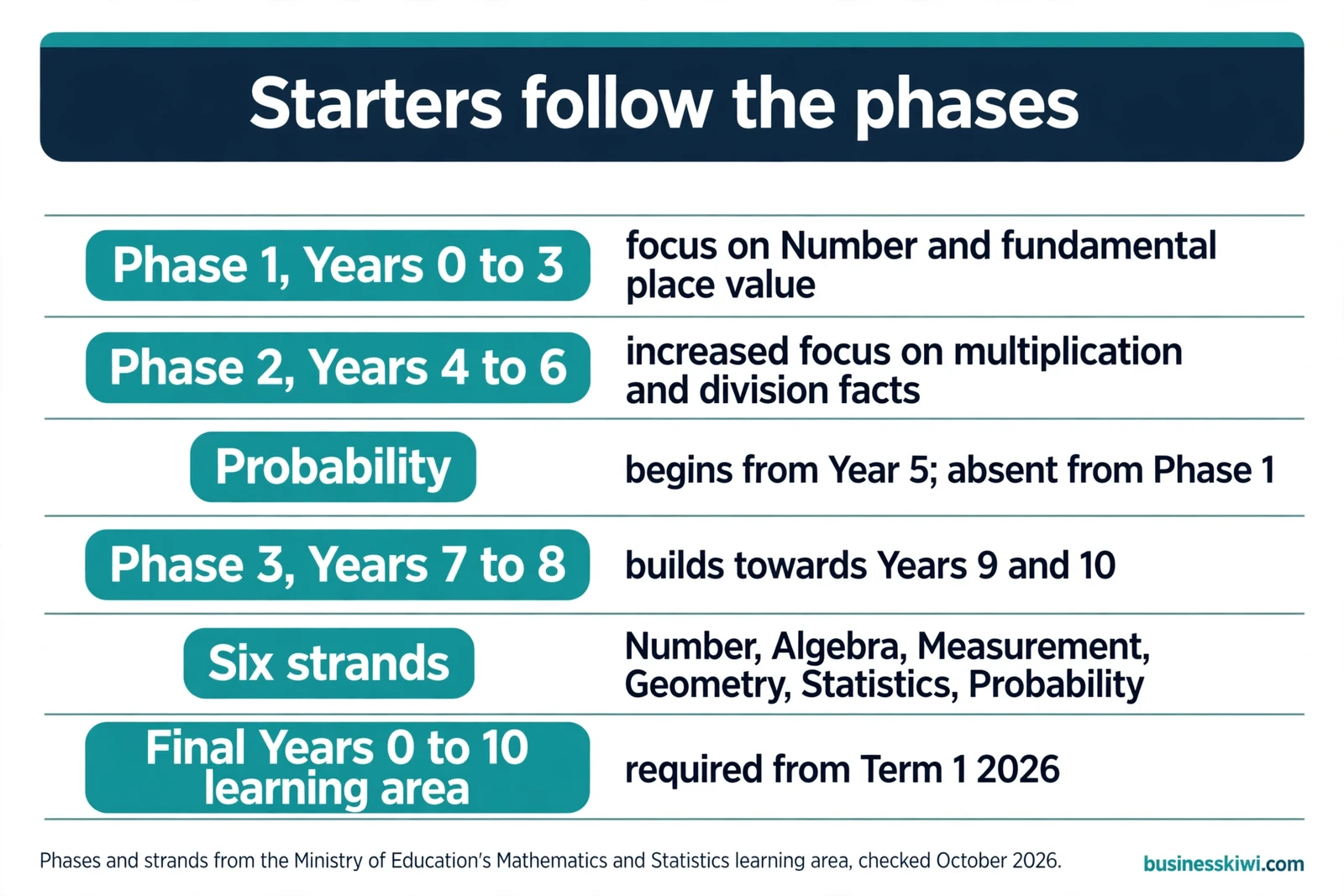
The curriculum position matters here, because it changed recently. The final Years 0 to 10 Mathematics and Statistics learning area was released in October 2025. The Ministry states that this content is part of the statement of official policy from 1 January 2026, and it is required to be used from Term 1 2026 in state and state-integrated schools. Years 11 to 13 content follows a later timeline, with no formal requirement until 2028 for Year 11.
The updated learning area is organised into phases rather than the old curriculum levels. Each phase has a year-by-year teaching sequence, organised through knowledge strands. The strands are Number, Algebra, Measurement, Geometry, Statistics and Probability. Probability begins from Year 5, and it is not part of Phase 1, where the focus stays on number and fundamental place value knowledge.
| Phase | Years | Curriculum emphasis that shapes starter choices |
|---|---|---|
| Phase 1 | Years 0 to 3 | Fundamental place value knowledge; number ranges stated precisely; probability removed to allow greater focus on Number |
| Phase 2 | Years 4 to 6 | Increased focus on learning multiplication and division facts; clearer progression of fractions; decimals to three decimal places |
| Phase 3 | Years 7 to 8 | Clearer progression between Years 7 and 8; content preparing students for Years 9 and 10, such as parts of a circle and algebraic notation |
| Phase 4 | Years 9 to 10 | Statistics and probability written with a different structure; the statistical enquiry cycle is no longer the main structure for the strand |
One wrinkle for teachers: the large NZMaths resource library was built against the 2007 curriculum. Its activities still carry curriculum level labels and achievement objective codes, such as NA1-2 for knowing forward and backward counting sequences to 100. Those resources remain useful. Teachers simply map the activity to the year and strand in the current teaching sequence rather than to the old level.
Where NZ teachers find starters
The main official source is NZMaths at nzmaths.co.nz, the Ministry of Education’s maths site. Its library includes units of work, individual activities and problem-solving tasks. Each activity states its purpose, the achievement objectives it addresses, the specific learning outcomes, the materials needed and the teaching steps. Many include a printable student activity or PDF. That format suits starters well, because a teacher can lift one activity, check its level at a glance and run it with no preparation beyond reading the notes.
The Figure It Out series sits inside the same library. Figure It Out is a Ministry resource series of student activity books with teacher support material on NZMaths. Its problem-solving activities come with detailed teacher notes that suggest models, alternative strategies and ways to extend the problem by changing its numbers. A teacher can run the first problem as a starter and keep the rest for later lessons.
Tāhūrangi, at tahurangi.education.govt.nz, is now the home of the current curriculum content. It holds the final learning area, the phases and the teaching sequences, and a growing set of supporting resources and lesson materials. NZMaths itself directs teachers to Tāhūrangi for up-to-date information. One change to note: the Ministry will stop funding licences for e-ako maths, e-ako Pāngarau and PLD 360 from 30 June 2026, and access to those tools ends on that date, as NZMaths advises on its homepage.
Running starters by year band
The year band changes what a starter looks like, even though the routine stays the same.
In Years 0 to 3, starters are short, spoken and concrete. Counting forwards and backwards in 1s, 2s and 10s, quick recognition of small groups of objects without counting them one by one, doubles to 10 and simple number stories with objects all fit. Materials help: counters, ten frames and fingers are normal at this age. The Ministry’s Year 1 parent guide describes children learning basic addition facts to 10, including doubles and halves, which is exactly starter-sized content.
In Years 4 to 6, starters carry the facts load. Times tables, division facts, fractions of amounts and place value with decimals all rotate through the week. Strategy sharing grows in importance, because students now have several strategies worth comparing. A problem of the day once or twice a week keeps problem solving warm between units.
In Years 7 to 8, starters lean on estimation, mental strategies with larger numbers and quick algebra thinking. Students work with negative numbers, percentages, ratio and patterns they can describe with a rule. A starter might ask for an estimate before a calculation, or for three different ways to work out 15 percent of 80.
In Years 9 to 10, starters become retrieval practice for the skills the day’s topic depends on: simplifying expressions, solving a one-step equation, reading a graph or recalling a fact about probability. The format stays short. The difference is that students are expected to justify answers briefly, in words or working, as part of the routine. Teachers in these years also use starters diagnostically. A question on prerequisite knowledge, asked before new content begins, shows within minutes whether the class is ready for it or whether a quick reteach has to come first.

Starters at home for parents
Parents do not need a whiteboard or a lesson plan. A starter at home is just a short maths question or game, asked regularly, with a bit of talk about how the answer was found.
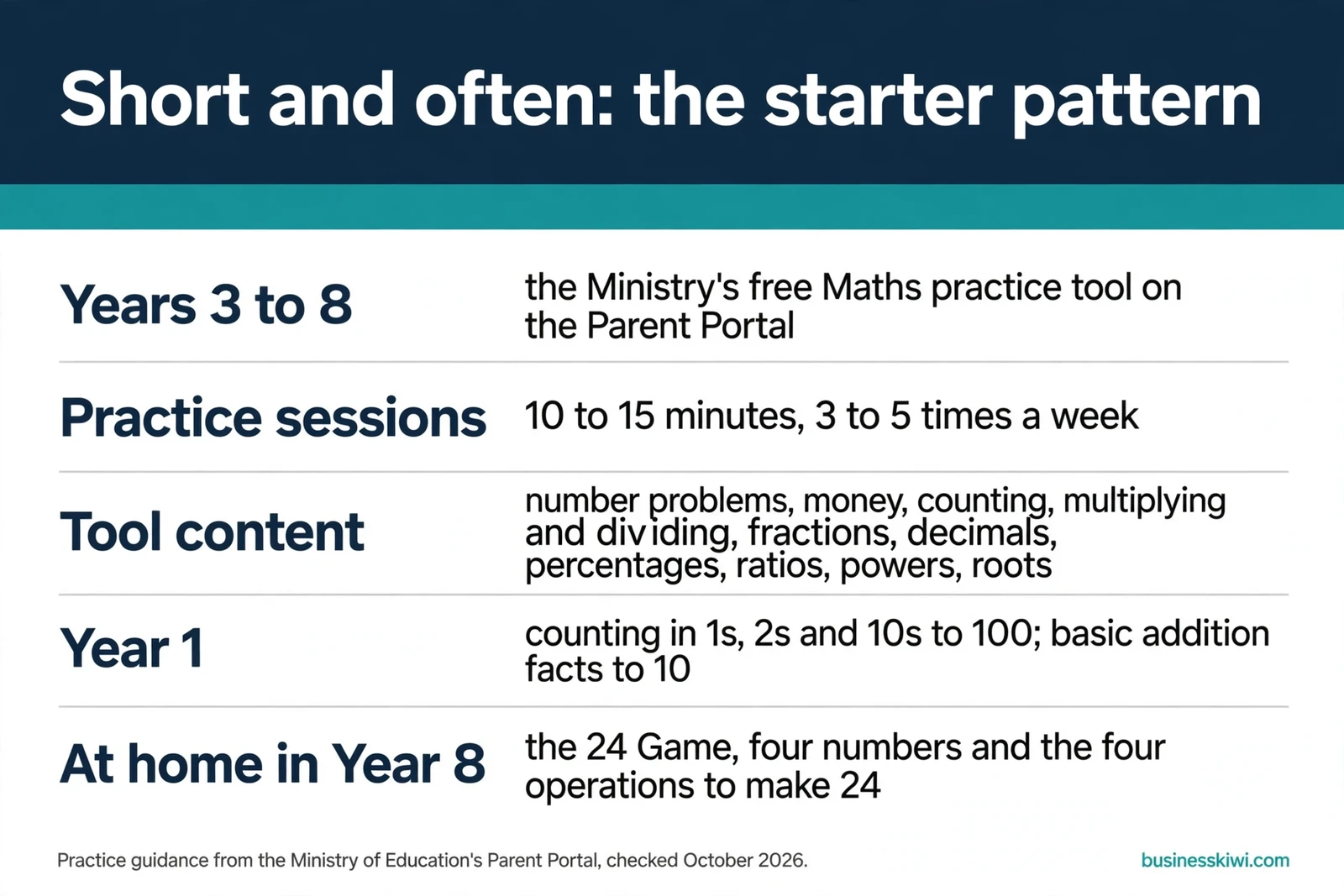
The Ministry’s Parent Portal on education.govt.nz has a page for each year of schooling that sets out what children learn in mathematics and statistics, strand by strand, with ideas to help at home. The ideas are deliberately small. Count forwards and backwards using clocks, letterboxes and action rhymes. Make up number stories about brothers, sisters and marbles. Build patterns with shells or blocks and ask what comes next. For Year 8, the guide suggests the 24 Game: write down four numbers and challenge your child to use addition, subtraction, multiplication and division to make 24.
The Ministry also runs a free interactive Maths practice tool for Years 3 to 8 through the Parent Portal. It covers number problems, working with money, counting, multiplying and dividing, fractions, decimals, percentages, ratios, powers and roots. The Ministry’s guidance on using it matches the starter principle: short, regular sessions of 10 to 15 minutes, three to five times a week, help build confidence. The same guidance notes that you do not need to be a maths expert. Spending a few minutes together, encouraging effort and celebrating progress is the job.
Keep home starters light. Ask one question while breakfast is made or on the drive to school. Let your child explain their method, even when the answer is wrong, because the explanation is where the learning sits. If a question is too hard, drop to a smaller number rather than giving the answer. Little and often beats a long session once a week.
Related guides: our times tables NZ guide covers the facts themselves, our reading levels guide covers the reading side of the curriculum, and our NZ school holidays guide has the term dates. More education guides are in the Jobs and Education section.
Frequently asked questions
What is a maths starter?
A maths starter is a short activity at the beginning of a maths lesson, usually five to ten minutes. The whole class does the same task, such as recalling facts, counting, estimating or solving one small problem. It settles the class, revises earlier learning and warms up the skill the lesson is about to use.
How long should a maths starter take?
Five to ten minutes is the usual range. The starter is an opening routine, not a second lesson. If a task runs long or opens a rich discussion, a teacher may park it and return to it later. At home, the Ministry suggests practice sessions of 10 to 15 minutes, three to five times a week, for its Years 3 to 8 practice tool.
Are maths starters part of the New Zealand Curriculum?
Starters are a teaching routine rather than a named curriculum requirement. The curriculum sets out what is taught, in year-by-year teaching sequences across six strands. Teachers choose routines, including starters, to teach that content well. The final Years 0 to 10 mathematics and statistics learning area applies from Term 1 2026.
What is the difference between a starter and a warm-up?
In practice, very little. Teachers use the two terms for the same opening activity. Starter is the more common word in staffrooms. Some teachers draw a small distinction and use warm-up for a game-like activity and starter for the first task of the lesson, but the purpose is the same.
Where can teachers find free maths starters in NZ?
The main official sources are NZMaths, which hosts activities, units of work and problem-solving tasks with teacher notes, and the Figure It Out series within it. Tāhūrangi holds the current curriculum content and supporting resources. These are Ministry sources, so they are free and aligned to New Zealand classrooms.
Can parents use maths starters at home?
Yes. A home starter is one short question, game or challenge asked regularly. The Ministry’s Parent Portal gives year-by-year ideas for each strand, and its free Maths practice tool for Years 3 to 8 is built for short sessions. Ask your child to explain how they got their answer. The explanation matters more than speed.
Do maths starters help with times tables?
They are one of the main ways schools build fact fluency. Short daily practice, mixed with strategy talk, helps facts stick better than occasional long drills. The Phase 2 curriculum for Years 4 to 6 puts increased focus on learning multiplication and division facts, so times tables starters feature heavily in those years.
The bottom line
A maths starter is a small routine with an outsized effect. Five to ten minutes of focused practice and talk at the start of a lesson builds fluency, keeps old learning alive and shows the teacher what the class knows. NZ teachers are well supplied with official material through NZMaths, Figure It Out and Tāhūrangi, matched to the phases and strands of the curriculum that applies from 2026. Parents can use the same pattern at home in minutes, with the Parent Portal’s year guides and practice tool doing the planning for them.
Sources
- Ministry of Education, Updated curriculum content released for Years 0-10 English, Te Reo Rangatira, Maths and Pāngarau, Tāhūrangi: https://tahurangi.education.govt.nz/final_y0to10_english_maths
- Ministry of Education, Mathematics and Statistics Learning Area Years 0-10, information sheet, 20 October 2025, Tāhūrangi: https://files-au-prod.cms.commerce.dynamics.com/cms/api/qwxsnqcpfm/binary/MLetvO?domain=newzealandcurriculum.tahurangi.education.govt.nz
- Ministry of Education, NZC Mathematics and Statistics Curriculum, Tāhūrangi: https://newzealandcurriculum.tahurangi.education.govt.nz/new-zealand-curriculum-online/new-zealand-curriculum/learning-areas/mathematics-and-statistics-curriculum/5637165587.c
- Ministry of Education, NZC Mathematics and Statistics Phases 1-4 (Years 0-10), Tāhūrangi: https://newzealandcurriculum.tahurangi.education.govt.nz/new-zealand-curriculum-online/nzc—mathematics-and-statistics-phases-1-4-years-0-10/5637289330.p
- NZMaths homepage, Ministry of Education: https://nzmaths.co.nz/
- NZ Maths, Teenagers (Level One activity), NZMaths resource library: https://meaningfulmaths.nt.edu.au/mmws/nz/resource/teenagers.html
- NZ Maths, Slippery Solutions (Figure It Out, Levels 2-3, Problem Solving), NZMaths resource library: https://www.meaningfulmaths.nt.edu.au/mmws/nz/resource/slippery-solutions.html
- Ministry of Education, Mathematics and Statistics in Year 1, Parent Portal: https://www.education.govt.nz/parents-and-caregivers/schools-year-0-13/parent-portal/guide-for-the-new-zealand-curriculum-years-0-to-8/year-1-new-zealand-curriculum/maths-and-statistics-in-year-1
- Ministry of Education, Mathematics and Statistics in Year 8, Parent Portal: https://www.education.govt.nz/parents-and-caregivers/schools-year-0-13/parent-portal/guide-for-the-new-zealand-curriculum-years-0-to-8/year-8-new-zealand-curriculum/mathematics-and-statistics-in-year-8
- Ministry of Education, Promoting the Maths practice tool for Years 3 to 8, Tāhūrangi, 18 August 2026: https://newzealandcurriculum.tahurangi.education.govt.nz/promoting-maths-practice-tool
This article is general information about maths starters in New Zealand and how they are used in classrooms and at home. It is not teaching advice for a specific child or class. Curriculum requirements and resources change over time, so check Tāhūrangi and the Ministry of Education for the current position, and talk to your child’s teacher about the routines used in their classroom.