Fairleigh Kindergarten: Enrolment, Sessions, ERO Report & Parent Guide
The short answer
Fairleigh Kindergarten is a small, community-run kindergarten at 27 A Garden Rd in Merivale, Christchurch. It takes children from two years old through to school age, with places for up to 45 children at a time and no under-two-year-olds. It opens Monday to Friday from 8.00am to 2.45pm, with a choice of an 8.00am or 8.30am start and a morning session that ends at 1.00pm. The kindergarten itself currently says, on its enrolment page, “We have spaces available!” Every teacher is fully qualified, and the Education Review Office (ERO) rated the service Whakaū | Embedding across every domain in its most recent quality evaluation, published in November 2021. Fees are not published anywhere, so parents need to email the kindergarten for its current fee schedule.
The kindergarten at a glance
| Fact | Detail |
|---|---|
| Service name | Fairleigh Kindergarten |
| Education Counts service number | 70357 |
| Service type (Education Counts) | Education & Care |
| Address | 27 A Garden Rd, Merivale, Christchurch |
| Phone | 03 355 4502 |
| admin.fairleigh@kindergarten.co.nz | |
| Ages | From 2 years to school age (no under-2s) |
| Licensed places (maximum children) | 45 |
| Total roll listed by ERO | 60 |
| Service roll in ERO’s 2021 report | 53 |
| 20 Hours ECE | Yes, for children aged 3 and over |
| Hours | Monday to Friday, 8.00am to 2.45pm |
| Governance | Parent board, elected annually |
| Centre Manager | Rebecca Glithero |
| Teaching team | Centre Manager plus 6 full-time teachers, all fully qualified |
| Staff ratio | 1 staff member to every 8 children |
| Founded | 1915, on the Garden Road site since 1929 |
| Latest ERO report | Akarangi | Quality Evaluation, 4 November 2021 |
One naming point is worth knowing. Fairleigh has kindergarten in its name and works like a community kindergarten, but Education Counts lists its service type as Education & Care rather than Kindergarten. That is a Ministry classification detail, not a difference in what children experience day to day.
Roll and community
ERO’s page for Fairleigh lists a total roll of 60 children. That is ERO’s current headline figure for the service. In its November 2021 quality evaluation, ERO recorded a service roll of 53 at the time of the review, and the two figures come from different dates, so they should not be mixed together. Education Counts publishes no roll or enrolment figure for Fairleigh at all, which is why every roll number in this guide comes from ERO. The 2021 report also recorded the make-up of that roll of 53: 7 Māori children, 33 NZ European/Pākehā children and 13 children of other ethnicities.
The licence allows up to 45 children on site at once, all aged over two. A roll larger than the daily licence is normal for a sessional service, because children attend on different days and for different session lengths across the week.
Fairleigh is genuinely community owned. It began in 1915 on the veranda of a home in Rossall Street, spent some years as a preparatory school in Holmwood Road, and moved to the Garden Road site in 1929, where it still stands. A group of parents formed the Fairleigh Preschool and Community Centre, later bought the property, and set up an incorporated, not-for-profit society to own and run the kindergarten. That is still the model today. Every parent or caregiver becomes a member of the society, and the governing board is elected from those members each year. ERO describes the service the same way, as a long established, community-based kindergarten governed by a parent board.
Enrolment and availability
The kindergarten’s enrolment page currently carries the message “We have spaces available!” and invites families to visit at any time. Visits are the usual first step, and the site lists no formal open day or appointment process: you are welcome to call in. No waiting list is mentioned anywhere on its website. Availability changes as children start school and new families enrol, so the spaces position is one to confirm on the day you enquire.
Children can start from their second birthday and stay until school age. There are no places for children under two. To enrol, contact the kindergarten by email at admin.fairleigh@kindergarten.co.nz or by phone on 03 355 4502. There is an enrolment form to complete, and joining Fairleigh also means joining the society behind it, since every parent or caregiver becomes a member.
Fairleigh offers 20 Hours ECE for children aged three and over, which Education Counts also confirms. Families attest their 20 Hours ECE hours to the service as part of enrolment, and those funded hours reduce what a family pays for a three, four or five year old. Two year olds are not covered by 20 Hours ECE, so their hours sit outside the subsidy.
Because the parent board governs the kindergarten, enrolment comes with a say in how it runs. Parents elect the board annually and can put themselves forward for it. For many Merivale families, that community ownership is the main point of difference from a commercially run centre.
What ERO found
ERO’s most recent report on Fairleigh is an Akarangi | Quality Evaluation, dated 4 November 2021, after a review team visited in August 2021. Akarangi is ERO’s quality evaluation approach for early childhood services, and it judges how well a service provides the learning and organisational conditions that support equitable and excellent outcomes for all learners.
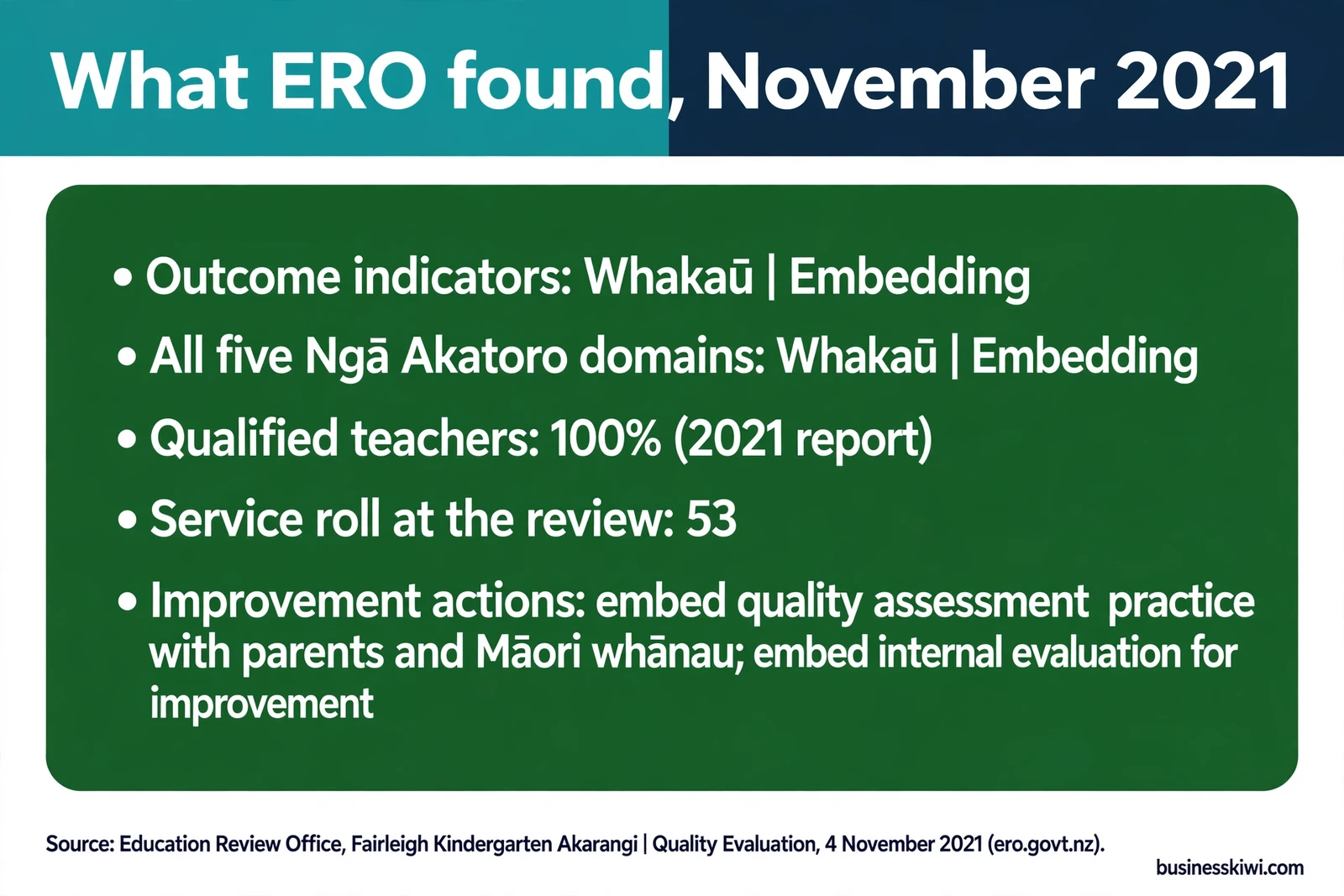
The headline result is unusually even. ERO judged the service Whakaū | Embedding on the outcome indicators, and Whakaū | Embedding in every one of the five Ngā Akatoro domains: the learner and their learning; collaborative professional learning; evaluation for improvement; leaders fostering collaboration and improvement; and stewardship through effective governance and management. Whakaū | Embedding is the second band on ERO’s Akarangi rubric, and it signals practice that is established and being embedded rather than still emerging.
In its summary of findings, ERO said tamariki are well supported by kaiako to become independent and resilient learners within a rich play-based curriculum. Ongoing inquiries based on children’s interests and curiosities foster their creativity and give them chances to refine their knowledge and develop thinking skills. Toddlers and older tamariki play cooperatively in an unhurried environment, learn to care for each other, and build positive social skills.
ERO also found effective learning-focused partnerships with parents. Parents get regular opportunities to contribute meaningfully to their children’s learning and to the daily curriculum, and leaders and kaiako advocate positively for children with diverse learning needs so they have full access to a meaningful curriculum. The board and leaders promote the kindergarten’s philosophy, vision and goals, and foster a culture of relational trust and collaboration. The 2021 report’s service table records that 100 percent of the teachers were qualified teachers.
The report was clear about where the work still lies. Improving assessment practice was a work in progress: the team was continuing to embed systematic assessment for learning, consistent with Te Whāriki, the early childhood curriculum, with the service’s values as a focus. Kaiako were still building their collective capability to deliver a meaningful bicultural curriculum, including deeper understanding of te ao Māori and greater use of te reo me ngā tikanga Māori in daily practice. Internal evaluation was continuing to be embedded as a process for improvement.
ERO recorded two improvement actions in the kindergarten’s Quality Improvement Planning. The first is to keep embedding quality assessment practice, working with parents and Māori whānau to analyse and evaluate learning outcomes in Te Whāriki, and to better reflect children’s identities, languages and cultures. The second is to embed internal evaluation for improvement, by broadening the scope of the data gathered for analysis, interpretation and decision making.
The 2021 report also covers management assurance. Before the review, the staff and management completed ERO’s Centre Assurance Statement and Self-Audit Checklist, attesting that they had taken all reasonable steps to meet their legal obligations on curriculum, premises and facilities, health and safety practices, and governance, management and administration. During the review ERO looked at the systems in the areas with a potentially high impact on children’s wellbeing: emotional safety, including positive guidance and child protection; physical safety, including supervision, sleep procedures, accidents, medication, hygiene and excursion procedures; suitable staffing, including qualification levels, police vetting, teacher registration and ratios; and evacuation procedures and practices for fire and earthquake.
For background, ERO’s previous report in June 2016 judged the kindergarten “Well placed” to promote positive learning outcomes for children. At that time it was licensed for 50 children and had a service roll of 47. Since that 2016 report, a new manager and a new curriculum leader have been appointed, which ERO notes in the 2021 evaluation. The 2016 report praised motivated, confident children who made very good use of the well-resourced indoor and outdoor areas, good progress in including te reo and tikanga Māori in the daily programme, and well supported transitions to school, with parents and the receiving school given very good documentation about each child. Its key next steps were strengthening strategic planning and internal evaluation, embedding a new staff appraisal system, and increasing te reo and tikanga Māori in documentation. Read together, the two reports show a consistent service whose long running development themes, internal evaluation, assessment and bicultural practice, were still the focus five years later.
Fees, sessions and the kindergarten day
Fairleigh is open Monday to Friday, 8.00am to 2.45pm. Children start at either 8.00am or 8.30am. The morning session runs until 1.00pm, and the full day finishes at 2.45pm. Families book the pattern of days and session lengths that suits them within those hours.
Fees are the one thing this guide cannot give you a number for, because Fairleigh does not publish them. Its enrolment page says, in full: “For our updated fee schedule please email admin.fairleigh@kindergarten.co.nz”. No dollar figure appears on the website or in its enrolment form, so any fee quoted anywhere else is not coming from the kindergarten. Email for the schedule before you budget.
Two fee arrangements are published. The enrolment form includes an optional charge for children over three, which covers things such as staffing above the Ministry ratio, outdoor space above the Ministry requirement, fully first aid qualified staff, Storypark and sunblock. It is optional, and there is no published amount for it. Separately, 20 Hours ECE applies for children aged three and over, which offsets part of the cost for those children.
Term breaks have their own published rules. A holiday programme runs over the state school term breaks, and attendance is optional. No fees are charged for term breaks if non-attendance is notified at least two weeks in advance. The kindergarten closes for six weeks over the Christmas and New Year break, and no fees are charged for that closure either. The enrolment form notes one exception to the no-charge pattern: fees are charged as usual for public holidays.
Learning and daily life
Fairleigh’s motto is “Poipoia te kakano kia puawai – Nurture the Seed and it will Blossom”. Its programme follows Te Whāriki, the New Zealand early childhood curriculum, and is responsive and inclusive of the bicultural curriculum of Aotearoa New Zealand. The kindergarten describes its environment as calm, peaceful and welcoming, with manaakitanga, respect and kindness for others, at its centre.
Four values guide the programme. Whanaungatanga covers positive and collaborative relationships. Manawaroa covers resilience, independence and persistence. Manaakitanga covers respect, empathy and kindness. Takohanga covers responsibility for self, others and the environment. ERO saw these same values in action in 2021, recording them as a focus in the service’s assessment practice.
Learning is play based and led by children’s interests. The kindergarten says it aims for children to become competent and confident learners in a safe, stimulating and secure environment, where individuality and positive self esteem are encouraged alongside co-operation, awareness of others and independence. Children choose their own path, learn with and from people, places and things, and build a sense of themselves as capable, confident learners. Whānau are treated as the experts on their own child: they are invited to share their views and aspirations, and those views inform practice and guide learning. The kindergarten uses Storypark to share children’s learning with families.
The teaching team is a real strength here. The kindergarten employs a Centre Manager, Rebecca Glithero, and six full-time teachers, and states that the team are all fully qualified ECE teachers. The ratio is one staff member to every eight children. Rebecca Glithero has worked at Fairleigh since 2011 and has been Centre Manager since 2018, and the curriculum leader is Victoria Watson, a qualified early childhood teacher who has been at Fairleigh since 2014. The team mixes long serving kaiako with newer graduates, and staff take part in ongoing professional development. Families quoted on the kindergarten’s website single out the teachers’ engagement in play alongside children, and the Kahikatea group, its school preparation group, for building interpersonal and fine motor skills before school.
Related guides: our Avalon Kindergarten parent guide profiles another community kindergarten, our Corinna School parent guide and our Gisborne Central School parent guide cover primary schools. More education guides are in the Jobs and Education section.
Frequently asked questions
Where is Fairleigh Kindergarten, and how do I contact it?
It is at 27 A Garden Rd, Merivale, Christchurch, which is the address Education Counts lists for the service. Phone 03 355 4502 or email admin.fairleigh@kindergarten.co.nz. Its Education Counts service number is 70357.
What ages does Fairleigh take, and how many children can attend?
Children attend from two years old through to school age, and there are no places for under-two-year-olds. The licence allows up to 45 children at a time. ERO lists a total roll of 60, which is higher than the daily licence because children attend on different days and sessions.
Does Fairleigh Kindergarten have spaces available?
The kindergarten’s enrolment page currently says “We have spaces available!” and no waiting list is mentioned on its website. Spaces change quickly in a small service, so confirm the current position by email or phone before you rely on it.
What are the hours and session times?
Monday to Friday, 8.00am to 2.45pm. Sessions start at 8.00am or 8.30am. The morning session ends at 1.00pm and the full day ends at 2.45pm. A holiday programme runs over state school term breaks, and attendance then is optional.
How much does Fairleigh Kindergarten cost?
The kindergarten does not publish its fees. Its enrolment page directs parents to email admin.fairleigh@kindergarten.co.nz for the updated fee schedule. Children aged three and over can use 20 Hours ECE, which reduces the cost, and the enrolment form includes an optional charge for over-threes with no published amount.
What did ERO say about Fairleigh Kindergarten?
In its Akarangi | Quality Evaluation of 4 November 2021, ERO judged Fairleigh Whakaū | Embedding on the outcome indicators and in all five Ngā Akatoro domains. ERO praised the play-based curriculum, the partnerships with parents and the collaborative culture, and set two improvement actions: embedding quality assessment practice with parents and Māori whānau, and embedding internal evaluation.
Who runs Fairleigh Kindergarten?
Parents do. It is owned by an incorporated, not-for-profit society whose members are the parents and caregivers of current children, and a parent board elected each year governs it. Day to day it is led by Centre Manager Rebecca Glithero, with a team of six full-time, fully qualified teachers.
The bottom line
Fairleigh is one of Christchurch’s long standing community kindergartens: founded in 1915, on its Garden Road site since 1929, and still owned and governed by the parents whose children attend. Its official record is tidy. Education Counts lists it as an Education & Care service for up to 45 children aged two and over, ERO lists a total roll of 60, and ERO’s 2021 quality evaluation put it at Whakaū | Embedding in every domain, with assessment practice and internal evaluation named as the work in progress. The practical steps are simple: visit, ask about spaces for the days you need, and email for the fee schedule, because fees are the one thing Fairleigh does not publish.
Sources
- Education Counts, Fairleigh Kindergarten profile and contact details (service 70357): https://www.educationcounts.govt.nz/find-an-els/els/profile-and-contact-details?region=13&district=60&area=589300&ece=70357
- Education Review Office, Fairleigh Kindergarten (institution 70357), including the Akarangi | Quality Evaluation of 4 November 2021 and the Education Review of June 2016: https://www.ero.govt.nz/institution/70357/fairleigh-kindergarten
- Fairleigh Kindergarten, homepage: https://kindergarten.co.nz/
- Fairleigh Kindergarten, Enrolment (hours, sessions, spaces, fees position, term breaks): https://kindergarten.co.nz/enrolment/
- Fairleigh Kindergarten, About Us (history, governance, philosophy and values): https://kindergarten.co.nz/about-us/
- Fairleigh Kindergarten, Staff (team, ratio, manager): https://kindergarten.co.nz/staff/
This article is general information about Fairleigh Kindergarten in Merivale, Christchurch, based on Education Counts, Education Review Office and kindergarten sources published at the time of writing. It is not published by or for the kindergarten. Enrolment, fees and availability can change, so confirm anything that matters for your family with the kindergarten before you act on it.