Sodium Percarbonate NZ: What It Is, How to Use It and What It Costs

The short answer
Sodium percarbonate is the white powder sold in New Zealand as oxygen bleach. It is a single ingredient, not a brand name, and it is the active ingredient in most oxygen bleach and “oxy” stain removers, including the well-known supermarket powders. Mixed with warm water, it releases hydrogen peroxide, which lifts stains and brightens fabrics without chlorine.
Pure powder from New Zealand specialist suppliers costs about $15.00 a kilogram. Supermarket blends look cheaper per kilogram, but they contain far less of the active ingredient, so compare on cost per load, not cost per kilogram. This guide explains what it is, what it does, how much to use, what it costs in New Zealand, and how to handle it safely.
What sodium percarbonate is
Sodium percarbonate is a white granular powder. Its chemical name is sodium carbonate peroxyhydrate, its CAS number is 15630-89-4, and its formula is written as 2Na2CO3·3H2O2. That formula tells the whole story: it is an addition compound of washing soda (sodium carbonate) and hydrogen peroxide, locked together in a dry, stable crystal.
Kept dry, it sits quietly in its bag or tub. Add warm water and it separates back into its two parts, washing soda and hydrogen peroxide. The hydrogen peroxide then releases active oxygen, and that oxygen is what does the cleaning. When the job is done, the solution breaks down into water, oxygen and soda ash. Nothing chlorine based is involved at any point.
It is worth being clear about the names, because the shops use several of them for the same thing:
- Sodium percarbonate is the chemical name.
- Oxygen bleach is the common retail name for the pure powder.
- “Oxy” stain removers are branded products built around it.
- Washing soda (sodium carbonate) is one half of the compound, but it is not the same product. Washing soda on its own has no oxygen bleach action.
- Baking soda (sodium bicarbonate) is a different substance again, and it does not bleach.
Pure oxygen bleach sold by New Zealand eco stores is 100% sodium percarbonate, with no fillers and no fragrance. Branded supermarket powders are blends. The Reckitt safety data sheet for Vanish NapiSan Oxi Action Pink Powder lists sodium percarbonate at 30% or more of the product, and the Gold range is listed at 330 grams per kilogram. The rest is made up of washing soda, surfactants, enzymes and other cleaning helpers. That difference matters when you compare prices, because a kilogram of pure powder contains far more of the active ingredient than a kilogram of a blend.

How it works, in plain words
Stains get their colour from chemical structures that absorb light. The active oxygen released by sodium percarbonate attacks those structures and breaks them apart, so the colour disappears. At the same time, the washing soda half of the compound makes the water alkaline, which helps shift grease and grime. The combination is why it works on such a wide range of marks, from tea and coffee to grass and blood.
Heat speeds the whole process up. In cold water it still works, but slowly. Eco Warehouse, a New Zealand supplier, gives 37 to 65°C as the best temperature range for its oxygen bleach, and notes that cold soaks need longer. Figgy & Co, another New Zealand supplier, says the same thing in plainer terms: use warm to hot water to get the most whitening power out of the powder.
A mixed solution does not keep. Eco Warehouse puts it at about 5 to 6 hours. After that the oxygen has escaped and the solution is spent. Mix only what you plan to use, and pour any leftover down the drain.
Oxygen bleach vs chlorine bleach
The two products are often confused because both are called bleach. They are not the same chemical, and they behave very differently.
| Oxygen bleach (sodium percarbonate) | Chlorine bleach (sodium hypochlorite) | |
|---|---|---|
| Active ingredient | Sodium percarbonate, CAS 15630-89-4 | Sodium hypochlorite |
| What it releases | Hydrogen peroxide, then active oxygen | Chlorine |
| Smell | None | Strong chlorine smell |
| Safe on colours | Yes, on most colourfast fabrics (test first) | No, it strips dye |
| Effect on fabric fibres | Does not weaken fibres the way chlorine bleach does | Weakens fibres with repeated use |
| Breaks down into | Water, oxygen and soda ash | Chlorine compounds |
| Septic tanks | Considered septic safe by both NZ suppliers quoted in this guide | Can harm the bacteria a septic system relies on |
Chlorine bleach is still the stronger choice for two jobs: disinfecting laundry during illness, and rescuing severely yellowed whites. Oxygen bleach is the better everyday choice for stain removal, brightening, and cleaning around the home, because it is gentler on fabrics and surfaces and leaves no chlorine behind.
What you can use it for
Laundry
This is the job most New Zealand buyers reach for first. Add 1 to 2 tablespoons to the washing machine drum with your regular detergent to brighten whites and freshen a load. Dissolve the powder in a little warm water first rather than sprinkling dry powder straight onto fabric.
For stains, dissolve the powder in warm water and soak the item for at least an hour, or overnight for best results. Eco Warehouse lists the stains its oxygen bleach handles as coffee, tea, wine, fruit juice, food, sauces, grass and blood. A paste made with a little warm water, worked into a single mark and then washed, suits small spots.
Cloth nappies are a common use. Eco Warehouse recommends 1 cup in a hot soak for 30 minutes to overnight, then a normal wash. Yellowed linen, net curtains, sports shoes and underarm marks take half a cup per 4 litres of water, soaked for an hour to overnight and then rinsed.
Around the house
A diluted solution cleans and deodorises kitchens, bathrooms, decks and outdoor areas. Eco Warehouse lists plastics, fibreglass, porcelain, ceramics, wood, carpet and concrete among the surfaces it suits. For a bath or shower, make a paste with hot water, scrub with a cloth or sponge, leave it for 15 minutes and rinse. For grout and tiles, Figgy & Co recommends adding the powder to hot water, applying it to the surface and leaving it for 2 hours before scrubbing.
Other jobs from the same supplier guides include stained plastic containers and dish cloths (a quarter cup in the dishwater, soaked at least 15 minutes), shower curtain mildew (a quarter cup per 4 litres, soaked overnight), carpet and upholstery spots (1 cup per 4 litres, wiped or sponged on), and the fridge and camping gear (1 cup per 4 litres).
Toilets and drains
For a toilet, Eco Warehouse recommends 1 cup left for 15 minutes, then a scrub. For a slow or smelly drain, a quarter cup in 500 ml of hot water, poured in and left overnight, is the suggested dose.
Decks and outdoor areas
Figgy & Co gives a deck wash recipe of 500 grams dissolved in 8 litres of hot water, sprayed or poured over a wetted deck, left until it stops fizzing (10 to 20 minutes), then scrubbed with a stiff brush and hosed off. Eco Warehouse gives a similar recipe of 1 cup per 4 litres, or about 2 cups for 20 square metres, scrubbed, hosed off, dried and then oiled. Oxygen bleach is gentler on timber than chlorine bleach, which can leave wood blotchy and unnaturally washed out. Once the deck is clean and dry, a coat of decking oil protects the timber.
Septic tanks
Both New Zealand suppliers quoted in this guide describe oxygen bleach as septic safe. It breaks down into oxygen, water and washing soda, which do not harm the bacteria a septic system relies on. Eco Warehouse suggests 1 cup flushed through the toilet twice a week as routine septic care.

How much to use
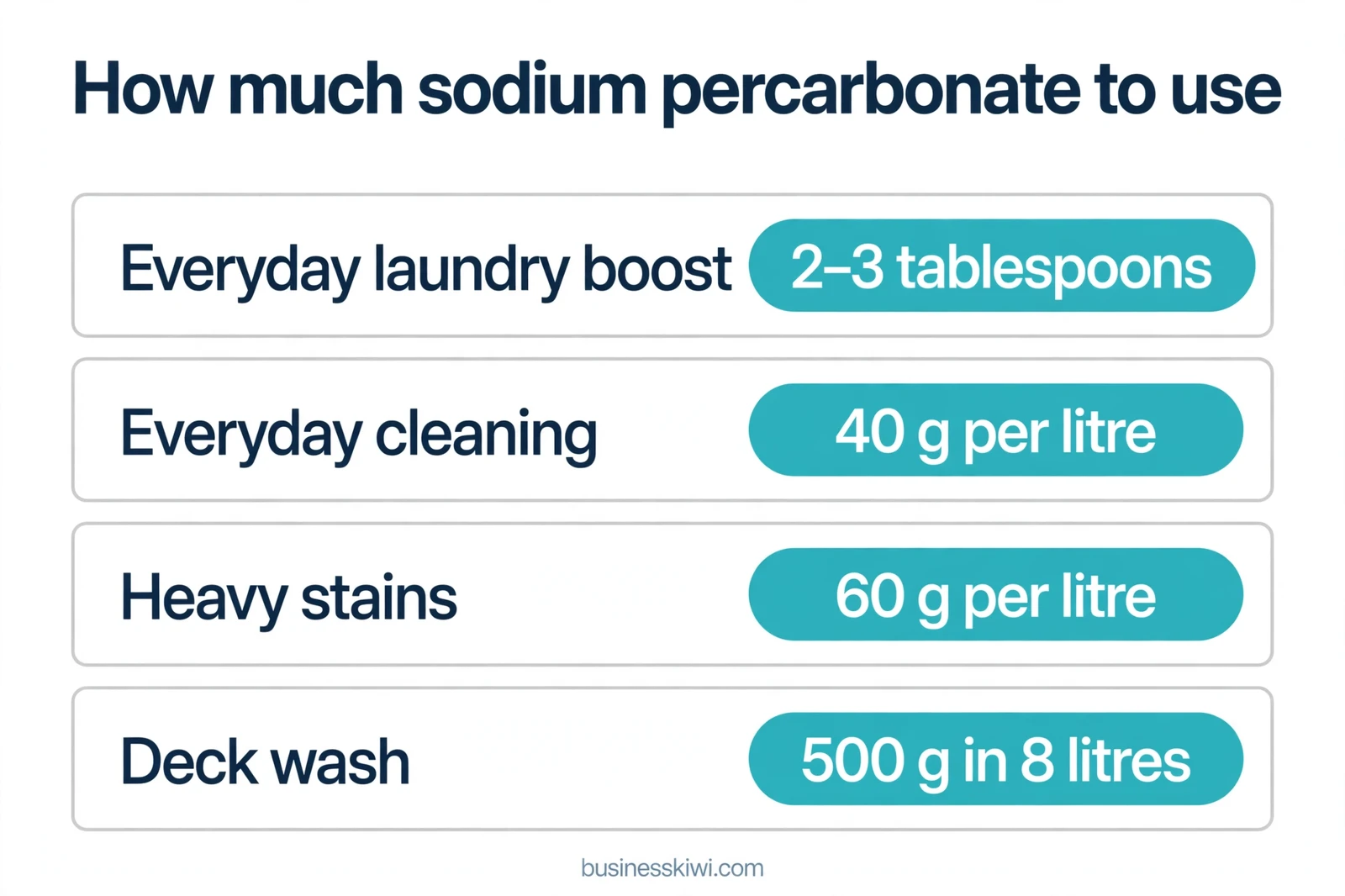
Doses vary a little between suppliers, so the table below brings the two New Zealand supplier guides together. Figgy & Co measures in grams and tablespoons, noting that 20 grams is about 1 tablespoon. Eco Warehouse measures in tablespoons and cups. Use the supplier guide that matches the product you bought, and always follow the label on your own pack.
| Job | Figgy & Co dose | Eco Warehouse dose |
|---|---|---|
| Everyday laundry boost | 2 to 3 tablespoons in the main wash | 1 to 2 tablespoons in the drum |
| Everyday cleaning or mild stains | 40 g per litre of water | 1/4 cup, dissolved in warm water |
| Heavy soiling or heavy stains | 60 g per litre of water | 1/2 to 1 cup, soaked 1 hour to overnight |
| Bucket soak, clothing | Soak at least 2 hours or overnight | 1/4 to 1 cup depending on soiling |
| Cloth nappies | Not specified | 1 cup, hot soak 30 minutes to overnight |
| Toilet | Not specified | 1 cup, leave 15 minutes, then scrub |
| Drains | Not specified | 1/4 cup in 500 ml hot water, leave overnight |
| Deck wash | 500 g in 8 litres of hot water | 1 cup per 4 litres (about 2 cups for 20 m²) |
| Grout and tiles | Add to hot water, leave 2 hours | Paste with hot water, leave 15 minutes |
Two habits make the difference between good results and wasted powder. First, dissolve it in warm water before use. Dry powder sitting on fabric can leave marks, and cold water slows the release of oxygen. Second, give it time. A quick wash cycle is not enough for a stubborn stain. A soak of an hour or more, or overnight, is where oxygen bleach earns its reputation.
What it costs in New Zealand
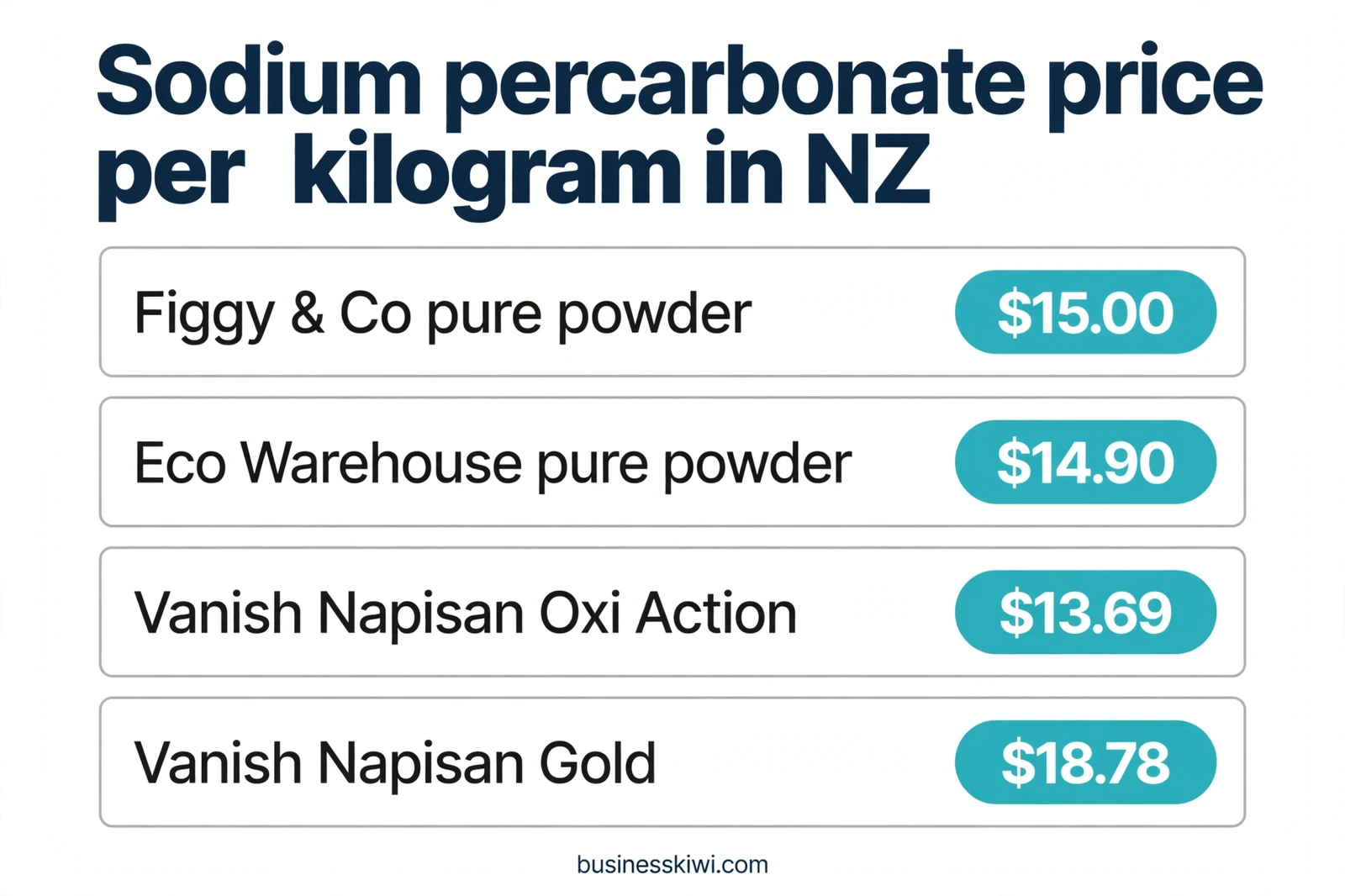
Prices below are as listed on the suppliers’ own websites on 10 November 2026. Supermarket prices vary by store, so treat the PAK’nSAVE figures as a snapshot of what one store listed on that date.
| Product | Size | Listed price | Price per kilogram |
|---|---|---|---|
| Figgy & Co Oxygen Bleach (100% sodium percarbonate) | 500 g | $8.00 | $16.00 |
| Figgy & Co Oxygen Bleach (100% sodium percarbonate) | 1 kg | $15.00 | $15.00 |
| Figgy & Co Oxygen Bleach (100% sodium percarbonate) | 3 kg | $45.00 | $15.00 |
| Eco Warehouse Oxygen Bleach (100% sodium percarbonate) | 1 kg | $14.90 (was $15.50) | $14.90 |
| Vanish Napisan Oxi Action (blend) | 1 kg | $13.69 | $13.69 |
| Vanish Napisan Oxi Action (blend) | 3 kg | $33.59 | $11.20 |
| Vanish Napisan Oxi Action Crystal White (blend) | 1 kg | $13.69 | $13.69 |
| Vanish Napisan Oxi Action Gold (blend) | 500 g | $9.39 | $18.78 |
| Vanish Napisan Oxi Action Gold (blend) | 2 kg | $18.49 | $9.25 |
Three things to notice in that table. First, pure powder from the two specialist suppliers costs about $15.00 a kilogram, and Eco Warehouse cuts the unit price further on volume, with $1.50 off each kilogram when you buy 4, and $2.50 off each when you buy 10. Second, the supermarket blends look cheaper per kilogram, but they are not the same product. Vanish Napisan Gold is listed at 330 grams of sodium percarbonate per kilogram, so a kilogram of Gold contains about a third of the active ingredient in a kilogram of pure powder. Third, delivery is extra with the specialist suppliers. Figgy & Co charges $10 courier to urban and business addresses and $15.50 to non-urban and rural addresses, and does not ship to Waiheke, Great Barrier or Chatham Islands, or to PO boxes.
The honest way to compare is cost per wash, not cost per kilogram. At 1 to 2 tablespoons per laundry load, a kilogram of pure powder lasts a long time. A 1 kilogram bag at $15.00 works out at roughly 50 loads at 20 grams a load, or about 30 cents a load. A blended product needs a larger scoop to deliver the same amount of active ingredient, so the cheaper sticker price does not always mean cheaper washing.
Pure powder or a branded stain remover?
The choice comes down to what you value. Pure sodium percarbonate is one ingredient, with no fragrance, no fillers and no dye. You control the dose, you know exactly what is in the wash, and the cost per load is low. It suits people who mix their own cleaning products, buy in bulk, or want a fragrance-free option.
Branded powders add other ingredients for a reason. Surfactants lift grease, enzymes break down food and starch stains, and TAED (tetraacetylethylenediamine) helps the oxygen bleach work at lower temperatures. That is why Vanish Napisan says its Oxi Action formula works in a cold wash at 25°C, while pure sodium percarbonate wants warm water. If you mostly wash in cold water, a blend may clean better. If you wash warm or hot and soak when needed, pure powder does the same job for less money per load.
Check the label either way. The ingredient list, or the safety data sheet for the product, will tell you how much sodium percarbonate is actually in the tub. For the Vanish Napisan range in New Zealand, the manufacturer’s safety data sheets list sodium percarbonate at 30% or more in the Pink powder and 330 grams per kilogram in the Gold range.
Safe handling and storage
Sodium percarbonate is a household product, but it is also a hazardous substance under New Zealand law, and it deserves the same respect as any cleaning chemical. The safety data sheet issued by Clark Products in New Zealand gives it the EPA New Zealand HSNO approval code HSR001351, and lists these hazard classifications: 5.1.1B (oxidising substance), 6.1D (harmful if swallowed), 6.4A (irritating to the eye), 9.1D (slightly harmful to the aquatic environment) and 9.3C (harmful to terrestrial vertebrates). The signal word is Danger, and the key hazard statement is H272: may intensify fire, oxidiser.
Handle it with care. Keep it dry and sealed, store it cool and away from heat, flame and combustible materials, and keep it out of reach of children and pets. It is harmful if swallowed and causes serious eye damage, so wear eye protection when you handle the dry powder and rinse eyes with water immediately if any gets in. If someone swallows it, or it gets into their eyes, call the National Poisons Centre on 0800 764 766. That number is printed on the New Zealand safety data sheets for the product.
In practical terms, that means:
- Keep it dry and sealed. It activates with water, so humidity alone will slowly use it up. Figgy & Co tells buyers to take the powder out of its paper bag and store it airtight. Eco Warehouse says the same thing: kept dry in its sealed bag it lasts a long time, but moisture makes it slowly release its oxygen and lose strength.
- Store it cool, away from heat, flame and combustible materials. It releases oxygen, and oxygen supports combustion. The safety data sheet says to store it in a cool, dry, well-ventilated place, out of direct sunlight, away from foodstuffs and away from sources of heat or ignition.
- Keep it out of reach of children and pets. It is harmful if swallowed, and Figgy & Co warns that if it is swallowed it releases gas when activated by moisture, which causes bloating and can be harmful.
- Protect your eyes. It causes serious eye damage. Wear eye protection when you handle the dry powder, and rinse eyes with water immediately if any gets in.
- Read the label before use, and follow the directions on the product you bought. Different products have different strengths and different warnings.
- For transport, it is classified as a dangerous good: Class 5.1 oxidising substances, UN number 3378, proper shipping name sodium carbonate peroxyhydrate. That is why some suppliers cannot ship it to the islands or to PO boxes.
If someone swallows it, or it gets into their eyes, call the National Poisons Centre on 0800 764 766. That number is printed on the New Zealand safety data sheets for the product.
What never to mix it with
Do not mix sodium percarbonate with chlorine bleach. Eco Warehouse states this plainly in its safety guidance, and other cleaning suppliers say the same. The two products react, release gas, and can build pressure in a closed container. They also cancel each other out, so you end up with two wasted products instead of one stronger one.
Do not mix it with vinegar or other acids either. Vinegar is acidic and sodium percarbonate solution is alkaline, so the acid neutralises the alkalinity and uses up the active oxygen before it can clean anything. The result is fizz, not cleaning power.
The rule that covers every case is simple: use one cleaning product at a time, rinse between products, and never mix cleaning chemicals in the same bucket or bottle. If you have already used one product on a surface, rinse it away before you use another.
What it cannot do
Oxygen bleach is useful, but it has limits, and knowing them saves disappointment:
- It does not remove rust. Eco Warehouse lists this directly in its safety and tips section.
- It does not remove hard water mineral deposits or limescale.
- It is not suitable for wool, silk or leather. Eco Warehouse lists all three, and Figgy & Co warns against wool and silk. The reason is that the alkaline solution can damage protein fibres.
- It can cause colour to bleed. Some fabrics lose colour just from being soaked in warm water, so Figgy & Co advises soaking like colours together and testing coloured fabrics for colourfastness first. Always check garment care labels before you soak anything.
- Metal zips and fasteners can corrode in a long soak, so Figgy & Co warns to be careful with them.
- It is not a substitute for chlorine bleach when disinfection is the goal, for example washing bedding and clothing during illness. Chlorine bleach kills a wider range of germs.
Buying guide
Start with how you will use it. If you want a laundry booster and stain soaker for a family wash, a 1 kilogram bag of pure powder is the sensible first buy. It is enough to learn the doses without committing to bulk storage. If you already use it for decks, grout, nappies or a septic tank as well, the 3 kilogram size from the same supplier costs the same per kilogram, and Eco Warehouse offers volume discounts at 4 and 10 kilograms.
Buy pure powder if you want one ingredient, no fragrance, and the lowest cost per load. Buy a branded blend if you wash mostly in cold water, or you want the extra stain-fighting ingredients in the same scoop. Either way, check the label for the sodium percarbonate content before you compare prices, because a cheap kilogram of blend is not the same as a kilogram of pure powder.
Buy from a New Zealand supplier if you want the product quickly and without import hassles. The two specialist suppliers quoted in this guide ship from New Zealand, while some overseas listings on marketplace sites ship from the United States or China and add shipping and customs charges at checkout. Supermarket shelves are the easiest option for a first try, with Vanish Napisan stocked at PAK’nSAVE and other supermarkets.
Store what you buy properly from day one. An airtight container in a cool, dry cupboard, away from the sink and away from children, keeps the powder at full strength. A damp laundry cupboard is the worst place for it.
If you clean around the house with it, the Business and Industry section has more home and garden guides.
Frequently asked questions
What is sodium percarbonate?
Sodium percarbonate, also called sodium carbonate peroxyhydrate (CAS 15630-89-4), is a white granular powder made by combining washing soda with hydrogen peroxide. Dissolved in warm water, it releases hydrogen peroxide, which lifts stains and brightens fabrics. It is the active ingredient in most oxygen bleach and “oxy” stain removers. Pure oxygen bleach sold in New Zealand is 100% sodium percarbonate with nothing added.
Is oxygen bleach the same as chlorine bleach?
No. Chlorine bleach is sodium hypochlorite. Oxygen bleach releases hydrogen peroxide instead, so it whitens and lifts stains without chlorine, without the chlorine smell, and without weakening fabric fibres the way chlorine bleach does. It is also safe on most coloured fabrics, though you should test first. Chlorine bleach is still stronger for disinfecting laundry and for severely yellowed whites.
Is sodium percarbonate safe for septic tanks?
Yes, according to both New Zealand suppliers quoted in this guide. It breaks down into water, oxygen and washing soda, which do not harm the bacteria a septic system relies on. Eco Warehouse suggests 1 cup flushed through the toilet twice a week as routine septic care. Chlorine bleach, by contrast, can disrupt septic system function.
Can I use it on coloured clothes?
Yes, on most colourfast fabrics, but test first. Soak a hidden corner in the solution and check for colour loss before you soak the whole garment. Soak like colours together, because some fabrics bleed colour in warm water even without any bleach. Do not use it on wool, silk or leather.
What temperature water should I use?
Warm to hot water works best, between 37 and 65°C according to Eco Warehouse. It still works in cold water, but more slowly, so soak for longer. A blended product containing TAED can work at lower temperatures, which is why Vanish Napisan says its formula works in a cold wash at 25°C.
Does sodium percarbonate expire?
Kept dry in its sealed bag, it lasts a long time. Moisture is the enemy: it makes the powder slowly release its oxygen and lose strength, so always reseal the bag and store it airtight. A mixed solution is a different story. It stays active for about 5 to 6 hours, then the oxygen has escaped and it should be poured away.
Can I mix sodium percarbonate with vinegar or bleach?
No. Do not mix it with chlorine bleach, and do not mix it with vinegar or other acids. Mixing with bleach can release gas and build pressure, and mixing with vinegar neutralises the solution and wastes the product. Use one cleaning product at a time and rinse between products.
This article is general information only. Always read the label on the product you buy and follow its directions, including safety warnings. If you are unsure whether a fabric or surface is suitable, test a small hidden area first. If sodium percarbonate is swallowed or gets into someone’s eyes, call the National Poisons Centre on 0800 764 766.