Best Decking Oil NZ: NZ Guide, Requirements & Practical Information
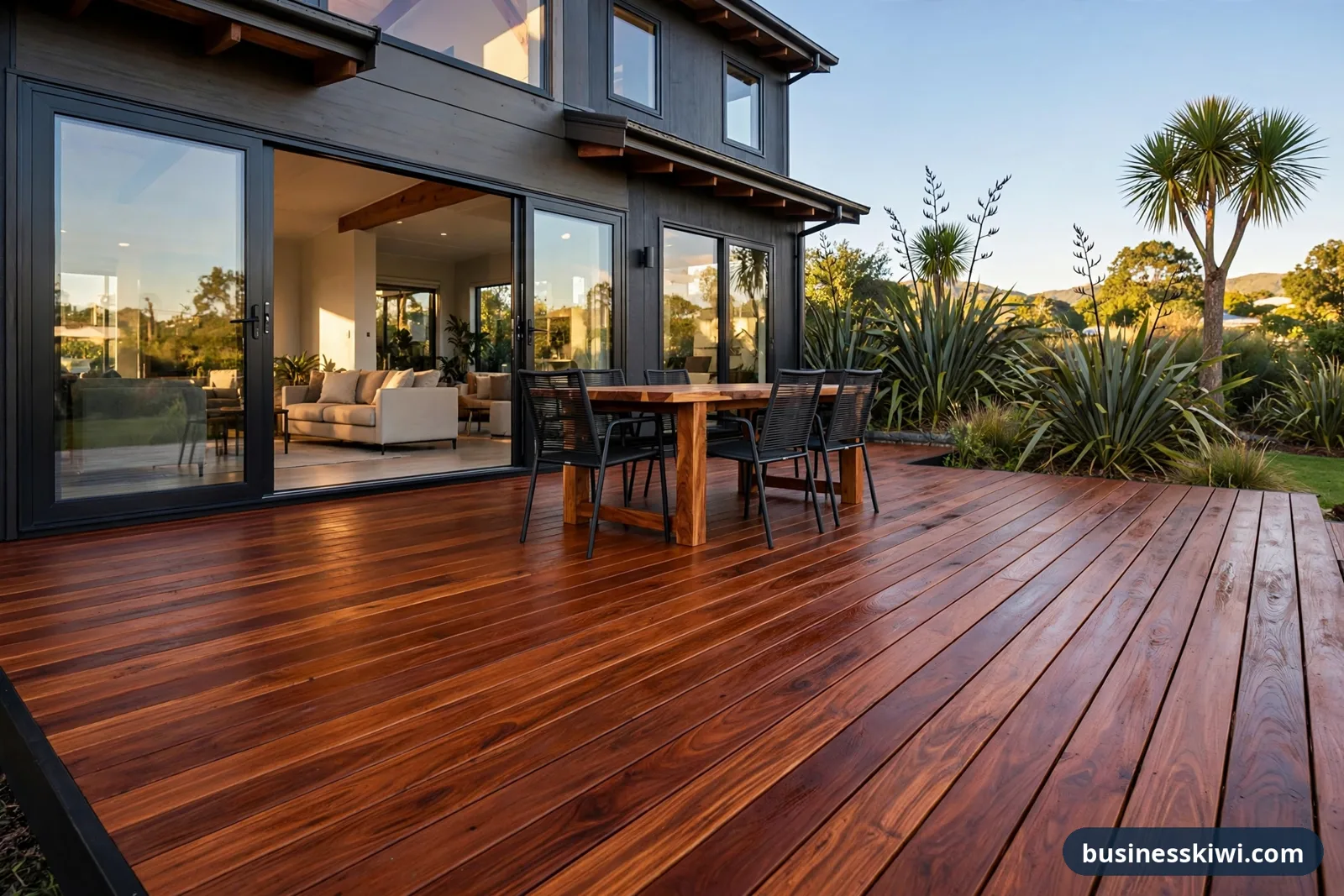
The short answer: There is no single best decking oil, and no official ranking exists to name one. The best oil matches your timber, your exposure and the finish you want. Dense kwila in full sun, weathered pine in shade and a pool deck are three different jobs. Match the oil family to the deck first, then compare the makers’ own datasheet figures for coats, recoat time and coverage.
Every deck owner asks the same question in the hardware aisle, and the honest answer is annoying: it depends. On what the deck is made of, how much sun and rain it cops, and whether you want the timber to hold its colour or silver off gracefully. This guide replaces the mythical winner with a decision framework, built only from the manufacturers’ own datasheets and product pages for oils sold in New Zealand.
Why no honest guide can name one winner
Decking oils are not tested against each other by any NZ standards body, and makers measure their own products under their own conditions. When a maker says its oil lasts twice as long as a traditional oil, that is a claim about its own product, not a verdict on the shelf. Cabot’s says exactly that about Aquadeck, and it may well be right. It is still a claim, not a ranking.
What can be compared fairly is the machinery in the datasheets: how a product goes on, how many coats it needs, how fast you can recoat, how far a litre spreads, and how soon it wants attention again.
The families of decking oil
Almost every decking oil sold in New Zealand belongs to one of three families. The family decides the behaviour. The brand decides the details.
| Oil family (named example) | Base | Coverage per coat | Coats | Recoat | Maintenance rhythm |
|---|---|---|---|---|---|
| Traditional penetrating oil (Feast Watson Traditional Timber Oil) | Solvent-borne oil | 6 m²/L | 2 on bare timber, 1 for maintenance | Wipe excess at 30 minutes, recoat after 1 hour | One maintenance coat as it weathers |
| Migrating penetrating oil (Dryden WoodOil) | Penetrating oil, NZ made | 12–14 m²/L on new hardwood decking | 2, second coat 30–90 days later | No same-day recoat; the oil migrates in over 24 hours | Maintenance coat, often at the end of summer |
| Water-based decking oil (Cabot’s Aquadeck) | Water-based, lightly pigmented | About 12 m²/L | 2, or 3 in full sun and around pools | 1 hour minimum | Check every 12 months |
| Water-based high-traffic oil (Intergrain UltraDeck Timber Oil) | Water-based | 10–14 m²/L | 2–3 | 3 hours (8 in cool weather) | Inspect every 12 months, recoat before bare timber shows |
| Waterborne oil stain hybrid (Resene Woodsman Decking Oil Stain) | Waterborne alkyd hybrid | 20 m²/L on new dressed timber, 6–12 on weathered | 2 new, 1–2 to restain | 1 hour on pine, 24 hours on dense kwila and vitex | On average after 1 to 2 summers |
Traditional penetrating oils
The classic deck oil soaks into the timber, feeds it, and never forms a skin, so there is nothing to crack or peel. Feast Watson’s Traditional Timber Oil works this way: two coats on bare timber, excess wiped off after 30 minutes, a second coat after an hour, and brushes cleaned in mineral turpentine. Its coverage, about 6 m² per litre, is the honest cost of a thirsty, oil-rich product. It weathers gradually and tops up with a single maintenance coat.
Migrating penetrating oils
Dryden, a New Zealand maker, builds its WoodOil to migrate deep into the timber rather than sit on top. It is not a film at all, so it cannot flake. The system is patient: a first coat, then a second coat 30 to 90 days later. On new hardwood decking it spreads furthest of the products here, about 12 to 14 m² per litre per coat. Used clear, it lets exposed timber silver naturally. With Dryden’s ColourTone stirred in, the pigment carries the UV protection and the colour holds.
Water-based oils and hybrids
Water-based oils trade the turpentine smell for water clean-up and fast recoats. Cabot’s Aquadeck goes on in two coats an hour apart, can be walked on after eight hours, and wants a check every 12 months. Intergrain’s UltraDeck is the high-traffic take: two to three coats, a three-hour recoat in mild weather, full cure in seven days, and a third coat required in harsh spots such as full sun and pool surrounds. Resene’s Woodsman Decking Oil Stain is a hybrid, a waterborne alkyd that penetrates fully and carries UV-resistant pigment. Its recoat rule makes the timber point neatly: one hour on open-grained pine, a full 24 hours on dense kwila, vitex and garapa.
One honest gap: hardwax oils, popular on interior floors and furniture, are not an exterior deck category in New Zealand. None of the maker ranges behind this guide sells one for decks, so if a hardwax product is pitched for an outdoor deck, ask the maker to show you the exterior deck datasheet before you buy.
Start with your timber
The oil decision starts with the boards, not the tin.
Match the timber first
- Kwila: dense, oily and slow to drink. New boards need the tannin drawn out before coating (Cabot’s makes a New Timber Prep for exactly this), or a weathering period first. Expect long recoats: Resene allows 24 hours between coats on kwila. No oil stops kwila tannin bleed entirely; Resene says so itself.
- Vitex and garapa: dense hardwoods that behave like kwila. Slow recoats, patient systems, thin coats.
- Radiata pine: open-grained and thirsty. It takes oil quickly, recoats fast (an hour with Resene’s stain), and wears its coating faster in the sun.
- New timber, any species: new dense boards need weathering before most oils. Resene asks for two to three months on new dressed or dense timber; Feast Watson asks four to six weeks. Dryden adds a hard limit: timber moisture at or under 18 percent.
- Weathered timber: grey boards drink far more. Resene’s rates fall from 20 m² per litre on new dressed timber to 6 to 7 on weathered tread-up decking. Buy for the thirsty figure.
- Not timber at all: if your boards are composite, oil is simply the wrong product. Our guide to composite decking in NZ covers what those boards need instead.
If the deck itself is still on the drawing board as part of a bigger backyard project, our guide to shed prices in NZ covers the other structure most people price up at the same time.
Colour, pigment and the sun
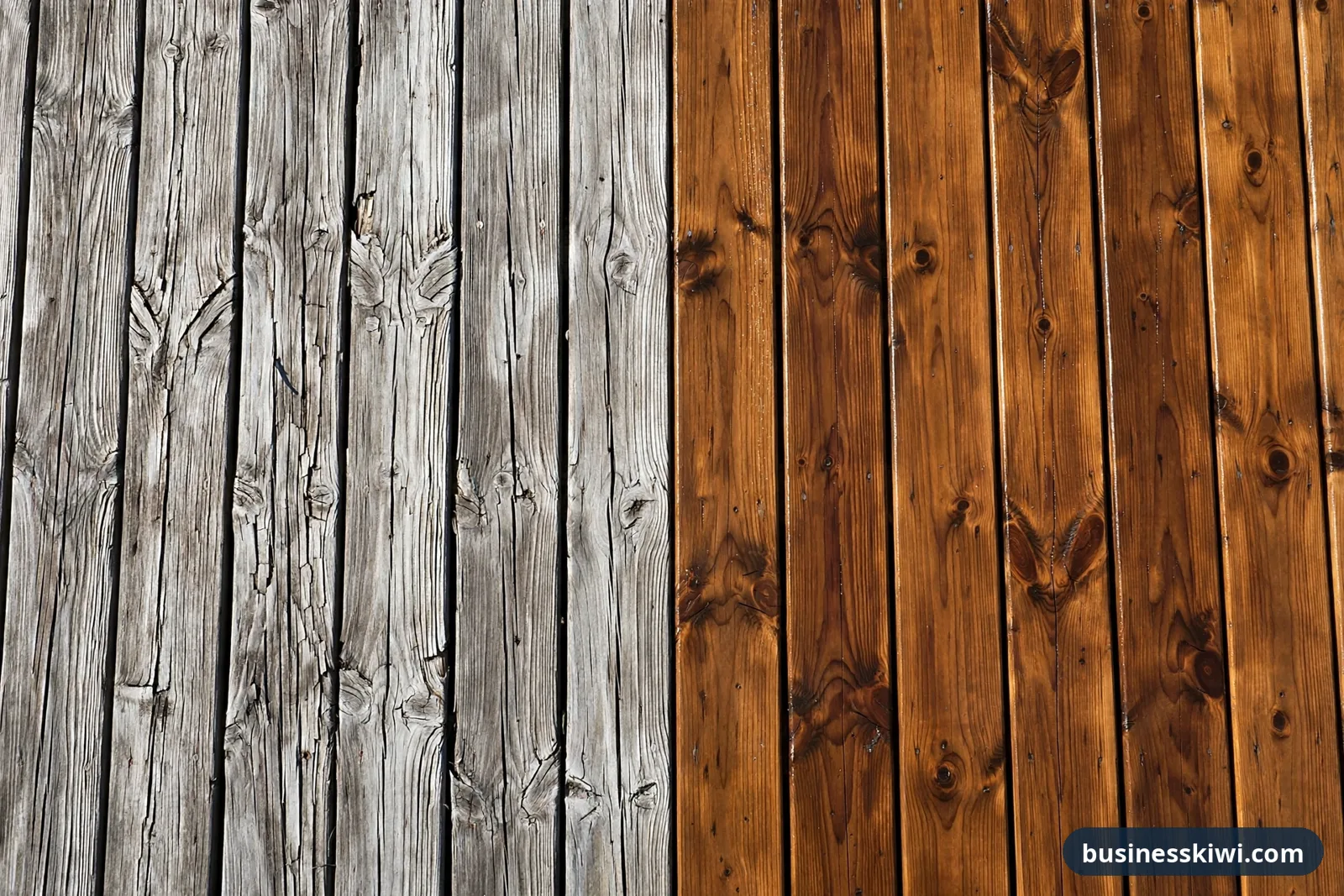
Clear oil is not a sunscreen. Dryden is blunt about its clear WoodOil: exposed timber will weather and silver over time, while sheltered boards under the eaves keep their colour. Pigment is what blocks UV. Every tinted product here, from Aquadeck’s light pigment to Resene’s oxide pigments, holds colour longer than a clear equivalent, and darker pigments generally hold longest.
So the colour question is really a maintenance question. Choose clear if you like the silvered look and low-key upkeep. Choose a tint near the timber’s natural colour if you want the new-deck look, and accept a recoat on the maker’s cycle to keep it.
Wet decks, pools and slippery boards
Water changes the pick twice over. First, harsh wet zones need more product: both Cabot’s and Intergrain call for a third coat in full sun and around pools. Second, grip. A smooth oiled finish can be slippery when wet, and Resene’s datasheet goes further, noting that trafficable areas coated with its decking oil stain will not meet the Building Act slip-resistance clause. Treat that as a warning for stairs, ramps and pool decks with any brand.
Intergrain answers the problem directly with a slip-resistant version of UltraDeck, which carries its UltraGrip additive and a matt finish for stairs, walkways and pool surrounds. If your deck has steps down to a pool, that class of product, not a standard gloss-leaning oil, is the right starting point.

Preparation decides the result
More decking jobs fail in the prep than in the tin. The makers agree on the shape of it, even when their products differ.
Prep, whichever oil you choose
- Clean first. Sweep, then scrub with the maker’s deck cleaner. Intergrain’s path is typical: cleaner for soiling, a tannin and oil remover first on new raw timber.
- Deal with the old finish honestly. Sound oil in good condition can often be recoated (Cabot’s allows Aquadeck over a coating at least 30 days old and sound). A failed film finish is different: Intergrain and Resene both require film-forming coatings off, back to bare timber, before a penetrating oil goes on.
- Use the water test. Feast Watson’s check for previously coated decks: sprinkle water on the boards. If it soaks in, you can coat. If it beads, the deck needs more weathering, sanding or stripping first.
- Weather new dense timber. Weeks for pine, up to two to three months for new kwila before some systems (Resene). Cabot’s prep route shortens this by drawing the tannin and oil out chemically.
- Check moisture and forecast. Dryden’s ceiling is 18 percent timber moisture, with no application if rain is due inside 6 to 8 hours. Intergrain’s window: no coating above 35°C, below 5°C, or in humidity over 85 percent.
Applying the oil
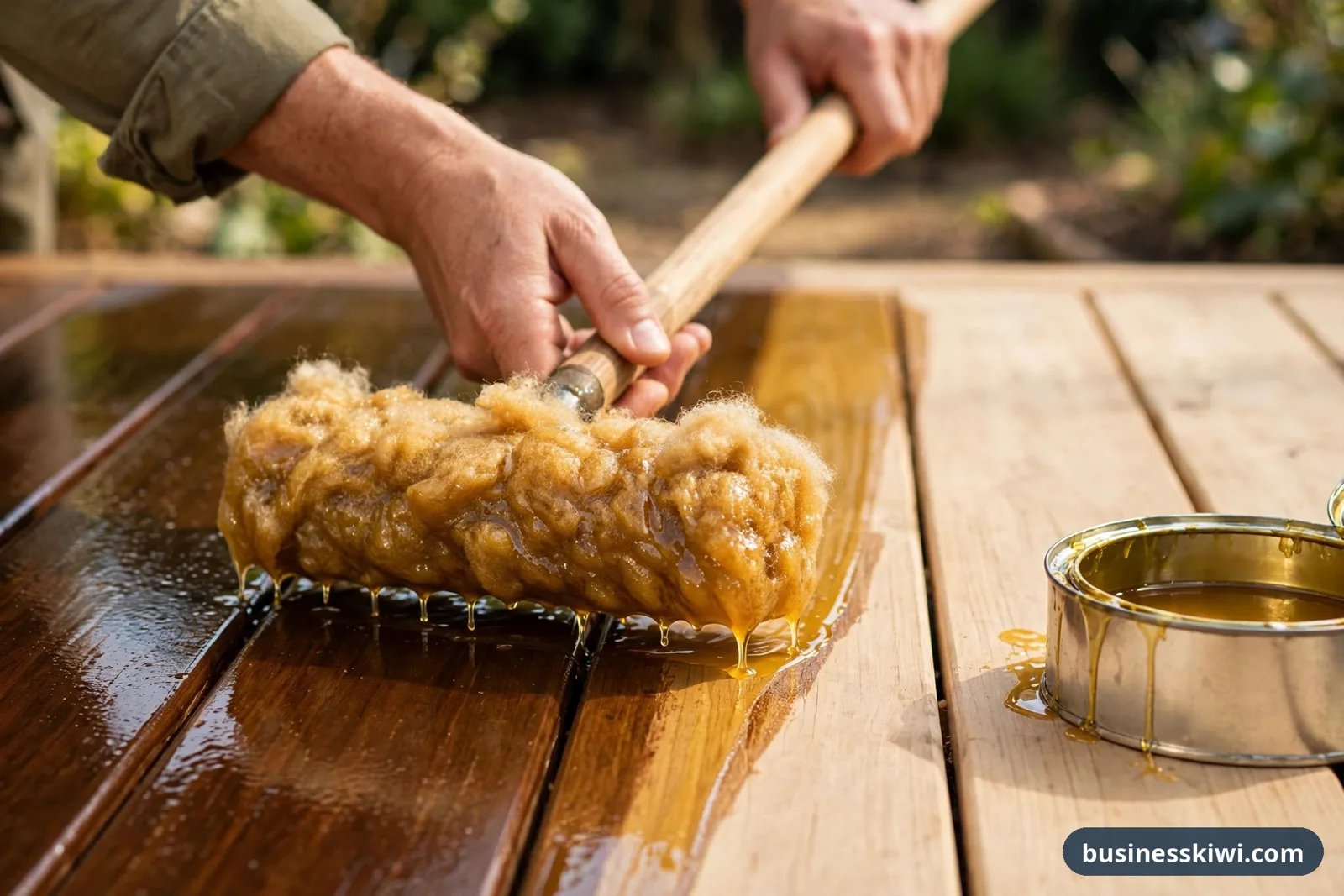
Work along the boards, not across them, a few boards at a time, and finish each board end to end so no lap mark dries mid-board. Intergrain is specific about UltraDeck: brush, pad or spray, never a roller, and do not overspread it, or the film weakens and lap marks show. Traditional oils ask the opposite discipline: flood it on, let it drink, then wipe the excess off at about 30 minutes (Feast Watson) so nothing sits on the surface to go tacky. Resene warns of the same failure: excess Woodsman pooled in the board grooves can turn sticky.
Drying, recoat and walking on it
The spread here is the widest in the guide, which is why the family matters more than the brand. Aquadeck can be walked on after eight hours, furniture back after seven days. UltraDeck is rain ready in three hours and fully cured in seven days. Resene allows 48 hours before heavy foot traffic. Dryden’s oil works to a different clock: the wet look gone within 24 hours at the correct rate, and the second coat weeks later, not hours.
Coverage: how much to buy
Do the maths from the datasheet rate for your timber’s condition, not the best case on the tin. A 30 m² deck at Aquadeck’s roughly 12 m² per litre needs about 2.5 litres a coat, so a 5 litre tin covers two coats. The same deck in Feast Watson’s traditional oil at 6 m² per litre needs about 5 litres a coat, 10 litres for two. Weathered boards sit at the thirsty end of every range, so plan on the low figure.
Keeping it up: the maintenance cycle
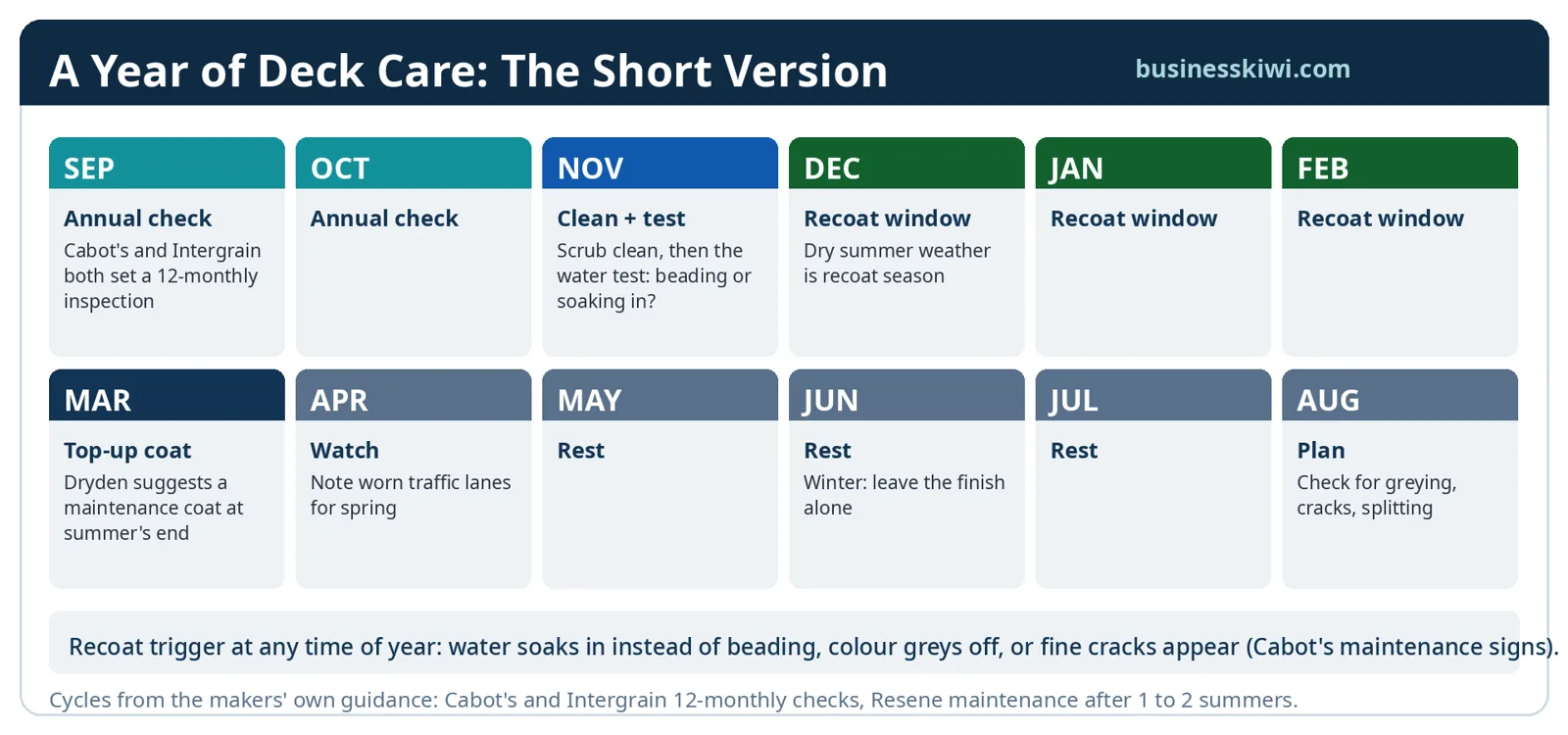
Every oil here is a maintenance finish. That is the deal: easy recoats, no sanding back a peeling film, in exchange for regular top-ups. Cabot’s and Intergrain both set a 12-monthly inspection. Intergrain’s rule is to recoat before bare timber shows. Resene puts maintenance at one to two summers on average. Dryden’s specification suggests a maintenance coat at the end of summer, before winter.
The home test matches Cabot’s own maintenance signs. Flick water on the boards. Beading means the oil is still working. Water soaking straight in, boards greying, or fine cracks at the surface mean the deck is asking for its coat.
Watch-outs
- Oiling over a dead film finish. Penetrating oils cannot soak through a sealed, flaking coating. Strip or sand back to bare timber first.
- Coating new kwila too early. Fresh kwila is full of tannin and natural oil. Coat it green and the finish can come up patchy (Cabot’s), with tannin bleed still showing through (Resene).
- Leaving excess oil on the surface. Pooled oil turns tacky or sticky. Wipe traditional oils off at the maker’s mark, and spread water-based coats at the rated coverage.
- Trusting clear oil to hold colour in full sun. It will silver. If colour matters, the pigment has to be in the tin.
- Using the wrong applicator. Intergrain says no roller for UltraDeck; a roller lays the wrong film thickness. Use the pad or brush the datasheet names.
If your outdoor surface is concrete instead
Decks are not the only surface that needs sealing. A concrete patio or path wants a sealer, not an oil, and the choice there runs on film-forming versus penetrating sealers. Our guide to concrete sealer in NZ works through those datasheets the same way.
The bottom line
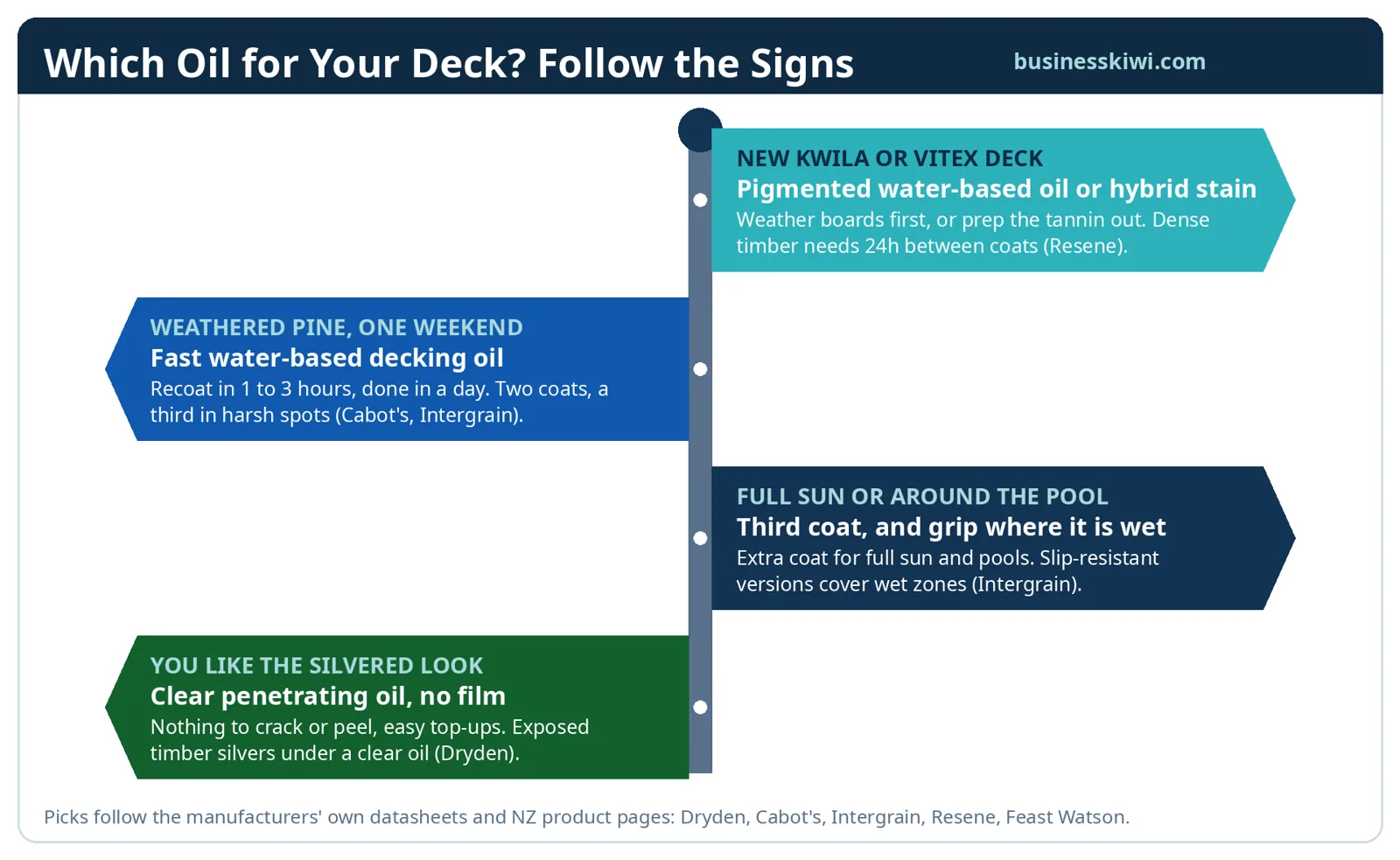
Pick the family for your timber and exposure, then let the datasheets settle the brand. Dense hardwood in full sun points to a pigmented, patient system. A pine deck you want done in a weekend points to a fast water-based oil. A pool deck points to grip first and everything else second. Then keep the date: check the deck every year, and recoat while the job is still a single easy coat.
For more building and trade reference guides like this one, browse our Business and Industry category.
Sources: the manufacturers’ own publications, read in full for this guide: Dryden WoodOil Data Sheet; Cabot’s Aquadeck product page and NZ datasheet NZCA00059; Intergrain UltraDeck Timber Oil datasheet AUIN00038; Resene Woodsman Decking Oil Stain data sheet D57D; Feast Watson Traditional Timber Oil product page (NZ).
Frequently asked questions
How many coats of decking oil do I need?
Two coats is the standard starting point across all five products read for this guide. Intergrain and Cabot’s both add a third coat for harsh exposure: full sun, pool surrounds and humid spots. Dryden spreads its two coats out, the second going on 30 to 90 days after the first.
How often should I recoat my deck?
Plan on checking every 12 months, which is the inspection interval both Cabot’s and Intergrain publish. Resene puts maintenance at one to two summers on average for its decking oil stain. The water test tells you more than the calendar: if water soaks in instead of beading, the deck is due.
Can I oil over an existing coating?
Sometimes. Cabot’s allows Aquadeck over an existing oil or water-based coating at least 30 days old and in good condition. A failed film-forming finish is the exception: Intergrain and Resene both require it removed back to bare timber, because a penetrating oil cannot soak through a sealed surface. Feast Watson’s water test settles most cases: soaking in means ready, beading means not.
Is water-based or traditional oil better?
Neither wins outright. Water-based oils (Aquadeck, UltraDeck) recoat in one to three hours, clean up in water and carry low odour. Traditional penetrating oils (Feast Watson, Dryden) never form a film that can peel and top up with a single maintenance coat, but clean up in turpentine. Match the family to your timber and how you like to work.
Why has my oiled deck gone grey?
Because clear oil carries no pigment to block UV. Dryden states it plainly for its clear WoodOil: exposed timber silvers naturally while sheltered boards keep their colour. A pigmented oil slows the greying but does not stop it. The fix is a clean and a fresh tinted coat, or accepting the silvered look as the finish.
Can I oil a brand new kwila deck straight away?
Not with most systems. New dense timber needs to weather first: Resene asks for two to three months on new dressed or dense timber, and Dryden sends new unseasoned decking to its dedicated Decking & Hardwood WoodOil rather than its standard clear base. Cabot’s New Timber Prep is the shortcut, drawing tannin and oils out so the deck can be coated sooner. Fresh kwila coated too early can finish patchy.
I have a pool deck. Does that change the oil I should buy?
Yes, twice. Around pools, Cabot’s and Intergrain both specify a third coat, because sun and water strip a finish faster. And grip matters more than gloss: Intergrain sells a slip-resistant UltraDeck with a grip additive for stairs, walkways and pool surrounds, and Resene’s datasheet warns its standard stain does not meet the Building Act slip-resistance clause on trafficable areas. Start with grip.