Warehouse Trolley NZ: Types, Prices and What to Check Before You Buy
Warehouse Trolley NZ: Types, Prices and What to Check Before You Buy
The short answer
A warehouse trolley is a wheeled platform, cage or shelf unit that lets one person move a load that would otherwise take two people, or a forklift, to shift. In a New Zealand warehouse it is the everyday tool for moving cartons from the dock to the rack, carrying picked orders to the dispatch bench, and shifting stock during a stocktake. The cheapest useful models cost about $141 before GST, and a heavy duty platform trolley rated to 1,000 kilograms costs about $895 before GST. This guide explains the types, what they cost in New Zealand, how to pick the right load capacity, and how to use one safely.
What a warehouse trolley is
The names get used loosely, so it helps to start with plain definitions. Rex, the New Zealand manufacturer that has built handling equipment here since 1946, sets them out clearly on its own site. A hand truck, also called a sack barrow or sack truck in New Zealand, is a two-wheeled unit with a small toe plate for tilting and moving individual boxes, bags or drums. A hand trolley usually means the same thing, it is the common everyday term for a hand truck in New Zealand. A platform trolley has a flat load deck on four wheels for moving multiple items or heavier, awkward loads as one unit, rather than tilting a single item. A shelf or cage trolley adds tiers or mesh sides so smaller, loose or fragile stock stays contained and does not need re-stacking each trip.
The distinction matters because the wrong type slows the job down. If you are moving one bagged or boxed item at a time, a hand truck is faster. If you are moving a stacked or bulky load, a platform trolley does the job better. If you are picking several small items for different orders, a shelf or cage trolley keeps them separate and contained.
A warehouse trolley is not a pallet jack and it is not a forklift. It carries loads a person can push, usually from 150 kilograms to 1,000 kilograms depending on the model, and it works on smooth warehouse floors. It does not lift pallets off the ground, and it is not rated for loads above its stated capacity. The capacity figure on the supplier’s page is the limit, not a target.
The main types of warehouse trolley
There are five types you will see in New Zealand warehouses. Most suppliers stock all of them, and the choice comes down to what you move and how the load needs to be held while it travels.
| Type | What it looks like | Best for | Typical capacity |
|---|---|---|---|
| Platform trolley | Flat deck on four wheels, one or two push handles | Stacked cartons, drums, bulky or awkward loads | 150kg to 1,000kg |
| Folding platform trolley | Flat deck with a handle that folds down for storage | Light loads, vans, sites with little storage space | 150kg to 250kg |
| Shelf trolley | Two or three flat shelves on a frame | Order picking, moving several totes or loose items | 150kg to 350kg per shelf |
| Cage trolley | Mesh or solid sides, sometimes with a roof and doors | Loose, small or fragile stock that must stay contained | 350kg to 500kg |
| Scissor lift trolley | Platform that raises and lowers by pump or motor | Lifting loads to bench height without bending | 150kg to 1,000kg |
Platform trolleys are the workhorse. Shelf and cage trolleys are the picking tools. Folding trolleys are the light, portable option. Scissor lift trolleys sit in a different price range and are closer to lifting equipment than to a trolley, so they are covered briefly at the end of the prices section rather than in detail here.
Platform trolleys in detail
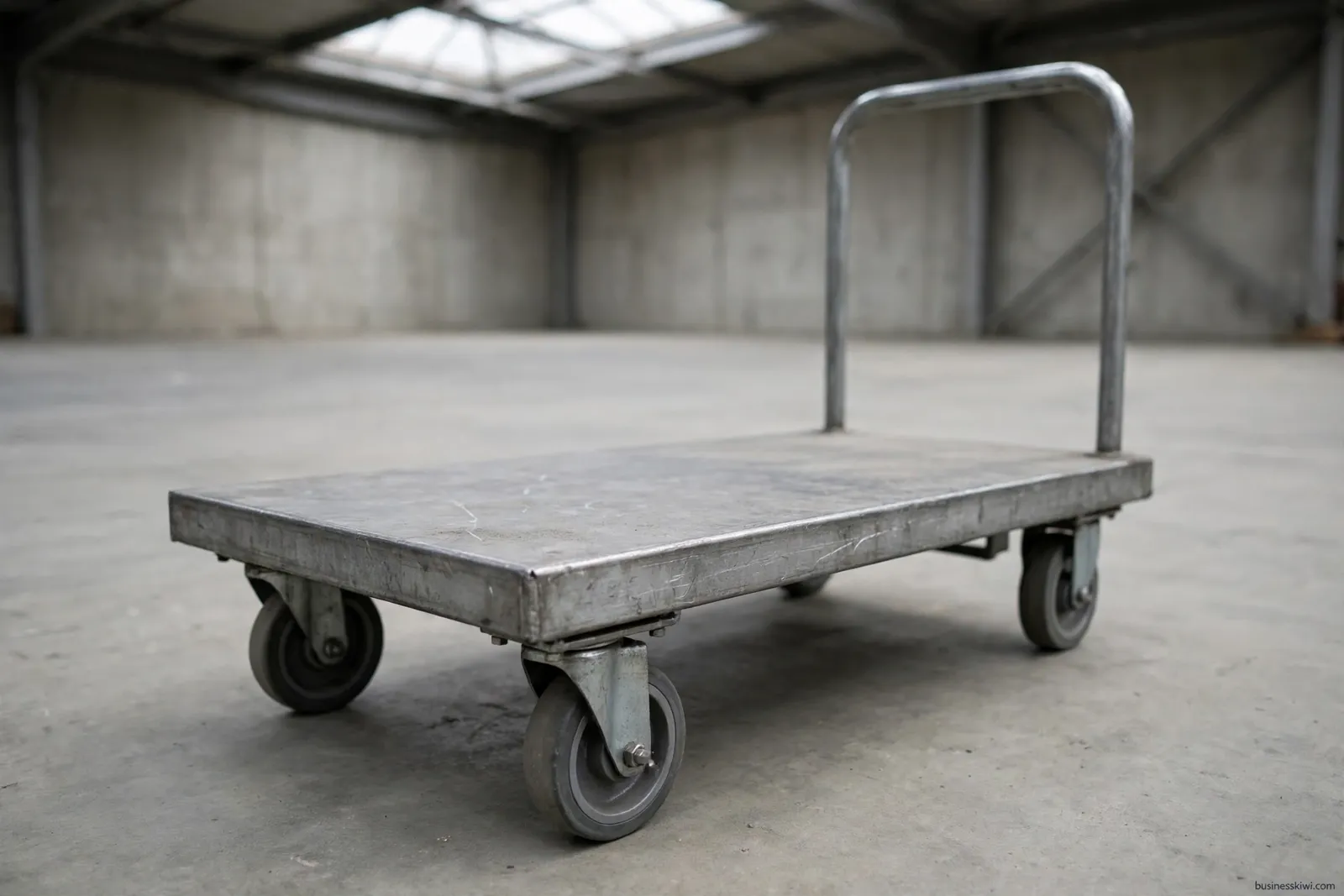
A platform trolley is a flat deck, usually steel, with four wheels and a push handle at one end. Some models have a handle at both ends, which helps when the trolley has to be pulled back out of a tight aisle. The deck sits low, which makes loading easy: boxes are slid or lifted a short distance onto the deck rather than lifted to waist height.
The most useful difference between platform trolleys is size. Astrolift, the New Zealand supplier whose prices are used in this guide, lists a narrow single platform trolley at 1,260 millimetres long and only 500 millimetres wide, with a platform 1,207 millimetres long. Its narrow design suits supermarket and retail aisles, where a wide trolley would not fit between shelving. At the other end of the range, its heavy duty platform trolley has a platform 1,510 millimetres long and 750 millimetres wide, or 1,595 millimetres long with two handles, and is rated to 1,000 kilograms.
Deck height matters too. A low deck, around 190 to 200 millimetres off the floor, is easier to load and unloads with less lifting. A higher deck, around 250 millimetres, usually means larger wheels underneath, which roll better over expansion joints and dock levellers. The heavy duty Astrolift model sits at 250 millimetres, while the zinc-plated model sits at 189 millimetres.
Six-wheel platform trolleys are a variant worth knowing about. They have a pair of larger central wheels and smaller wheels at the ends, which lets the trolley pivot on the spot. They are useful in tight spaces, but they are a specialist item and cost more than a standard four-wheel model.
Cage and shelf trolleys
A cage trolley is a platform trolley with sides. The sides are usually wire mesh or steel, and some models have a roof, a mid shelf and double doors that lock. The point is containment: loose cartons, small parts and fragile stock stay inside the trolley while it moves, so nothing falls off in a turn and nothing needs re-stacking at the other end.
Astrolift’s dual-door steel cage trolley is a typical example. It is rated to 500 kilograms, measures 1,090 millimetres long, 830 millimetres wide and 1,664 millimetres high, and holds 1,265 litres. Its zinc-plated version is slightly larger at 1,200 by 880 by 1,679 millimetres, holds 1,215 litres, and has two internal platforms. The zinc-plated version is sold on application rather than at a listed price, which is common for larger warehouse equipment.
Cage trolleys suit order fulfilment, laundry, and any job where stock has to be moved in bulk and kept secure. Some models nest together when empty, which saves floor space. If you buy a cage trolley, check whether it nests, because a row of non-nesting cages takes up a surprising amount of room.
A shelf trolley is the open version of the same idea. Instead of mesh sides it has two or three flat shelves, so the picker can see everything and reach each shelf without opening a door. Astrolift’s two-shelf order picking trolley comes in two sizes: 950 by 550 millimetres at $649.10 before GST, and 1,150 by 670 millimetres at $751.20 before GST. Both are rated to 350 kilograms. The distance between the shelves is 636 millimetres on the smaller model and 729 millimetres on the larger one, which is the measurement that decides whether your cartons actually fit.
An adjustable two-tier trolley is a useful middle option. Astrolift’s model costs $838.10 before GST, with a bottom shelf rated to 350 kilograms and a top shelf rated to 150 kilograms, on a platform 1,260 by 500 millimetres. The split rating is the detail to notice: the top shelf carries less than half of what the bottom shelf carries, so heavy items go low.
Folding trolleys
A folding trolley is a platform trolley whose handle folds flat, so the whole unit can be stored against a wall or carried in a van. They are the lightest and cheapest type, and they suit work that moves between sites, such as deliveries, trade work and small storerooms.
Astrolift lists two folding models. The folding steel platform trolley costs $141.30 before GST, is rated to 150 kilograms, and measures 740 by 480 by 860 millimetres overall. The folding aluminium trolley costs $263 before GST, down from $293, is rated to 250 kilograms, and has a platform 900 by 610 millimetres. The aluminium model carries more, weighs less, and costs about $122 more. Which one suits you depends on whether the trolley will be lifted in and out of a vehicle often, because that is where the weight of the trolley itself starts to matter.
Folding trolleys have a real limit: a 150 kilogram rating is not much once a few cartons are stacked on the deck. If the job regularly involves loads over 100 kilograms, a standard platform trolley is the safer buy. Folding models are also less stable on uneven ground, because their wheels are small and their frames are light.
What a warehouse trolley costs in NZ
Prices below are from Astrolift New Zealand’s own website, checked on 10 November 2026. All prices are in New Zealand dollars, before GST and before freight. Astrolift states on its site that all prices are in NZD and are plus freight and GST. Freight is quoted per order, so the delivered price will be higher than the figures below. GST-inclusive figures in the text are worked out by adding 15 percent GST to the supplier’s price; they are not prices the supplier publishes.
| Model | Capacity | Price before GST |
|---|---|---|
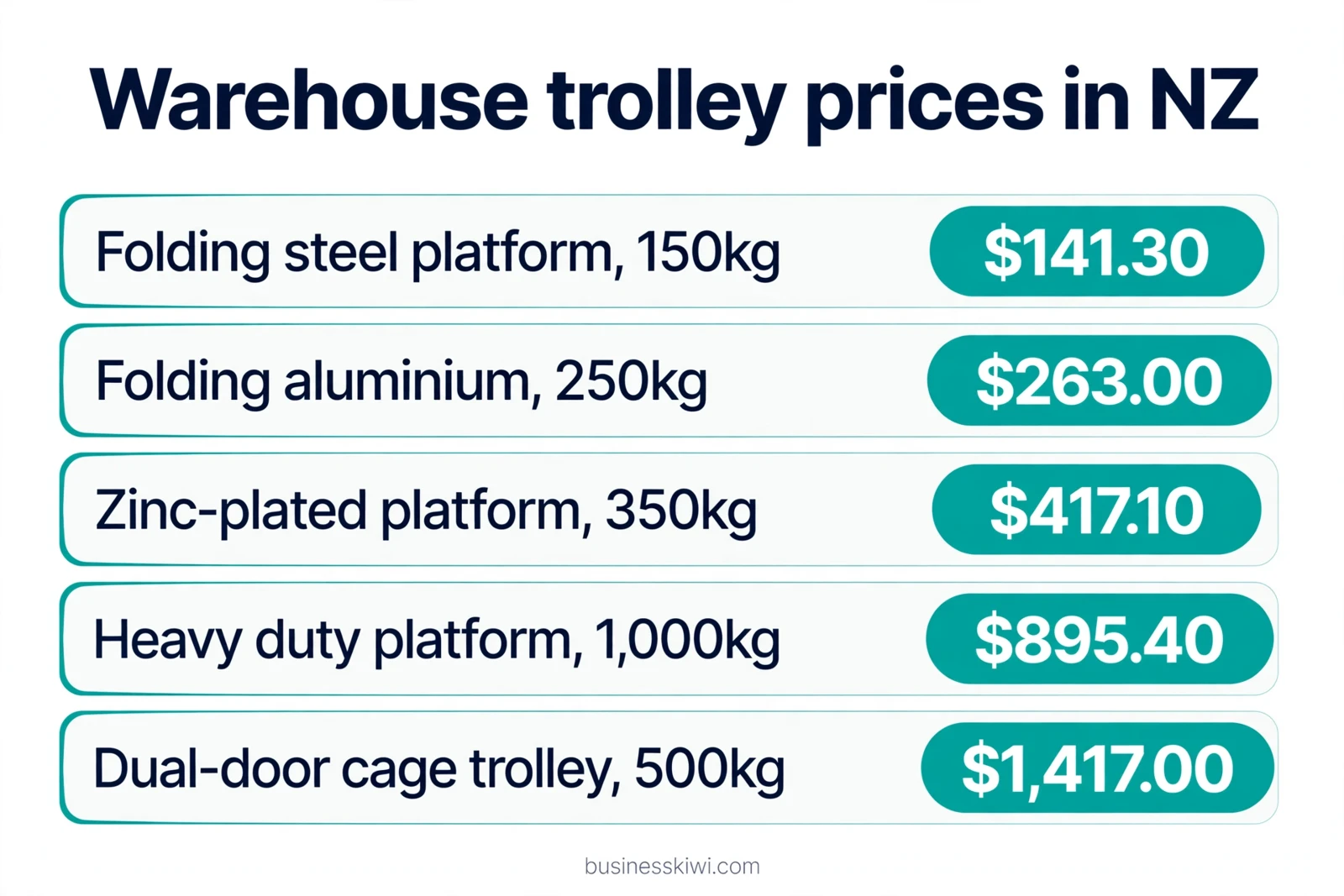
| Folding Steel Platform Trolley | 150kg | $141.30 |
| Folding Aluminium Trolley | 250kg | $263.00 (was $293.00) |
| Zinc-Plated Platform Trolley | 350kg | $417.10 |
| Vinyl Deck Platform Trolley | 300kg | $419.00 |
| Single Platform Trolley | 350kg | $595.00 (was $699.80) |
| 2-Shelf Order Picking Trolley, 950 x 550mm | 350kg | $649.10 |
| 2-Shelf Order Picking Trolley, 1150 x 670mm | 350kg | $751.20 |
| Adjustable 2-Tier Trolley | 350kg bottom, 150kg top | $838.10 |
| Heavy Duty Platform Trolley, 1 handle | 1,000kg | $895.40 |
| Heavy Duty Platform Trolley, 2 handles | 1,000kg | $987.70 |
| Cage Trolley, dual door, steel | 500kg | $1,417.00 (was $1,574.00) |
The range is wide: from $141.30 before GST, which is $162.50 with GST added, for the lightest folding model, to $1,417 before GST, which is $1,629.55 with GST added, for the dual-door cage trolley. Most warehouse buyers will land in the middle of that range. A standard steel platform trolley rated to 350 kilograms costs $417.10 to $595 before GST, depending on the deck and finish, and a 1,000 kilogram heavy duty model costs $895.40 to $987.70 before GST.
A few prices are not published. The zinc-plated dual-door cage trolley and one heavy duty platform trolley model are sold on application, which means the supplier quotes for them. Rex, the New Zealand manufacturer, does not publish prices on its website at all; it quotes freight after purchase and offers bulk and trade pricing on select ranges. That is normal for industrial equipment. If a supplier will not give a price without a quote, ask for the delivered price in writing, with GST stated, before you compare it with a listed price.
Scissor lift trolleys cost considerably more. Astrolift lists a mobile scissor lift trolley from $499.30 before GST, an electric lift model from $4,194.30 before GST, and a stainless steel model from $1,754 before GST. Those are lifting machines rather than trolleys, and they are priced as such.
How to choose the right load capacity
The capacity figure is the first thing to get right, and the most common mistake is to buy too little of it. Rex puts the rule plainly on its own site: it depends on the heaviest single load you will move regularly, not the occasional outlier. A trolley rated to 350 kilograms will carry a 350 kilogram load, but if most of your loads are 300 kilograms and the trolley is used all day, it will wear out faster than a 500 kilogram model doing the same work.
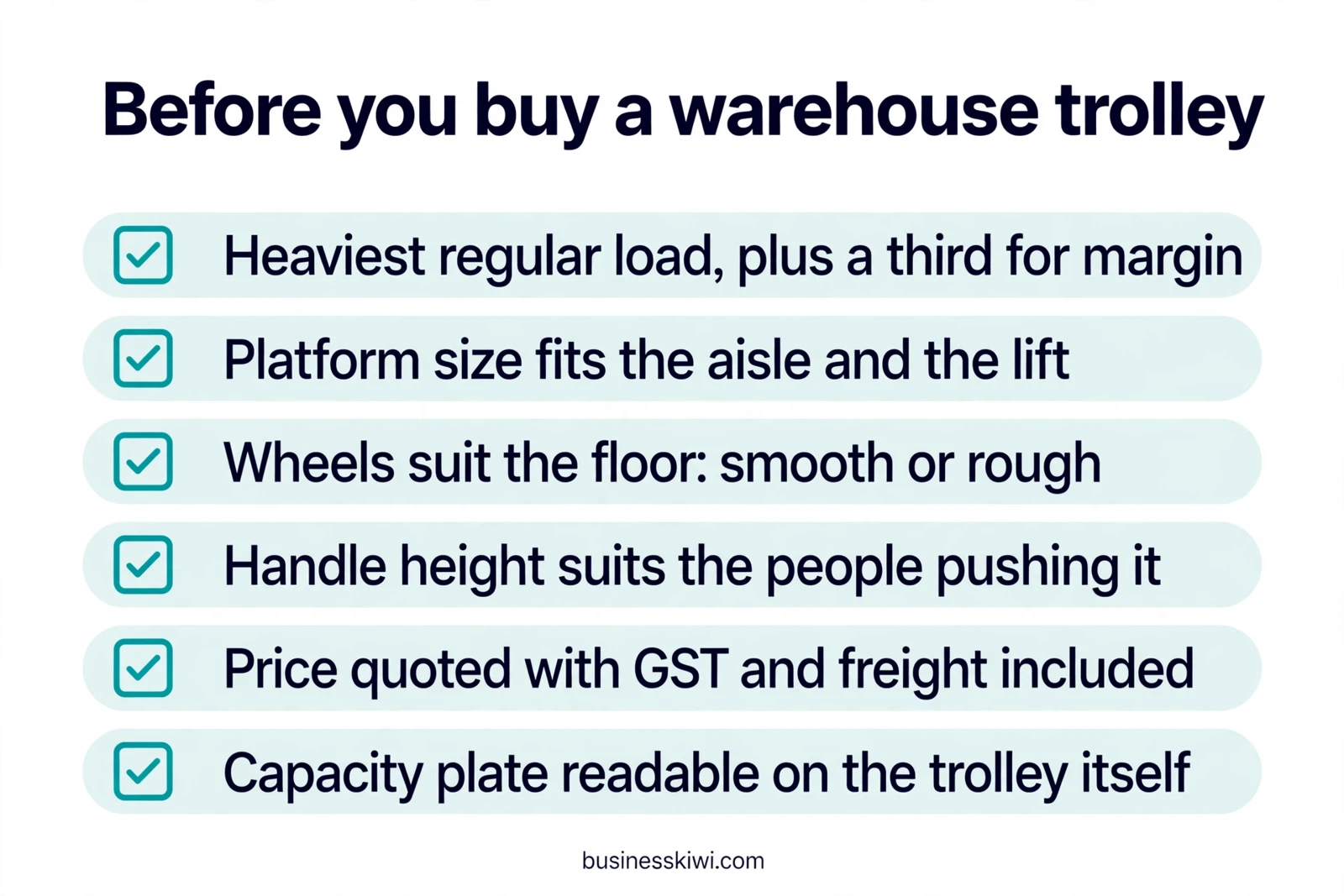
A practical approach is to work out the heaviest load you move in a normal week, then add a margin. A margin of about a third is a sensible starting point: if the heaviest regular load is 250 kilograms, look at a trolley rated to 350 kilograms or more. The margin covers uneven loads, a carton added at the last minute, and the extra force needed to get a loaded trolley moving over a floor joint or up a small ramp.
Capacity figures assume the load is spread evenly across the deck. A heavy item sitting on one corner loads that corner’s wheels far beyond the average, and it makes the trolley tip more easily in a turn. The same applies to shelf trolleys: the rating is usually per shelf, and on the adjustable two-tier model the top shelf is rated to less than half of the bottom shelf. Heavy items always go on the lowest shelf, or on the deck itself.
Also check whether the rating is for the trolley or for the platform alone. On most supplier pages the capacity is the total load the trolley will carry, including the weight of anything on it. If the page is not clear, ask the supplier before you buy. A trolley that is overloaded will not necessarily break on the first trip, but its wheels will flatten, its bearings will wear, and its frame will bend over time.
Size, wheels and handle height
A trolley that does not fit the building is useless, however strong it is. Measure before you buy. The three measurements that matter are the overall width, the overall length, and the turning space the trolley needs.
Overall width decides whether the trolley fits down the aisle. Astrolift’s narrow single platform trolley is 500 millimetres wide, which fits a standard retail aisle. Its heavy duty model is 750 millimetres wide, which needs a proper warehouse aisle. Measure the narrowest point on the route, including doorways, racking ends and the gap between the dispatch bench and the wall, and leave room for the operator to walk behind the trolley.
Overall length decides whether the trolley fits in a lift, a van or a storage bay. The single platform trolley is 1,260 millimetres long, the heavy duty model is 1,695 to 1,780 millimetres long, and the dual-door cage trolley is 1,090 millimetres long but 1,664 millimetres high. A cage trolley that fits through the door may still not fit in the lift.
Wheels decide how the trolley behaves on your floor. Larger wheels roll more easily over expansion joints, dock plates and rough concrete, and they carry heavy loads with less rolling resistance. Smaller wheels keep the deck low and make the trolley easier to load, but they struggle on anything but a smooth floor. Most warehouse platform trolleys use a mix of two fixed wheels and two swivel castors, which gives straight-line stability and steering. Four swivel castors make a trolley easier to spin in a tight space but harder to push in a straight line when loaded.
Handle height should suit the people who will push the trolley. Handles on the models in this guide sit between 860 and 1,200 millimetres high. If the handle is too low, the operator bends forward and pushes with their back. If it is too high, they push with their shoulders. Neither is comfortable over a full shift. If several people of different heights will use the same trolley, a model with a handle that suits the tallest regular user is usually the better compromise, because a tall person stooping is worse than a shorter person reaching up slightly.
Materials: steel, aluminium, zinc and vinyl
The material of the deck and frame decides how heavy the trolley is, how long it lasts, and where it can be used.
Steel is the standard choice for warehouse work. It is strong, it takes knocks, and it is the cheapest option at a given capacity. Astrolift’s single platform trolley is steel with a powder-coated finish, and its heavy duty models are steel. The drawback is weight: a steel trolley is heavy to lift into a vehicle, and if the coating is chipped the steel underneath can rust.
Aluminium is lighter than steel, so it suits trolleys that are carried in and out of vans, or pushed by one person all day. The folding aluminium trolley is rated to 250 kilograms, which is more than the steel folding model at 150 kilograms, and it will not rust. The trade-off is cost: the aluminium folding model costs about $122 more than the steel one.
Zinc plating is a coating rather than a different metal. A zinc-plated steel trolley resists rust better than a painted one, which makes it a good choice for damp warehouses, chillers and outdoor use. Astrolift’s zinc-plated platform trolley costs $417.10 before GST, and its zinc-plated cage trolley is sold on application. If the trolley will be hosed down or left outside, zinc plating is worth the extra cost.
A vinyl deck is a different idea again. The deck is covered in vinyl, which stops cartons sliding around and protects both the cartons and the deck from scuffs. Astrolift’s vinyl deck platform trolley costs $419 before GST and is rated to 300 kilograms, with a platform 860 by 760 millimetres. It suits retail stockrooms and any job where the load is light but needs to stay put.
Stainless steel is the specialist option. It is used where hygiene matters, such as food manufacturing and pharmaceuticals, and it costs considerably more. Astrolift lists a stainless steel scissor lift trolley from $1,754 before GST. For ordinary warehouse work it is more than you need.
Using a trolley safely
A trolley is a mechanical aid, and WorkSafe New Zealand treats it as one. On its page about lifting, carrying, pushing and pulling, WorkSafe says that hazardous manual tasks like lifting, carrying, pushing or pulling heavy loads put workers at risk of serious injury. The injuries it names are work-related musculoskeletal disorders, which include strains and sprains, joint and bone injuries, nerve injuries, hernias and chronic pain.
WorkSafe’s order of controls is clear. First, eliminate the risks where you are reasonably able to, for example by redesigning the task, using automated palletisers, or using conveyors to transport products in a warehouse. Where elimination is not reasonably able to be done, minimise the risk. The examples WorkSafe gives include making sure the building layout limits the need to push, pull or carry loads, providing appropriate mechanical aids and equipment, and ensuring they are used properly and maintained in accordance with manufacturer specifications.
A trolley is one of those mechanical aids, and the same page gives the conditions that make it work safely. Keep the load below the trolley’s rated capacity, and spread it evenly across the deck with the heaviest items at the bottom. Push rather than pull where you can, because pushing lets you see where you are going and keeps the load in front of you. Keep the route clear and the floor in good repair, because a wheel catching on a damaged floor joint is a common cause of a tipped load. Do not use a trolley on a slope it was not designed for, and do not ride on it.
WorkSafe also provides assessment tools for manual handling. The New Zealand manual handling assessment charts, known as NZMAC, help identify high-risk lifting, carrying and team handling tasks, using a traffic light system to show the level of risk. A separate tool, the New Zealand risk assessment of pushing and pulling, known as NZRAPP, covers pushing and pulling tasks. A trolley changes a lifting and carrying task into a pushing task, which is the point of using one, but the pushing task itself still needs to be assessed if the load is heavy or the distance is long.
Training matters as much as the equipment. Workers should be shown how to load a trolley, how to push it, and what to do when a wheel jams or a load shifts. They should also be told the rated capacity of the trolley they are using, because a number printed on a supplier’s page is no use if nobody in the warehouse knows it. And they should be asked for their input: WorkSafe notes that workers, including contractors and temps, are the eyes and ears of the business, and they can spot risks and suggest practical fixes that a manager might miss.
Looking after your trolley
A warehouse trolley is a simple machine, and simple maintenance keeps it working. The wheels are the part that wears first. Check them regularly for flat spots, cracked tyres and seized bearings. A wheel that does not turn freely makes the trolley much harder to push, which puts the extra force back onto the operator, and that defeats the purpose of having a trolley at all.
Keep the deck clean, especially on vinyl deck models, where a build-up of dust and grit makes cartons slide. Check the handle fixings and the frame for cracks, particularly on folding models, where the folding joint takes the load every time the handle is raised. Tighten bolts that have worked loose, and replace a wheel or castor as soon as it shows damage rather than waiting for it to fail under load.
Store trolleys where they will not be damaged. A trolley left in a traffic lane will be hit by a forklift. A cage trolley left outside will rust, even a zinc-plated one, if it is left standing in water. If you have several trolleys, store folding models flat against a wall and nest cage trolleys together where the design allows it.
Check the capacity plate or label on the trolley itself. If it is missing or unreadable, find the model number and check the supplier’s page, or ask the supplier. Do not guess. A trolley with no readable rating should be treated as unrated until the figure is confirmed.
Where to buy one in NZ
Two New Zealand suppliers cover most of the range in this guide. Astrolift is a national materials handling supplier with prices listed on its website, in New Zealand dollars before GST and freight, and it delivers nationwide. Its range runs from the $141.30 folding steel platform trolley to the $1,417 dual-door cage trolley, with platform, shelf, cage, folding and scissor lift models in between. It also offers bulk quote requests for larger orders.
Rex is the other name to know. It has manufactured handling equipment in New Zealand since 1946, and it builds several lines in-house at its Auckland, Wellington, Christchurch and Dunedin branches. Its New Zealand-made lines include the CC Series general purpose hand truck, the heavy duty winch hand truck rated to 180 kilograms, the PTR205 rocking platform truck rated to 350 kilograms, and the SH stock handler series rated to 350 kilograms. Rex does not publish prices on its website; it quotes freight after purchase and offers bulk and trade pricing on select ranges. If you need a non-standard size or configuration, Rex builds to order rather than substituting an imported model.
General retailers also stock light trolleys, and trade suppliers will quote on heavier models. Whatever the source, the checks are the same: confirm the rated capacity, the platform size, the overall dimensions, whether the price includes GST and freight, and what the warranty covers. Get the delivered price in writing before you order, and keep the supplier’s specification sheet with the trolley so the next person who uses it can check the rating.
For more on running a warehouse safely, see our health and safety management guide.
For more on business and industry in New Zealand, browse the Business Guide section.
Frequently asked questions
What is the difference between a warehouse trolley and a hand truck?
A hand truck, also called a sack barrow, is a two-wheeled unit with a small toe plate for tilting and moving one box, bag or drum at a time. A warehouse trolley, usually a platform trolley, has a flat deck on four wheels for moving several items or a heavier, awkward load as one unit. If you are moving stacked cartons or a bulky load, a platform trolley is the better fit.
How much does a warehouse trolley cost in NZ?
From about $141.30 before GST for a light folding steel platform trolley, to about $1,417 before GST for a dual-door steel cage trolley, based on Astrolift New Zealand’s listed prices checked on 10 November 2026. A standard steel platform trolley rated to 350 kilograms costs $417.10 to $595 before GST. All prices are before GST and freight, so add 15 percent GST and the delivery charge to get the total.
What load capacity do I need?
It depends on the heaviest load you will move regularly, not the occasional outlier. Rex advises matching the trolley to the heaviest regular load, and a margin of about a third above that load is a sensible starting point. Warehouse platform trolleys in New Zealand commonly carry 200 to 350 kilograms, with heavy duty models rated to 1,000 kilograms. Check that the rating is for the whole trolley, and remember that shelf ratings are per shelf, with the top shelf usually rated lower than the bottom one.
Are warehouse trolleys made in New Zealand?
Some are. Rex has manufactured handling equipment in New Zealand since 1946, and its CC Series hand truck, heavy duty winch hand truck, PTR205 rocking platform truck and SH stock handlers are built in New Zealand. Many other trolleys sold in New Zealand are imported. If New Zealand-made matters to you, ask the supplier where the model is built before you buy.
Do I need training to use a warehouse trolley?
There is no licence for a hand-pushed trolley, but workers should still be shown how to load it, how to push it, and what its rated capacity is. WorkSafe expects mechanical aids to be used properly and maintained in accordance with manufacturer specifications, and it expects workers to be trained on the key risks and how to keep healthy and safe. A short induction that covers loading, pushing, and what to do when a load shifts is enough for most trolleys.
Can I use a warehouse trolley outside?
It depends on the model and the surface. Zinc-plated trolleys resist rust better than painted steel, and larger wheels cope better with rough ground. Most warehouse trolleys are designed for smooth concrete floors, and small wheels struggle on gravel, grass or broken asphalt. If the trolley will regularly go outside, tell the supplier and ask for a model suited to the surface.
What should I check before buying a used warehouse trolley?
Check the wheels for flat spots and seized bearings, the frame for cracks and bends, the handle fixings, and the capacity plate. If the capacity plate is missing or unreadable, find the model number and confirm the rating with the supplier before you use it. Push it loaded across the floor it will be used on, and check that it rolls straight, turns freely and stops without the load shifting.
This guide is general information only. Prices were checked against the suppliers named in the article on 10 November 2026, and all prices quoted are before GST and freight unless stated otherwise. Prices change, so confirm the current delivered price, including GST, before you order. Load capacities are the suppliers’ published ratings; never exceed them.