Construction Loans NZ: How Building Loans Work, Rates and Drawdowns
Buying an existing house is a single transaction. The bank values the property, approves a loan, and hands over the full amount on settlement day. Building a house does not work like that. For most of the construction period there is no finished house to lend against, only land, foundations, framing and a contract promising the rest. A construction loan is the product banks use to bridge that gap. The lender approves a total limit up front, then releases it in stages, called drawdowns or progress payments, as each part of the build is completed and verified.
That staged structure changes almost everything: how interest is charged, what paperwork the bank needs before it releases a cent, how much deposit you need, and what can go wrong if costs move mid-build. This guide explains how construction loans work in New Zealand, drawing on the building pages published by ASB, ANZ and BNZ, the Reserve Bank’s loan-to-value ratio (LVR) rules, and Kāinga Ora’s First Home Loan material.
What a construction loan is
A construction loan funds the building of a new home rather than the purchase of a completed one. Some borrowers use one to buy land and build on it under a single arrangement.
The defining feature is that the money follows the work. When you buy an existing home, the bank’s security is complete from day one: a house that could be sold if you stopped paying. During a build, the security is incomplete for months. A half-framed house on a bare section is worth far less than the finished product and much harder to sell. Lenders manage that risk by controlling the release of funds. They approve lending against what the property is expected to be worth when finished, then advance the money in step with the value actually being created on site.
ANZ describes this in its Building and Renovating Handbook as lending approved against the “Tentative on Completion Value”, the valuer’s estimate of what the home will be worth once the work is done. The borrowing limit is set against that figure, but the funds are drawn in stages, with the amount advanced at each stage able to depend on how much the property’s value has increased so far. ASB calls its version a progress payment loan: you draw the loan down in instalments as the build reaches the milestones in your building contract.
The building contract shapes the loan
Before a lender looks at your income, it looks at how the build is contracted, because the contract type determines how predictable the final cost is.
A fixed price contract is the arrangement lenders are most comfortable with. You and your builder agree a total price for the completed home, based on your plans and your site, before work starts. ASB notes that a fixed price contract gives more certainty over costs than the alternatives and reduces the risk of cost overruns, because the price holds even if labour and material costs rise during the project. Two catches remain. First, the contract will list exclusions and items that can still vary, so the price is only fixed for what is actually in it. Second, changes you request mid-build, called variations, sit outside the original price. ANZ states that variations which increase the cost or affect the value of the home need the bank’s approval, and that you should talk to the bank before committing to any new costs, not after.
A labour-only contract sits at the other end of the scale. The builder charges for labour, usually at an hourly rate, and you pay for materials as they arise. ASB describes these contracts as open-ended: there is no agreed total, so if the build takes longer than expected, or prices rise while it is underway, the extra cost lands on you. With no fixed end point to lend against, lenders assess labour-only builds more cautiously and want strong evidence that you can absorb overruns.
Between the two sit partial contracts and cost-and-quotes arrangements, where part of the work is contracted and part is priced job by job, or where you engage tradespeople directly and manage the project yourself. ANZ’s handbook covers this as its “cost and quotes” category: you may save a project manager’s cost, but these projects usually experience higher overruns than fixed price contracts, take longer, and carry more risk of non-completion. Lenders respond with more documentation: full costings, quotes, a payment schedule, and valuations throughout the build.
Turnkey contracts work differently again. You buy a completed home from a developer or building company, usually off the plans, paying a deposit when you sign and the balance when you take legal possession. There are no progress payments, because the builder funds the build, and ANZ notes the interest saving that creates. The trade-off is less flexibility, since late changes are harder and more expensive.
How drawdowns work
Once the loan is approved and the conditions are met, the money starts moving. The pattern is the same across the banks reviewed for this guide, even though the details differ.
First, your own money goes in before the bank’s. ANZ states that when you are building a home, you are required to use your own funds for the deposit before you can draw down your loan.
Each drawdown is tied to a stage of work. Under a fixed price contract, the contract itself contains a schedule of progress payments, payable when the project reaches defined milestones. ASB lists the common ones: when you give the go-ahead, when earthworks are complete, when framing is up, when the roof is on, and when the project is complete.
Paperwork gates every release. For the first drawdown, ANZ requires a copy of your building consent and confirmation that the property is insured while under construction. For later drawdowns, it requires copies of your builder’s invoices that match the schedule of payments in the original contract.
Valuations are the lender’s other control. ASB’s building page explains that progress payments normally follow an inspection by a registered valuer, who confirms the stage has been reached. There is an exception: where you have a fixed price contract with a Registered Master Builder or a Certified Builder, ASB says progress payments may be drawn against the builder’s invoices without a valuer’s inspection at each stage. A registered valuation is still needed at the start, and a valuer’s completion certificate at the end. ANZ similarly refers to an “as is” value during the build (the value of the work to date) and requires registered valuation reports at stages, with a completion certificate before the final drawdown.
There is also a clock running. ASB gives borrowers 12 months to make the first drawdown on a building loan, with drawdowns continuing until the build is complete, and the facility can be closed if no drawdowns are made over a 24-month period. ANZ’s handbook describes loan instalments drawn over a maximum period of 12 months.
Interest during the build: floating and interest-only
Construction loans are almost always floating and interest-only while the build is underway, and both features follow from the drawdown structure.
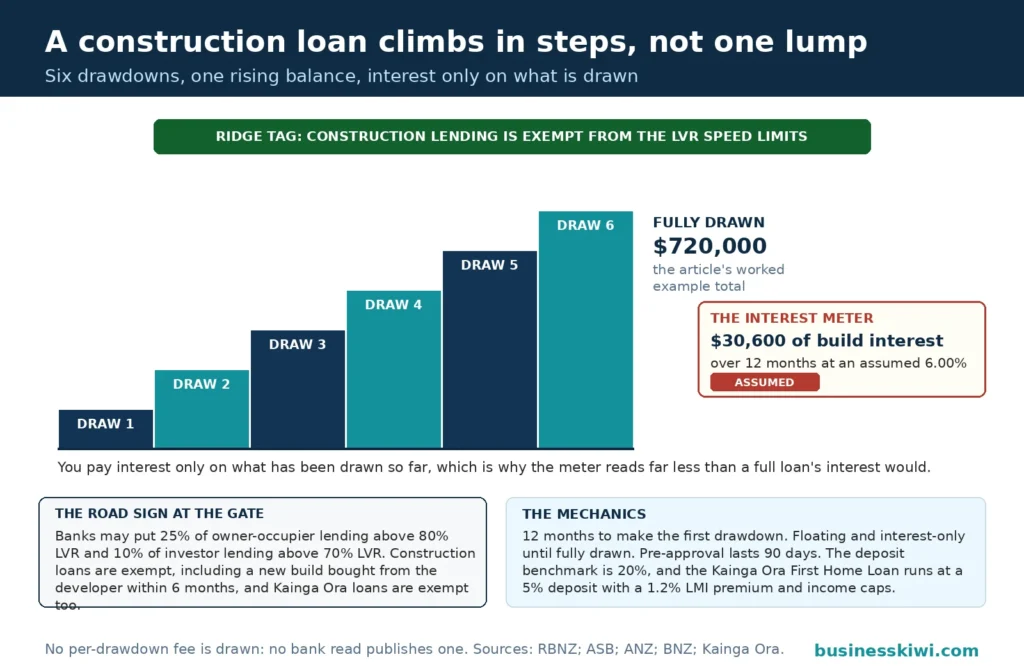
Interest is charged only on the amount drawn, not on the full approved limit. If you have approval for $720,000 but have drawn $280,000, you pay interest on $280,000. That keeps costs down early in the build, but your interest bill grows with every stage. ANZ makes this point explicitly to its building customers: as your loan increases with each progressive drawdown, so will your interest costs.
Repayments during construction are interest-only at the banks reviewed. ASB’s help pages confirm that progress payment loans sit on a variable (floating) rate during the drawdown period, with interest-only repayments on the drawn balance until the approved amount is fully drawn. Only once the loan is fully drawn can you move it to a fixed rate. ANZ likewise says the loan needs to remain on a floating or flexible structure while the build is in progress, and offers an interest-only option for 12 months while you focus on completing the build.
The rate that matters during a build is therefore the floating rate, not the fixed rates that dominate home loan advertising, and it can move while your house is being built. Our home loan rates pillar tracks the published rates themselves.
A worked example of drawdowns and interest
The example below uses assumed figures to show the mechanics. It is an illustration only, not a quote or an offer. The interest maths has been checked, but the inputs (property prices, a 6.00% interest rate, two months between stages) are assumptions chosen to make the arithmetic easy to follow.
Suppose a couple buys a section for $350,000 and signs a fixed price build contract for $550,000, a total project cost of $900,000. They contribute a 20% deposit of $180,000 from their own funds: $70,000 towards the land and $110,000 towards the build. The bank approves a construction loan of $720,000, drawn in six stages.
- Land settlement: $280,000 drawn. Balance $280,000. Interest at 6.00% a year: about $1,400 a month.
- Foundations and earthworks complete: $80,000 drawn. Balance $360,000. Interest: about $1,800 a month.
- Framing up: $110,000 drawn. Balance $470,000. Interest: about $2,350 a month.
- Roof on and house closed in: $100,000 drawn. Balance $570,000. Interest: about $2,850 a month.
- Fit-out: $90,000 drawn. Balance $660,000. Interest: about $3,300 a month.
- Completion: $60,000 drawn. Balance $720,000. Interest: about $3,600 a month.
If each stage takes two months, the interest paid across the 12-month build totals about $30,600, an average of roughly $2,550 a month, even though the final monthly bill is $3,600. Budget for that shape: payments are smallest at the start and largest just before you move in, often when you are also paying rent or another mortgage on the place you live in now.
On completion, the loan converts to a standard principal-and-interest home loan. At the same assumed 6.00% rate over a 30-year term, repayments on $720,000 would be about $4,317 a month.
What lenders require before and during the build
A construction loan application normally needs the following in place before the first drawdown.
A signed building contract. ANZ’s handbook states that construction lending requires a written contract for the building work, and its fixed price process requires the signed contract containing the progress payment schedule, plus floor plans and specifications.
Building consent, and any resource consent the project requires. ANZ lists a copy of the building consent among the items needed before the first drawdown.
A valuation based on the completed home. The lender commissions a registered valuation estimating the completed value (ANZ’s Tentative on Completion Value) and the land value, and that valuation anchors the approved limit. If the completed value comes in below the total project cost, the gap has to be found elsewhere; it will not automatically come from the bank.
Insurance during construction. A standard house policy does not cover a building site properly, and ANZ requires confirmation that the property is insured while under construction before the first drawdown. Its handbook distinguishes the builder’s own cover, often called builder’s risk insurance and usually set out in the contract, from contract works insurance, which covers the build where the builder’s insurance is not adequate or where you are managing the build yourself. Contract works cover is generally needed until the council issues the final Code Compliance Certificate.
Evidence of your own contribution: savings, equity in another property, or a KiwiSaver first home withdrawal if you are eligible. ASB notes building deposits can come from any of these.
At the end of the build, final conditions typically include the Code Compliance Certificate, a valuer’s completion certificate, and house insurance with the lender’s interest noted on the policy.
Deposits, LVR and the new-build exemption
The Reserve Bank’s LVR restrictions limit how much low-deposit lending banks can do. Under the current settings published by the Reserve Bank, no more than 25% of a bank’s new owner-occupier lending can have an LVR above 80%, and no more than 10% of new investor lending can have an LVR above 70%.
Construction loans are exempt. The Reserve Bank’s own LVR page lists them among the exemptions, applying where the borrower is constructing a new home or buying a newly built home from the developer within six months of completion. Kāinga Ora loans, including First Home Loans, are exempt as well. BNZ’s LVR guidance confirms that an exempt loan is not included in the bank’s lending quota, and that the exemptions include lending to finance the build of a new house or apartment.
Exempt does not mean deposit-free. The Reserve Bank itself notes that banks still apply their own lending criteria and may choose to lend only at lower LVRs. ANZ’s handbook gives its general position: you will generally need a 20% deposit of the total cost to buy the land and fund the build, although depending on your situation and build type, there may be exceptions. Low-deposit lending also carries extra cost where offered: BNZ’s LVR page explains that with a deposit under 20%, a low equity premium applies to the interest rate, and other lenders apply similar margins under different names.
For first home buyers, the Kāinga Ora First Home Loan is the main low-deposit route, and building is not automatically excluded. Kāinga Ora’s First Home Loan brochure says the loan lowers the deposit to 5% for eligible buyers, and that some participating lenders allow you to buy vacant land and build a new home with one, subject to that lender’s criteria. Two conditions deserve emphasis. You must not already own land: the brochure states you are not eligible if you currently own or have an interest in land, even with no house on it. And there is a cost: Kāinga Ora charges a Lender’s Mortgage Insurance premium of 1.2% of the loan amount, which the lender may pass on to you. Income caps also apply ($95,000 for an individual buyer, or $150,000 for an individual buyer with dependants and for multiple buyers combined), and the lender still assesses serviceability. Arrange it with a participating lender before you buy a section, not after.
Costs and fees specific to construction lending
A construction loan carries the usual home loan costs, establishment and legal fees among them (BNZ’s LVR page notes an establishment fee of up to $150 may apply to its home loans). Building adds its own layer on top.
Valuations are the most predictable extra. A valuation at the outset is standard, stage valuations may be required during the build, and a completion valuation or certificate is needed at the end. ANZ advises borrowers to factor valuation costs into the build budget and arrange them ahead of time to avoid delays.
Interest during the build is a real cost of the project, not a banking detail: in the worked example above it came to about $30,600 over 12 months. Whether you budget for it within the loan or pay it from savings, it belongs in the project budget from the start.
Contract works insurance premiums, consent fees, and the cost of holding two homes during the build (rent, or repayments on the place you are selling) belong in the same budget. So does a contingency for overruns. ANZ’s handbook tells borrowers to allow for overruns because they are common, and points at the specific leak in fixed price contracts: provisional cost sums, or PC sums, are allowances for work whose exact cost is not yet certain, such as excavation, kitchens and bathrooms. A PC sum is an estimate wearing a fixed price contract’s clothing, and the difference between the allowance and the actual cost is yours to pay.
Finally, check the lender’s fee schedule for anything charged per drawdown or per valuation inspection, since the banks’ construction pages emphasise process over fee tables. Sorted, the Retirement Commission’s money guidance service, suggests asking any lender for the total cost of a loan including fees and interest before you sign.
The risks that are specific to building
Cost overruns are the risk everyone names, and the banks name it too. ANZ devotes a section of its handbook to them: despite the best planning, unexpected costs happen. Its process is instructive. Check whether the cost is covered by your contract. Discuss it with the bank. If you need to borrow more, the additional lending is assessed against the current value of the home and whether you can meet the higher repayments. There is no automatic top-up, and an overrun discovered late in the build, when the house is unfinished and its “as is” value is lowest, is the hardest to fund. Variations you choose yourself are the most avoidable version: a more expensive kitchen agreed in month five still has to be paid for, and the bank must approve increases to the contract before you commit to them.
Delays compound the problem. A build that runs long costs more interest, because the drawn balance sits accruing while work stalls, and it can strain the loan’s timetable: drawdown windows and pre-approval expiry dates were set for a build proceeding on schedule. ANZ pre-approvals are valid for up to 90 days, after which the bank may reassess your financial position.
Valuation shortfall is the quieter risk. Your lending limit was set against an estimate of the finished home’s value. If the final valuation comes in below that estimate, the bank’s final advance may be smaller than planned, and the difference has to be found in cash at the moment your savings are most committed. The stage rule cuts the same way during the build: because the amount advanced can depend on how much value has been added, spending heavily on low-value items early (ANZ’s example is committing to kitchen costs before the roof is paid for) can leave a stage underfunded.
Builder risk underlies all of it. If your builder fails mid-build, you hold a part-finished house, a contract in dispute and a loan still charging interest. The banks’ own guidance is the practical defence: use a builder whose track record you can check, confirm their insurance, get the contract reviewed by a lawyer, and keep records of every invoice, variation and payment.
When the build finishes
The final drawdown is usually released once the lender has the completion evidence: the Code Compliance Certificate, the valuer’s completion certificate where required, and confirmation the house is insured with the lender’s interest noted. The construction phase then ends and the loan is restructured into an ordinary home loan. You choose how to split it between fixed and floating rates, set your repayment term, and begin principal-and-interest repayments. ASB’s position sums up the sequence: a progress payment loan can only be fixed once the entire balance has been drawn down in full.
Our home loans guide covers the general mortgage process and loan structures in full; this article has deliberately stayed on construction, where the rules are different.
Frequently asked questions
What is a construction loan?
A home loan used to fund building a new home rather than buying a completed one. The bank approves a total limit, usually assessed against the expected value of the finished home, and releases the money in stages (drawdowns or progress payments) as the build reaches the milestones in your building contract. Interest is charged only on the amount drawn so far.
How do construction loan drawdowns work?
Your building contract sets a schedule of progress payments tied to stages such as earthworks complete, framing up, roof on and completion. To release each payment, the lender typically needs the builder’s invoice for that stage and, in many cases, a registered valuer’s confirmation that the stage has been reached. ASB allows an exception where a fixed price contract with a Registered Master Builder or Certified Builder can be drawn against invoices without a valuer’s inspection each time, although valuations are still required at the start and completion.
How much deposit do I need to build a house in NZ?
Plan on 20% of the total project cost (land plus build) as the benchmark; ANZ’s handbook states that position generally, while noting exceptions can apply. Construction loans are exempt from the Reserve Bank’s LVR restrictions, so a smaller deposit does not count against a bank’s high-LVR quota, but each bank still sets its own minimum equity requirements, and low-deposit lending usually attracts a low equity premium or similar extra cost.
Do I pay interest on the full loan amount during construction?
No. Interest is charged only on the amount drawn down, so costs are low early in the build and rise with each progress payment. During the build the loan is normally floating and interest-only.
Can I fix the interest rate on a construction loan?
Not during the drawdown phase, at the banks reviewed. ASB states that a progress payment loan can only be fixed once the entire balance has been drawn down in full, and ANZ requires the loan to stay on a floating or flexible structure while the build is in progress. Fixing happens at completion.
Are construction loans exempt from LVR restrictions?
Yes. The Reserve Bank lists construction loans among the exemptions, covering borrowers constructing a new home or buying a newly built home from a developer within six months of completion. Kāinga Ora loans, including First Home Loans, are also exempt.
What happens if my build goes over budget?
Check whether the extra cost is covered by your building contract, then talk to your lender before committing to it. ANZ advises that variations increasing the contract cost need the bank’s approval, and any additional borrowing is assessed against the current value of the home and your ability to meet the higher repayments.
What insurance do I need while building?
The lender will require the property to be insured while under construction before the first drawdown. The main cover is contract works insurance, which protects the build itself against events such as fire and storm damage, generally until the Code Compliance Certificate is issued. Standard house insurance, with the lender’s interest noted, is required once the home is complete.
This article is general information only and is not financial advice. It does not take into account your personal circumstances, income or objectives. Construction lending criteria, interest rates and fees change and vary between lenders, and approval is never guaranteed. Before borrowing to build, read the lender’s loan offer and fee schedule carefully and consider getting advice from a qualified financial adviser and a lawyer.
Sources
- Reserve Bank of New Zealand, Loan-to-value ratio restrictions, rbnz.govt.nz
- ASB, Building or renovating, asb.co.nz
- ASB, Understanding building contracts, asb.co.nz
- ASB, Can I fix my interest rate on a progress payment loan?, asb.co.nz
- ANZ, Starting your building or renovation project, anz.co.nz
- ANZ, Building and Renovating Handbook, anz.co.nz
- BNZ, Understanding different loan to value ratios, bnz.co.nz
- Kāinga Ora, First Home Loan brochure, kaingaora.govt.nz
- Sorted, Questions to ask a lender, sorted.org.nz