Low Deposit Home Loans NZ: Borrowing With 5% or 10% Down

Saving a 20% deposit takes many New Zealand households years, and house prices rarely wait politely while they do it. So lenders do, in the right circumstances, lend to buyers with 10% or even 5% down. What changes is not just the size of the loan. A small deposit moves you into a different lending category, one with its own regulator-imposed limits, its own pricing and its own approval hurdles. This article explains how that category works: the Reserve Bank’s loan-to-value rules, how banks charge for low equity lending, the Kāinga Ora First Home Loan in detail, and what a smaller deposit actually costs over the life of a loan, worked through in real numbers.
What counts as a low deposit: LVR explained
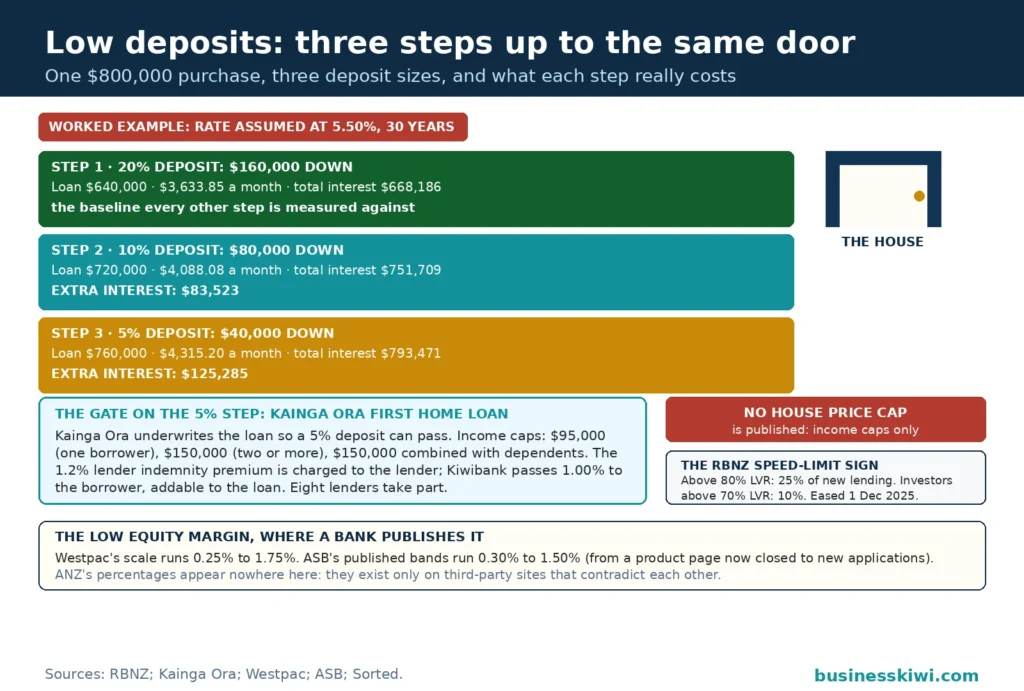
Everything in low deposit lending turns on one ratio. The loan-to-value ratio, or LVR, is your loan size divided by the value of the property securing it. Buy a home for $800,000 with a $160,000 deposit and your loan is $640,000, an LVR of 80%. Put down $80,000 and the loan is $720,000, an LVR of 90%. With a $40,000 deposit the loan is $760,000 and the LVR is 95%.
Lenders generally work from the lower of the purchase price and the property’s value, so an optimistic valuation does not flatter the ratio. A low deposit loan is simply a loan with a high LVR, and the dividing line that matters most in New Zealand is 80%. At or below 80% LVR you are a standard borrower. Above it, you are a high-LVR borrower, and three things change at once: the Reserve Bank’s restrictions start to bite, the lender prices your loan differently, and your application is assessed against a limited internal allowance rather than on its merits alone.
The 20% deposit remains the benchmark because it gives the lender a genuine buffer: if prices fall or a borrower defaults, there is equity to absorb the loss. Sorted, the government-funded financial capability service, makes the same point from the borrower’s side: the bigger your deposit, the less interest you pay over the life of the loan, and borrowing with as little as 5% is possible but typically more expensive, and riskier for both borrower and lender.
The Reserve Bank’s LVR restrictions
The LVR restrictions are rules the Reserve Bank of New Zealand places on registered banks, limiting how much of each bank’s new lending can be high-LVR. They have been in place since October 2013, and the Reserve Bank’s stated purpose is financial stability. Highly indebted borrowers are more likely to default in an economic downturn, and borrowers with little equity are less likely to sell, because a sale may not repay the loan. Fewer forced sales means less downward pressure on prices across the whole market.
The speed limits
The restrictions work as speed limits on each bank’s flow of new loans, measured over a three-month or six-month lending period depending on the size of the bank. Under the settings the Reserve Bank currently publishes:
- For owner-occupiers, lending is high-LVR when the LVR is above 80%, and no more than 25% of a bank’s total new owner-occupier lending can be in that category.
- For property investors, the threshold is tighter. Lending is high-LVR when the LVR is above 70%, and no more than 10% of a bank’s total new investor lending can be above it.
Those settings took effect on 1 December 2025, when the Reserve Bank eased the limits from 20% for owner-occupiers and 5% for investors. In its November 2025 Financial Stability Report the Reserve Bank said the easing was possible because separate debt-to-income restrictions, in force since July 2024, now act as a guardrail, and because high-DTI and high-LVR lending remained low, even though house prices sat near the top of its assessed sustainable range.
Two features matter for individual applicants. First, the rules apply only to new lending. Existing loans are not retrospectively affected, although a top-up that takes your total LVR above the threshold counts as high-LVR lending. Second, breaching a speed limit is a breach of a bank’s conditions of registration and can attract sanctions, which is why banks guard their high-LVR allowances carefully. The restrictions are ceilings, not entitlements: banks apply their own lending criteria and may lend only at lower LVRs than the rules allow.
The exemptions
Some lending sits outside the speed limits entirely. The Reserve Bank lists these exemptions:
- Kāinga Ora loans, including First Home Loans.
- Refinancing, where the new loan is no greater than the original loan.
- Portability, where a loan is shifted between properties with no increase.
- Bridging finance.
- Property remediation, such as fixing a leaky home.
- Construction loans, covering both building a new home and buying a newly built home from the developer within six months of its completion.
There is also a combined collateral exemption for borrowers with loans secured against both property types, allowing finance of up to 70% of the value of investment properties together with 80% of the value of the owner-occupied property. The construction exemption is one reason new builds feature so heavily in low deposit marketing: a new build loan above 80% LVR does not consume the bank’s high-LVR allowance at all.
The debt-to-income rules sit alongside
Since 1 July 2024, banks have also worked under debt-to-income (DTI) restrictions. A borrower’s DTI is their total debt divided by their gross annual income. Banks may make up to 20% of their owner-occupier lending to borrowers with a DTI above 6, and up to 20% of investor lending to borrowers with a DTI above 7, with the same exemptions broadly applying. The practical effect is that a low deposit application can be constrained twice over, because a bigger loan on the same income pushes the DTI up as well as the LVR. The rules bind registered banks; non-bank lenders are not captured and set their own policies.

The Kāinga Ora First Home Loan in depth
The main structured route into a home with 5% down is the First Home Loan. The loans are issued by selected banks and other lenders, but they are underwritten by Kāinga Ora, the government’s housing agency. That underwriting is what makes the product possible: it lets lenders provide loans outside their usual lending standards, and because First Home Loans are exempt from the LVR speed limits, they do not use up a bank’s high-LVR allowance either.
Most lenders require a minimum deposit of 20% of a home’s value; with a First Home Loan, you need a deposit of only 5% of the purchase price.
Who qualifies
Kāinga Ora’s published eligibility criteria, from its current First Home Loan brochure, are:
- You are over 18, and a New Zealand citizen, permanent resident or resident visa holder.
- You are a first home buyer, or a previous homeowner whose financial position is similar to that of a first home buyer. Previous homeowners face an additional assessment of their financial position.
- Your before-tax income over the last 12 months is less than $95,000 if you are an individual buyer, less than $150,000 if you are an individual buyer with dependants, or less than $150,000 combined if there are two or more buyers.
- You have a minimum deposit of 5% of the purchase price.
- You meet the lending requirements of a participating bank or lender, and you will live in the home as your main place of residence.
There is no minimum income requirement, although your income still has to service the loan under the lender’s assessment. Kāinga Ora sets the minimum criteria, lenders may add their own, and the lender makes the final decision. You cannot qualify if you currently own, or have an interest in, land, even land with no home on it. Pre-approval is available, and some lenders may allow a First Home Loan to buy vacant land and build. Kāinga Ora’s published criteria set the income caps above and do not list a house price cap, but criteria change, so confirm the current position before relying on it.
What it costs: the insurance premium
A First Home Loan carries a lender’s mortgage insurance premium of 1.2% of the loan amount. Kāinga Ora charges that premium to the lender, to insure the loan, and the borrower may be required to reimburse the lender for it. You should also expect a loan application fee if the lender applies one.
Kiwibank’s current fees and limits document shows how the cost lands in practice at that bank. Kāinga Ora charges Kiwibank a premium of 1.20% of the loan amount; Kiwibank charges the borrower a fee of 1.00% of the loan amount, which can be added to the loan and reimburses Kiwibank for most of the premium. On a $760,000 loan, the premium charged to the lender is $9,120, and a 1.00% borrower fee would be $7,600. Added to the loan rather than paid in cash, that fee itself accrues interest.
One point is worth stating clearly, because Sorted makes it too: lender’s mortgage insurance protects the lender, not you. It covers the bank’s loss if you cannot repay, and pays out nothing to the borrower.
Participating lenders
Kāinga Ora lists the participating lenders as ASB, Westpac, Kiwibank, The Co-operative Bank, SBS Bank, Unity, Nelson Building Society and NZHL. You apply to the lender, not to Kāinga Ora, and each lender applies its own lending criteria within the scheme’s rules.
How banks charge for low equity
Outside the First Home Loan scheme, banks recover the extra risk and cost of high-LVR lending in one of two ways: an ongoing margin added to your interest rate, or a one-off premium charged at drawdown.
Low equity margins
Westpac publishes its low equity margin scale on its own website. A low equity margin is an additional interest amount added to the home loan rate when you borrow more than 80% of the property’s value, applied, Westpac says, because lending above 80% is higher risk. Westpac’s published scale is 0.25% p.a. for an LVR of 80.01–85.00%, 0.75% p.a. for 85.01–90.00%, 1.50% p.a. for 90.01–95.00%, and 1.75% p.a. above 95.01%. Westpac notes it may change the margins from time to time.
ASB publishes a similar banded scale on its lending pages: 0.30% p.a. at 80.01–85.00% LVR, 0.75% p.a. at 85.01–90.00%, 1.30% p.a. at 90.01–95.00%, and 1.50% p.a. above 95.01%. ASB defines the ratio the same way, as total borrowings divided by the total value of the security property.
A margin is not a one-off hit. It applies to your balance for every month it remains in place, so its cost depends heavily on how long you stay above 80% LVR, covered further below.
One-off premiums
ANZ takes the other route. Its own home loan documentation states that it charges a Low Equity Premium when a customer borrows over 80% of the value of the property securing the loan, counting other loans the customer has with ANZ against the same security. The premium is a percentage of the loan amount on a graduated scale: the more you borrow against the property’s value, the higher the fee can be. It is taken from the borrower’s account on the draw-down date. ANZ’s loan summary says the scale itself is set out on its website or in its Fees and Charges document, so check the current scale there.
The honest position across the market is that low equity pricing varies by lender and by structure, and not every lender publishes a full schedule on its public pages. Where a bank does not publish the figure, the only reliable number is the one in your own loan offer.
How approval differs when your deposit is small
Affordability is necessary but not sufficient at high LVR, because your application is competing for a rationed product. A bank’s high-LVR allowance is a fixed share of its new lending over its measurement period. Once that allowance is used, an otherwise sound application can be declined or deferred until the next period, not because the borrower failed a test but because the bank has no room left under the speed limit. This is also why high-LVR pre-approvals can be harder to get, and shorter-lived, than standard ones.
The servicing assessment itself is thorough. Lenders look first at the income you have free after existing commitments. Sorted notes that lenders assess you as if you were using your credit card limits in full, even if you rarely use the cards, and that they weigh your credit history and repayment record. Student loan repayments reduce the income available for a mortgage, and a lender may lend less, or nothing at all, where debts already absorb too much of a household’s income. For pre-approval you will generally need identification, proof of income, three months of payslips and evidence of your deposit.
The property matters more at high LVR too. Lenders lend against the lower of the price and the value, and Sorted observes that lower percentages are often loaned on properties outside urban areas and on apartments. A small deposit against an apartment or a rural property may need to be larger, in percentage terms, than the same deposit against a standard suburban house.
Finally, remember the double constraint. On a gross household income of $120,000 with no other debt, the $640,000 loan in our example has a DTI of 5.33, comfortably inside the threshold of 6. The $720,000 loan sits exactly on 6.00, and the $760,000 loan reaches 6.33, so it also counts against the bank’s limited high-DTI allowance unless it is exempt lending, such as a First Home Loan or a new build. Shrinking your deposit does not just raise your LVR. It can move you into a second rationed category at the same time.

The real cost of a smaller deposit: worked examples
The examples below use a purchase price of $800,000 and an assumed interest rate of 5.50% p.a., held constant over a 30-year term with monthly repayments. The rate is an assumption for illustration, not a rate any lender is offering; current home loan rates change constantly and are a separate topic. The comparison isolates the effect of the deposit itself.
Halving the deposit from 20% to 10% adds $454.23 a month to the repayment and about $83,500 in extra interest if the loan ran its full term at that rate. Going to 5% adds $681.35 a month against the 20% case and about $125,300 in extra interest. Few loans run 30 years untouched and rates move, but the shape of the result does not change: interest is charged on the balance, and a smaller deposit means a bigger balance from day one.
The table also understates the true gap, because it prices all three loans at the same rate. Add Westpac’s published 1.50% p.a. margin for the 90.01–95.00% band to the 5% deposit loan and the margin alone costs roughly $11,330 in extra interest in the first year. Margins normally come off once equity reaches 20%, so few borrowers pay one for a full term. But if an effective rate of 7.00% somehow applied for all 30 years, total interest on the $760,000 loan would reach about $1,060,268, roughly $266,797 more than at the assumed 5.50%. Treat that as an upper bound, not a prediction.
Then there is the equity risk. With a 5% deposit, a 5% fall in value takes the home to $760,000, exactly what you owe: your equity is gone. A 10% fall takes the value to $720,000 against a loan of $760,000, leaving you owing roughly $40,000 more than the home is worth before repayments are counted. That negative equity position is precisely what the Reserve Bank’s restrictions are designed to keep rare across the banking system, and it has a practical consequence for the household: selling may not clear the debt, and refinancing becomes difficult until equity is rebuilt.
Building equity and getting the margin removed
Equity grows two ways: the property’s value rises, or the loan balance falls. You control only the second, and it is slower than most borrowers expect. At the assumed rate in our example, with the value unchanged, standard repayments alone take about nine years to bring a $760,000 loan down to $640,000, the 80% LVR line on an $800,000 home, and about seven years for a $720,000 loan. Extra repayments shorten that considerably, which is why paying down principal aggressively in the early years is worth more at high LVR than the interest saving alone suggests.
Lenders do remove low equity pricing once you genuinely have 20% equity, but you may need to ask. Westpac says the margin applies while you have less than 20% equity, and that once your equity reaches 20% or more you can arrange a review to have it removed. The review needs the latest valuation report, which Westpac can sometimes obtain at no cost. On a floating rate the margin is removed immediately, provided it has been in place for at least six months; on a fixed rate it is removed the day after the fixed term ends.
ASB’s published terms describe a similar process. From six months after drawdown you may request a reduction or removal of the margin; ASB decides based on your LVR at the date of the request and may require a current registered valuation at your expense. ASB also reviews margins periodically and may lower or remove one itself, notifying you in writing.
A one-off premium, by contrast, is not refunded when your equity improves. It is a sunk cost of the original loan, which is worth weighing when two lenders price the same loan differently.
Who low deposit lending suits, and who it does not
Low deposit lending exists for households whose constraint is the deposit rather than the income: borrowers with steady earnings and comfortable servicing headroom who would otherwise spend years saving while paying rent. For them, the extra interest and any premium or margin can be a rational price for buying earlier, particularly where the loan is exempt from the speed limits, through a First Home Loan or a new build.
It is a poorer fit where income is irregular, where no buffer remains after purchase costs are paid, or where a move or sale is likely within a few years. Then the extra costs are certain, the time to build equity is short, and a modest fall in value can leave the borrower unable to sell without bringing cash to the settlement. That is not a judgement about any individual borrower. It is the arithmetic of owing a high proportion of a property’s value.
Frequently asked questions
Can I buy a house in New Zealand with a 5% deposit?
Yes, in some circumstances. The structured route is the Kāinga Ora First Home Loan, which needs a 5% deposit and is offered by participating lenders to buyers who meet the income caps and other criteria. Banks can also lend at 95% LVR in limited volumes under the Reserve Bank’s speed limits, and new builds are exempt from those limits, but a 5% deposit outside the scheme is uncommon and tightly rationed.
What is the difference between a low equity margin and a low equity premium?
A margin is an extra interest amount added to your rate for as long as your LVR stays above the threshold, so its total cost depends on how long it applies. A premium is a one-off fee, calculated as a percentage of the loan amount and charged at drawdown. Westpac and ASB publish margin scales; ANZ’s loan documentation describes a one-off premium on a graduated scale.
Does lender’s mortgage insurance protect me if I lose my job?
No. Lender’s mortgage insurance protects the lender against loss if you cannot repay your loan. It does not pay anything to the borrower. On a First Home Loan, Kāinga Ora charges the 1.2% premium to the lender, and the lender may pass a fee on to you to reimburse it.
Why did the bank decline my application when I can afford the repayments?
Possibly because of rationing rather than affordability. Banks can only make a limited share of their new lending at high LVR, and a limited share to high-DTI borrowers. When a bank’s allowance for the period is used up, sound applications can be declined or deferred. Banks also apply their own criteria, which can be stricter than the Reserve Bank’s ceilings.
Are new builds really exempt from the LVR rules?
Yes. Construction lending is exempt from the Reserve Bank’s LVR speed limits, and the exemption covers both building a new home and buying a newly built home from the developer within six months of completion. The exemption removes the rationing problem; the lender’s normal servicing assessment and low equity pricing can still apply.
How long does it take to get rid of a low equity margin?
It depends on how fast your equity reaches 20%, through repayments, value growth, or both. On repayments alone, at an assumed 5.50% p.a., a loan at 95% LVR on an $800,000 home takes about nine years to reach 80% LVR if the value does not move. Once you are at 20% equity you can ask the lender for a review; Westpac and ASB both describe review processes, and a fresh valuation may be required.
Should I wait until I have 20% saved?
That depends on your income, your servicing headroom, how long saving the difference would take, and your tolerance for owing most of a property’s value. The worked examples above show the cost of buying earlier: on an $800,000 home at an assumed 5.50% p.a., a 5% deposit costs about $125,300 more in interest over a full 30-year term than a 20% deposit, before any premium or margin. A financial adviser can model your own situation.
This article is general information about how low deposit home loans work in New Zealand. It is not financial advice and does not take your personal circumstances into account. Lending criteria, Reserve Bank settings, Kāinga Ora criteria and bank pricing change over time, so check the current position with the lender or agency concerned, and consider advice from a qualified financial adviser before borrowing.
Sources
- Loan-to-value ratio restrictions, Reserve Bank of New Zealand (rbnz.govt.nz)
- Financial Stability Report November 2025, Reserve Bank of New Zealand (rbnz.govt.nz)
- Debt-to-income restrictions explainer, Reserve Bank of New Zealand (rbnz.govt.nz)
- First Home Loan product page, Kāinga Ora (kaingaora.govt.nz)
- First Home Loan brochure, Kāinga Ora (kaingaora.govt.nz)
- Low equity margin page, Westpac New Zealand (westpac.co.nz)
- GO Home Loans interest rates and fees, ASB (asb.co.nz)
- Sample Home Loan Summary, ANZ Bank New Zealand (anz.co.nz)
- Personal Banking Fees and Limits, effective 14 May 2026, Kiwibank (kiwibank.co.nz)
- How to save for a deposit and other costs when buying a home, Sorted (sorted.org.nz)