Mortgage Interest Rates NZ: How They Are Set and How to Compare Them

Two borrowers can walk into the same bank on the same morning, ask for the same loan amount, and be quoted different interest rates. Neither of them has been ripped off. The gap comes from how mortgage rates are built in the first place: a wholesale price for money, a set of costs and risk loadings added by the bank, and a discount (or a premium) that depends on the term you pick and the equity you bring. Once you can see those layers, comparing offers stops being a matter of grabbing the lowest number in an advertisement and becomes something you can actually test.
This guide stays with the price of the money itself. If you want today’s numbers, our separate page tracking current home loan rates lists what the main banks are advertising right now. Where rates go next is a forecasting question, and our mortgage rate predictions article covers how economists read those signals. The borrowing process, from application to approval, sits in our home loans guide. Here, the job is narrower: how a rate gets set, why yours may differ from your neighbour’s, and how to work out which of two offers really costs less.
What a mortgage interest rate actually is
An interest rate is the price of renting money. When a bank lends you $600,000, it is not handing over cash it happened to have in a vault. It has raised that money somewhere: from depositors, from wholesale investors here and overseas, and partly against its own capital. Every one of those sources charges the bank for the use of funds, and the rate on your loan has to cover those costs, cover the risk that some borrowers will not repay, pay for the people and systems that run the loan, and still leave the bank a return. Your rate is all of that, wrapped into a single percentage.
Interest is charged on the balance you still owe, and in New Zealand it is generally calculated daily and charged monthly (or in line with your repayment cycle). That is why the balance matters as much as the rate: early in a 30-year loan almost all of each repayment is interest, because the balance is at its largest. As the balance falls, the same rate produces a smaller interest charge and more of each payment eats into the principal.
A small rate difference is worth more than it looks. On a $600,000 loan over 30 years, a quarter of a percentage point (0.25%) changes the monthly repayment by roughly $90 to $100 and the total interest over the full term by tens of thousands of dollars. That is the arithmetic that makes understanding rate-setting worthwhile.
The OCR: the anchor under floating rates
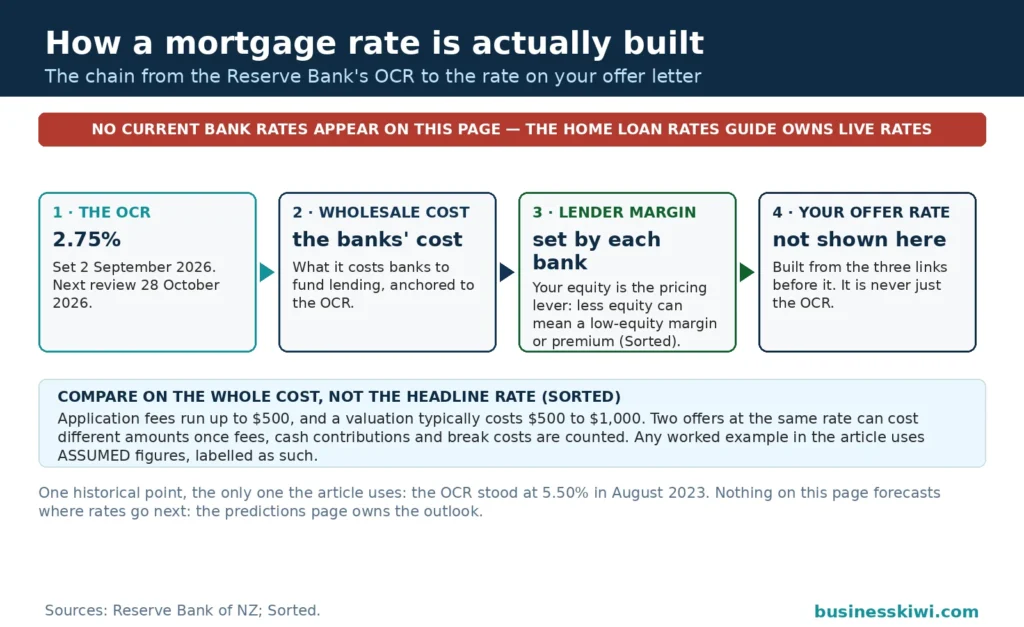
The starting point for almost every discussion of New Zealand interest rates is the Official Cash Rate, set by the Reserve Bank of New Zealand (RBNZ). The OCR is the rate banks earn on deposits they hold with the Reserve Bank, and the rate they pay when they borrow from it. As the RBNZ itself explains, it is the Bank’s main tool for keeping inflation between 1% and 3%, and its Monetary Policy Committee reviews it regularly through the year. The OCR was set at 2.75% on 2 September 2026 (as at October 2026), with the next review scheduled for 28 October 2026.
Floating (variable) mortgage rates hang directly off this anchor. When the OCR rises, a bank’s short-term funding costs rise with it, and floating rates usually follow within days or weeks. When the OCR falls, floating rates tend to drift down, although the bank decides how much of the change to pass on and when. Floating rates also carry a margin above the OCR, which is why your floating rate is always noticeably higher than the OCR itself.
The OCR matters for fixed rates too, but indirectly. Fixed rates are priced off where markets think the OCR is heading, not just where it sits today. The Reserve Bank makes this point itself: because banks plan ahead, they may change mortgage and savings rates even when the OCR has not moved, if expectations about future moves have shifted. So a fixed rate is, among other things, a market bet on the future path of the OCR, packaged up for households.
Fixed rates are priced in wholesale markets
A one-year or two-year fixed rate is not built from the OCR directly. It is built mainly from wholesale market rates for the same term, in particular interest rate swap rates. A swap rate is the price at which large institutions agree to exchange floating payments for fixed payments over a set period. The Reserve Bank tracks these wholesale interest rates in its B2 statistical series: they are the rates that apply between big institutions, rather than to individual borrowers.
Here is the logic. When a bank promises you a fixed rate for two years, it takes on the risk that its own funding costs move over those two years. It manages that risk in the wholesale market, effectively locking in a two-year cost of funds at or near the two-year swap rate. The swap rate therefore becomes the foundation of your two-year fixed rate. On top of it go the bank’s other funding costs (term deposits and bonds usually cost more than the pure swap rate), the cost of holding capital against your loan, operating costs, an allowance for credit losses, and the bank’s margin.
This explains something that confuses many borrowers: fixed rates can move in the opposite direction to the OCR, or move before any OCR announcement at all. If markets decide the OCR is likely to be cut over the next year, swap rates fall today, and banks trim fixed rates today, months before the Reserve Bank actually acts. If inflation data surprises on the upside, swap rates and fixed mortgage rates can jump within days. Short fixed terms lean more heavily on OCR expectations over the near term; five-year fixed rates reflect longer-run views about where interest rates will average out over years, which is why long terms do not simply track the OCR up and down.
What the bank adds on top
Between the wholesale price of money and the rate on your statement sits a stack of bank-specific loadings. The Reserve Bank lists the factors banks weigh when setting their own rates: how risky a loan is, their day-to-day costs, competition with other banks, the exchange rate, and where they think the OCR is going next. Unpacked, that stack usually includes:
- Funding costs. Deposits are not free: term deposit rates compete for your savings, and money raised from overseas investors carries extra costs, including hedging it back into New Zealand dollars. When global funding gets expensive, mortgage rates feel it even if the OCR is unchanged.
- Capital costs. Banks must hold capital against every loan, and regulators require more capital behind riskier lending. That capital has to earn a return, and the cost lands in your rate.
- Credit risk. Some loans are statistically more likely to default than others. Loans with small deposits, and lending secured against investment properties, are priced as riskier than a low-LVR loan on an owner-occupied home.
- Operating costs and margin. Branches, systems, staff and compliance all cost money, and on top of recovery of those costs the bank prices in its profit margin. Competition is the main force squeezing this layer, which is why rates can differ between banks facing identical wholesale costs.
None of these layers is published as a neat breakdown, and banks do not disclose the margin on an individual loan. The practical takeaway is that a rate is not one number handed down from the Reserve Bank. It is a wholesale base plus a series of judgements, and the judgements are where negotiation and shopping around have their effect.
Why your quote differs from someone else’s
The term you choose. Six-month, one-year, two-year and five-year fixed rates are each priced off the wholesale rate for that term, and those wholesale rates are rarely the same. When markets expect rates to fall, longer terms can price below shorter ones; when markets expect rises, the pattern flips. Floating usually sits above fixed rates, because you are paying for the freedom to repay or leave at any time without penalty.
Your equity. The single biggest pricing lever most borrowers control is their loan-to-value ratio (LVR), the loan as a share of the property’s value. Borrowers with at least 20% equity (an LVR of 80% or less) qualify for the banks’ best pricing. Borrow with less than 20% deposit and you will usually pay more: Sorted describes this as a low equity margin, an extra charge for borrowing more than 80% of the property’s value, collected either as an upfront fee or as a higher interest rate. Some lenders charge a one-off low equity premium instead. Either way, crossing the 80% threshold changes your rate, not just your approval odds.
Standard rates versus special rates. The Reserve Bank actually measures this gap. Its B20 series tracks the average rates banks advertise as their standard rates, while the B21 series tracks the lower special rates offered to borrowers who meet conditions set by the bank. Specials typically require solid equity and sometimes things like having your salary credited to the bank. The card on the branch window is the standard rate; the rate in the bold headline is usually a special, and not everyone qualifies for it.
Owner-occupied versus investment. Lending on rental properties is generally priced a step above lending on the home you live in. Investors are treated as higher risk, deposit requirements are tougher, and interest-only periods (common for investors, as Sorted notes) do not reduce the balance, which keeps the lender’s exposure higher for longer. The result is that the same bank, on the same day, may quote an investor a higher rate than an owner-occupier with the same deposit.

Fixed, floating and split: the mechanics
Strip away the marketing and there are three ways a rate can behave.
A fixed rate is locked for a set term, in New Zealand usually somewhere between six months and five years. Your rate and repayments cannot move during the term, whatever the OCR does. The trade-off is rigidity: extra repayments are usually capped (Sorted notes many lenders allow only a limited amount extra each year without charge), and leaving early triggers a break cost, covered below.
A floating rate moves when the bank moves it, generally in response to the OCR and funding costs. In exchange for that uncertainty you get freedom: repay extra whenever you like, repay the whole loan, restructure or move banks without a break cost. Floating rates have historically been higher than fixed rates, which is the price of that flexibility.
A split loan divides the balance into portions, for example part fixed for two years and part floating, or two fixed portions with different end dates. Mechanically, splitting does two things. It staggers your exposure, so only part of the loan reprices at any one time instead of the whole balance rolling onto whatever rates are doing that month. And it lets the floating portion act as a penalty-free channel for lump sums while the fixed portion provides repayment certainty. Splitting across two fixed terms (often called laddering) spreads the rollover risk further. None of this predicts rates; it simply smooths the impact of wherever rates happen to be when each term ends.
The advertised rate is not the whole cost
A mortgage’s real cost is the interest plus everything around the interest. When you compare offers, the extras to line up are:
- Establishment or application fees. A one-off charge for setting up the loan. Sorted puts application fees at up to $500, and notes banks often waive them for new customers, which makes them a negotiating point rather than a fixed cost.
- Valuation fees. If the lender requires a registered valuation, Sorted gives a typical range of $500 to $1,000, usually paid by you.
- Ongoing account fees. Some loan types carry monthly or annual fees, and revolving credit facilities can charge transaction fees on top.
- Cashbacks and cash contributions. Banks competing for your business may offer a cash payment, often framed as a contribution toward legal and other costs. It is real money off your total cost, but read the conditions: cashbacks commonly have to be repaid, in whole or in part, if you move your lending away within a set period.
- Break costs. If you end a fixed term early (selling, refinancing, repaying in full, or making extra repayments beyond the allowed limit), the lender can charge a break fee. Sorted explains that the amount depends on how much of the term is left and how interest rates have moved. The mechanics: the bank locked in funding for your fixed term, and if wholesale rates have fallen since, your old rate is worth more than the current one, so the fee roughly recovers the difference over the remaining term. If rates have risen instead, the fee can be small or nil. This is why breaking a fixed loan to chase a lower rate so often disappoints: the fee is designed to claw back most of the apparent saving.

How to compare two offers properly
The reliable method is to cost each offer over the period you are actually committing to, usually the fixed term, rather than comparing headline rates or weekly repayments. For each offer, add up: the interest you will pay over the term, plus upfront fees, plus any ongoing fees during the term, minus any cashback. Then check the balance remaining at the end of the term, because a lower rate also chews through slightly more principal. The offer with the lower total, on the same loan amount and same term, is the cheaper one, whatever the advertisements say.
Worked example (illustrative figures only, not any bank’s actual rates). Suppose a $600,000 loan over 30 years, and two offers for a two-year fixed term. Offer A: 4.99% with a $400 establishment fee and no cashback. Offer B: 5.15% with no establishment fee and a $3,000 cashback.
On headline rate, Offer A wins easily. On total cost, Offer B comes out about $1,480 ahead over the two years, because the cashback outweighs the extra interest. Offer A’s balance is roughly $500 lower, which claws back part of that gap, so the true advantage is just under $1,000, but it is still an advantage, and it belongs to the offer with the higher rate. Change the assumed figures and the answer can flip, which is precisely the point: run your own numbers over your own term, including every fee and every condition, before you decide. Sorted’s free mortgage calculator is a good tool for this, and any lender should be able to give you the fee figures in writing.
What the official numbers can tell you
Because banks set their own prices, the cleanest picture of what borrowers actually pay comes from the Reserve Bank’s statistics rather than from advertising. Three series are worth knowing about. B20 tracks the average standard rates banks advertise, and B21 the average special rates, so the gap between them shows how much of the headline pricing is conditional. B30, the new residential mortgage weighted average interest rates series, goes a step further: it records the average rates on new lending actually drawn down each month, reported by 20 registered banks, covering floating and fixed terms out to two years, with data back to April 2021. When B30 shows new borrowers fixing at rates well below the advertised specials, that tells you discounting off the card is widespread. When it moves, real borrowing costs are moving, whatever the advertisements claim.
History gives the same lesson in a bigger frame. As recently as August 2023 the OCR stood at 5.50%, held there to squeeze inflation, and fixed mortgage rates at the time sat far above where they had been in the cheap-money years before. By October 2026 the OCR is 2.75%. Rates set in wholesale markets travel a long way in both directions over a few years, which is why the structure of a loan, and the total cost over the term you are committing to, matter more than trying to pick the exact week rates bottom out.
Frequently asked questions
Is my mortgage rate just the OCR plus a fixed margin?
No. Floating rates move with the OCR but the gap between the two is not fixed, because the bank’s other funding costs, risk settings and competitive position all shift as well. Fixed rates are priced mainly from wholesale swap rates for the matching term, which reflect where markets expect the OCR to go, plus the bank’s funding and capital costs and its margin.
Why did fixed rates change when the OCR did not?
Because fixed rates are forward-looking. If markets revise their view of future OCR moves, on new inflation data, for example, swap rates adjust immediately and banks reprice fixed terms to match. The Reserve Bank notes that banks may change mortgage rates even when the OCR itself has not changed, because they plan around where it is heading.
Why is the rate I am offered higher than the rate in the bank’s advertising?
The advertised headline is usually a special rate, which the Reserve Bank tracks separately (its B21 series) from standard rates (B20). Specials come with conditions, commonly at least 20% equity and sometimes salary crediting or other business with the bank. If your deposit is under 20%, expect a low equity margin or premium on top as well.
Do investors pay higher mortgage rates than owner-occupiers?
Generally, yes. Lending secured on investment property is treated as higher risk, deposit requirements are stricter, and interest-only periods are more common, all of which push investor pricing above owner-occupied pricing at the same bank. The exact gap varies by lender and over time.
When does it make sense to break a fixed rate?
Only after you have the break fee in writing and have run the total-cost comparison over the remaining term. Break fees are designed to recover the lender’s loss when wholesale rates have fallen, so the fee usually absorbs most of the saving from a lower rate. Breaking tends to stack up only when the fee is small, for example when rates have risen since you fixed, or when you are selling or restructuring anyway.
What is a swap rate and why should I care?
A swap rate is a wholesale market price: the fixed rate institutions agree to pay in exchange for floating payments over a set term. Your bank uses the swap rate for the matching term as the base when it prices a fixed mortgage, then adds its funding, capital and risk costs and its margin. When you hear that swap rates have fallen, fixed mortgage rates usually follow.
How much difference does 0.25% really make?
On a $600,000 loan over 30 years, roughly $90 to $100 a month in repayments, and tens of thousands of dollars in total interest if the gap persisted for the whole term. Over a two-year fixed term the interest difference alone is around $3,000 before fees and cashbacks, which is why those extras belong in any comparison.
This article is general information only and is not personalised financial advice. Mortgage rates change frequently, sometimes daily, and the rate you are offered depends on your circumstances and the lender’s criteria at the time. Check current rates with lenders directly (our home loan rates page tracks the main banks’ advertised rates), read the conditions attached to any special rate or cashback, and consider speaking with a qualified mortgage adviser before making decisions about your own borrowing.
Sources
- Reserve Bank of New Zealand, The official cash rate (OCR), rbnz.govt.nz
- Reserve Bank of New Zealand, Exchange and interest rates (statistical series B2, B20, B21 and B30), rbnz.govt.nz
- Reserve Bank of New Zealand, New residential mortgage weighted average interest rates (B30), rbnz.govt.nz
- Reserve Bank of New Zealand, Monetary Policy Statement August 2023, rbnz.govt.nz
- Sorted, Types of mortgages in New Zealand, and how to choose, sorted.org.nz